A carburetor mixes air and fuel for an internal combustion engine using Bernoulli’s principle: a narrow venturi accelerates the incoming air, drops its static pressure, and sucks fuel up from a float chamber into the airstream. A choke and throttle regulate how much air (and therefore fuel) enters the engine. Modern cars use fuel injection instead, but carburetors still run small engines, motorcycles and most piston-engine light aircraft.
If you have ever come across an automobile vehicle revving up (mostly motorbikes), that growl is due to the main component in the engine known as the carburetor. Now, while most of today’s vehicles work on a fuel injection system, the carburetor was the first advancement to revolutionize how the engine in automobiles consumed fuel. Before we look at the principle and operation of the carburetor, let’s look for a moment at how an engine burns fuel.
How Does An Engine Burn Fuel?
Engines are dependent on mechanical and chemical principles. The primary goal of an engine is to change heat energy into mechanical energy. The process of combustion within an engine consists of mixing fuel with air and then burning it to start the process of combustion. When fuel is ignited with a combination of air, it releases heat energy, carbon dioxide and water (other substances are produced, but these are the main ones we will consider). To obtain the maximum amount of efficiency while burning any fuel, we need to add a lot of air.
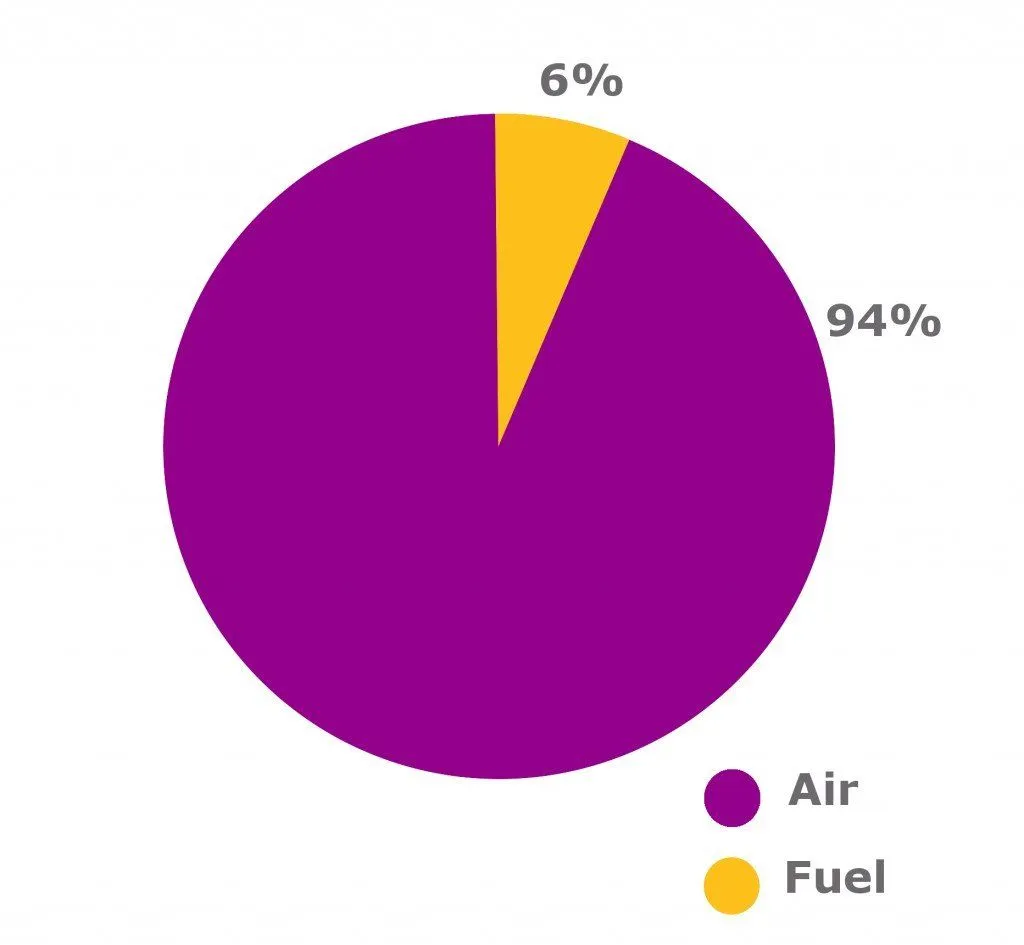
Stoichiometric Mixture
Oxygen is the main ingredient that helps the fuel burn more efficiently. An ideal situation is where there are exactly enough oxygen atoms to burn all the atoms of fuel; this mixture is known as a stoichiometric mixture. For gasoline, that ideal ratio works out to roughly 14.7 parts air to 1 part fuel by mass. If there is too much air, the engine is said to be burning ‘lean’; with too much fuel, it is burning ‘rich’. Real engines deliberately tune slightly off the stoichiometric point: a slightly rich mixture (roughly 12.5:1) gives the best peak power, while a slightly lean mixture (about 15–16:1) gives the best fuel economy.
Principle
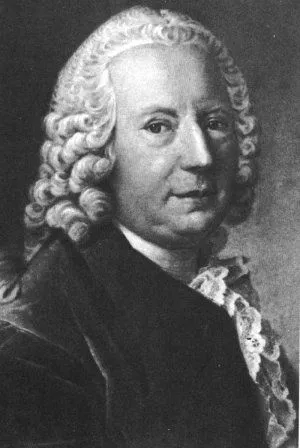
A carburetor works on a single physics idea: Bernoulli’s principle (sometimes called Bernoulli’s theorem). The principle was formulated by the Swiss mathematician and physicist Daniel Bernoulli in his 1738 treatise Hydrodynamica. In plain terms, it says that when a fluid speeds up, its static pressure drops, because the total energy of the flowing fluid (pressure energy plus kinetic energy plus gravitational energy) stays constant along a streamline.
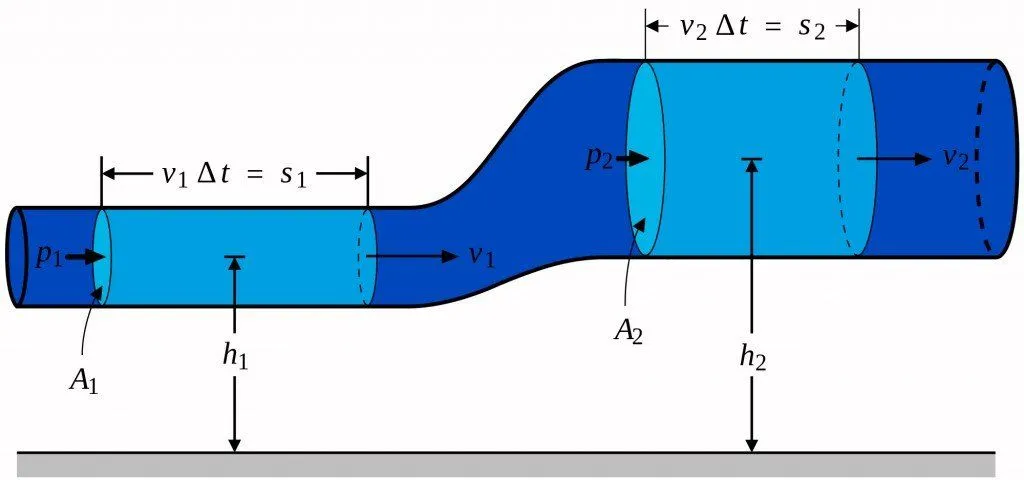
Using the above principle, the primary job of the carburetor is to make air move faster so that both low static pressure and high dynamic pressure are created. The accelerator (or throttle) in any automobile does precisely this with a carburetor. It does not directly control the amount of fuel being used. However, it does control the carburetor mechanism, which controls the amount of air that flows into the engine. The speed of this air flow changes the static pressure, which in turn draws in a certain amount of fuel that is pulled up and used.
Operation Of A Carburetor
Carburetors come in various degrees of complexity and design. The simplest model of a carburetor comes in the form of a single vertical air pipe located above the engine cylinders, along with a horizontal fuel pipe joined to its side. The air flows down the vertical pipe and acts as a gateway to the narrow middle part (the kinked section). The kinked central part is called the Venturi, and it significantly speeds up the air flow. This increase in the speed of the air causes a fall in pressure, which creates a sucking effect and draws fuel up from the pipe attached to the side.
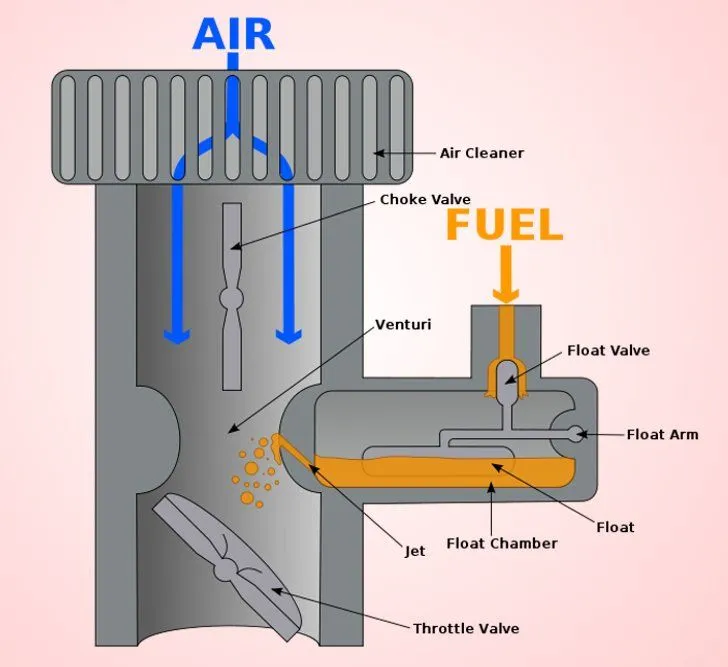
The air that is sucked out also pulls fuel along with it. The next logical question is – how is the air-fuel mixture controlled? The carburetor contains two swiveling valves in the venturi. At the top, the valve is called the choke. The choke controls the amount of air that flows in. If the choke is in its closed position, only a small amount of air can enter the venturi, while a larger amount of fuel is drawn in. This makes the engine consist of a more fuel-rich mixture. The advantage arises when one would like to start an engine or when the engine is cold. The bottom part of the valve contains a secondary valve known as the throttle. The more the throttle is open, the more air flows into the carburetor. The more air that flows into the carburetor, the more fuel it pulls in from the horizontal fuel pipe attached to it. This makes the engine produce more energy and deliver more power, which makes the automobile go faster. So, whenever you push down on the accelerator, you’re giving the engine more oxygen and fuel to burn.
The fuel pipe attached to the carburetor leads into a miniature reservoir called the fuel feed chamber, which contains a float and a needle valve. As the engine consumes fuel and the level in the chamber drops, the float sinks with it, and the falling float opens the needle valve to let more fuel flow in from the gas tank. Once the level rises back to its set point, the float floats up and closes the valve, cutting off the inflow. It’s the same mechanism that keeps a toilet tank from overflowing.
So, next time you go out for a joyride and put your foot to the pedal, you will understand why your car speeds up!
What Are The Main Parts Of A Carburetor?
Now that you know how a carburetor works, it helps to put names to the pieces doing the work. A carburetor is really a small collection of passages and valves stacked around one central air tube, and each part has a single job. Here are the components you would find inside a typical float-type carburetor.

Air inlet and venturi: Air enters through the air inlet at the top and is squeezed through the venturi, the narrow throat that speeds the air up and drops its pressure. That low-pressure zone is what pulls fuel into the airstream.
Float chamber and float: The float chamber (also called the fuel bowl) is a small reservoir that keeps a steady supply of fuel ready for the engine. A float riding on the fuel surface pushes against a needle valve to hold the level constant, shutting off the incoming fuel once the bowl is full and opening it again as the engine draws the fuel down.
Main jet and discharge nozzle: The main jet is a precisely sized hole that meters fuel out of the float chamber, and the discharge nozzle sprays that fuel into the venturi. Because the flow is limited by the size of the jet, the carburetor delivers a controlled amount of fuel rather than emptying the whole bowl at once.
Idle (or pilot) circuit: At idle or light throttle, the air moving through the venturi is too slow to draw fuel from the main jet. A separate idle circuit solves this by feeding a small amount of fuel from an opening near the edge of the throttle valve, which is what keeps the engine ticking over when your foot is off the pedal.
Choke and throttle valves: The choke is a flap near the air inlet that restricts air for a richer mixture during cold starts, while the throttle valve (a butterfly plate lower down) controls how much air-fuel mixture reaches the engine and therefore how much power it makes.
Accelerator pump: When you suddenly snap the throttle open, the airflow jumps faster than the fuel can follow, leaving a momentary lean spot that would make the engine stumble. A small accelerator pump squirts an extra shot of fuel into the venturi at that instant to smooth the transition.
Where Are Carburetors Still Used Today?
Modern cars have largely abandoned the carburetor in favor of electronic fuel injection (EFI). The shift was driven by tightening emissions rules (the US Clean Air Act and the standards that followed it required precise air-fuel control, which a mechanical carburetor cannot deliver) and by the OBD-II diagnostics mandate of 1996, which requires closed-loop feedback on the air-fuel ratio. The last new car sold in the United States with a carburetor is generally credited as the 1990 Subaru Justy; from 1991 onwards, every mainstream US-market car shipped with fuel injection.
That doesn’t mean the carburetor has vanished. It is still the workhorse of small four-stroke and two-stroke engines: lawnmowers, chainsaws, leaf blowers, portable generators, and most outboard motors below a certain power class. Many motorcycles continued using carburetors well into the 2010s, and a large share of the world’s general aviation fleet, with engines from Lycoming and Continental, still relies on carbureted designs because the simplicity (no electronics, no fuel pumps, no sensors) is a real asset where reliability and field repair matter more than peak efficiency.
References (click to expand)
- Carburetor. Encyclopedia Britannica.
- Daniel Bernoulli (biography). Encyclopedia Britannica.
- How Do Carburetors Work? The Drive.
- How Does the Carburetor Work Within the Fuel System? YourMechanic.
- Float-Type Carburetors: Components and Operation. Aircraft Systems Tech (FAA-based).
- What's a Carburetor? How It Works, Common Types, and DIY Diagnostics. CarParts.com.