Table of Contents (click to expand)
The Infinite Chocolate Paradox is a phenomenon where a chocolate bar can be cut into pieces and rearranged to create an extra block of chocolate. This is possible because the chocolate bar is made up of infinite chocolate blocks, which can be rearranged to create the extra block.
In Jan 2018, a chain of French supermarkets decided to sell Nutella, also known as God’s sacred nectar sent from heaven, at a 70% discount. This astonishing slash in price resulted in what one could logically expect – a riot.
However, I’m not using the word ‘riot’ in its metaphorical sense. I mean it in the literal sense.
The ‘riots’ spread across the supermarkets forced them to summon the police for help when customers resorted to fighting and jostling. While the hunt for discounted chocolate saw one woman’s hair being gruesomely pulled, another one’s hand was profusely bleeding.
The mathematics underlying the paradox is, as you may have guessed, extremely esoteric and therefore incomprehensible, defying common sense and challenging our intuitive perception of spatial concepts such as “volume” and “density.” It operates in the strange realm of infinity, a concept that has always puzzled mathematicians.
The ridiculous phenomenon is possible only if one assumes that the sphere or matter is generally infinitely divisible, which it obviously is not. The matter is based on rigid structures held by atoms. The concept is applicable only in the abstract world, not in the real world, because, in the real world, the matter is limited by size.
However, in the abstract world, where the paradox is possible, matter can simply be considered a collection of points, in this case, infinite points.
Different Infinities
The paradox deals with measurable sets composed of immeasurable quantities. Consider the set of numbers 0,1 and all the numbers between them. This set is denoted by [0,1]. This measurable set can be further divided into uncountable, infinite real numbers starting from 0.000000000000000000001 followed by 0.0…2 and so on.
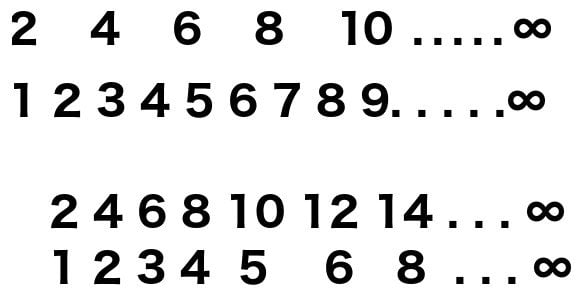
The length of these infinite numbers can be divided into two halves. The points constituting both the halves have the same cardinality because infinity divided by two is still infinity. This implies that there are as many even numbers as there are natural numbers!
Another way to magically conjure an additional set of infinite numbers from a given set of infinite numbers out of thin air is to distinguish between ‘countable’ and ‘uncountable’ infinities.
People who believe that the number of natural numbers until infinity and the infinite number of real numbers between them are equal, such that each natural number can be assigned to each real number, are clearly wrong. This is because you can diagonally move down the real numbers and simply increment the numbers you progressively parse.
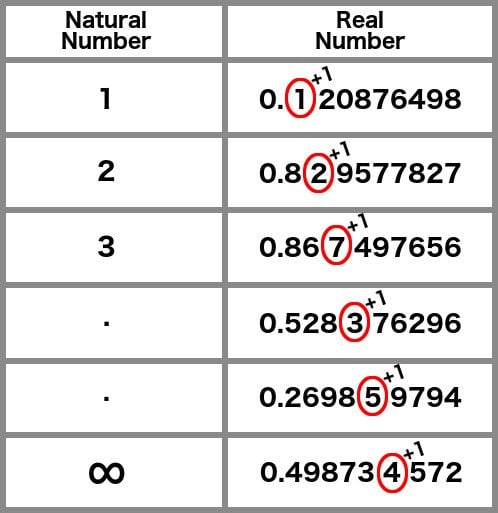
Since all-natural numbers are exhausted, as they are ‘countable,’ there are no new natural numbers that can be assigned, meaning that the infinity of real numbers is greater, up to ‘countable’ than the infinity of natural numbers. We can now separate the newly created numbers to form another set of infinite numbers.
This explains how the sphere can decay into two identical spheres, albeit by painful simplification, as the density reduced to half is still infinite.
Remember that this only works for mathematical points, not for physical atoms.
Moreover, the five shapes into which the sphere divides are highly eccentric, complex, and distorted entities, unlike any “shape” you have ever encountered.
Enjoy your finite bar of chocolate.