Table of Contents (click to expand)
Mirror writing (where letters like J, Z, 3, and 7 come out flipped) is a normal developmental phase in 4-to-7-year-olds: a still-maturing brain tends to write all asymmetric letters facing the same way (rightward), so the few that should face left get flipped. It is not, on its own, a sign of dyslexia, autism, or giftedness.
Parents and teachers all over the world put a lot of effort into educating children. They prod and poke 4-year-olds to read bat, rat, and cat, to say the three golden words, ‘please, thank you, sorry’, and to write all their letter within the dotted lines. However, one quirk most children share that frustrates adults is writing 3, R, S and B backwards!
These poor children are probably confused as to why their teacher keeps telling them to flip the letters, but with repeated practice and corrections, children gradually begin writing letters that face the correct way—to everyone’s great relief!
Yet, is it strange that children write certain letters as a mirror image?

What Is Mirror Writing?
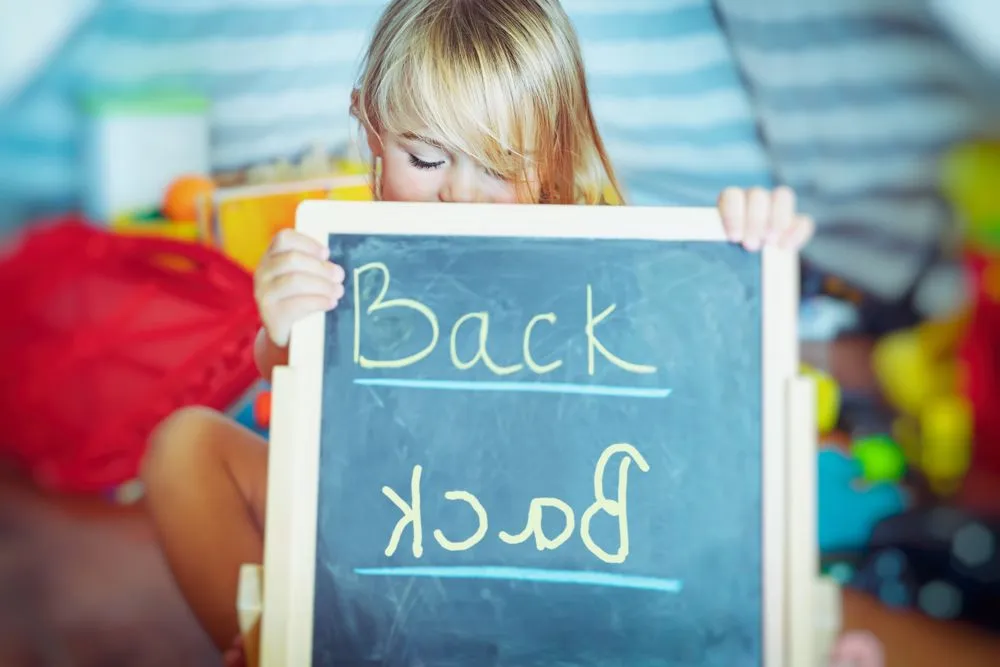
Mirror writing is writing that would look correct when reflected in a mirror. The writing runs in the opposite direction of normal English script—right to left, with individual letters being reversed.
Mirror writing isn’t completely anomalous and even adults may do it in some capacity. If you’re right-handed, try writing with your left hand. You may find that your left hand tends to mirror write, meaning that you have to actively suppress the urge to flip your writing into the “right” orientation. Research has shown this phenomenon on a larger scale. Most left-handed people are more likely to be able to mirror write—and do so just as competently as they can write normally—than right-handed individuals.
Leonardo da Vinci, who was left-handed, mirror-wrote almost all of his private notebooks (though he used conventional script for letters and documents meant for other people). The most commonly cited explanation is the simplest: as a left-hander dipping a quill in wet iron-gall ink, writing right-to-left kept his hand from dragging through the still-drying line he had just written. Older theories about secret codes, hand injuries, or a stroke (Source) have largely fallen out of favour.
Children typically mirror-write between the ages of 4 and 7, when they are first learning to form letters; the habit usually fades by the end of second grade as systematic literacy instruction takes hold. They are inconsistent mirror writers, only making errors with certain asymmetric characters, most commonly J, Z, and the digits 3, 7, and 9.
Why Children Mirror Write?
British neurologist Macdonald Critchley, who wrote one of the first dedicated papers on mirror writing in 1927 (and turned it into a small book the following year), suggested that children simply forget the orientation of certain letters.
In his paper, The significance of mirror writing, he writes, “In the case of children learning to write there persists for some little time an element of doubt as to the correct orientation in space not only of letters, but even of words, which after all is purely an arbitrary arrangement. This is particularly true in the case of children who attempt to write before they have completely mastered their letters. This indecision accounts for the occasional reversals of letters or words seen in the earliest efforts at penmanship in many normal children.”
Later research noted that children tend to mirror write letters and digits that face left (like 3) more often than those that face right (like D). One reason for this, as researchers have suggested, is that children convert all letters to right-facing letters when they can’t remember the right orientation. This makes sense, as most asymmetrical letters face right, meaning that they have an extension on the right hand side (E, D, B).
These studies and the hypotheses they put forth still don’t account for why children don’t completely mirror write. We also don’t know the exact neurological underpinnings of why children mirror write. To oversimplify the issue, we know that the brain doesn’t stop developing until the end of adolescence, and young brains are still more malleable. How do young brains process images differently than older, more mature brains? Mirror writing might give us some insight into that.
Most of this research is performed with small sample sizes (between 30 and 100 subjects). Furthermore, we don’t fully understand how the visual system works or to what extent certain cognitive functions of the brain influence spontaneous mirror writing in children. Much of the neurological information we have on mirror writing comes from neurological injuries, such as from a stroke.
Is Mirror Writing A Sign Of Dyslexia, Autism, Or Giftedness?
If you’ve just watched your kindergartener write a perfect mirror-image “J”, your next Google search is probably “is mirror writing a sign of something serious?” The short, evidence-based answer: usually no.
Dyslexia. Letter reversals before age 7 are not on the diagnostic criteria for dyslexia, and most children who mirror-write never develop a reading disability. Reading Rockets, Understood.org, and the International Dyslexia Association all stress that reversing letters is a developmental quirk, not a marker. What does warrant a closer look is a child who is still reliably flipping common letters past age 7–8 and is struggling with reading, sounding out words, or remembering letter shapes, in which case, an evaluation is reasonable.
Autism. There’s some loose correlation in the literature, but mirror writing on its own is not a diagnostic marker for autism either. The condition is diagnosed from social communication and behaviour patterns, not from handwriting.
Giftedness. The viral claim that mirror writing means your child is the next Leonardo da Vinci does not hold up. Studies looking for a correlation between mirror writing and IQ have come up empty. Da Vinci was extraordinary; his backwards handwriting wasn’t the reason.
A Final Word
Mirror writing is common in young children, and a normal part of their development. As children write more frequently, they learn to write correctly and fluently; whether they develop good handwriting is a different matter altogether.
Writing today, I think, isn’t as important as it once was. Many of us have transitioned to typing on our phones and computers rather than taking notes in our notebooks. This is a relief for those of us who live with the curse of bad handwriting.
References (click to expand)
- Portex, M., Hélin, C., Ponce, C., & Foulin, J.-N. (2018, March 19). Dynamics of mirror writing compared to conventional writing in typical preliterate children. Reading and Writing. Springer Science and Business Media LLC.
- Fischer, J.-P. (2011, June). Mirror writing of digits and (capital) letters in the typically developing child. Cortex. Elsevier BV.
- Fischer, J.-P., & Koch, A.-M. (2016, April). Mirror writing in typically developing children: A first longitudinal study. Cognitive Development. Elsevier BV.
- Schott, G. D. (2007, January 1). Mirror writing: neurological reflections on an unusual phenomenon. Journal of Neurology, Neurosurgery & Psychiatry. BMJ.
- FAQs about reversing letters, writing letters backwards, and dyslexia. Understood.org.
- Should I Be Concerned About Mirror Writing? Reading Rockets.