Table of Contents (click to expand)
- What Happens When A Plane Actually Runs Out Of Fuel?
- Could An Airline Actually Run Out Of Fuel?
- Mid-air Refueling Via Flying Gas Stations
- When Would An Aircraft Run Out Of Fuel In Mid-air?
- What Kind Of Aircraft Can Be Refueled Mid-air?
- How Does Mid-air Refueling Take Place?
- Risks In Mid-air Refueling
- Why Don’t Passenger Planes Refuel In Mid-Air?
- A Final Word
A plane that runs out of fuel does not drop straight down, it becomes a glider. Modern jet airliners can travel roughly 10 nautical miles for every mile of altitude. Pilots aim for the nearest suitable airport and attempt a "dead-stick" landing. The famous 1983 Gimli Glider (Air Canada Flight 143) glided 100 km on no fuel and landed safely. Military jets sidestep the problem entirely by refueling in flight from tanker aircraft.
Although man’s understanding of aviation has come much farther than what the Wright brothers had originally conceived, the fear-in-chief remains the same!
“What if I fall out of the sky?”

The idea that any help available to you is several thousand feet below you, safely on the ground, and that gravity will invariably act against you, provides no solace for these worries. For perspective, think of running out of gas while driving. The very thought of having to push your car to the nearest fuel stop is exhausting.
However, so long as cars are on land, they will arrive at a gas station sooner or later.
But what would happen if an aircraft were to run out of ‘gas’ mid-flight? Is dropping from the sky inevitable?
What Happens When A Plane Actually Runs Out Of Fuel?
Hollywood likes to show fuel-starved planes dropping out of the sky like a rock. That isn't what happens. The moment the engines lose fuel, you lose thrust, but you do not lose lift. The wings are still wings, the air is still air, and the aircraft becomes a glider.
Modern commercial jets have a glide ratio of roughly 15 to 20:1 in the cleanest configuration. In practical terms, that means at a typical cruise altitude of 35,000 to 40,000 feet (about 7 miles up), a healthy airliner can glide somewhere between 60 and 130 miles to a landing while losing all its altitude. That is enough range, in most parts of the world, to reach an airport.
The most famous example is the Gimli Glider: on 23 July 1983, Air Canada Flight 143, a Boeing 767, ran out of fuel at 41,000 feet because of a fuel-quantity calculation error mixing up pounds and kilograms. Captain Bob Pearson glided the aircraft roughly 100 km (~62 miles) to a decommissioned air force base at Gimli, Manitoba, and landed it safely with only minor injuries to two passengers. Another well-known case is the Azores Glider (Air Transat Flight 236, 24 August 2001), an Airbus A330 that glided 75 nautical miles after a fuel leak emptied its tanks over the Atlantic and made a safe landing in the Azores.
When fuel runs out, pilots are trained to run a checklist that prioritizes:
- Restarting the engines if anything is salvageable (sometimes a fuel imbalance, not true exhaustion, is the cause).
- Deploying the ram air turbine (RAT), a small propeller that drops out of the underside of the aircraft and uses airflow to generate basic electrical and hydraulic power for the cockpit and flight controls.
- Picking the best available airport or open ground for a landing and gliding toward it.
- Communicating an emergency to air traffic control and broadcasting a Mayday call.
Not every case ends well. Avianca Flight 52 in January 1990 crashed near Cove Neck, New York after fuel exhaustion linked to holding patterns and miscommunication, killing 73 people. But fuel exhaustion in commercial flight is extremely rare; modern flight planning, in-cockpit fuel monitoring, and required minimum fuel reserves make it one of the lower-probability emergencies pilots train for.
Could An Airline Actually Run Out Of Fuel?
Headlines about a “fuel shortage” grounding flights sound alarming, but they almost never mean a plane will run dry in the sky. Every commercial flight is dispatched with a legally mandated fuel load that is deliberately padded beyond what the route needs. In the United States, the FAA rule for domestic flights (14 CFR 121.639) says an airliner must carry enough fuel to reach its destination, then fly on to the most distant alternate airport, and then keep flying for another 45 minutes at normal cruising consumption. International flights under ICAO and EASA rules use a similar recipe: trip fuel, a contingency allowance (typically 5% of the trip fuel), fuel to divert to an alternate, and a final reserve equal to 30 minutes of holding at 1,500 feet (about 450 metres) above that alternate for a jet.

In other words, a jet pushes back from the gate with a cushion on top of the cushion. A jet-fuel supply crunch on the ground can delay departures, force airlines to tanker extra fuel from another airport, or cancel flights before they leave, which is what most of those “will flights be cancelled?” stories are really about. A plane that is already airborne does not run its tanks empty because the market is short of kerosene. When an aircraft genuinely does exhaust its fuel in flight, it is almost always a planning or handling error rather than a shortage: the Gimli Glider’s pounds-versus-kilograms mix-up and Avianca Flight 52’s holding delays and miscommunication are the textbook cases.
Long over-water routes carry an extra guardrail. Under ETOPS rules (Extended-range Twin-engine Operations), a twinjet is only allowed to fly a path that keeps it within a certified single-engine diversion time of a usable airport. An ETOPS-180 aircraft, for example, must always stay within 180 minutes of somewhere it could land, and newer types such as the Boeing 787 and Airbus A350 are cleared even further. That is also why a plane can keep flying safely on one engine long enough to reach a runway. The system is built so that a fuel emergency stays a rare, survivable event rather than a free fall.
Mid-air Refueling Via Flying Gas Stations
Turns out, the brighter minds amongst us have already pre-empted such a problem. The risk of an aircraft running out of fuel over long distances is only too real. Due to this, aircraft are fueled mid-flight by bigger aircraft that are essentially flying tanks of fuel.
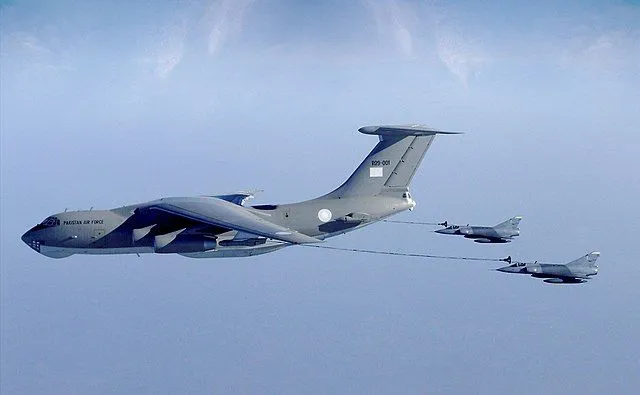
This is commonly known as mid-air refueling. However, mid-air refueling is not a standard practice and is only used as a resort in critical operations.
When Would An Aircraft Run Out Of Fuel In Mid-air?
An aircraft engine not getting fuel can be caused by two things. The first is fuel starvation, wherein fuel is present in the aircraft, but unable to reach the engine due to line faults. Fuel starvation can only be rectified by servicing.
Fuel exhaustion, on the other hand, is the complete absence of fuel. The reasons for fuel exhaustion could be, but are not restricted to:
- Missions over longer distances
- Miscalculation or underestimation of fuel required
- Loss of mileage due to air currents at lower altitudes
Fuel exhaustion typically occurs towards the end of a given journey and can be rectified by refueling.
What Kind Of Aircraft Can Be Refueled Mid-air?
Aircraft are generally designed to be refueled on the ground. In order to be refueled in mid-air, the craft’s fuel ports have to be moved to a convenient position so that they can be accessed by refueling pipes. Thus, it is possible to refuel all aircraft in mid-air, provided they are modified for it.
However, unlike road vehicles, where the cost of refueling is just the cost of fuel; mid-air refueling is a very expensive affair. When coupled with safety issues arising from two aircraft flying in such close proximity, the tangible and intangible costs can quickly add up. Thus, mid-air refueling is exclusively restricted to military operations.
Notable exceptions to this rule are strategically important aircraft, such as presidential carriers. Most presidential carriers are commercial aircraft, modified to accept mid-air refueling, owing to their national importance.
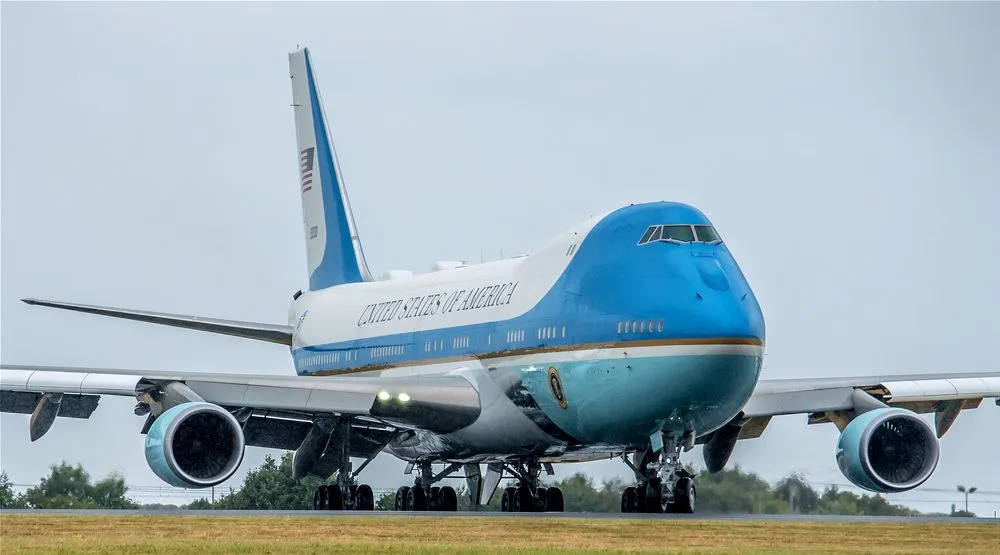
It is not feasible to refuel commercial and private aircraft mid-air, from safety, economical and logistical standpoints. Due to this, it is desirable for them to take layovers instead, and there are protocols for emergency landings at various airports.
How Does Mid-air Refueling Take Place?
In principle, mid-air refueling is a pretty simple operation. Fuel is delivered by means of a ‘tanker’ aircraft to the ‘receiver’ aircraft while in flight. It goes without saying that the receiver aircraft should have some fuel left, as it must sustain its flight until it gets refueled.
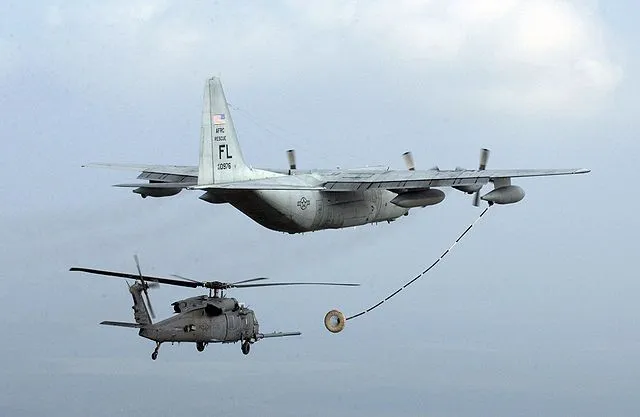
The tanker aircraft flies and connects to the receiver aircraft by means of either fixed or flexible tubing, and then pumps the fuel over. This tubing fixes to a receptacle or probe in the receiver aircraft. To assist fuel flow, the receiver aircraft fly behind and below the tanker aircraft. The rate of refueling is dependent on the refueling system and the size of the recipient aircraft.
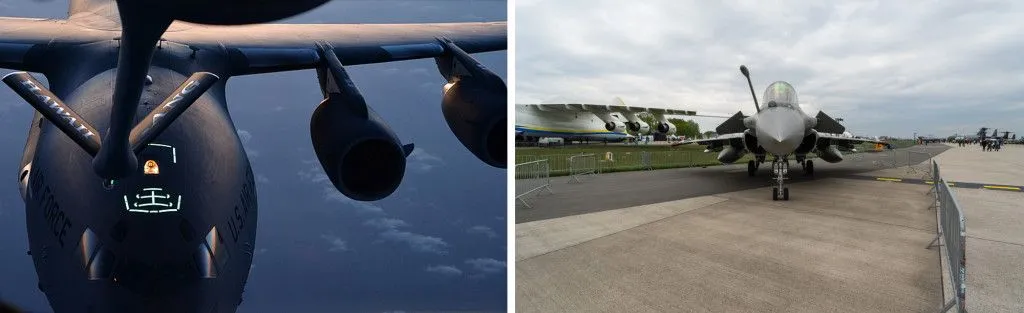
Across the world, mid-air refueling operations are carried out using one of the following two systems:
Flying Boom System
The boom is a rigid, retractable pipe that extends from the tail end of a tanker aircraft. It is deployed by a boom operator sitting in the tanker aircraft, with virtual or real-time visibility of the boom and the recipient aircraft.
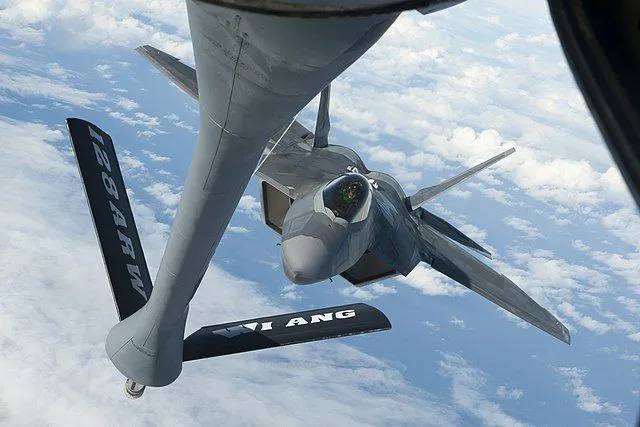
When the recipient aircraft is in the ‘refueling envelope’, the boom is inserted into a receptacle, allowing for fuel pumping to commence. The boom has high drag due to its non-aerodynamic configuration and rigidity. It is thus equipped with winglets that stabilize it while filling.
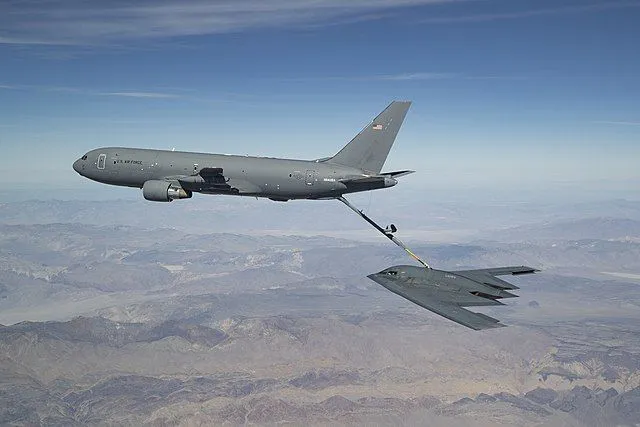
Flying booms are capable of pumping as much as 1000 gallons per minute (source). Due to this, they are best used for refueling bigger military aircraft with high-volume storage tanks.
Tanker aircraft have just one flying boom that can cater to a single aircraft at a time.
Probe And Drogue System
Some tanker aircraft use flexible hoses instead of a rigid boom. They can also carry fuel in multiple storage units aboard a single aircraft. This makes them capable of refueling multiple aircrafts in one mission. Since flexible hoses flutter when deployed from aircraft in flight, they have to be stabilized.
This is achieved by attaching a collapsible, drag-inducing contraption called a drogue. Drogues resemble badminton shuttlecocks in design, and add drag to the pipeline, thus preventing it from whiplashing.
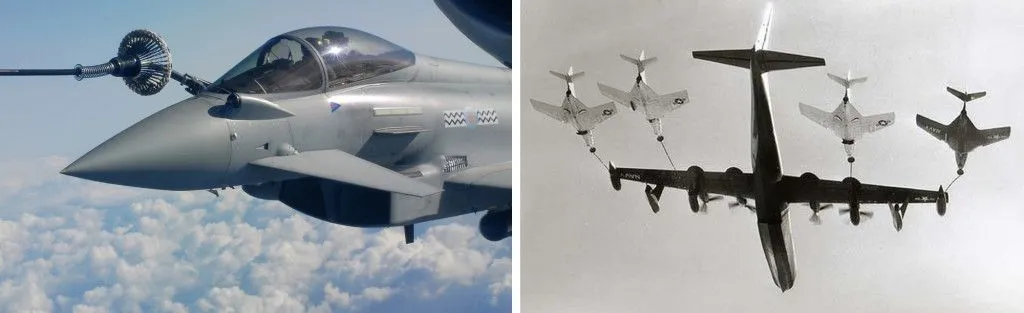
Recipient aircraft for such refueling systems are equipped with probes, which are fixed or retractable pipes extending from their body. These pipes are rigid and get funneled into the drogue, establishing a connection to transfer fuel. Probe and drogue systems can usually fill up to 600 gallons of fuel per minute, and are thus more desirable for smaller aircraft. At the same time, multiple small aircraft can be accommodated in the tanker’s refueling envelope.
Risks In Mid-air Refueling
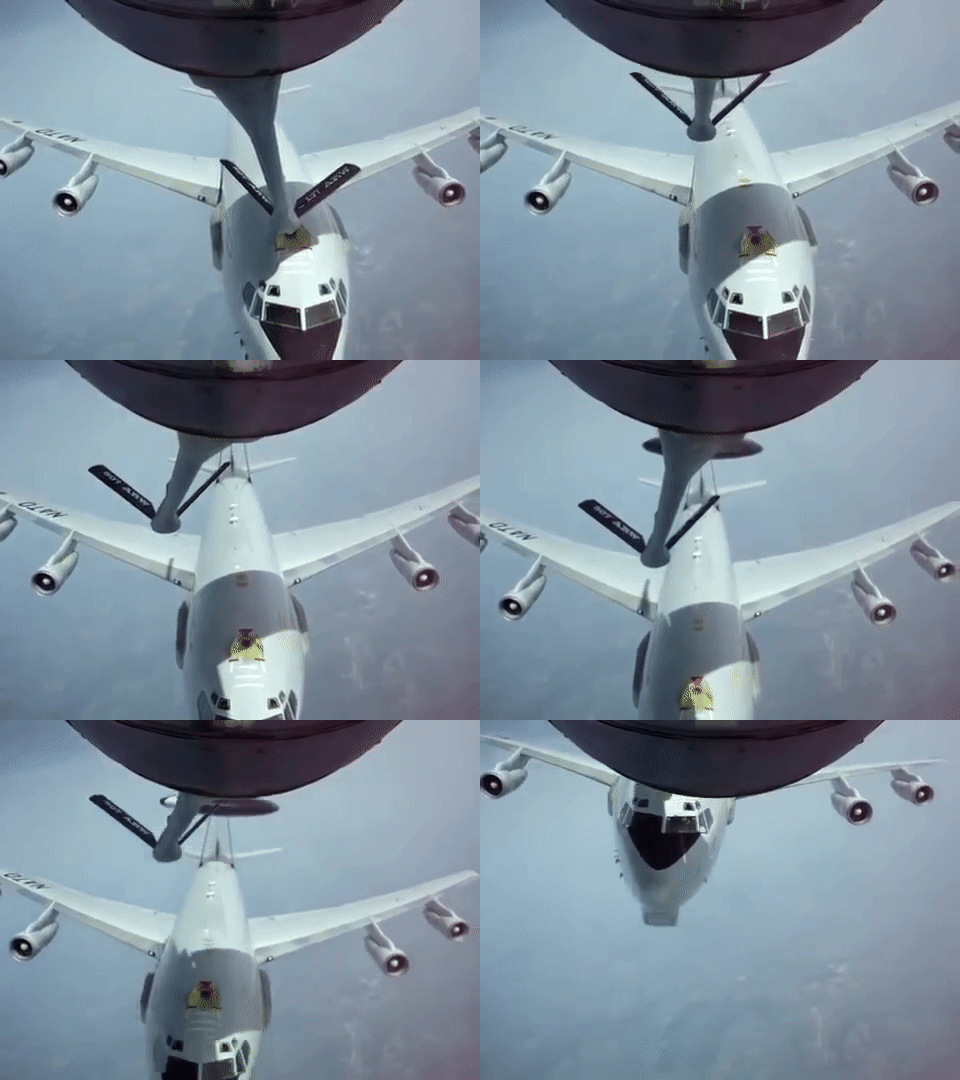
Other than the implicit danger of two aircraft flying in close proximity, there are several other risks to mid-air refueling. Internal risks include the failure of refueling systems, such as hose release and retraction, fuel pumps etc.
External risks arise from the risk of fuel spillage, refueling hardware damage while connecting or disconnecting, and improper aircraft alignment. Spatial disorientation, especially for night flights, also presents huge risks in mid-air refueling.
Safety Protocols For Risk Reduction
It is inevitable for the tanker aircraft to come in close proximity to the receiving aircraft. Thus, safety protocols and failsafe mechanisms are devised to improve situational awareness and reduce refueling accidents.
Tanker aircraft use dimmable exterior lighting to prevent recipient aircraft from disorientation and blinding, especially at night. The autopilot feature is especially useful for monitoring the relative speeds of both aircraft.
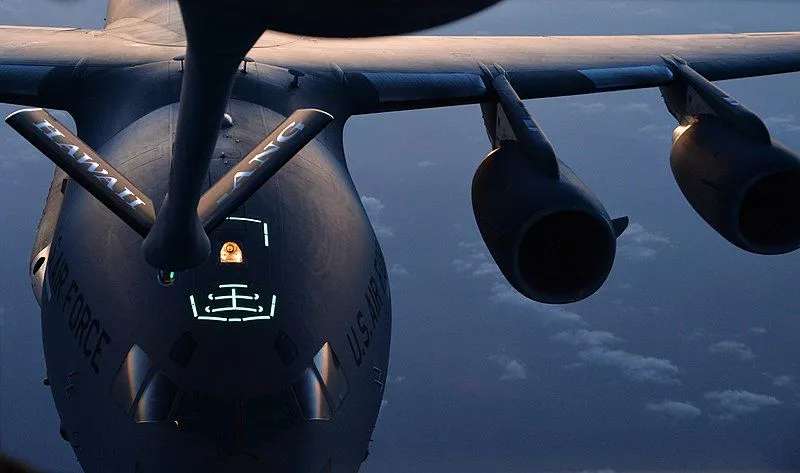
Aircraft generally fly in pre-established formations to reduce the risk of collision.
Gas pumping does not commence until a secure seal is established. After refueling, the hose is reeled back in a manner that prevents residual fuel from spilling onto the viewports of the recipient aircraft. Emergency disconnects and quick releases also add a layer of safety to prevent fuel spillage.
Why Don’t Passenger Planes Refuel In Mid-Air?
If fighter jets can top up their tanks in flight, why not airliners? The short answer is that they simply do not need to. A modern twin-engine airliner already has the range to connect almost any two cities on Earth, and the reserve rules above mean it lands with fuel to spare. Aerial refueling solves a military problem, keeping a jet on station or crossing an ocean without landing, that scheduled passenger flying does not have.

The economics and safety maths make it even less appealing. An airline would have to buy, crew and fly a second aircraft, the tanker, purely to pass fuel to the first. A wide-body such as a Boeing 777 would need far longer hooked up to a tanker than a fighter’s two to three minutes, so a single tanker could only serve a handful of jets per sortie. On top of that, deliberately flying a passenger jet in tight formation and physically connecting it to a fuel-laden tanker is exactly the kind of close proximity that safety investigators normally treat as an incident. And because the receiver still needs enough fuel to divert if the hookup fails, you would have to carry reserves anyway, which cancels out the point of refueling in the first place.
So airliners take all their fuel on board from a truck or hydrant before departure, and when a route is too long for one tank, they make a scheduled fuel stop on the ground. No airliner in normal passenger service is even fitted with the receptacle or probe hardware that mid-air refueling requires, and airline crews are not trained for it.
A Final Word
Risks arising due to fuel exhaustion stem from large distances between airports. Due to well-established routes and high flying frequencies, these risks are significantly low for commercial aircraft.
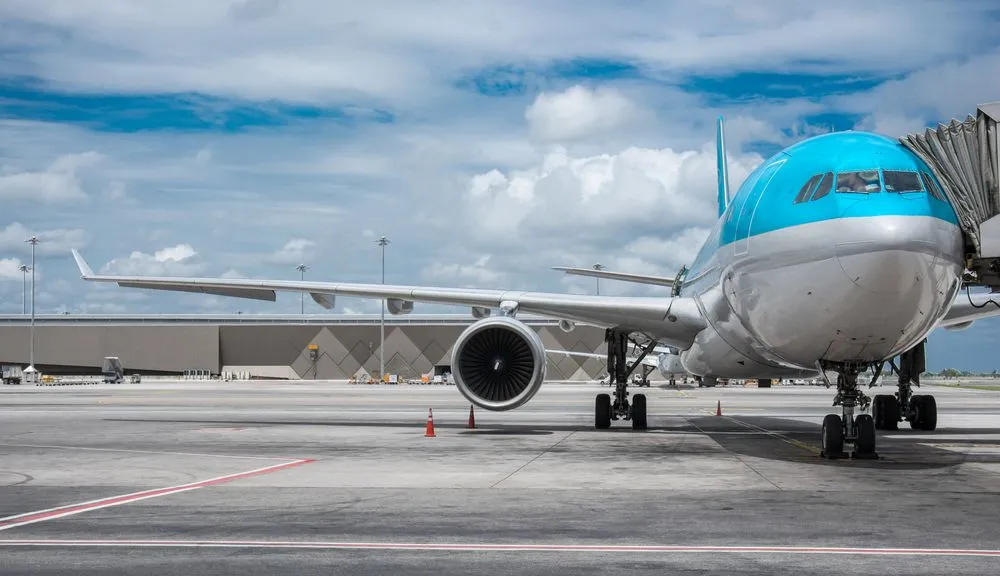
On the other hand, military aircraft have non-standard flight plans and the risk of fuel exhaustion is higher.
An alternative solution? Aircraft carriers.
These large warships act as floating airports and are stationed at sea. They increase military responsiveness and significantly decrease land-based distances, thereby addressing fuel exhaustion and reducing the need for risky mid-air refueling missions!
References (click to expand)
- https://havarikommissionen.dk/media/9230/fuel.pdf
- (2018) Aerial Refueling Probe/Drogue System - DTIC. apps.dtic.mil
- FAA Guide to Ground Vehicle Operations. faa.gov
- C Bolkcom. Air Force Aerial Refueling Methods: Flying Boom versus Hose .... The Federation of American Scientists
- (2007) Boom-receptacle vs. Probe-and-drogue. Oklahoma State University–Stillwater
- How Difficult is Aerial Refueling? - Hill Aerospace Museum. Hill Aerospace Museum
- 14 CFR 121.639 - Fuel supply: Domestic operations. Legal Information Institute, Cornell Law School
- Fuel - Flight Planning Definitions. SKYbrary Aviation Safety
- ETOPS (Extended-range Twin-engine Operations Performance Standards). Wikipedia
- Why Don't Passenger Planes Have In-Flight Refueling? Simple Flying