Table of Contents (click to expand)
A bearing is a machine element that constrains relative motion to only the desired motion (rotation or sliding) while reducing friction between moving parts. Its purpose is to support loads and let components move smoothly with minimal wear, which is why bearings turn up everywhere, from car wheels and electric motors to skateboards and ceiling fans.
Remember the fidget spinner? Back in 2017, these tiny whirring toys took the world by storm, and no age group was immune. When the off-the-shelf designs no longer appealed to the more creative tinkerers among us, they set about building their own versions, picking out the ball bearings at the heart of the toy and wrapping fancy contraptions of their own making around them.
That little ball bearing is doing all the work. It is what lets the spinner whirl for a minute or more on a single flick. And it belongs to a much larger family of components that quietly keep almost every machine you own running smoothly. So what exactly is a bearing, and why does it matter so much?
Bearing Surfaces
A bearing is a machine element that constrains the relative motion between two parts to only the motion you want, such as rotation or sliding, while reducing friction between them. The ball bearing inside that fidget spinner is just one member of a much larger family of these components, each designed to support a load and keep moving parts gliding past one another with as little wear as possible.
Types Of Bearings
1. Sliding Bearings
Sliding bearings are the simplest form of bearings that comprise plain or grooved surfaces on which machine elements can slide. They are inexpensive to manufacture and can support both linear and rotary movement.
The simplest example of a sliding bearing is a shaft in a hole. It can either rotate within the hole about its own axis, or it can perform linear motion along it. Without bearings, shaft movement in the hole can lead to erosion of the shaft, or the walls of the hole.
Rotary sliding bearings are designed like a sleeve in which the shaft rotates. The sleeve fits into the hole and supports the movement of the shaft. It can either be a single piece (bushing) or a split piece (journal bearing), depending on the required application.
Linear sliding bearings, on the other hand, allow the shaft to move along the hole. Sliding bearings require external lubrication to reduce friction between the moving parts.

They are inexpensive to maintain and can be made of a variety of materials, such as cast iron, Babbitt, bronze, and other zinc-based alloys. Bushings can also be made of rubber, depending on their application.
Some common sliding bearing examples include:
- Crankshafts in car engines that use journal bearings
- Door hinges that use bushing
2. Rolling Bearings
Rolling bearings are the most popular form of bearings and are composed of rolling elements encaged in a housing, allowing relative motion between machine components. The rolling elements can be balls or cylindrical rollers, depending on the application of the bearings. Due to having a larger contact area, cylindrical element bearings are capable of bearing higher loads than their similarly-sized ball element counterparts. When the rolling elements are arranged in a straight line, they can be used to support linear motion, and when arranged around a circumference, they can be used to support rotary motion.

Rolling bearings are available in various configurations, such as tapered bearings, needle bearings and conical bearings.
Rolling bearings are typically manufactured from stainless and chrome steel. However, they may also be manufactured from silicon nitride. Rolling element bearings must be lubricated for optimal performance, but specially manufactured dry bearings can also be used for high-temperature applications. While used quite extensively in everyday life, they can often go unnoticed. A few examples of rolling bearings include:
- Bicycle pedaling mechanisms
- Drawer sliders
- Skateboard wheels
3. Flexure Bearings

Unlike the above mentioned bearings that reduce friction failure, there is another class of bearings that addresses failure due to repeated flexing. Such bearings are also known as flexure bearings. They connect two surfaces that move relative to each other at an angle, i.e., by bending or stretching.
The flexure bearing is made of a material engineered to tolerate repeated stress cycles without fatigue failure. However, stretching it beyond the tolerable limit on a repeated basis shortens its life cycle and can cause it to prematurely fail. Depending on their application, flexure bearings can be made of various materials, such as metals or plastics, and can be linear or spiral in their shape.
A common example of a flexure bearing is the flip lid often seen on plastic boxes containing mints. They are also used with long beams to permit beam movements, such as sag.
Why Use A Bearing In The First Place?
When machine parts move relative to each other, the surfaces that come in contact erode, resulting in a loss of material. This changes the required clearances between them, reducing efficiency and even causing complete failure of the machine.
Bearings are ‘sacrificial’ contact surfaces designed to be strong enough to withstand repeated friction and heat cycles, while being weaker than the machine component with which they are in contact. In this way, deterioration due to friction is restricted to the bearing surfaces only, thereby preventing expensive repairs.
Life Of A Bearing
The theoretical bearing life is often represented by the L10 number, the rating life defined by the international standard ISO 281. It refers to the time (in hours or millions of revolutions) that a population of identical bearings can run before 10% of them have failed from metal fatigue. Put another way, 90% of the bearings are expected to still be going strong at the L10 mark.
The L10 number is strictly theoretical, as it assumes ideal operating conditions, such as optimal lubrication, a dust-free environment and proper alignment. In the real world, those conditions rarely hold, and wear, contamination and misalignment (rather than fatigue) tend to retire a bearing first. That is what makes it so difficult to estimate the ‘installed life’ of a bearing in service.
A Note On Unconventional Bearings
1. Jewel Bearings
Jewel bearings are special types of slider bearings that are used in the construction of mechanical watches. The bearing surfaces are lined with synthetic sapphire or ruby, which helps reduce friction, while maintaining dimensional accuracy of the system.
2. Magnetic Bearings
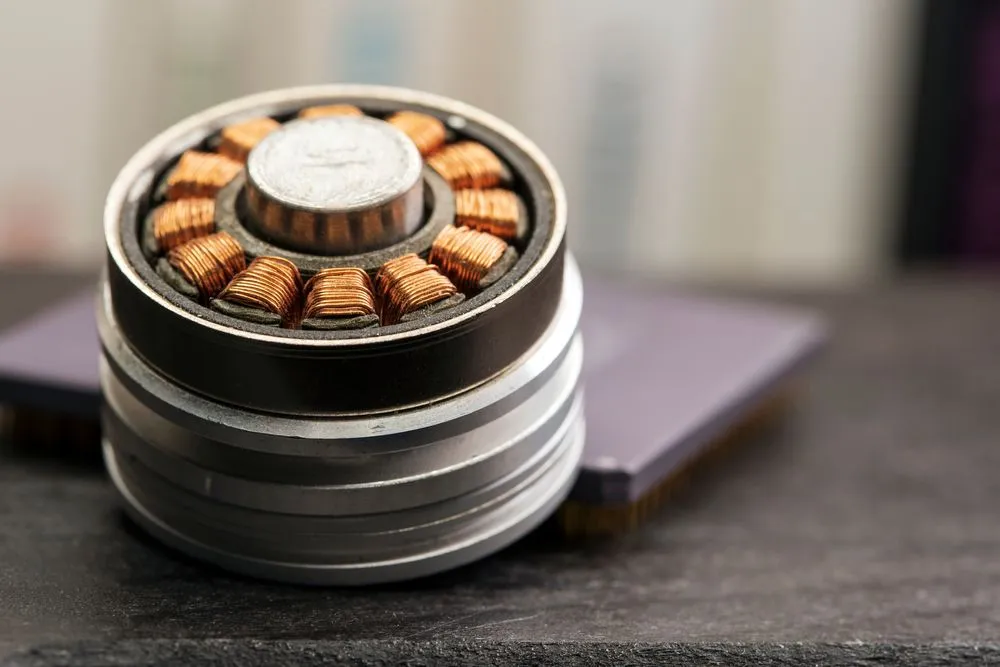
Magnetic bearings are frictionless bearings that utilize levitation by means of a strong magnetic field. While they have not gained popularity yet, owing to their size and high costs, they are an upcoming trend, as they can function in vacuum and without lubrication. Magnetic bearings are becoming increasingly popular in machines like compressors, turbines, motors, generators and pumps.
3. Fluid Bearings
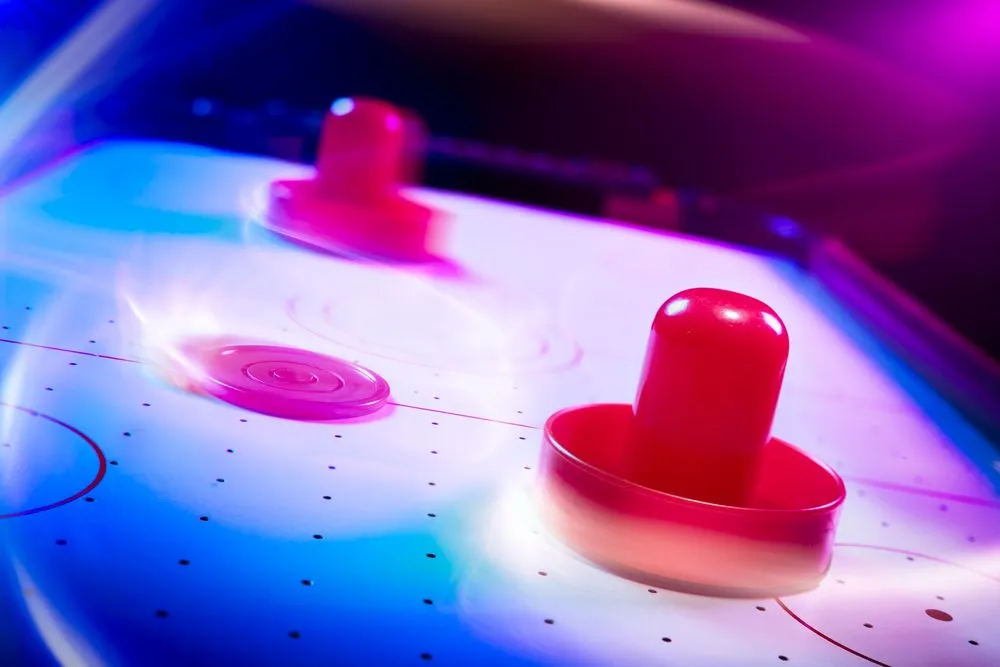
Fluid bearings are another example of contactless bearings where a thin layer of pressurized fluids prevents contact between the surfaces in motion. The advantage of fluid bearings is their near-zero wear and noiseless operations, making them useful for high-speed and high-precision applications.
They are commonly used in hard drive motors. Another common example of such bearing surfaces is an air hockey table, where the puck ‘floats’ on a layer of air issuing from small holes on the table surface!
References (click to expand)
- Brändlein J., Eschmann P., Hasbargen L., & Weigand K. (1999). Ball and Roller Bearings: Theory, Design and Application. Wiley
- Bearing (machine component). Encyclopaedia Britannica.
- Rolling bearing. Encyclopaedia Britannica.
- Mott, R. L., Vavrek, E. M., & Wang, J. (2017). Machine Elements in Mechanical Design. Pearson