Table of Contents (click to expand)
Blue fireworks are rare because the only chemical that produces a true blue flame, copper(I) chloride (CuCl), falls apart above roughly 1,200 °C (about 2,200 °F). Fireworks need to burn far hotter than that to ignite cleanly and lift, so the very molecule that paints the sky blue is destroyed before it can shine. Pyrotechnicians have to thread a narrow temperature window, which is why blue almost always looks dimmer than red, green, or gold.
Fireworks are beautiful and add vibrant colors to celebrations, whether a grand event or a casual get-together. Fireworks light up the sky with bursts of colors such as white, gold, red, emerald, yellow, and pink. Look closely on the next Fourth of July (or Bonfire Night, or Diwali), though, and you will notice something odd. Reds, greens, and golds burn bright and saturated, but the blues, when they show up at all, tend to look washed out, faint, or weirdly purplish. There is a real chemistry reason for this, and pyrotechnicians have been fighting it for almost two centuries.
History Of Fireworks: Blue Was Always Elusive!
The story of fireworks starts in China around the 2nd century BCE, during the Han Dynasty, when people tossed hollow bamboo stalks into fires. Trapped air pockets inside the bamboo expanded and burst with a loud crack, producing the original "firecracker" effect. The real chemistry showed up during the Tang Dynasty (618–907 CE), when alchemists looking for an elixir of life accidentally combined saltpeter (potassium nitrate), sulfur, and charcoal and stumbled into black powder. Tradition credits a monk named Li Tian, from Liuyang in Hunan province, with the discovery. By the Song Dynasty (960–1279 CE), gunpowder was being packed into paper tubes with fuses, producing what we would recognize today as a firework.
Here is the catch though: for the next thousand years or so, fireworks were essentially white, gold, and orange. That bright glow was just incandescent charcoal and metal sparks (the same reason a sparkler is silvery). Real, saturated color did not arrive until the 1830s, when Italian pyrotechnicians in southern Italy figured out how to swap potassium chlorate in for potassium nitrate as the oxidizer. That single change pushed flame temperatures from around 1,700 °C up toward 2,000 °C (roughly 3,100–3,600 °F), hot enough to excite metallic salts into pure color emission. Red came from strontium, green from barium, yellow from sodium, and copper was added to chase blue. Red, green, and yellow were essentially solved in that one 19th-century burst of chemistry. Blue, however, has been chased ever since. Pyrotechnics insiders still call it the "Holy Grail" of their field.
Science Of Fireworks
Inside every firework shell are dozens of small pellets called "stars". Each star is a tightly packed mixture of an oxidizer (commonly potassium nitrate, potassium chlorate, or potassium perchlorate), a fuel (charcoal, sulfur, or aluminum), a binder to hold it together, and most importantly, a metal salt that does the coloring. The lift charge that throws the shell into the sky is usually plain black powder (75% potassium nitrate, 15% charcoal, 10% sulfur).
When a star ignites, the intense heat strips electrons in the metal atoms out of their ground state and kicks them into higher-energy orbitals. As those electrons fall back down, they release the energy difference as photons of very specific wavelengths, a kind of atomic fingerprint unique to each element. Sodium’s 589 nm "D-line" is the same yellow glow you see in old streetlamps. Strontium chloride emits in the deep red. Barium chloride sits in the green band around 511–533 nm.
The element-to-color cheat sheet looks like this:
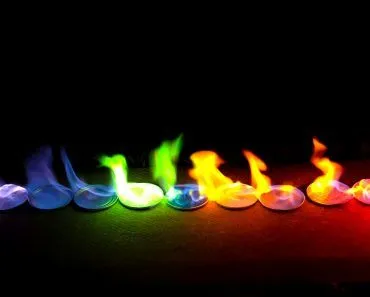
- Red: strontium compounds (strontium carbonate, strontium nitrate), via SrCl emission
- Orange: calcium salts (calcium chloride), via CaCl bands around 591–608 nm
- Yellow: sodium nitrate, via the powerful 589 nm sodium D-line
- Green: barium compounds (barium chloride, barium nitrate), via BaCl
- Blue: copper(I) chloride (CuCl), emitting around 420–460 nm
- Purple/violet: a copper + strontium mix (blue + red)
- White/silver: aluminum, magnesium, or titanium, which simply burn furiously hot and glow with incandescent light, no electronic transition needed
Notice that most of the colored emitters are monochlorides (SrCl, BaCl, CuCl). That is why most colored stars also contain a chlorine donor, usually PVC or Parlon (a chlorinated rubber), because the metal needs a chlorine partner inside the flame to form the right emitting molecule.
Problem With Copper Chloride (Salt Which Imparts ‘Blue’ Color)
Now we get to the awkward part. The species that actually produces that crisp blue light at 420–460 nm is copper(I) chloride, CuCl, and CuCl is famously fragile in a flame.
CuCl has to be hot enough to vaporize and radiate, which happens around 1,000 °C (about 1,800 °F), but it must stay below roughly 1,200 °C (around 2,200 °F). Above that threshold, CuCl thermally dissociates: the copper and chlorine part ways before the molecule can emit anything blue. Once that happens, you either get a pale copper(II) oxide (CuO) glow or just the washed-out white-ish incandescence of everything else in the star burning at full bore.
The cruel part is that fireworks have to burn hot, typically 1,700–2,000 °C (3,100–3,600 °F), to ignite cleanly, propel the star, and not fizzle out halfway through their arc. So a blue star is engineered around a contradiction: hot enough to launch and burn, yet cool enough not to destroy the very molecule that makes it blue. Pyrotechnicians thread that needle by carefully tuning the fuel-to-oxidizer ratio and adding moderators like carbonates or oxalates that pull the flame temperature down. Get it slightly wrong and the CuCl dissociates before it can radiate. Get it really wrong and you end up with smoky soot instead of a star.
There is also a public-health wrinkle. When the chlorine donor (PVC, Parlon) does not combust completely, it can produce polychlorinated dibenzodioxins, dibenzofurans, and PCBs, all real, documented byproducts of traditional copper-chloride blue stars. That is one reason researchers have been actively hunting for cleaner blue chemistries (more on that below).
Blue Sky In Contrast To The Background
Even when a blue star is chemically perfect, your own eyes are conspiring against it. Human cone cells, the daytime color receptors, are most sensitive around 555 nm in the yellow-green, exactly where sodium and barium emit. Blue at around 450 nm sits near the edge of cone sensitivity, so a blue burst radiating the same actual power as a red or green one simply registers as fewer perceived "lumens" to your brain.
The night sky also helps less than you might think. As your eyes dark-adapt and rod cells take over, peak sensitivity shifts toward shorter wavelengths (around 500 nm), an effect called the Purkinje shift. The catch is that rods are colorblind: they only signal brightness, not hue. So a deep-blue burst against a black sky tends to read as a dim glow rather than the saturated punch of red or green. Add in city skyglow, which already biases the background toward blue thanks to Rayleigh scattering, and a blue firework loses contrast against its own backdrop. Red and green pop because they stand far away from anything else in the sky. Blue just blends in.
Which Firework Color Is The Hardest To Make?
If you ranked firework colors by how hard they are to produce, blue would sit alone at the top. Pyrotechnicians have called it the "Holy Grail" of their craft for good reason: the copper(I) chloride that emits true blue survives only inside a narrow temperature window, so a blue star that runs even slightly too hot simply washes out. The difficulty runs so deep that experts treat it as shorthand for skill. As chemist Andy Brunning of Compound Interest puts it, "it's often said that you can judge the quality of a fireworks display on the quality of the blue fireworks."

Second place goes to purple (or violet). Purple is not a single emitter but a blend, made by mixing copper-based blue stars with strontium-based red ones. Because it leans on the same fragile copper chemistry that makes blue so temperamental, and then has to balance it against a second colorant, a clean, saturated purple is nearly as elusive as blue itself.
Purity makes the job harder still. Even a trace of sodium contamination floods a star with intense yellow light and drowns out subtler colors. As chemist Anne Helmenstine notes, "even trace amounts of sodium flood a firework with yellow light, making it difficult to get true reds, blues, and greens." Red, green, gold, and white, by contrast, come from sturdier chemistry that shrugs off the full heat of the burst, which is why they turn up bright and saturated in almost every show.
Are Blue Fireworks More Expensive Than Other Colors?
Short answer: blue tends to be the priciest color to pull off well, and the reason surprises people. It has little to do with the ingredients. Copper is a common, inexpensive metal, so a batch of blue colorant does not cost much more than any other. What you are really paying for is precision.

Because copper(I) chloride only radiates blue inside a narrow temperature band, a blue star has to be formulated far more carefully than a red or gold one. John A. Conkling, longtime technical director of the American Pyrotechnics Association, told NPR that a blue firework needs "a perfect flame temperature": push it too hot and the color washes out, keep it too cool and it barely glows. A star that drifts outside that window loses its blue entirely.
Purity raises the stakes further. Because even a trace of sodium can flood a star with yellow and swamp the blue, the raw chemicals have to be cleaner and the mixing tighter than they are for other colors. Add up the extra formulation work, the tighter tolerances, and the expertise it takes to get all of it right, and a bright, saturated blue becomes the pyrotechnician's benchmark of a high-end display rather than a color you can produce on the cheap.
A Final Word
Blue is a fascinating color that is hard to find in nature. Despite this, it is one of the most popular colors.
The good news is that the picture is not as bleak as it once was. Pyrotechnic chemist John A. Conkling, longtime professor at Washington College and author of the standard reference Chemistry of Pyrotechnics, has long argued that brighter blue is achievable with smarter chemistry. The most cited modern breakthrough comes from US Army Research Laboratory chemist Jesse J. Sabatini, who in 2014 demonstrated a chlorine-free blue formulation built around copper(I) iodide (CuI) generated in situ. It burns brighter, is less sensitive to friction and static, and crucially eliminates the perchlorate and dioxin byproducts of the traditional chlorine-donor blues.
So the future of blue fireworks looks promising. Researchers are inching toward a star that is both bright and safe, and one day soon, we might finally see sparkling blue, red, and white bursts that hold their own on Independence Day.
Last Updated By: Ashish Tiwari
References (click to expand)
- The Evolution of Fireworks. Smithsonian Science Education Center.
- Juhasz, M., Steinhauser, G., Klapötke, T. M., & Sabatini, J. J. (2014). Chlorine-Free Pyrotechnics: An Environmentally Friendly Blue-Light Emitter. Angewandte Chemie International Edition.
- Sabatini, J. J. (2017). A Review of Illuminating Pyrotechnics. Propellants, Explosives, Pyrotechnics. Wiley.
- Pyrotechnic colorant. Wikipedia.
- Sterba, J. H., Steinhauser, G., & Grass, F. (2012). Illicit utilization of arsenic compounds in pyrotechnics. Journal of Radioanalytical and Nuclear Chemistry.
- Conkling, J. A. & Mocella, C. (2019). Chemistry of Pyrotechnics: Basic Principles and Theory, 3rd ed. CRC Press.
- Cornish, A. (2013). Exploding The Mystery Of Blue Fireworks. NPR.
- Brunning, A. (2013). The Chemistry of Fireworks. Compound Interest.
- Red, white but rarely blue - the science of fireworks colors, explained. The Conversation.
- Helmenstine, A. How Do Fireworks Get Their Colors? Science Notes.