Table of Contents (click to expand)
Yes. Scientists already build "artificial suns" on Earth by recreating the same nuclear fusion that powers the real Sun. In December 2022, the US National Ignition Facility became the first lab to get more fusion energy out than its lasers put in, and tokamaks like China's EAST and Korea's KSTAR now hold 100-million-degree plasmas for over a thousand seconds. A practical fusion power plant is still about 10-20 years away.
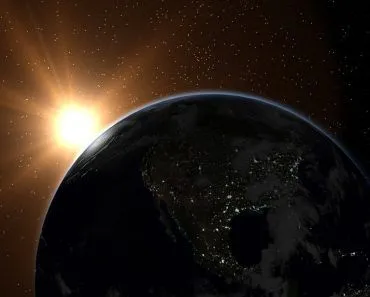
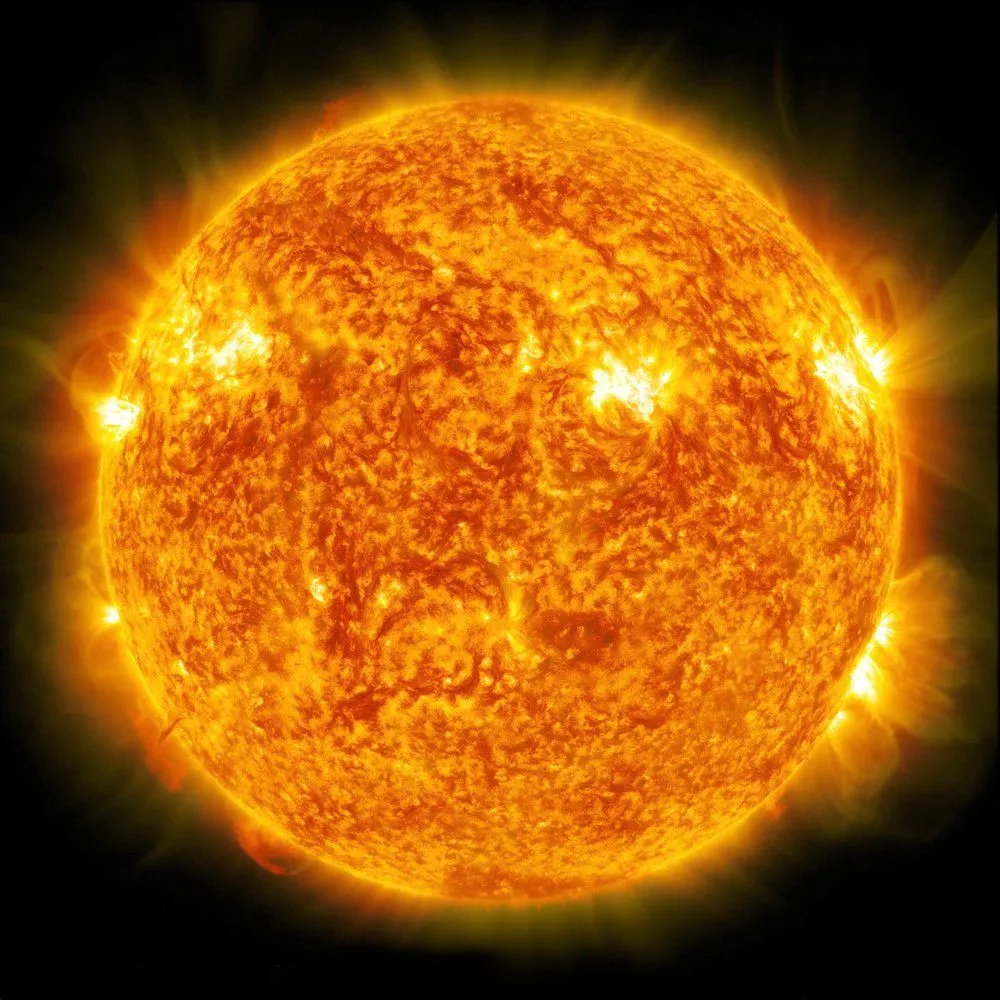
We all know how important the Sun is for our species’ survival. It’s not just some celestial body in outer space; it’s a tremendous fireball and an incredible source of energy, ensuring that life, as we know it, can exist and thrive.
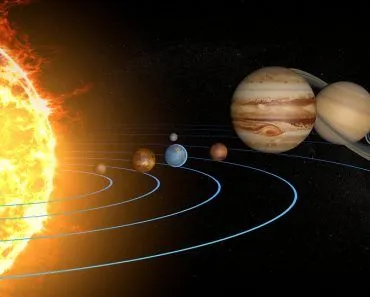
You likely understand that the Sun is a long way off from Earth, which is actually a good thing. We lie, fortunately for us, at the safest possible distance from the Sun, in an area astronomers affectionately call the “Goldilocks Zone”, where it’s not too hot and not too cold. Despite the distance, it would be incredible if we could harness some, if not all, of the tremendous energy that the Sun contains. This is precisely what Dr. Octavius was trying to achieve: harnessing the energy of the Sun.
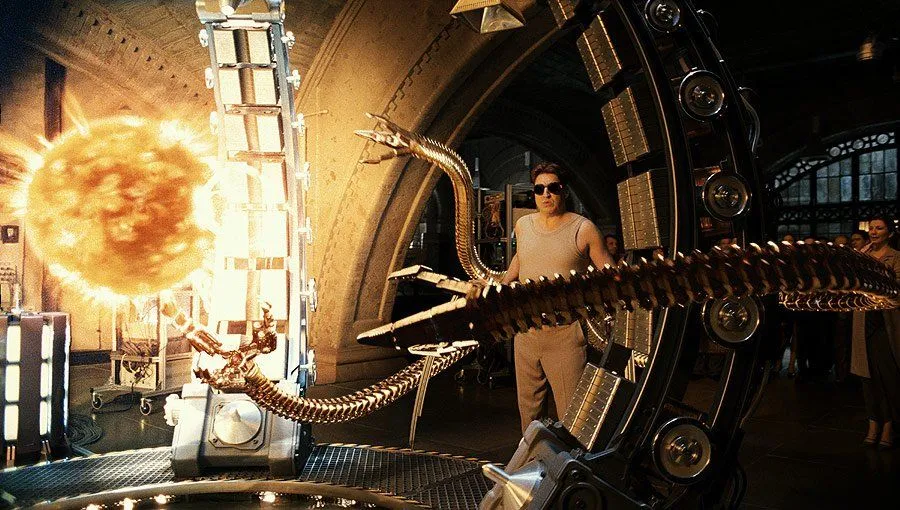
However, is it even possible? Can we have an artificial sun on Earth?
It’s Definitely Possible!
As it turns out, we can have an artificial sun on Earth, but as you might expect, creating an artificial sun takes a bit more than conducting a small experiment with regular equipment in a typical laboratory. It’s an incredibly daunting task to undertake and thus, quite justifiably, will take many years before it becomes a reality.
Einstein’s Energy-Mass Equivalence
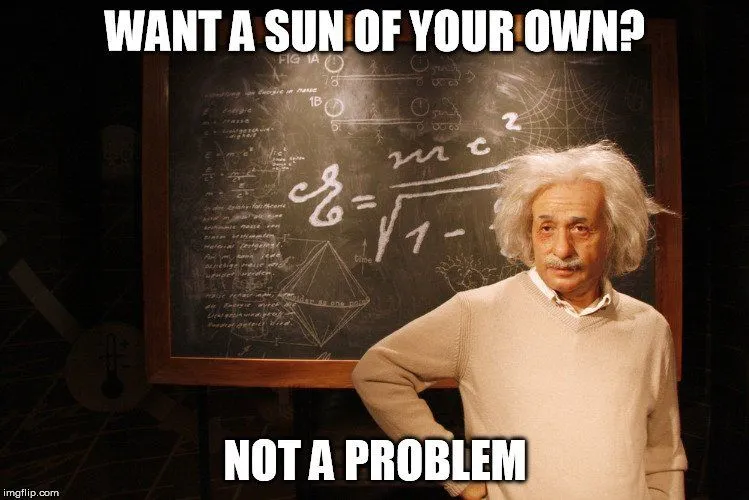
The equation that has helped push this seemingly bizarre idea into the realm of feasibility is Energy-Mass equivalence, which was postulated by Albert Einstein in 1905. According to the equation, it is believed that fusing a number of atoms together can release massive amounts of energy. To put it in perspective, if this equation is successfully put into practical use, the energy locked up in one gram of matter can power 28,500 100-watt lightbulbs for an entire year!
Researchers at the National Ignition Facility (NIF) in Livermore, California have already pulled this off. They fire 192 high-powered laser beams at a tiny fuel pellet inside a 10 m (32-foot) wide reaction chamber, briefly triggering a fusion reaction. On 5 December 2022, NIF made history when 2.05 MJ of laser energy delivered to a hohlraum produced 3.15 MJ of fusion output, the first time any lab achieved a fusion energy gain (Q > 1). Subsequent shots in 2023 and 2024 pushed the output even higher, hitting roughly 5.2 MJ from 2.2 MJ of laser input in February 2024.
How Can An Artificial Star Be Born?
Since we’re talking about creating an artificial star, of sorts, it goes without saying that the conditions in which the experiment must be carried out will be highly optimized. The area needed for the experiment will be equivalent to the area of three football pitches combined. A single infrared laser beam will strike the target after passing through many lenses, amplifiers, and mirrors over the length of an entire mile!
This laser beam will then be split into 192 different beams, which will be converted into ultraviolet light. This UV light will be focused onto the center of a capsule. The inside of this capsule is where the aluminum and concrete-coated target chamber will be housed.
When the beam strikes the inner walls, high-energy X-rays will be produced in a very, very short span of time (a billionth of a second!). This will subsequently create a fuel pellet inside the capsule until the outer shell of the capsule blows off. As a result of this explosion, a nuclear fusion reaction will be triggered, thereby releasing tremendous amounts of energy.
Lo and behold! You’ve just created an artificial sun!
Where Do We Stand Now?
This matter-of-fact explanation may lead you to believe that it’s not all that difficult, but in fact, it is incredibly complex. The proper arrangement of lenses and mirrors alone takes more than a year, and the chamber has to be kept almost perfectly free of impurities.
NIF’s laser approach is just one route. The other one, the one most often nicknamed an "artificial sun" in news headlines, is a magnetic-confinement reactor called a tokamak. A tokamak is a doughnut-shaped vacuum chamber wrapped in superconducting magnets that suspend a wisp of plasma in mid-air at temperatures hotter than the core of the real Sun, sometimes 100 million °C or more, while keeping the plasma from touching the walls. Several of these are already running:
- EAST (Hefei, China), often called “China’s artificial sun”, held a steady high-confinement plasma for 1,066 seconds on 20 January 2025, beating its own 2023 record of 403 seconds.
- WEST (CEA, France) broke EAST’s record a month later with 1,337 seconds on 18 February 2025.
- KSTAR (South Korea) ran a 100-million-°C ion plasma for 48 seconds during its 2023-24 campaign, helped by a new tungsten divertor.
- JET (UK), the previous world champion, set a final fusion-energy record of 69.29 MJ in 5.2 seconds from 0.21 mg of deuterium-tritium fuel on 3 October 2023, and was decommissioned shortly after.
- ITER, a multi-nation megaproject under construction in southern France, is meant to be the first tokamak to produce 10 times more fusion energy than it consumes. Its 2024 revised baseline pushed first plasma to 2034 and full deuterium-tritium operation to 2039.
A wave of private fusion companies has piled in too. Commonwealth Fusion Systems is finishing its SPARC reactor near Boston and aims for first plasma in 2027, with a 400 MW commercial plant called ARC planned for Virginia in the early 2030s. Helion Energy has signed the world’s first fusion power-purchase agreement, promising Microsoft 50 MW by 2028, and TAE Technologies in California demonstrated hydrogen-boron fusion in a magnetically confined plasma in late 2025.
That being said, the good news is that creating an artificial sun is possible, and we no longer have to wonder if it can be done, only when it can be done at a price worth paying. In the not-too-distant future, saying “My entire house is powered by the artificial sun at 26 Avenue, Livermore, USA,” won’t actually make you sound like a crazy person.