Yes. An odometer counts how many times the tire rotates and multiplies by a calibrated circumference; if you swap in tires of a different diameter, the readout drifts off by roughly the same percentage as the diameter change. A typical aftermarket size step (around 1 inch larger in diameter) leaves the odometer reading 3-7% short of the actual distance, until the vehicle is recalibrated.
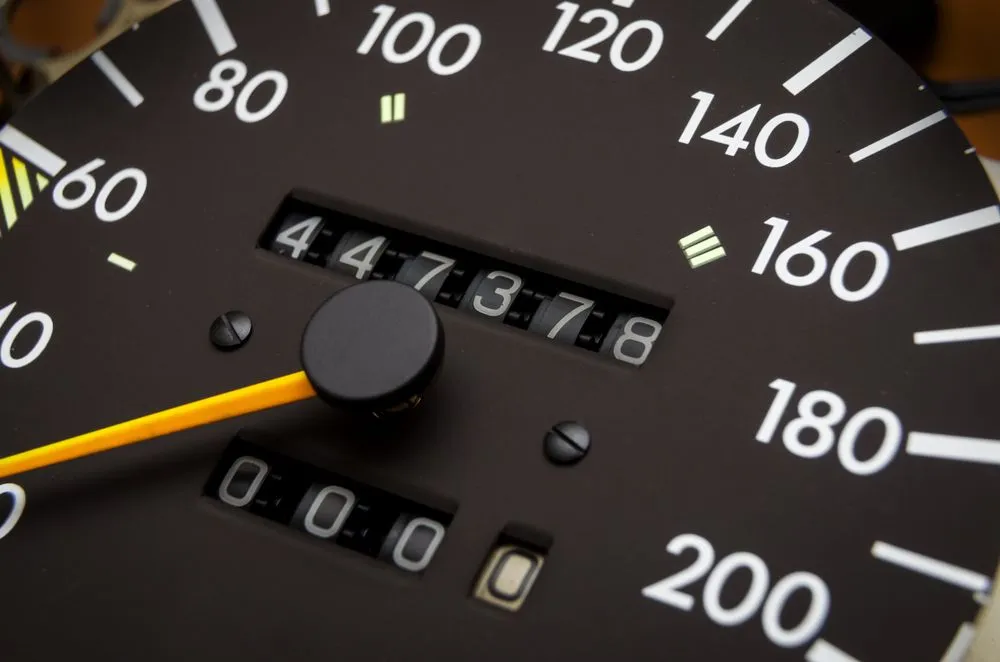
As a child, you might have spent quite a bit of time wondering what the random numbers rolling up and down your dad’s car dashboard meant. By now, you know that these numbers are actually a count of the number of miles the car has traversed since its maiden ride. The device that measures the distance covered by the vehicle is called an odometer.
What Is An Odometer?
An odometer is a mechanical device and, like everything mechanical, is prone to certain errors. Two principal reasons why an odometer may show incorrect readings include faulty mechanical parts or a change in tire dimensions, the latter of which we’ll be addressing in this article.
How Does An Odometer Work?
Understanding how an odometer works will help explain why their readings can get messed up when tires of different sizes are used. So, let’s get into it!
An odometer, much like a speedometer, can be either purely mechanical or electronic in nature. Mechanical odometers go back a long way. Heron of Alexandria described one in the first century AD, and Vitruvius and Zhang Heng each built versions of their own. For cars specifically, gear-driven mechanical odometers were standard by the early 1900s. The electronic versions started appearing in passenger cars in the 1980s and had largely pushed the mechanical units out by the mid-2000s.
Nowadays, vehicle manufacturers primarily employ electronic milometers because of their lower cost and more useful features. Both types enjoy a similar working procedure to their speedometer cousins, and they share many of the same errors.
Mechanical odometers are incredibly simple in their construction and manner of operation. They are essentially a set of gears with a very large gear ratio (on the order of 1000:1 in a typical setup, though the exact figure depends on tire circumference and the speedometer cable’s turns-per-mile spec). A gear ratio is the ratio of the rotational speeds of the first gear to the final gear in the gear train, so 1000:1 means that for every 1000 rotations of the first gear, the number dial makes one full rotation. The first gear is driven by the same drive cable that drives the speedometer. One end of this drive cable connects to the output shaft of the transmission.
As the vehicle moves, the rotary motion of the tires carries forward to the drive cable. The drive cable then turns the small gear appended at its other end. Next, a set of gears (usually 3-4 gears) transfers this motion to the number drum. After a set number of rotations of the tires, the numbers on the drum will roll to indicate the distance traveled. The number of rotations needed for the number dial to record a mile or kilometer varies depending on the gear ratio and tire size used.
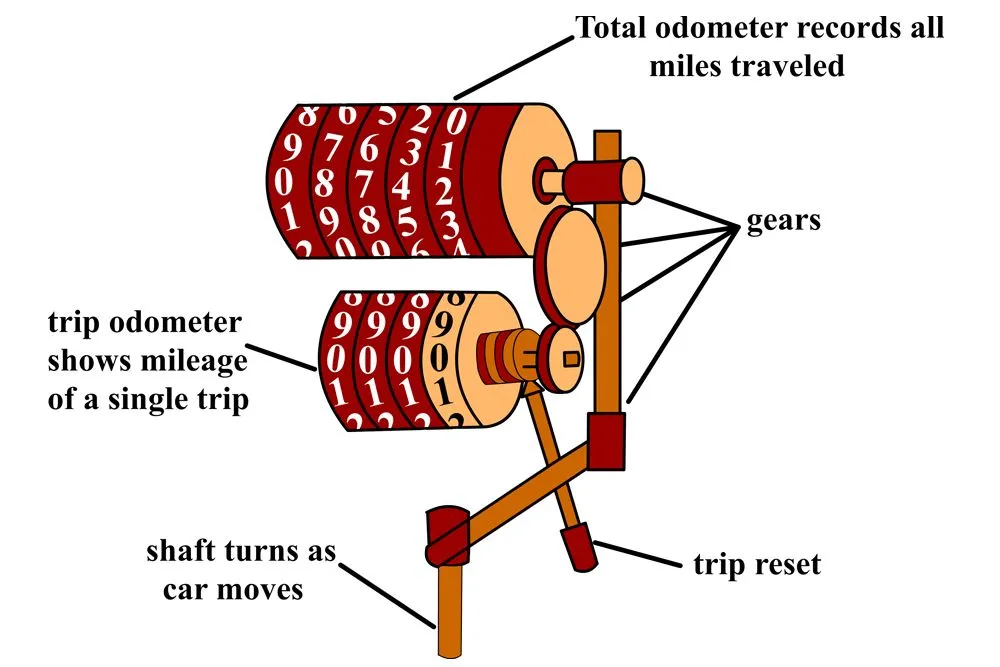
Apart from the basic distance-recording apparatus, additional trip milometers are also present. These have a relatively smaller number-indicating drum and record the distance traveled in a single trip/ride of the vehicle. The setup also includes a mechanism to dial back the main odometer readings to zero.
Modern cars dispense with the spinning cable entirely. Instead, the ECU (engine control unit) reads pulses from the ABS wheel-speed sensors or the transmission output speed sensor, sends them over the vehicle’s CAN bus, and the instrument cluster integrates those pulses into a distance value that it stores in non-volatile memory. The maths is the same as for a mechanical odometer (rotations multiplied by a calibrated circumference), but everything happens digitally.
Why Do Odometer Readings Get Messed Up?
As mentioned earlier, odometers and speedometers are prone to the same types of errors. These errors are primarily caused by changes in tire dimensions. These changes in dimension may be the result of wear and tear, a change in tire pressure, load, temperature, etc.
How Odometer Calculates?
An odometer calculates the distance by multiplying the circumference of the tire by the number of times it rotates.
Distance measured = Circumference of the tire × number of rotations of the tire
Circumference of a tire is its diameter times the mathematical constant pi.
Distance measured = (3.14 × Diameter of the tire) × number of rotations of the tire
Here, the diameter of the tire is expected to be a constant, but in reality, it isn’t. Tires undergo wear and tear as a car traverses more distance. These small forms of wear and tear change the overall dimension of a tire, resulting in an incorrect calculation of the distance covered. A change in outside temperature also causes a change in the internal tire pressure, which alters the overall tire dimension.
Furthermore, manufacturers calibrate the dashboard odometers for the tires installed by them, which are considered “standard”. If the car owner switches to a different sized tire for some reason, the odometer will need to be recalibrated. The device will continue to be off by several percent if it isn’t recalibrated, leading to inaccurate calculations of distance traveled.
Percentage Error Calculation For Odometer
The formula to find the percentage error for a faulty odometer is:
Percentage error = (Actual distance covered – Distance indicated by the odometer / Actual distance covered) × 100
Here, the term ‘actual distance covered’ represents the distance the vehicle truly covers to reach from point A to point B. The actual distance covered can be found by simply googling the distance between the two points or by using the formula given below.
Actual distance covered = (final reading of the odometer – initial reading of the odometer) × (actual tire diameter) / (standard tire diameter)
The actual tire diameter is the diameter of the tire after suffering the various wear and tears while standard tire diameter is the diameter of the tire installed by the manufacturer to which the odometer is calibrated.
In practice, the drift is usually 3-7% for common aftermarket tire upsizes (about 1-2 inches in overall diameter), and may climb past 10% with truly aggressive lifts and oversize tires.
If You Swap 295/30R19 Tires For 285/35R18, How Far Off Is The Odometer?
This is where the tire code stamped on your sidewall finally earns its keep. A size like 295/30R19 looks cryptic, but it breaks down neatly: 295 is the section width in millimeters, 30 is the aspect ratio (the sidewall height is 30% of that width), R means radial construction, and 19 is the wheel diameter in inches. If you want the full breakdown of every marking, we have a whole article on what the numbers on a tire mean.

What the odometer actually cares about is neither the wheel size nor the width on its own, but the tire's overall diameter. You find it by adding the wheel diameter to twice the sidewall height:
295/30R19: (19 × 25.4) + 2 × (295 × 0.30) = 482.6 + 177 = 659.6 mm (about 26.0 inches)
285/35R18: (18 × 25.4) + 2 × (285 × 0.35) = 457.2 + 199.5 = 656.7 mm (about 25.9 inches)
Look closely at those two totals. Despite dropping a full inch of wheel and changing both the width and the profile, the two tires land only about 0.44% apart in overall diameter. So if your car's odometer was calibrated for the 295/30R19 and you fit the 285/35R18, driving a true 1,000 km would leave the odometer reading roughly 1,004 km. That is smaller than the error you pick up from ordinary tire wear, and you would never spot it on the dashboard.
This is the whole idea behind plus sizing: fitting a larger-diameter wheel with a lower-profile tire so the overall diameter barely changes, which keeps the speedometer, odometer and traction control reading true. An odometer only gets thrown off when the swap changes that overall diameter, not when the wheel-size number changes by itself.
Does Changing Tire Size Throw Off The Speedometer Too?
Yes, and by the same percentage. Your speedometer and your odometer are driven by the very same wheel rotations, so anything that fools one fools the other to an identical degree. If a taller tire makes the odometer under-report distance by 3%, the speedometer under-reports your speed by 3% as well.
The direction is worth knowing before you get pulled over. Fitting taller tires than stock means the wheel rolls farther with every turn, so your true speed is actually higher than the figure on the dial. An indicated 100 km/h could really be around 103 to 105 km/h, an easy way to collect a speeding ticket you were not expecting. Smaller tires do the reverse: the needle reads high, so you are actually crawling along slower than it claims.
Width is the part that trips people up. A wider tire is not automatically a problem, because what these instruments respond to is the overall rolling diameter, not the tread width. A fatter tire with the same overall diameter leaves the reading essentially unchanged; it is only when a width change also brings a taller or shorter sidewall that the diameter, and therefore the reading, shifts. As a rough guide, tire shops suggest keeping any size change within about 3% of the original diameter to keep both gauges honest.
Conclusion
Odometers may display incorrect readings when tire size changes, but they can also be tampered with for the purpose of resale. Some people call this practice clocking or busting miles. Vehicle owners tamper with odometers to indicate a lower overall distance traveled by the vehicle, as this increases its market value. The readings are tampered with by either removing the odometer and winding back the numbers or by connecting the drive cable to another (newer) odometer.
However, strict laws are now in place to deter odometer fraud. In the United States, the federal Odometer Act (49 U.S.C. § 32703) makes tampering a federal offense, with civil penalties of up to $10,000 per vehicle and criminal penalties of up to $250,000 and three years in prison. The NHTSA estimates odometer fraud still costs US consumers more than $1 billion a year, which is why mechanics and repair shops are required to record readings whenever they service a vehicle.
References (click to expand)
- Odometer Fraud. National Highway Traffic Safety Administration.
- 49 U.S. Code § 32703 (Federal Odometer Act). Legal Information Institute, Cornell Law School.
- Odometer (history, mechanical and electronic designs). Wikipedia.
- Rajput, R. (2007). A Textbook of Automobile Engineering. Laxmi Publications Pvt Ltd.
- Lawlor, J. (1991). Auto Math Handbook: Calculations, Formulas, Equations and Theory for Automotive Enthusiasts. Penguin.
- Tire Size Explained: Reading the Sidewall. Les Schwab Tire Centers.
- 295/30R19 Tire Size Specifications (overall diameter, circumference, revolutions per mile). Tiresize.com.
- Speedometer Calibration: How Tire Size Changes Your Reading. Tiresize.com.
- Plus Sizing (keeping overall tire diameter constant). Wikipedia.