A thermos flask or vacuum flask is a bit like a super-insulated jug. A typical thermos has an inner glass chamber and an outer plastic one. Between the inner and outer layers there is a vacuum. The outer material can also be made of metal, like stainless steel, for greater durability.
‘As a rule, man is a fool, when it’s cool he wants hot, when its hot he wants cool’! I have a faint recollection of this quote being on my calendar during my school days. Don’t you agree humans can be quite contrarian? When the winter is here, we long for warmth and do whatever we can to keep ourselves toasty. Then, when the summers come, we affix our eyes on air conditioners to shield ourselves from heat—the same heat that we embraced in the winter!
A thermos flask is one such invention that saves us in our contrarian needs. This is not exactly about keeping us warm/cold, but it does apply to our beloved beverages, e.g., coffee, tea, milk etc.
A thermos flask, also called a Dewar flask, is a special kind of bottle in which hot liquids like tea and coffee remain hot and cold items like ice or cold water remain cold for a long time. It is also popularly known by other names, such as a vacuum flask or simply a thermos.
Controversial History Of The Dewar Flask
The vacuum flask was invented by Scottish chemist and physicist Sir James Dewar in 1892. Dewar was conducting research in cryogenics and needed a way to keep liquefied gases at stable low temperatures long enough to study their properties. His solution was a double-walled vessel with the air evacuated from the space between the walls, drastically reducing heat transfer.
Interestingly, Dewar never patented his invention. He viewed it as a scientific instrument rather than a commercial product. This decision would come back to haunt him. Reinhold Burger, a German glassblower who had worked with Dewar, recognized the commercial potential of the flask. Burger redesigned it for everyday use and secured a patent in 1903.
In 1904, Burger held a naming competition for the product. A Munich resident suggested the name "Thermos," derived from the Greek word therme, meaning heat. By 1906, Burger had formed Thermos GmbH and the product became a worldwide sensation. Dewar later sued Thermos for patent infringement, but the court ruled that since he had never patented his design, he could not prevent others from manufacturing it. The case became a famous example of the importance of intellectual property protection.
Construction And Working Of A Thermos Flask
A thermos flask is essentially a container within a container. The inner vessel, which holds the liquid, is separated from the outer shell by a near-perfect vacuum. This vacuum is the key to the flask's insulating ability.
Traditional thermos flasks used double-walled glass for the inner vessel, with the inner surfaces coated in a reflective material such as silver. However, modern consumer thermos flasks have largely transitioned to double-walled stainless steel, which is far more durable and resistant to breakage.
The flask is sealed with an insulating stopper or cap, typically made from plastic or cork, which minimizes heat transfer at the opening. The basic design exploits the three mechanisms of heat transfer—conduction, convection, and radiation—and attempts to block all three:
- Conduction: Heat transfer through direct contact between molecules. The vacuum between the walls eliminates conduction through gas, while the glass or steel walls are poor conductors compared to metals like copper or aluminum.
- Convection: Heat transfer through the movement of fluids (liquids or gases). The vacuum removes the air that would otherwise carry heat via convection currents.
- Radiation: Heat transfer through electromagnetic waves. The reflective coating on the inner walls reflects thermal radiation back toward the contents, preventing radiative heat loss.
How Thermos Flask Prevents Heat Leakage From The Container?
Now that you know about conduction, convection, and radiation, let’s get back to the working of a thermos flask. Now, the main purpose of a thermos flask is to prevent the flow of heat to and from the flask. The inner chamber of the flask is made up of glass, which is a poor conductor of heat. Hence, heat does not flow by conduction. Since there is a vacuum between the inner and outer walls of the bottle, heat transfer by both conduction and convection through gas is virtually eliminated—both require matter as a medium, and the vacuum removes that medium. Finally, the silvering (or reflective coating) on the walls ensures that heat is not lost by radiation, as it reflects thermal radiation back toward the contents. The main points of heat loss in a thermos are the cap and the neck where the inner and outer walls are joined. As a result, the liquid kept in a thermos flask continues to maintain its temperature for hours.
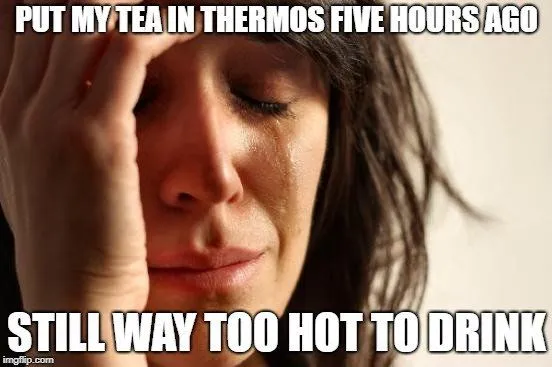
This means that the coffee you poured in the thermos in the morning will still be hot/warm when you sip it in the afternoon. Similarly, the cold soda you put in the thermos late at night will still be chilled when you crack it open in the morning.
Does A Thermos Keep Cold Things Cold Too?
Absolutely, and the reason is wonderfully simple. Heat only ever flows in one direction: from the warmer object to the cooler one. A thermos does not "make" heat or "make" cold. All it does is slow that flow to a crawl. So the very same vacuum and reflective lining that stop a hot drink's heat from leaking out will, in summer, stop the warm room's heat from leaking in. As the people at Explain that Stuff neatly put it, if heat cannot escape from a vacuum flask, then heat cannot penetrate into it from outside either. The insulation works equally well in both directions, which is exactly why your flask can chaperone an iced drink on a hot day just as faithfully as it babysits your morning coffee.

Here is a curious twist, though. A thermos often keeps cold drinks cold for longer than it keeps hot drinks hot. That sounds like favoritism, but it comes straight from the physics. The speed at which heat sneaks across any barrier depends on the temperature difference between the contents and the surroundings, a relationship captured by Newton's law of cooling. Picture boiling tea at roughly 95 °C (203 °F) sitting in a 20 °C (68 °F) room: that is a 75 °C gap pushing heat outward hard. Now picture iced water near 4 °C (39 °F) in the same room: the gap is only about 16 °C, so heat trickles inward far more slowly. Smaller gap, slower flow, longer chill. The flask is identical in both cases; only the temperature difference has changed.
How Long Does A Thermos Keep Drinks Hot Or Cold?
No flask is a perfect barrier, so a fair question is: how long does the magic actually last? For a good-quality double-walled stainless steel thermos, hot liquids typically stay genuinely hot for several hours, and a large, well-sealed flask can keep its contents hot for the best part of a day. The exact figure depends on the size of the flask, how full it is, the quality of the vacuum, and how warm the world outside is, so treat any single number as a rough guide rather than a promise.

If your flask seems to be losing the battle, the culprit is usually the one place the insulation cannot reach. As we saw, the inner and outer walls of a thermos join only at the neck, and that junction, together with the stopper, is the main highway for heat to escape or sneak in. There is also a simple trick that genuinely helps. When you pour a hot drink into a cold, empty flask, the first thing your drink does is surrender heat to warm up the chilly walls and lid. Pre-warm the flask first by filling it with boiling water for a minute and tipping it out, then add your drink, and far less heat is wasted on the container itself. For cold drinks, the same logic runs in reverse: pre-chill the flask, and your iced water keeps its bite for longer.
References (click to expand)
- Heat transfer - Bluffton University. Bluffton University
- Characteristics of Dewars | Physics Van | UIUC. The University of Illinois Urbana-Champaign
- Vacuum flask | Thermal Insulation, Heat Retention, Double-Walled. Encyclopaedia Britannica
- How do Thermos vacuum flasks work? Explain that Stuff
- Heat Transfer. HyperPhysics, Georgia State University