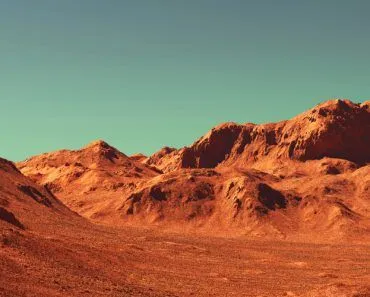
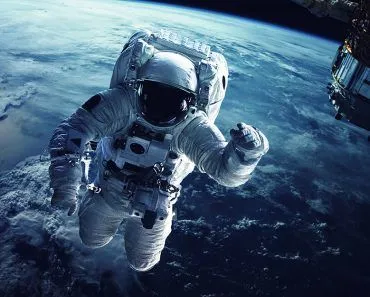
Building an artificial planet from scratch, whether as a planet-sized space station or a full planetary replica, is far beyond present-day engineering and would demand resources only a Type II civilization could marshal. Terraforming an existing planet like Mars is more feasible in principle, but a 2018 NASA-led study concluded Mars no longer holds enough accessible CO2 to be terraformed with present-day or near-future technology.
These days, it seems like everyone wants to go into space. Some even want to build a nation in space!
With global threats like climate change, overpopulation, and pandemics lurking around every corner, it’s always good to have a backup plan ready. The obvious plan is to reach out into space and discover places where we can build colonies away from Earth.
We often see humans inhabiting planet-sized objects in science fiction. From the legendary Death Star of Star Wars to the planet-building facility in The Hitchhikers Guide To The Galaxy, geeks like us have been toying with the idea of making a livable planet of our own for a long time. The question is, can we do it? If so, how can we go about doing it?
Basic Habitable Conditions Of A Planet
To start off, if we intend to inhabit an artificially built planet, we would need to find a good spot for it in space. Most importantly, it needs to be in a habitable zone. This means that the orbit of this artificially built planet, or its distance from the nearest star, should be just right for temperatures to be livable.
If this planet is too close to the star, we would simply be roasted by star’s heat, while too far away means that we would be deep freeze in the cold temperatures. Also, we would need an abundant supply of liquid water, because there can be no life without water.
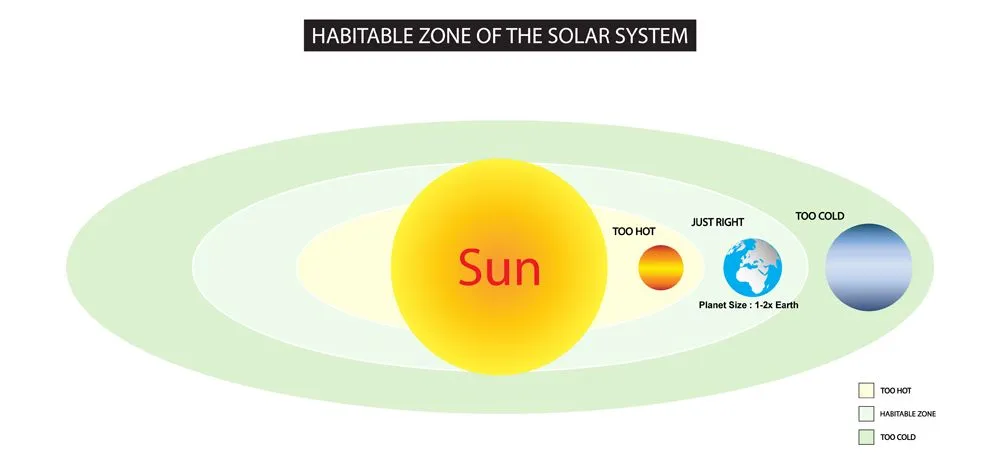
Besides being the right temperature and right distance from the star, we would also need to have an atmosphere with breathable air, a stable Earth-like gravity, proper day and night cycles, and so on. If we can meet these preliminary conditions, only then can we think about constructing a habitable planet from scratch.
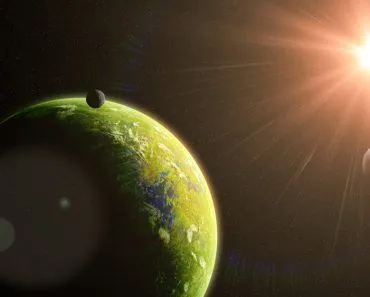
Now, what would be considered an “artificial but habitable planet” could have two interpretations. The literal interpretation is making a planetary replica, wherein a massive chunk of rock is fabricated into a giant sphere, and would be almost indistinguishable from the other planets in our Solar System. The other way to go about it is to build a massive satellite in space, perhaps a spherical space station, like the Death Star from Star Wars. This second option will not be a planet in the true sense, except for the spherical shape. It also would not be orbiting in a fixed orbit around the Sun, but would perhaps just hover above Earth like our other satellites.
Either of the approaches would be one heck of a job for engineers and scientists, but the second one is comparatively more viable, so let’s start there.
Planet-like Space Station
As mentioned earlier, building a spherical space station resembling a planet is easier than building a gigantic Earth-like planet. The Death Star, as shown in Star Wars IV: A New Hope, had a diameter of approximately 75 miles, which is very big! For perspective, the biggest space station we’ve ever built is less than 0.1 mile in length. However, when you compare a station like that to the 7900-mile diameter of Earth, it would still look like a dwarf. Nevertheless, let’s stick to 75 miles for the size for simplicity.
If we create this new planet-like space station like we make an aircraft carrier, and build it primarily from steel, then somewhere on the order of a quadrillion (1015) tonnes of steel would be needed for even a relatively thin shell, and a solid sphere would push that figure up by roughly an order of magnitude. Presently, the world produces about 1.89 billion tonnes of steel annually. At that rate, smelting even a single quadrillion tonnes would take on the order of half a million years, and a solid sphere would push that into millions of years.
The only workaround to get raw materials for the construction of this type of planet-like space station is to procure it from space itself, rather than relying on Earth’s resources. We would likely need to mine asteroids and maybe even our Moon for that. In fact, many companies are working on this idea and several studies on this topic are ongoing. You can read more about it here.
Now, assuming we somehow overcome this logistical challenge of procuring raw materials, we would need to have advanced robots (capable of working in microgravity) capable of building a spherical body that we could inhabit.
We would need to build this planet-like space station such that it has Earth-like gravity, because our bodies get messed up in the absence of gravity. Astronauts who are on long assignments at the International Space Station (ISS) often have to deal with bone mass loss, low blood pressure, and other health issues that are attributed to microgravity.
While making this planet-like spherical space station resembling a Death Star sounds like a cool idea, it is likely to suffer from an inherent flaw: lack of stability. To keep it stable, a lot of active maintenance would be required. We would need to be at least a Type 1 civilization on the Kardashev scale to achieve this feat, and according to some scientists, we are still a few centuries away from attaining that status. You can read more about the Kardashev scale here.
So… how about making a full-fledged planet then?
Planetary Replica
Mark Hempsell, an aerospace engineer formerly with the British company Reaction Engines and a past president of the British Interplanetary Society, conducted a full-fledged thought experiment on the possibility of building a planetary replica. His paper, “Some Speculations on the Construction of Artificial Planets,” appeared in the Journal of the British Interplanetary Society (JBIS, vol. 58, 2005).
Hempsell opines that it is not necessary to replicate Earth to its exact size in order to build its replica. We can do just fine with a smaller size replica. He reckoned that to achieve the equivalent of Earth’s gravity on an artificial planet, engineers could aim for packing one-tenth of Earth’s mass into a nearly Moon-sized sphere. For the uninitiated, Earth’s mass is about 5,972 quintillion tonnes (5.9722 × 1024 kg) and the Moon’s diameter is 2159 miles. That’s still a lot of rock to bring on, but Hempsell suggests how engineers could go about mimicking nature’s own way of making a planet.
Taking Cues From Nature
Rocky planets like Earth were formed from the leftover material exuded from the Sun at the time of its birth. These leftover grains coalesced together, bit by bit and chunk by chunk for millions of years until a proper planet was formed. Hempsell reckons that we can try to emulate nature’s process of building a planet, but do so at an expedited rate.
To speed things up, Hempsell suggests that we would need to build an advanced fusion facility near the Sun, wherein heavier materials that would be needed to build a new terrestrial planet could be procured. Denser elements like osmium, iridium, and platinum would be a good choice for constructing a planetary replica, according to Hempsell. Layers of these heavier elements could be laid on top of each other and we would then allow them to cool.
Hempsell admits that presently, the only way known to humanity to derive these elements is by thermonuclear explosions of supernovae. Perhaps we would need to advance to a Type 2 civilization on the Kardashev scale to build a nuclear fusion facility with that much power.
Even if we could expedite the process of planet building with this process, it would still take thousands of years to build a planet by this method, according to Hempsell.
How Would An Artificial Planet Hold Onto Its Air?
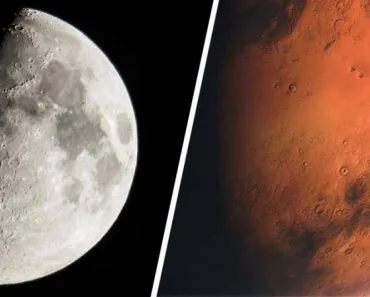
Manufacturing a breathable atmosphere is only half the battle; the harder trick is keeping it. A planet holds onto its air through sheer gravity. The molecules in any atmosphere are constantly zipping around, and if a world's gravity is too feeble, the fastest of those molecules reach escape velocity and leak away into space. Earth's escape velocity is roughly 11.2 km/s, whereas the Moon's is a meager 2.4 km/s. That gulf is a big reason our Moon is a barren, airless rock while Earth wears a thick, life-giving blanket of gas.

This is precisely why Mark Hempsell's target of packing one-tenth of Earth's mass into a Moon-sized sphere matters so much. It isn't just about walking around comfortably; you need enough gravitational grip to stop your hard-won atmosphere from drifting off. Build your artificial planet too small or too light, and it will slowly suffocate itself.
Gravity alone, however, isn't enough. The second threat comes from the solar wind, a relentless stream of charged particles blowing off the Sun. Mars is the cautionary tale here. It once had a much thicker atmosphere, but its planet-wide magnetic field, generated by a churning molten core, faded roughly four billion years ago and left the atmosphere undefended. Ever since, the solar wind has been stripping Martian air into space at a rate of about 100 grams every second, a figure measured directly by NASA's MAVEN orbiter. Over billions of years, that steady bleed helped turn a once-wetter world into today's frozen desert.
Earth avoids that fate because its molten iron core acts like a giant dynamo, generating a magnetic field that deflects most of the solar wind before it reaches us. So a genuinely habitable planet built from scratch would need to tick two boxes at once: enough mass for strong surface gravity, and some kind of magnetic shield to fend off the Sun. Miss either one, and even a perfectly engineered atmosphere would eventually escape into the void.
Which Real Worlds Come Closest To Being A Second Earth?
If manufacturing or fully terraforming a world is still centuries or millennia away, which existing places are our best bets? The honest answer is that none of them is ready to move into, but a few come tantalizingly close. Within our own Solar System, Mars remains the favorite despite being cold, thin-aired and, as we just saw, unshielded from the Sun.
Venus is the surprise runner-up. Its surface is the hottest of any planet, roasting at about 467°C, which is hot enough to melt lead. Climb roughly 50 km up into its clouds, though, and the temperature and air pressure become remarkably close to those at Earth's surface. That is why NASA engineers have sketched out concepts like HAVOC, in which crews would drift through the Venusian cloud deck in airships rather than ever touching the ground.

Cast the net beyond the Solar System, and astronomers track a growing list of exoplanets sitting in their star's habitable zone, the band where liquid water could survive. The nearest is Proxima Centauri b, just 4.2 light-years away and roughly the mass of Earth, although its red-dwarf star bathes it in radiation fierce enough to have possibly stripped its atmosphere. About 40 light-years out, TRAPPIST-1e, one of seven Earth-sized worlds huddled around a single dim star, is 0.92 times Earth's radius, sits squarely in its star's habitable zone, and ranks among the most Earth-like planets in density found so far.
A few worlds might even outdo Earth. A 2020 study in the journal Astrobiology, led by astrobiologist Dirk Schulze-Makuch, drew up a shortlist of “superhabitable” planets that could be friendlier to life than our own, being slightly larger, warmer and wetter and orbiting long-lived, stable K-type dwarf stars. His team flagged 24 candidates, though every last one lies more than 100 light-years away, making them targets for telescopes rather than colony ships. For now, even the closest of these worlds sits impossibly far off, and building or borrowing a home in our own cosmic backyard remains the only realistic plan.
Terraforming: A Better Alternative
Alternatively to these two fascinating ideas, there is a more feasible option—colonizing planets/moons by terraforming.
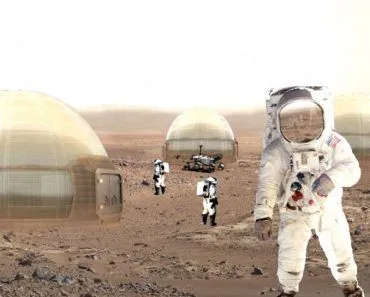
In terraforming, we don’t need to build a planet from scratch. All we need to do is manipulate an existing planet (or moon) to make its environment habitable for life. For example, Carl Sagan and, more recently, Elon Musk have floated the idea of detonating nuclear devices over Mars’s poles to release frozen CO2 and warm the atmosphere. A 2018 Nature Astronomy study by Jakosky and Edwards used data from MAVEN, Mars Reconnaissance Orbiter and Mars Odyssey to inventory every accessible CO2 reservoir on the planet, and concluded that even releasing all of it would raise atmospheric pressure to only about 7% of Earth’s, far below the ~600 mbar needed to keep liquid water stable on the surface. On current science, full terraforming of Mars is not achievable with present-day or near-future technology.
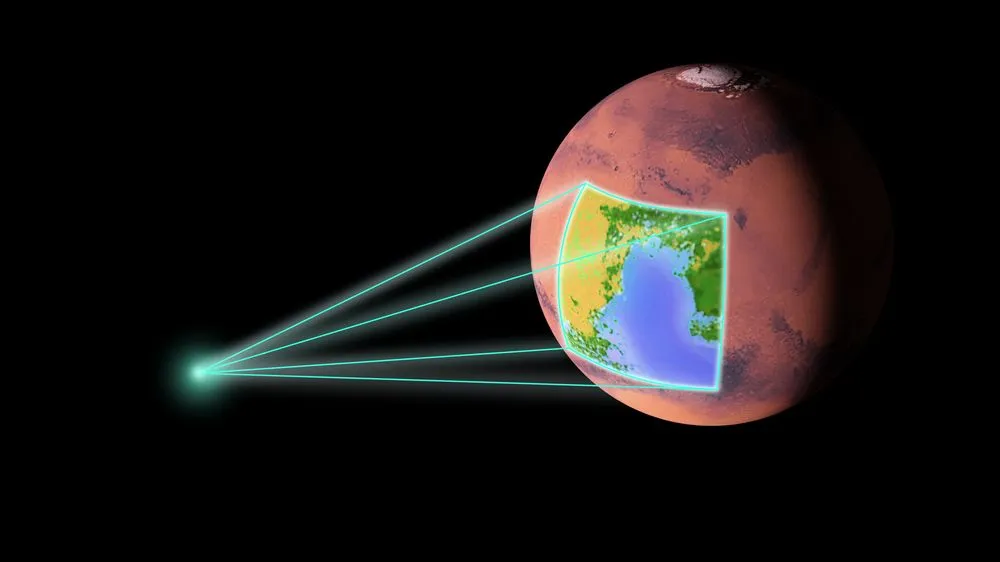
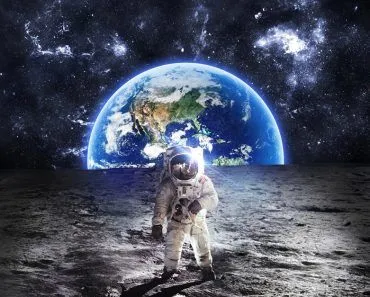
So, to conclude, the idea of building a planet from scratch makes for a good science fiction plot, but in reality, we are nowhere close to achieving that in the near future. Full terraforming of Mars is similarly out of reach with anything resembling present-day technology. More modest steps, however, are well underway: NASA’s Artemis programme is already flying crews around the Moon (Artemis II completed its lunar flyby in April 2026), and pressurised greenhouses or shielded habitats inside lunar lava tubes and Martian craters could host the first off-Earth colonies well within this century. Building a brand-new home in space is unlikely, but borrowing parts of one is increasingly within reach.
References (click to expand)
- International Space Station Facts and Figures. NASA
- Earth Fact Sheet. NASA Goddard Space Flight Center
- Moon Fact Sheet. NASA Goddard Space Flight Center
- Jakosky, B. M. & Edwards, C. S. Inventory of CO2 available for terraforming Mars. Nature Astronomy 2 (2018)
- World Steel in Figures. World Steel Association
- Mark Hempsell. Wikipedia
- What ISS Taught Us In the Past 20 Years. Popular Mechanics
- NASA Mission Reveals Speed of Solar Wind Stripping Martian Atmosphere. NASA
- Revisiting Timeline That Pinpoints When Mars Lost Its Dynamo. Harvard Gazette
- Venus Facts. NASA Science
- High Altitude Venus Operational Concept (HAVOC). NASA
- Proxima Centauri b. NASA Exoplanet Catalog
- TRAPPIST-1 e. NASA Exoplanet Catalog
- Schulze-Makuch, D., Heller, R. & Guinan, E. In Search for a Planet Better than Earth: Top Contenders for a Superhabitable World. Astrobiology 20 (2020)