Table of Contents (click to expand)
Spacecraft heat up on re-entry because they compress the air ahead of them into a superheated shock wave, not from friction. They survive thanks to an ablative heat shield, whose outermost layer absorbs that heat and erodes away, carrying the energy off and protecting the crew inside.
Man has sought protection from invading elements for millennia, in some form or other. As our adventures took ever-riskier paths, the role of protective equipment also became more critical. Beginning as any kind of barrier between a man’s skin and the external environment, protective equipment has come to play far more active roles in work, travel, industry and survival. One such crucial role is in the flight back home from space!
What Is Re-entry From Space Like?
Before we look at the evolution of safety materials, we should first attempt to understand the basics of entering Earth’s atmosphere from space. Getting a spacecraft to land safely back on Earth is no walk in the park.
A craft returning from low Earth orbit comes screaming in at roughly 7.8 km/s, or about 28,000 km/h (17,500 mph). Capsules returning from the Moon hit the atmosphere even faster, at close to 40,000 km/h (25,000 mph). All of that orbital speed has to be shed before the vehicle reaches the ground, and the atmosphere is what does the braking.
Here’s the part that trips most people up: the searing heat of re-entry is not really caused by friction. As the vehicle slams into the upper atmosphere far faster than the speed of sound, it cannot shove the air aside quickly enough. Instead, it violently compresses the air in front of it, forming a detached bow shock wave. Squeezing a gas that hard heats it up dramatically (the same thermodynamics that makes a bicycle pump warm), and the shock layer can reach several thousand degrees Celsius. So it is the compressed, superheated air, not rubbing against the skin of the craft, that does most of the damage.
It was NASA aerodynamicist H. Julian Allen, working with Alfred J. Eggers at the NACA Ames laboratory in the early 1950s, who turned this insight into the famous "blunt body" concept. A sleek, pointed nose seems sensible, but it keeps the shock wave clamped tight against the vehicle. A blunt shape pushes the bow shock forward and outward, so most of the heat is dumped into the air rather than into the spacecraft. That is why re-entry capsules, from Apollo to today’s crew vehicles, look like rounded gumdrops rather than darts.
The air gets so hot that it ionizes into an electrically charged plasma, which wraps the vehicle in a glowing sheath and briefly cuts off radio contact. This is the famous "communications blackout" that flight controllers wait out during the most intense phase of descent. Surviving all of this comes down to one thing: keeping that heat away from the crew and hardware inside.
What Is Ablation?
The word ablation refers to destructive consumption or elimination. Consequently, ablatives are materials that are consumed as the spacecraft enters Earth’s atmosphere. Since there are no materials that can withstand the heat generated during re-entry intact, a special type of material known as ablative is used.

The word ablation also finds use in genetic, surgical, geological and fire protection parlance. However, the context of material elimination through the use of energy remains the basis of ablation.
How Do Ablative Materials (Ablators) Work?
Ablation is a type of Thermal Protection System (TPS) that safeguards spacecraft from the intense heat faced during re-entry. During design and construction for the mission, the outermost surface of the spacecraft is coated with ablative materials.
The process of heat shielding can be divided into two stages. The first is material removal, wherein the outermost layer of the vehicle comes in direct contact with the atmosphere and is consumed in the process. The remaining part of the process is insulation, where the material must withstand heat without losing its own structural integrity. At the same time, it must not transmit heat to the base material of the vehicle.

Thus, the choice of ablative materials is dependent on various parameters related to both heat dissipation and structural integrity. It also depends on the return trajectory of the vehicle. A sharp trajectory would mean more aggressive heating for a shorter duration of time, along with very high landing speeds. On the other hand, a gentle trajectory would have slower landing speeds, and a lower intensity of heating, but the exposure time would increase significantly.
Apart from insulating, ablators are also used for structural and aerodynamic purposes in various components of the spaceship.
Various Types Of Ablative Materials
Ablators are designed to divert heat from the vulnerable base or virgin metal, while getting consumed in the process. Ablative materials are generally categorized into three types:
1. Subliming And Melting Ablators
As their name suggests, subliming and melting ablators melt or sublimate (get converted directly from solid to vapor) in the process of taking heat away from the base material. The liquid or gas that results from this process further blocks heat from penetrating into the base. Observations from both space shuttles and satellites show up to a 50% reduction in transmitted heat due to the generation of gases, in addition to the ablation process itself.
Early designs leaned on copper and beryllium "heat sinks," which soaked up heat into a heavy block of metal rather than ablating away. As true ablators took over, PTFE (polytetrafluoroethylene), commonly known as Teflon, was amongst the first subliming ablators. Other materials include graphite, carbon composites and even ceramics, owing to their low thermal conductivity and great structural properties.
2. Charring Ablators
Charring ablation involves material getting burnt to form a porous layer. It is porous due to selective melting or sublimation of the material. The gases derived from the formation of the char layer further add to the insulating properties. Charring ablators are also progressive in nature. This means that more char gets formed as the top layer erodes away, due to aerodynamic shear forces. Due to this, charring ablators are the most effective, and are therefore highly preferred for thermal protection. They are often used in conjunction with sublimating or melting ablators to increase their efficacy.
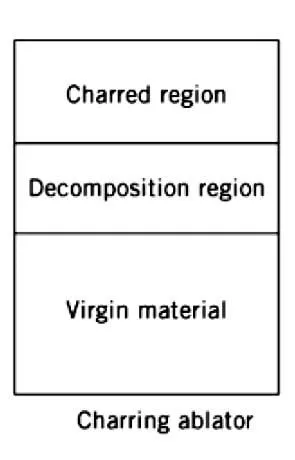
Carbon fiber-reinforced phenolic composites and resins are examples of charring ablators. They can be used with melting ablators, such as silica or nylon, to enhance their ablative characteristics.
Wood has been used as a low-cost charring ablator in the past, but it was phased out, as the thermal and physical characteristics of wood aren’t uniform throughout.
3. Intumescent Ablators
Intumescent ablators form a foam-like porous structure when exposed to heat. While you can think of them as charring ablators, they are actually the outcome of an exothermic reaction, as opposed to the endothermic reactions that take place in charred ablators. Since exothermic reactions add to the overall exposure to heat, they are usually reinforced with inorganic material that helps consume energy, rather than adding to it.
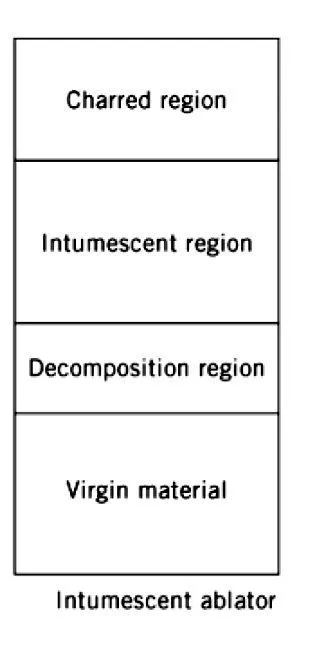
Intumescent ablators are known for their superior mechanical strength. However, this also means that their structure is detrimental to the aerodynamics of a vehicle as it enters Earth from space. For this reason, they are not used in high-speed re-entry vehicles. They find use in ammunition that is susceptible to fire, and in load-bearing applications, such as beams, pillars, and bridges on oil rigs. Intumescent ablators are easy to install, as they are available in the form of proprietary spray-on coatings, sheets and tapes.
Advancements In Ablator Technology
The process of ablation can be wasteful, given that material gets consumed in the process. Research bodies are looking for reusable ablatives that sacrifice less material. At the same time, scientists want to shift from using organic material to metallic ablators.
The use of such ablators would help to delay the oxidation and decomposition of ablators, especially in low-level orbits of Earth’s atmosphere, where temperatures are generally high, and satellites face prolonged exposure.
Ablation can still surprise the engineers who design it. When NASA’s uncrewed Artemis I mission returned from the Moon in 2022, its Orion capsule (shielded with an Avcoat ablator) lost more char in patches than the models had predicted. Rather than rebuild the heat shield, NASA studied the cause and adjusted the re-entry trajectory for the crewed Artemis II flight to steepen the descent and limit the time spent at peak heating. It worked: Artemis II carried its four astronauts around the Moon and splashed down safely in the Pacific on April 11, 2026, a reminder that even decades-old ablation technology is still being refined flight by flight.
How Does A Spacecraft Actually Get Back To Earth?
A heat shield only matters once the vehicle is already plunging into the atmosphere. So how does a crew actually get from orbit down to the ground? The return is a carefully staged sequence, and every step of it is about shedding speed in a controlled way.

It begins with a deorbit burn. The spacecraft turns around and briefly fires its engine against its direction of travel, trimming just enough velocity to let the low point of its orbit dip into the atmosphere. After that, gravity and air do the rest. NASA marks the formal start of re-entry at the entry interface, an altitude of about 122 km (400,000 feet). A capsule coming home from the Moon crosses that line at nearly 35 times the speed of sound.
Over the next few minutes the craft bores down through the thinning layers of the atmosphere, from the thermosphere into the mesosphere and stratosphere, and this is where the shock heating and the plasma blackout peak. On the crewed Artemis II flight in 2026, the astronauts rode through up to 3.9 g of deceleration and a planned six-minute radio blackout as glowing plasma wrapped the capsule.
Once most of that orbital speed has been burned off, the vehicle is still falling fast, but slowing a subsonic object is a far gentler problem. Capsules such as Orion pop drogue parachutes at around 6,700 m (22,000 feet) to steady the descent, then unfurl three big main parachutes near 1,800 m (6,000 feet) that bring the craft down to a soft splashdown at roughly 32 km/h (20 mph) in the ocean. Winged vehicles came home differently: the Space Shuttle rode its trajectory into the atmosphere and then glided down unpowered to a runway landing like a very heavy aeroplane, protected by reusable silica tiles and reinforced carbon-carbon panels rather than an ablator that burns away.
Why Don't Spacecraft Burn Up On The Way Up?
If re-entry is so violently hot, why doesn't a rocket cook itself on the way up through the very same atmosphere? It is a fair question, and the answer comes down to when the vehicle is fast and when the air is thick.

On the way up, a rocket accelerates gradually. Its engines burn continuously, but for the first minute or two it is still travelling fairly slowly while it is down in the dense lower atmosphere. It only reaches orbital speed much higher up, where the air has thinned to almost nothing and there is barely any gas left to compress and heat. The fiercest aerodynamic stress a launcher feels comes at a moment engineers call max q, the point of maximum dynamic pressure, which for the Space Shuttle occurred at an altitude of around 11 km (36,000 feet) about a minute after liftoff. Rockets are often throttled back through max q to ease the load; the Shuttle's main engines were dialled down to roughly 65 to 72 percent of full thrust as they passed through it.
Coming home, the geometry is reversed. The spacecraft arrives at the thick lower atmosphere already moving at full orbital speed, close to 28,000 km/h (17,500 mph). There is no engine easing it down gently over hundreds of kilometres; instead the air itself has to soak up all of that energy in a matter of minutes. A fast vehicle plus dense air is exactly the recipe for the superheated shock layer, which is why the real danger is all on the way down, not the way up.
Would A Human Burn Up During Re-entry?
A question that follows naturally: what would happen to a person falling from orbit with no spacecraft around them? The blunt answer is that they would not survive the heat. The searing shock layer does not care whether it is compressing air ahead of a metal capsule or a human body.

Anything arriving from orbit at roughly 28,000 km/h (17,500 mph) runs into the same wall of compressed, superheated air. That is exactly why small natural fragments, or meteoroids, flare into glowing meteors the instant they strike the upper atmosphere. The heat shield exists precisely so that the crew riding inside never has to meet those temperatures.
This is also why record-breaking high-altitude skydives are nothing like a re-entry. When Felix Baumgartner leapt from a balloon at about 39 km (24 miles) in 2012, he broke the sound barrier and reached roughly 1,358 km/h (Mach 1.25), yet he felt no fireball at all. That sounds blistering, but it is around twenty times slower than orbital velocity, and he was falling through extremely thin air. Heating climbs viciously with speed, so a supersonic freefall from the stratosphere and a plunge from orbit are simply not in the same league. To come home from orbit in one piece you need both the shielding and a trajectory that bleeds off that enormous speed a little at a time.
References (click to expand)
- H. Julian Allen (blunt body concept) - NASA
- Core Area of Expertise: Entry Systems - NASA Ames
- NASA on Track for Future Missions with Initial Artemis II Assessments - NASA
- (2017) Ablative Thermal Protection Systems Fundamentals Robin .... The National Aeronautics and Space Administration
- (2017) Fundamentals of Launch Vehicle Ablative Thermal Protection .... The National Aeronautics and Space Administration
- Artemis II Flight Day 10: Crew Sets for Final Burn, Splashdown - NASA
- Why Don't Spacecraft Burn Up During Reentry? - MIT School of Engineering
- Max q (maximum dynamic pressure) - Wikipedia
- Space Shuttle Thermal Protection System - Wikipedia
- Red Bull Stratos - Wikipedia