An ambulance or police siren sounds higher pitched as it approaches you, and lower pitched after it passes. The cause is the Doppler effect: motion compresses the sound waves in front of the vehicle (raising their frequency at your ear) and stretches them out behind it (lowering their frequency), even though the siren itself emits the same note the whole time.
Imagine driving home along a road that has a surprisingly small amount of traffic. Suddenly, you hear the distant wail of a siren. Before you even turn your head to see, your mind has already registered that an ambulance is approaching your position from behind. The siren sounds louder and more shrill as the ambulance approaches your car, but then changes its pitch as soon as the ambulance overtakes you, almost like an opera singer can change the shrillness of her voice. You can’t help but notice the unique, shifting sound of the siren.
Siren designers must be pretty clever to come up with a siren that changes its pitch automatically!
If this thought has ever crossed your mind, then you may be in for a surprise! In truth, cutting-edge sirens aren’t making you hear different pitches of the siren as it moves; instead, its an extremely simple physical phenomenon.
The Doppler Effect
First, listen to the changing pitch of the siren from a fire engine (fire truck) in the video below:
Notice how the sound of the siren changes as the truck passes by the camera? That’s the strange occurrence that we want to talk about.
This difference in the sound of the siren (or the horn of a car or a train) is due to a scientific phenomenon called the Doppler Effect. Like many other phenomena, the Doppler effect is named after a scientist, Christian Doppler, who is credited with its discovery. Our world is replete with events and daily-life experiences that are associated with Doppler effect. Let’s see a bit more about what the Doppler effect actually is.

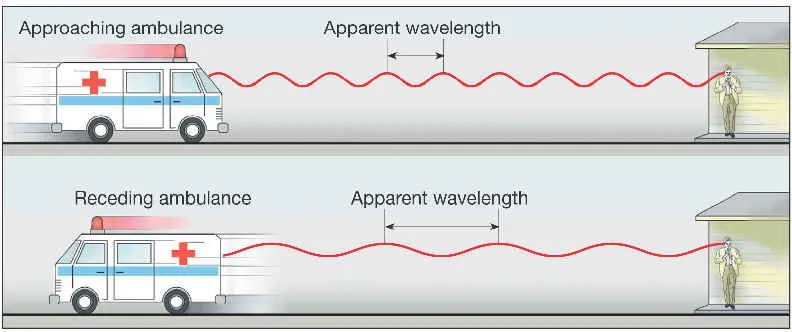
The Doppler effect is observed when the source of a particular set of waves is moving with respect to the observer. Suppose you are standing on the sidewalk, waiting to cross the street. On the far left side of your position, you see an ambulance racing in your direction. In this case, the siren on the ambulance is the source of the waves (sound waves, in this case) and you are the observer.
Apparent Increase In Wave Frequency
As the ambulance approaches you, the distance between the source of the waves and the observer decreases. Consequently, the siren sounds more shrill as the pitch of the wailing siren ‘sounds’ higher than its original value, as sound waves reach you ‘more frequently’. It should be noted that the siren itself is still emitting the same frequency as always; the difference is that, because the source is moving toward you, the waves arriving at your ear are bunched closer together and so reach you at a higher frequency. Your ears hear that higher frequency as a higher pitch.
Apparent Decrease In Wave Frequency
This is very similar to the case we discussed above, but in reverse. As the ambulance moves away from you, the distance between you (the observer) and the siren (source of the sound) increases. Therefore, the sound waves get to spread out in a bigger area, thus making you feel as if the siren sounds low-pitched, or just different!
Other Cases Of The Doppler Effect
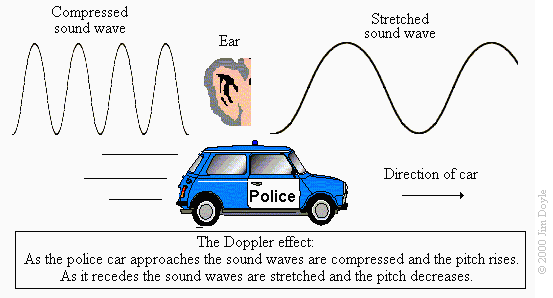
The example of the ambulance siren is just one of the many instances where the Doppler effect comes into play. The same case applies to a police vehicle as it passes you by, and those loud train horns you hear approaching on the tracks. These common phenomena seem to fascinate many people, especially literary minds, who make comparisons like ‘the blaring sound of a truck horn’ or ‘the shrillness of the horn of an approaching train’. Do these people realize that they are inadvertently entering the realm of physics when they describe these unique sounds?
The Doppler effect is also a working tool in much bigger science. Radar guns use it to clock the speed of cars and baseball pitches; weather radar uses it to spot how fast rain and wind are moving inside a storm; and astronomers use the Doppler shift of light to measure how fast stars and galaxies are racing toward or away from us (the famous "redshift" that helped show the universe is expanding).
(One common myth to clear up: the changing pitch you hear when filling a bucket with water from a tap isn’t the Doppler effect. That’s a different phenomenon called acoustic resonance. As the water rises, the column of air above it gets shorter, raising the resonant frequency of that air column.)
What Do The Different Siren Sounds (Wail, Yelp, Hi-Lo) Mean?
If you have ever wondered why one siren slowly slides up and down while another yelps in a frantic rush, you are not imagining things. Modern electronic sirens do not have a single sound; they have a menu of tones that the driver switches between by flicking a control. The siren box, an amplifier wired to a loudspeaker bolted near the bumper, plays back a pre-programmed pattern. The names you will hear most often are wail, yelp and hi-lo (also called the two-tone).

The wail is the long, slow sound. The tone sweeps smoothly up and back down over several seconds, and because it lingers in the air it carries well over distance. It is the tone you typically hear when an emergency vehicle is still far away and moving fast down an open road. The yelp uses the very same up-and-down sweep but races through it many times faster, producing that urgent, rapid-fire whoop. Drivers tend to switch to the yelp in busy traffic and at intersections, where a quick, attention-grabbing burst is more likely to cut through the noise. The hi-lo, common in Europe, is not a sweep at all but two fixed notes alternating back and forth (the sound British children imitate as nee-naw).
Why these particular sounds? Sirens pack their energy into a frequency range that human ears pick up well. The air column inside your ear canal resonates and makes us most responsive to sound waves roughly in the 2,000 to 5,000 Hz range, so the higher partials of a siren land right where the ear is most sensitive and are heard as louder for the same energy. The constant change in pitch helps too, since a sound that keeps moving is more likely to grab your attention than a single steady note. So the different sounds are not codes for different vehicles. They are simply tools the driver picks for the situation, with a slow tone to reach far and a fast tone to punch through clutter close up.
Do Ambulances And Police Cars Use Different Sirens?
This is one of the most-searched questions about sirens, and the honest answer surprises most people: in the United States there is no national standard that assigns one siren sound to ambulances and another to police cars. The recommended industry specification, SAE J1849 (titled simply Emergency Vehicle Sirens), lays out laboratory test procedures and loudness requirements for emergency sirens, but it does not hand each service its own signature tone. Police, fire and ambulance fleets generally buy the same kind of electronic siren hardware, and the differences you notice come from how each crew chooses to use it.

So the reason an ambulance can sound a little different from a police car usually comes down to habit and local practice rather than hardware. A crew might favor the slow wail, lean on the rapid yelp, or layer in an air horn blast as a last resort to move a driver who has not pulled over. Settings vary from one department, city and country to the next, which is exactly why your sense of which siren is which often falls apart the moment you travel somewhere new.
The clearest real exception is the fire truck. Many fire engines still carry the Federal Signal Q-siren, a motor-driven mechanical siren (rather than an electronic one) that produces a deep, growling sweep quite unlike the crisp electronic tones. That throaty sound is genuinely distinctive, but notice that it marks a type of device, not a rule that fire trucks must sound a certain way. Whatever the tone, the underlying physics is identical: as any of these vehicles races toward you and then past you, the Doppler effect shifts the pitch you hear up and then down, the same way it shifts the color of light from distant galaxies, no matter which siren setting the driver has chosen.
References (click to expand)
- The Doppler Effect for Sound - Hyperphysics. Georgia State University
- The Doppler Effect - UConn Physics. The University of Connecticut
- The Doppler effect - Florida State College - Florida State College at Jacksonville
- J1849 Emergency Vehicle Sirens (Recommended Practice). SAE International
- Maximum Sensitivity Region of Human Hearing - Hyperphysics. Georgia State University
- Diffraction - Salford Acoustics, University of Salford
- Q2B (Q-siren). Wikipedia