The Magnus effect is the sideways force on a spinning ball moving through air. As the ball spins, the boundary layer of air separates earlier on one side than the other, deflecting the wake and pushing the ball perpendicular to its direction of motion. It is named after the German physicist Heinrich Gustav Magnus, who first investigated it rigorously in 1852. The Magnus effect explains why a spinning soccer ball curves, why a topspin tennis shot dips, and why a backspun basketball can hook in mid-air.
Other than his dazzling looks, and counterintuitive helium-infused voice, David Beckham is primarily known for his swirling free kicks. First, he would distance himself from the ball with long strides in reverse, then, after the whistle shrieked, he would jog forward and strike the ball cautiously with his right foot. The ball would plunge into the air, initially in a direction which would make it appear as if it were moving astray from its target, but gradually, the ball would begin to curve inside.
The curvilinear trajectory would deceive the goalkeeper; the ball would curve just enough to let it creep inside the post, sending commentators around the world into a frenzy. However, the most popular, and arguably skillful, of such deceptions was the famously named ‘impossible goal’ performed by Brazil’s Roberto Carlos against France on 3 June 1997 at Le Tournoi de France, a four-team friendly tournament held as a warm-up for the 1998 World Cup. You can witness the astonishing feat here.

This phenomenon, however, is not exclusive to soccer; it is quite ubiquitous in rugby, tennis, table-tennis, basketball, baseball and every other sport that involves a ball. What’s more, balls don’t simply veer in one direction; knuckleballs in baseball and football are equally abhorred by hitters and goalkeepers for their notorious volatility. Both movements can be explained by a single effect – the Magnus effect.
What Is The Magnus Effect?
The effect is named after the German physicist Heinrich Gustav Magnus, who carried out the first rigorous experimental investigation of the phenomenon, using a spinning brass cylinder in a wind tunnel, in 1852. However, Isaac Newton is the one who originally discovered and inferred its cause. In 1672, in a letter to the Royal Society, Newton described how a tennis ball struck with oblique spin on the Cambridge courts curved in flight because one side of the ball, in his words, “presses and beats the contiguous air more violently” than the other. To the contrary, caressing the ball in certain ways imparts back-spin, causing it to gently lift and float across a small distance.
To understand why, let’s do the first thing requisite for problem-solving in physics – draw a diagram.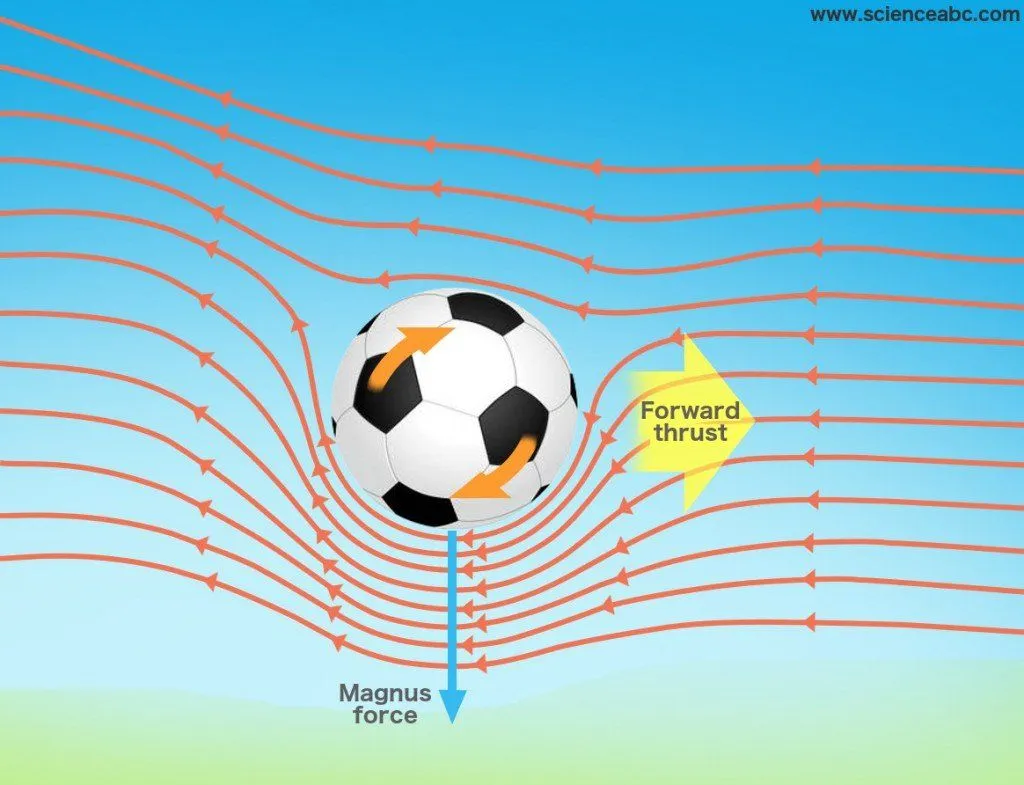
The diagram represents a ball that is struck or pitched in a way that propels it forward and rotates it clockwise. The wheat field pattern of arrows represents the drag force exerted by the incoming wind. The drag force is the resistance offered by the wind, the same resistance you feel while racing on a bicycle, or when your palm faces the wind when you stick it out the window of a fast-moving car.
Now, a cluster of lines run in the same direction as one side of the swirling ball, and in this case, these are the lines below the ball, whereas the ball’s other side moves in the opposite direction of the wind, colliding into its drag lines head-on in its course. On the side where the ball’s surface moves with the airflow, the air close to the ball is accelerated and the boundary layer hugs the ball further around before separating. On the opposite side, the surface moves against the flow, slowing the boundary layer and causing it to peel away earlier. This asymmetric separation deflects the wake to one side, and (in the simpler Bernoulli picture) leaves a lower-pressure region on the fast-moving side and a higher-pressure region on the slow-moving side.
Magnus Force
It is this pressure difference, ultimately rooted in the asymmetric boundary-layer separation around the spinning ball, that pushes the ball in the direction of the spin, or more formally, in the direction of the pressure differential (from high pressure to low pressure). This gradual curl can be shown to be encouraged by a force. The force is depicted by an arrow perpendicular to the axis of rotation, in the direction of the pressure differential. This is called the Magnus force.
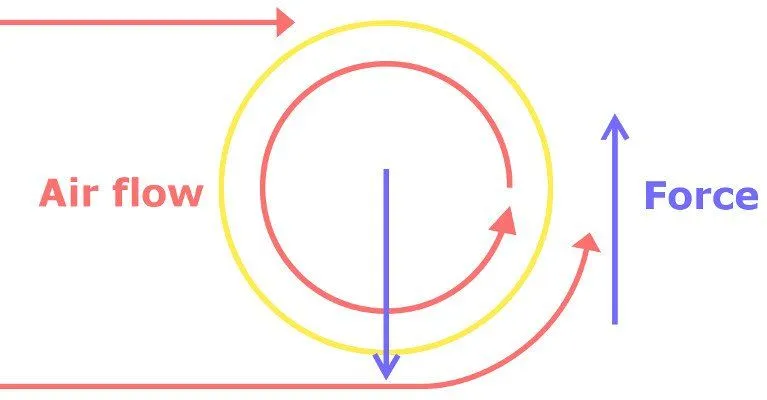
The Magnus force is known to be a result of Newton’s third law of motion – it is the equal and opposite force the air exerts on the ball as a reaction to the force the ball imposes on the air. The object pushes the air in one direction and, as a result, the air pushes the object in the other direction. The Magnus effect applies to swerving baseballs, tennis balls, cricket balls (in spin bowling) and especially ping-pong balls. The effect is enhanced and more conspicuous in ping-pong balls because of their small size and low density. The right contact brusquely swings the ball wider, out of the opponent’s reach. The same principle was used in the experimental Flettner rotor aircraft of the 1910s–1930s, whose wings were replaced by spinning cylinders, and lives on today in Anton Flettner’s rotor ships, where giant spinning columns on deck use wind to push the hull forward.
How Big Is The Magnus Force? The Equation
For a ball of cross-sectional area A moving through air of density ρ at speed v, the Magnus lift force is usually written in the same form as any other aerodynamic lift:
F = ½ · ρ · v2 · A · CL
Here CL is the lift coefficient, a dimensionless number that depends on how fast the ball is spinning compared to how fast it is travelling (often expressed through the spin parameter S = rω/v, where r is the ball’s radius and ω its angular speed). The faster the spin and the faster the ball, the larger the curve.
NASA’s beginner’s guide to aeronautics gives an equivalent expression for an idealised spinning ball, attributing the lift to the circulation of air the spin sets up around the ball (this is the Kutta–Joukowski theorem applied to a sphere). All three descriptions (asymmetric boundary-layer separation, pressure difference, and circulation around the ball) describe the same physical effect from different angles.
Plug in some football numbers: a soccer ball travelling at roughly 30 m/s (around 108 km/h or 67 mph) and spinning at about 10 revolutions per second can generate enough Magnus force to push the ball sideways by more than a metre over a 30 m flight. That is precisely the kind of curve Roberto Carlos and Beckham were buying with all that practice.
The Magnus Effect In Basketball, Tennis And Ping-Pong
The Magnus effect shows up across almost every sport involving a ball, but it is easier to spot in some than in others.
Basketball. During a normal jump shot the ball is not in the air for long enough to deflect by much, which is why you do not normally see Magnus curves on the court. But give the ball room to fall, and the effect becomes spectacular. In a now-famous 2015 demonstration, the Australian trick-shot team How Ridiculous teamed up with science vlogger Veritasium and dropped basketballs off the 126.5 m (415 ft) Gordon Dam in Tasmania. A ball released without spin fell almost straight down. A ball released with a flick of backspin curved horizontally away from the dam wall by tens of metres before splashing down. It is an exaggerated but textbook view of exactly the same Magnus force that bends a free kick.
Tennis. Newton’s original observation was actually on a tennis court. Topspin makes a passing shot dip steeply just before it crosses the baseline (because the spin axis is horizontal, so the Magnus force points downward), while slice and backspin make the ball float and skid. Modern players exploit topspin specifically to hit hard and keep the ball inside the lines.
Ping-pong (table tennis). Because table-tennis balls are tiny and very light (about 2.7 g and 40 mm across), they are extremely sensitive to spin. A small flick of the wrist can impart thousands of revolutions per minute, which is why competitive table-tennis loops, hooks and serves can curve so dramatically over such a short distance. Cricket’s spin bowlers use the same principle, and golfers use it (deliberately) to draw or fade the ball off the tee.
Knuckleballs
Lastly, a knuckleball, whether in soccer or baseball, is the strange flip-side of the Magnus story. The ball is thrown or kicked with almost no spin at all, so the Magnus force is essentially switched off. Without spin, there is no established pressure differential to guide its motion. Instead, the seams of the baseball (or the panel stitching of the soccer ball) sit in different positions as the ball drifts, producing asymmetric pockets of turbulence and tiny, fluctuating sideways pushes from shed vortices in the wake. The ball wobbles unpredictably, and a batter or goalkeeper is unable to discern when the capricious ball might duck. Peer-reviewed work on baseballs and soccer balls (Borg & Morrissey, 2014; Texier et al., 2016) confirms that knuckleball motion is driven by this seam-induced vortex shedding, not by Magnus.
Of course, throwing or kicking a knuckleball requires immense skill. Too slow and the ball falls prematurely; too fast and the ball does not dip, consequently becoming a training shot that can be thrashed across the park. The precision, of course, can only be achieved after years of deliberate practice. However, even that might not guarantee it.
How Do You Bend A Free Kick Like Roberto Carlos?
Picture the wall of defenders, arms locked across their chests, bracing for the whistle. To beat them, a free-kick specialist does not aim straight at the goal; they aim wide and let the air do the steering. The trick is to strike the ball off-center, usually with the inside or outside of the foot, so that it leaves the boot spinning about a roughly vertical axis. That sidespin is what gives the Magnus force a direction to push in, and the ball curls back toward the target after clearing the wall.

What makes the long-range efforts so jaw-dropping is that the curve is not a tidy arc. In 2010, four French physicists (Guillaume Dupeux, Anne Le Goff, David Quéré and Christophe Clanet) modeled the trajectory by firing small spinning spheres through water and published the result, fittingly, as The spinning ball spiral. They found that a fast, spinning ball does not trace a circle; it traces a spiral that tightens as the ball slows. Early in the flight the ball is moving so fast that drag dominates and the path looks almost straight. Once drag has bled off enough speed, the steady Magnus force begins to win, the radius of the curve shrinks, and the ball swerves hardest right at the end.
That late, almost supernatural bend is the signature of a long kick. The team showed that Roberto Carlos struck his famous 1997 effort against France from roughly 35 m (115 ft) out, comfortably far enough for the spiral to set in before the ball slammed into the side netting. Shorter Beckham-style free kicks from 20 to 25 m bend too, but they reach the goal before the spiral has time to tighten, which is why they look like a clean banana rather than a question mark. The same physics helps decide how round and predictable a soccer ball needs to be in the first place.
Who Discovered The Magnus Effect?
It is one of physics' gentler ironies that the Magnus effect was neither discovered by Magnus nor, strictly speaking, first explained by him. The earliest known account belongs to Isaac Newton. In 1672, in a letter to the Royal Society, he described how a tennis ball struck with oblique spin on the Cambridge courts curved in flight because one side, in his words, "presses and beats the contiguous air more violently" than the other.

Seventy years later the British mathematician and ballistics pioneer Benjamin Robins took the idea to the battlefield. In his 1742 work New Principles of Gunnery, Robins argued that the maddening tendency of musket balls to drift sideways was caused by their spin dragging the surrounding air along, the very mechanism Newton had sketched for tennis. His contribution was so foundational that some texts still call the phenomenon the Robins effect.
So why does Heinrich Gustav Magnus get top billing? Because the German physicist was the first to pin the effect down in a controlled laboratory, in 1852, by mounting a rapidly spinning brass cylinder in a stream of air and measuring the sideways deflection directly. A rigorous, repeatable experiment beat a clever observation, and the name stuck. Magnus never bent a free kick or fired a musket; he simply proved, on a lab bench, why both curve.
What Is The Reverse Magnus Effect?
Here is the twist that catches even seasoned physicists off guard: under the right conditions, a spinning ball can curve the wrong way. Normally the Magnus force pushes the ball toward the side that is turning along with the airflow. But in a narrow window of speed and spin, that sideways push flips sign, and the ball deflects in the opposite direction. Engineers call it the reverse, negative or inverse Magnus effect.
The culprit is the boundary layer, the thin skin of air clinging to the ball, and which side of it peels away first. Around the so-called drag crisis, near a Reynolds number of roughly 100,000, the airflow over a smooth sphere sits right at the transition from smooth (laminar) to chaotic (turbulent). A turbulent boundary layer hugs the surface longer before it separates. If the ball's spin happens to trip one side into turbulence while the other stays laminar, the separation points swap sides compared with the textbook case, and so does the force. Large-eddy simulations by Masaya Muto and colleagues in 2011 reproduced exactly this sign reversal for a smooth rotating sphere spinning slowly near the critical Reynolds number.
Surface texture is decisive. The dimples on a golf ball and the raised seams on a baseball trip the boundary layer into turbulence so early and so evenly that those balls almost always obey the normal Magnus rule. It is the smooth balls, struck with gentle spin at just the wrong speed, that can occasionally betray a player by ducking or sailing against expectation.
References (click to expand)
- Ideal Lift of a Spinning Ball - NASA Glenn Research Center. nasa.gov
- Explained: How does a soccer ball swerve? - MIT News. news.mit.edu
- Magnus effect - Encyclopaedia Britannica. britannica.com
- Physics of knuckleballs - Texier et al., New Journal of Physics 18 (2016) 073027. iopscience.iop.org
- Aerodynamics of the knuckleball pitch - Borg & Morrissey, American Journal of Physics 82 (2014). baseball.physics.illinois.edu
- Why Does a Curveball Curve? - KQED. kqed.org
- Watch: 'Magnus Effect' Whisks Basketball Into The Spin Zone - NPR. npr.org
- The spinning ball spiral - Dupeux et al., New Journal of Physics 12 (2010) 093004. iopscience.iop.org
- Negative Magnus Effect on a Rotating Sphere at around the Critical Reynolds Number - Muto et al., Journal of Physics: Conference Series 318 (2011) 032021. iopscience.iop.org