Titration is a quantitative chemistry technique that determines the concentration of an unknown solution (called the analyte) by slowly adding a solution of known concentration (the titrant) from a burette. An indicator changes color when the reaction is just complete (the endpoint), and the volume of titrant used at that point is plugged into M1V1 = M2V2 to calculate the unknown molarity.
Is lemonade your favorite drink? Or do you occasionally add it to your diet for weight loss? Whatever the reason may be, do you know what concentration of lemon juice you’re consuming in the form of lemonade? Aren’t you worried about causing damage to your own stomach if the concentration exceeds the limit?
First of all…Relax! You don’t have to worry about the concentration of lemon juice in your lemonade.
However, when it comes to certain drugs, food preservatives, the pH level of your fish tank, and in various industrial procedures, the concentration of different constituents in solutions does play a major role.
This is where titration comes into play! Titration determines the concentration of a solution by following certain strict procedures. This article explains the principle and methodology behind titration.

What Is The Principle Of Titration?
Titration is a quantitative chemical analysis used to determine the concentration of an unknown solution by adding a solution of known concentration to it, one drop at a time. In an acid-base titration, the acid or base of known concentration completely neutralizes the acid or base of unknown concentration. The actual reaction is between hydrogen ions (from the acid) and hydroxide ions (from the base), which combine to form water. The progress of the reaction is monitored either by a pH electrode or by a chemical indicator that changes color at a known pH.
The solution of known concentration is called the titrant (not the “titrate”, which is a common slip - the verb form is “to titrate”), and the solution whose concentration is to be determined is the analyte. The equivalence point is reached when the moles of titrant added exactly equal the moles of analyte being neutralized; the indicator’s color change marks the closely related endpoint, which the experimenter records.
How Is Titration Carried Out?
The analyte is measured and filled in a beaker. A few drops of an acid base indicator, such as methyl orange or phenolphthalein, is added to the analyte.
Phenolphthalein remains colorless in acid, but turns pink in the presence of a base. Similarly, methyl orange is a reddish-orange powder that turns to deep red in an acid and pales out to yellow in a base.
A standard solution is taken in a burette to start the process. The standard solution is allowed to drip slowly into the beaker containing the analyte. The process is carried out until the color of the analyte changes, indicating the arrival of an end point. This means that all of the base or acid in the analyte has been completely neutralized by the titrate.
The volume of standard solution dispensed at the moment the endpoint is reached is recorded. This volume indicates the amount of titrant that has been used to neutralize the analyte. These values are then used in further calculations.
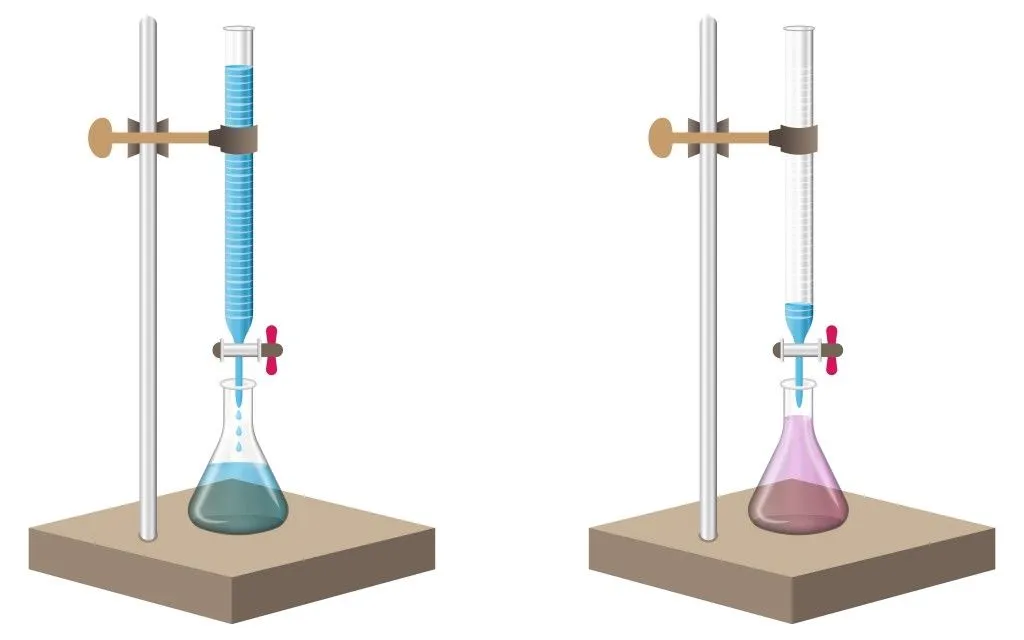
Run a titration yourself in the simulator below. Pick an acid and a base, drip the titrant drop by drop, and watch the pH curve, flask color, and indicator change as you reach the endpoint.
Titration Formula: How Is Concentration Of The Analyte Calculated?
Like every other quantitative analysis, titration has a standard formula to determine the unknown concentration. The generally used formula is:
Volume of titrant × molarity of titrant = Volume of analyte × molarity of analyte (or M1V1 = M2V2 for a 1:1 reaction)
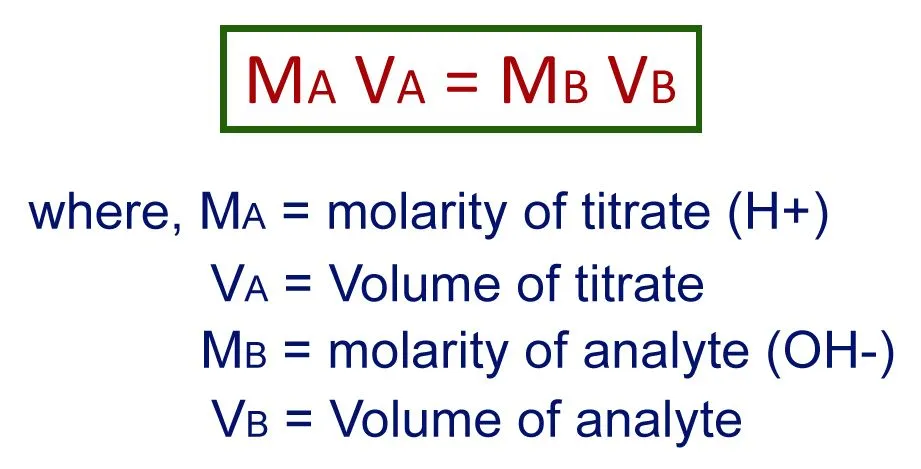
Let’s consider that 45.6ml of 1.25 M sodium hydroxide has been used to neutralize 20ml of hydrochloric acid. The concentration of HCl is then given by,
45.6 X 1.25 = 20.0 * molarity of analyte.
Solving the above equation will yield the concentration of the analyte.
Types Of Titration
Based on the type of reaction involved, titration is classified into 4 different types.
- Acid-base titration: This is based on the neutralization between an acid or base and the analyte.
acid + base → salt + water
- Complexometric titration: Widely used to determine the concentration of metal ions in a solution. EDTA is typically used as the titrant (a chelating agent that grabs the metal ion), while a separate dye such as Eriochrome Black T or murexide serves as the indicator. At the endpoint, an undissociated metal-EDTA complex has formed and the free indicator changes color. For example:
Ag+ + 2CN– → [Ag(CN)2]–
- Redox titration: In this type, the transfer of electrons takes place in the reacting ions of the solution. It is further classified into 3 types based on the type of reagent used.
Permanganate: MnO4– + 8H+ + 5e– → Mn2+ + 4H2O
Dichromate: Cr2O72– + 14H+ + 6e– → 2Cr3+ + 7H2O
Iodimetric and iodometric: I2 + 2e– → 2I–
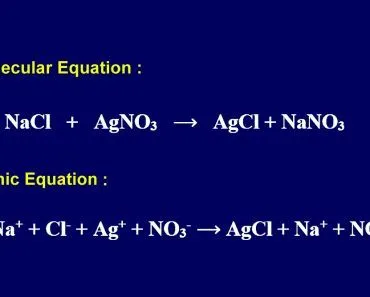
- Precipitation titration: This reaction forms an insoluble precipitate when the two reacting substance are brought into contact.
AgNO3 + NaCl → AgCl + NaNO3
Titration Utility: Practical Applications And Examples
Titration is presumably applied in one way or another in our day-to-day activities. Various clinical tests, such as blood tests and urine tests, use titration to determine the concentration of chemicals of interest. It is also used in the food industry to determine the amount of certain chemicals in food.
Often, it is used to determine carbohydrate, fat and vitamin content. Titration is also widely applied in the medical field. Pregnancy tests, blood glucose level tests and other urinalysis applications use titration. It is also included as a part of academics for high school students to analyze their practical aptitude.
Sea water properties, such as the concentration of ammonia, nitrates and pH level are calculated and the environment is modified accordingly to maintain optimum conditions.
Concentration, commonly expressed in terms of molarity (number of moles of solute per liter in solution), is of great importance in chemistry because it determines the rates of reaction and the conditions at equilibrium. Titration is the most prominent and widely used method to determine unknown concentration.