The butterfly effect is the idea that tiny changes in a complex system can cascade into very large, hard-to-predict outcomes. It was discovered in 1961 by meteorologist Edward Lorenz, who found that rounding a weather-model input from six digits to three produced a wildly different forecast. The popular story that a British soldier named Henry Tandey spared a young Adolf Hitler in WWI is often cited as a real-world example, but historians have largely debunked it.
“Minute changes within a complex system lead to bigger outcomes, which are sometimes impossible to predict.”
Wishful thinkers promote the idea that the events that have drastically changed our world are things like bombs, massive earthquakes, crackhead politicians or vast migrations. Blaming such unbeatable forces feels much safer than accepting true facts.
However, upon analyzing the significant events in history at their most basic roots, a rather ominous revelation appears. Every event that has a substantial effect or influences the least bit of change is fueled by a much smaller and more insignificant event.
Think of it this way; you might come to great revelations about certain events in your life by retracing them back to an initial cause that sparked them. That might not be as impressive as those people who were lucky enough not to board the Titanic or didn’t show up at the office on time on September 11 (The Twin Towers).

Edward Lorenz And The Butterfly Effect
The discovery of the Butterfly Effect has a rather mathematical backstory. On one particular winter day in 1961, Edward Lorenz, a meteorologist and mathematician at MIT, was running weather simulations on his own crude 12-variable model on a Royal McBee LGP-30 computer. Instead of observing the results from the start, he decided to save some time and restart the survey from somewhere in the middle. What he found was unusually shocking. The data obtained from this “time-saving” model deviated drastically from the original model, where the data was obtained from the start.
At first, Edward thought that it was a malfunction of a vacuum tube in his computer, but after learning that there was no malfunction, he realized that to save space, his printouts only used three digits, whereas the computer’s data memory contained six. Lorenz, ignorant of this fact, had entered these rounded-off data points from the printouts, assuming that the differences would be insignificant. To this day, the temperature is not routinely measured within one part in a thousand.
This led to the ultimate realization, namely that long-term weather forecasting is doomed. This crude model exhibited the phenomenon known as “sensitive dependence on initial conditions,” which soon came to be known as “The Butterfly Effect”.
Why Is It Called The “Butterfly Effect”?
The question, “Does the flap of a butterfly’s wings in Brazil set off a tornado in Texas?” (the title of Lorenz’s 1972 American Association for the Advancement of Science talk, actually coined by his colleague Philip Merilees) refers to a hypothetical idea that a butterfly’s wings might lead to tiny changes in atmospheric conditions that will ultimately alter the path of a tornado—perhaps delaying, accelerating or even preventing the occurrence of a tornado—thousands of miles away. Without a loss of generality, the butterfly itself has no power to create or delay a tornado, but a single flap of its wings signifies the initial conditions that set the stage for a much larger event, signifying that minuscule events can eventually cascade into large-scale events.

The Butterfly Effect is itself a principle of a much more elaborate theory, The Chaos Theory, which deals with expecting the unexpected and unpredictable outcomes. While most traditional sciences deal with seemingly predictable phenomena like electricity, chemical reactions, gravity or DNA, Chaos Theory deals with nonlinear subjects that are quite impossible to predict or control, such as weather, turbulence, the stock market and our brain states, among others.
Let’s take a look at some insignificantly simple butterfly “wing flaps” that have erupted into far greater events, some of which have resulted in the shape of the world we live in today.
If Not For A Wrong Turn, The First World War Could Have Been Prevented
World wars are events that have changed the course of history and every generation alive in our world. WW1 helped to shape the world and fuel the second and largest of any war in history—World War 2.
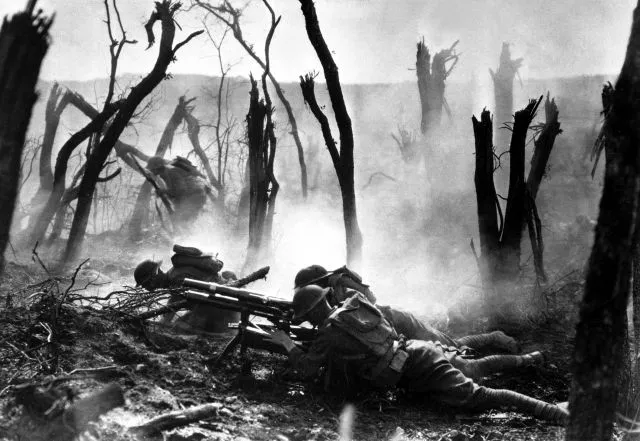
WW1 might have been destined to happen, as there were various factors to it. However, it can all be traced back to one event that, if altered, could have changed the course of history. That was the wrong turn and the stalling of a car—a car carrying The Archduke of Austria, Franz Ferdinand.
On June 28, 1914, Franz’s motorcade in Sarajevo was attacked with a grenade by Nedeljko Čabrinović, which bounced off the Archduke’s car and injured passengers in a vehicle behind. Later that morning, Franz decided to visit the injured at hospital. Along the way, his driver took a wrong turn onto Franz Joseph Street, then stalled the car directly in front of Gavrilo Princip, a Bosnian Serb and Austro-Hungarian subject affiliated with the same Young Bosnia movement, who happened to be standing right there. (The widely repeated detail that Princip was eating a sandwich at the moment is a modern myth, traced to a 2001 satirical novel; there is no contemporary trial evidence for it.) Without missing his chance, he took the shot, murdering the Archduke and his wife.
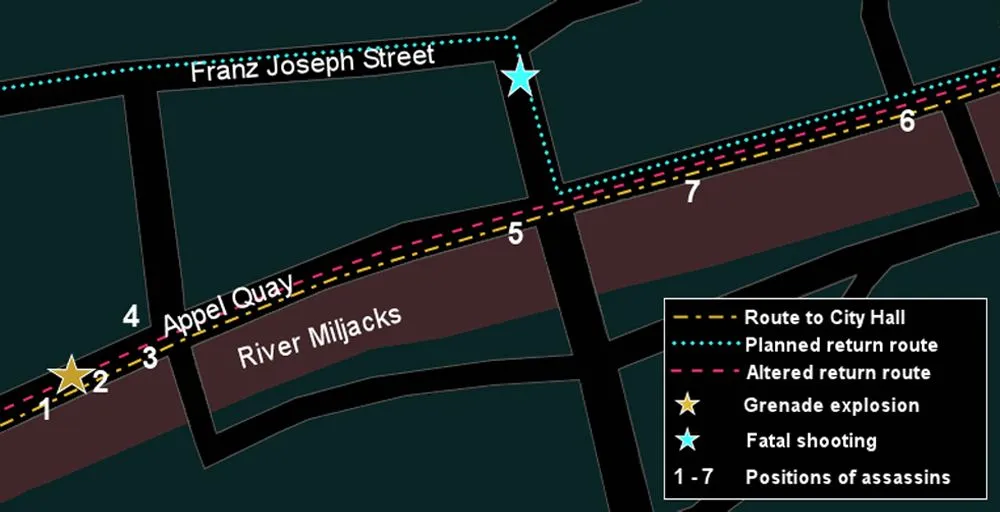
If not for that wrong turn, the Archduke and his wife would not have been killed, Austria-Hungary would not have declared war on Serbia on July 28, 1914. Russia mobilized in Serbia’s defense; Germany then declared war on Russia (August 1) and on France (August 3). When German troops crossed into neutral Belgium on August 4 to outflank France, Britain (treaty-bound to defend Belgium) declared war on Germany the same day, and World War 1 was on. All of these events were an outcome of the chain reaction launched by a wrong turn.
Of course, you might argue that another, more devastating war might have broken out even if the assassination didn’t take place. However, if WW1 had somehow been averted, there wouldn’t have been a WW2, no Hitler rising to power, and those 70 million lives would not have been lost. Fast forward to the present day, and there might not be rising tensions in the Middle East, terrorist groups would not have been born, and the world might be a better place.
The Humane Gesture That Led To The Death Of 75 Million People
According to a famous (and famously contested) story, Henry Tandey, a much-decorated British soldier, was fighting near Marcoing, France, in September 1918 when he held his fire and let a wounded young German walk away. The Germans went on to lose the war; that young soldier, the story claims, went on to start the next one. World War 2 ultimately killed an estimated 60 to 75 million people (roughly 3% of the world’s population at the time), including around 6 million Jews murdered in the Holocaust and millions more Soviet POWs, Poles, Roma, and other civilians killed by the Nazi regime, bringing the total Nazi civilian death toll to roughly 11 to 17 million.
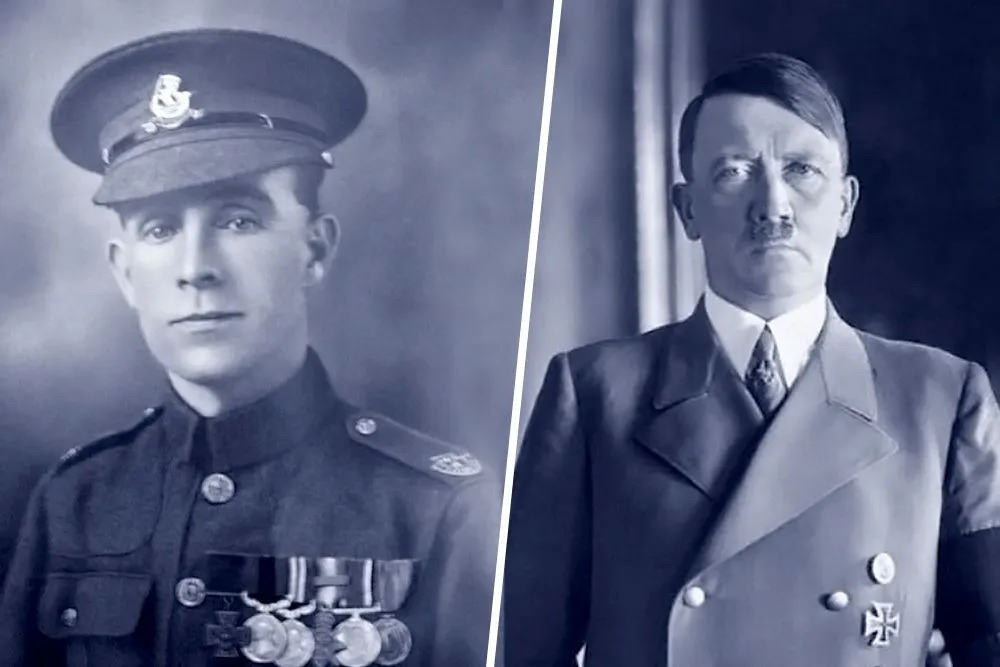
That young German boy, the legend goes, was Adolf Hitler, who later went on to start the most devastating war our world had ever seen, World War 2. The trouble is, the story falls apart under scrutiny: historian David Johnson (The Man Who Didn’t Shoot Hitler, 2014) found that Bavarian Army records place Hitler’s regiment about 50 miles away from Marcoing on the day in question, and no contemporary witness corroborates the encounter. The tale traces back largely to Hitler himself in a 1937 conversation; modern historians treat it as unsubstantiated legend rather than fact. It survives because we like to believe that history pivots on tiny hinges — which is, of course, the very idea this article is about.
India – Pakistan Partition, 1947: Birth Of A New Nation
If world history tingles your senses and makes you want to unearth ancestral graves, then the Indo-Pak partition is likely something you’ve heard of before.
When British rule finally ended, the Indian subcontinent was partitioned into two independent nation states: Hindu-majority India and Muslim-majority Pakistan. Soon enough, one of the greatest migrations in world history began, wherein millions of Muslims trekked to West and East Pakistan (Bangladesh) while millions of Hindus and Sikhs headed in the opposite direction, towards the new and independent India. Hundreds of thousands of these individuals never made it on either side.
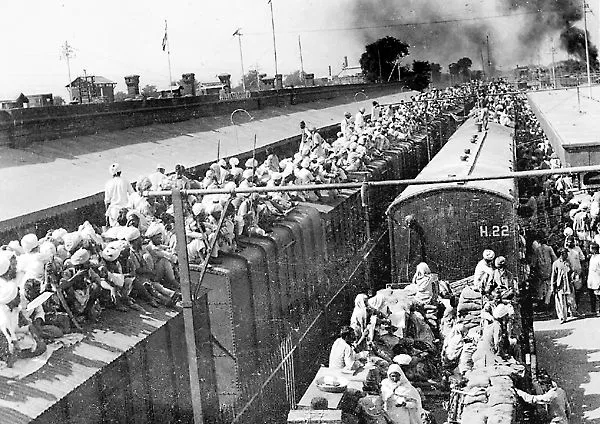
It’s hard to imagine that all of this happened as an outcome of fish trade, a casual remark and an X-Ray report.
Muhammad Ali Jinnah, the founder of Pakistan, supposedly had three small incidents in life spark the gruesome partition. According to one widely-repeated family tradition (Daily Times), Jinnah’s grandfather was a prosperous Hindu merchant in the fish trade, but his orthodox vegetarian community shunned him, which led Jinnah’s father (Jinnahbhai Poonja, per Stanley Wolpert’s standard biography) to convert himself and his sons to Islam in the mid-19th century. The conversion story is community oral tradition, not settled history, but if true, it would be the first butterfly wing flap for Jinnah.
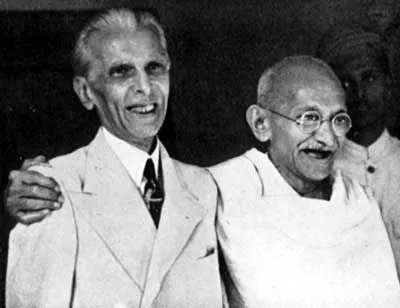
The second decisive moment was sparked by his arch-rival, Jawaharlal Nehru, then Prime Minister of the Independent and divided India. According to popular telling (the specific quote is not corroborated in Stanley Wolpert’s standard biography of Jinnah), Nehru remarked at a private dinner party that Jinnah was “finished”. Jinnah had been living a secluded life in London after the passing away of his wife, but this jibe made him furiously march back to India, fire the Muslim League, and transform it from a scattered band of individuals into the second-most powerful political party of India. This was the second butterfly flap.
The third and final butterfly wing twitch occurred when Jinnah’s doctor, Dr J. A. L. Patel pointed out two dark circles in his X-ray film and concluded that he had one or two years left to live, as tuberculosis would soon take his life. Jinnah pushed Lord Mountbatten, the Last Viceroy of India, towards speedy freedom and a partition of India, all while ensuring that news of his imminent death stayed between him and his doctor.
The doctor’s professional ethics stopped him from releasing such crucial information, and this tiny act of ethics and loyalty may have led to one of the greatest partitions in the world. That grey film held the secret to blocking the partition and saving the lives of millions. Had this report become public knowledge, Mahatma Gandhi and Lord Mountbatten would undoubtedly have delayed the independence of India, letting Jinnah pass away and thus preventing the partition.
References (click to expand)
- Circa January 1961: Lorenz and the Butterfly Effect. American Physical Society
- The Butterfly Effect. Space Telescope Science Institute
- What is Chaos Theory? Fractal Foundation
- Assassination of Archduke Franz Ferdinand. Britannica
- The Origin of the Tale That Gavrilo Princip Was Eating a Sandwich. Smithsonian Magazine
- The Man Who Didn't Shoot Hitler. Sky History
- Documenting Numbers of Victims of the Holocaust and Nazi Persecution. US Holocaust Memorial Museum