Table of Contents (click to expand)
- What Does A Temperature Measure?
- What Is A Boiling Point, And Why Is It 100°C?
- Can Water Be Hotter Than 100 Degrees Celsius?
- Can Water Get Hotter Than 100°C Without A Pressure Cooker?
- Why Can't You Boil An Egg On Mount Everest?
- Can Water Reach 1,000 Degrees?
- Can A Human Survive 140 Degrees?
- Why Does 100°C Air Feel Fine But 100°C Water Scalds?
- So, Is The Water Vapor Around You Hotter Than 100°C?
Yes. Liquid water can be hotter than 100°C: a home canner holds it at about 121°C, a hospital autoclave at 132°C, and a clean, still mug in a microwave can heat past its boiling point without bubbling until a spoon sets off a violent eruption. Above about 374°C and 218 atmospheres the difference between liquid and steam vanishes, and steam alone runs to 760°C inside modern power plants, but the invisible water vapor in your room is at room temperature, because every molecule that escapes a puddle shares its extra energy with the air within a fraction of a nanosecond.
Picture this: you put a mug of water in the microwave for tea. Three minutes later it sits there, still and quiet. No bubbles. You drop in a teabag, and the water erupts over the rim like a small geyser. The FDA has collected reports of exactly this. They describe “serious skin burns or scalding injuries around people's hands and faces.” That water was hotter than 100°C, and it had not boiled.
School taught us that 100°C is where water stops. Heat it more and it leaves as steam. So how did the mug break the rule? And there is a stranger version of the same question doing the rounds online. Escaping a puddle takes a burst of energy. So is the invisible vapor drifting around your living room secretly hotter than a kettle?
Both questions have the same answer. It starts with what a thermometer is measuring.
What Does A Temperature Measure?
Rub your hands together. They warm up, and here is what just happened. Your skin, like everything else, is made of molecules that never sit still. The rubbing shoved them into jiggling harder, and that extra jiggling is the warmth you feel. In a gas the molecules are free to fly about and bounce off each other, and the same rule holds. Temperature is our name for how hard, on average, they are moving. NASA puts it in one line. The temperature of a gas “is a measure of the average translational kinetic energy of the molecules.” Hotter means faster, on average.
That word average carries the whole article. The molecules in a glass of water at 20°C do not all move at one speed. They are a crowd that never agreed on a pace. Most amble along near 500 meters per second. A few dawdle. A few race along faster than the typical molecule in boiling water. That fast few is why a puddle dries on a cool day, which we cover in why water evaporates at room temperature.
So can one molecule be hot? No. A single molecule has a speed, not a temperature. Temperature belongs to the crowd. And a crowd of gas molecules settles its differences fast. At everyday pressure a gas molecule gets hit by a neighbor about every 0.2 billionths of a second. That is OpenStax's worked figure for argon at 0°C and 1 atmosphere. An escaped water molecule shares its extra energy with the air in a few nanoseconds. Hold on to this: temperature is an average over trillions of molecules, and it is set by the crowd they land in.

What Is A Boiling Point, And Why Is It 100°C?
Now for the number everyone knows. Even at room temperature, some of a liquid's molecules leave its surface as gas. They push back on the air above with a pressure of their own, called vapor pressure. At room temperature that push is about 20 mmHg. That is under 3% of an atmosphere. The air wins. The water sits there and only evaporates from the top.
Warm the water and the vapor pressure climbs. Boiling is the moment it catches up with the air pressing down. The textbook definition, from OpenStax, is “the temperature at which its equilibrium vapor pressure is equal to the pressure exerted on the liquid by its gaseous surroundings.” Written out:
Pvapor = Poutside
Here Pvapor is the push of the water's own vapor and Poutside is the push of the air on the surface. When they match, bubbles can form inside the liquid, not just at the top. For water at sea level that happens at 100°C. That is where its vapor pressure reaches one atmosphere.
Notice what that means. Water does not own a thermometer. It owns a pressure gauge. Change the pressure and you move the boiling point. OpenStax's example is Leadville, Colorado, at 10,200 feet. The air pressure there is 68 kPa, and water boils at about 90°C. That is the whole trick, and every section below is a different way of pulling on it.

Can Water Be Hotter Than 100 Degrees Celsius?
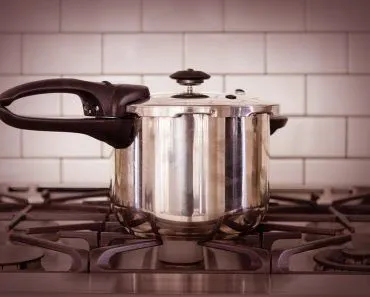
Yes, and you may own the machine that does it. A pressure cooker traps the steam, so the pressure inside rises. Water now needs a higher vapor pressure to boil, so its boiling point climbs. North Dakota State University's canning guide gives the figures for a pressure canner. Water boils “at 239 F under 10 psi, and at 250 F under 15 psi.” That is 115°C and 121°C, with liquid water sitting there, hotter than any open pot can manage. We explain the hardware in how a pressure cooker works.
Hospitals use the same trick to sterilize tools. The CDC's guideline states that “the two common steam-sterilizing temperatures are 121°C (250°F) and 132°C (270°F).” It adds why the pressure matters: “Pressure serves as a means to obtain the high temperatures necessary to quickly kill microorganisms.” That machine is an autoclave, and it answers an old kitchen question too. Some bacteria make tough spores that survive boiling. The NDSU guide says the higher temperatures in a pressure canner destroy “spores of Clostridium botulinum.” That is the bacterium behind botulism, and a rolling boil at 100°C does not kill its spores. The beans do not enjoy 121°C. Neither do the spores, which is the point.

Can Water Get Hotter Than 100°C Without A Pressure Cooker?
Back to the mug. The FDA describes super-heated water as “water heated past its boiling temperature.” It happens, the agency says, “when water is heated by itself in a clean cup.” The clean cup is the villain of this story.
Boiling needs bubbles, and a bubble needs somewhere to start. In a pot, small scratches, specks and pockets of trapped air do the job. Chemists call them nucleation sites. A 2015 study on microwave heating explains the trick. Superheating happens when “care is taken to avoid nucleation sites that could help trigger the liquid→gas phase change.” The liquid then “will exist in this metastable state until it is perturbed.” A smooth mug, still water and an oven that heats from the inside tick every box. The water slides past 100°C with nothing to bubble on. Then you add a spoon of coffee. Thousands of bubbles form at once. The FDA warns that even “picking up the cup, or pouring in a spoon full of instant coffee, may result in a violent eruption.”
So liquid water can pass 100°C at normal pressure, just not stably. The same study measured unstirred alcohols running 14°C to 28°C past their boiling points in a microwave. Stirring stopped it. The FDA's advice is the same idea: stir in the coffee or sugar before heating, and stick to the heating times in the manual.

Why Can't You Boil An Egg On Mount Everest?
Now pull the pressure gauge the other way. At the summit of Everest the air pressure is about a third of the sea-level value. Water's vapor pressure catches up early. Chemistry LibreTexts puts the boiling point on Everest at “about 70ºC.” At 70°C, NIST's tables put the vapor pressure of water at 0.31 bar. That is where the match happens.
An egg does not care that the water is “boiling.” It cares about temperature. The proteins in an egg set in a narrow band. The white “coagulates between 60°C and 65°C” and the yolk “between 62°C and 70°C.” In 70°C water the white sets, slowly, and the yolk sits right at the top edge of its range. A hard-boiled egg becomes a long negotiation. The same thing is why mountain cooks need longer times for pasta and beans. The water bubbles away, and it is still cooler than a kettle on a beach.

Can Water Reach 1,000 Degrees?
Liquid water, no. Water in general, yes, and the difference matters. The boiling point is a ceiling for the liquid, not for the molecule. Once water is steam, you can keep heating it. There is no boiling point left to stop you. Power plants do this on purpose. The US Department of Energy's National Energy Technology Laboratory has the history. Coal plants in the 1950s ran “main steam temperatures of up to 538 degrees Celsius.” Later “supercritical” designs reached “610 degrees C.” Its advanced program targets steam at “760 degrees Celsius (1400 degrees Fahrenheit)” and 5,000 psi. Steam at those temperatures is spinning turbines right now.
Push pressure and temperature up together and something odd happens. Chemistry LibreTexts explains that past 374.4°C and 217.7 atmospheres “the distinction between liquid water and vapor vanishes.” Water becomes a supercritical fluid, a dense fog that is neither one. NIST lists the critical point at 647 K and 220.64 bar. The chart above ends there because the line between liquid and steam ends there.
Keep going and water stops being water. Splitting it into hydrogen and oxygen with heat alone is called thermolysis. It needs more than 2,500 K to break up even a few percent of the water. Past about 2,200°C, then, calling it water is a courtesy. So 1,000°C steam is routine engineering. Liquid water at 1,000°C is not a thing. Above 374°C there is no liquid left to heat, whatever you do with the pressure.

Can A Human Survive 140 Degrees?
That depends on whether the 140 is air or water, and on which scale. Death Valley's official record, per the National Park Service, is 134°F (57°C), set on July 10, 1913. People live and work there every summer. So 140°F (60°C) air is survivable for a while, with water and shade. A Finnish sauna is hotter still. A 2025 study in the journal Temperature describes its air as “relatively dry air at high temperatures (typically 70–100 °C).” People sit in it for half an hour by choice.
The most famous test is older. In 1775 the physician Charles Blagden walked into a room heated by an iron stove. With him went a party of gentlemen, including Joseph Banks of the Royal Society, and Blagden reported the results. Blagden's thermometer read 198°F. Daniel Solander went in alone and “saw the thermometer at 210°.” Banks went in “when the thermometer stood above 211°” and stayed seven minutes. Blagden wrote that the air “felt unpleasantly hot, but was very bearable.” Their thermometers had cracked. Their bodies had not.
They came back in April for a hotter round. With the thermometer risen “almost to 260°,” or 127°C, they proved the heat was real the only way that seemed fair. They put “some eggs and a beef-steak upon a tin frame” near the thermometer. “In about twenty minutes the eggs were taken out, roasted quite hard.” A steak, with a bellows blowing on it, “was found pretty well done in thirteen minutes.” The men were fine. Science was less supervised in 1775. Blagden's own explanation still holds. The body has “a power of destroying heat,” which we now know as sweat evaporating off the skin.

Why Does 100°C Air Feel Fine But 100°C Water Scalds?
Blagden and a sauna prove the same thing: hot air is a weak deliverer of heat. Blagden noticed it himself. After twenty minutes, he wrote, none of the thermometers his party carried in “had acquired the real heat of the air by several degrees.” Air is a poor conductor. OpenStax's table lists a thermal conductivity of 0.023 for air and 0.6 for water, in watts per meter per degree. Still water hands heat to your skin about 26 times faster than still air does. Skin in 100°C water scalds at once. Skin in 100°C air, with sweat evaporating off it, has time.
Steam is the exception, and a serious one. Steam at 100°C carries all the energy that boiled it, called latent heat. It gives that energy back the instant it condenses on skin. Chemistry LibreTexts puts it this way. “In an exothermic reaction, steam is converted into liquid water and heat is released. This heat adds to the heat of boiling water as the steam condenses on your skin.” The numbers come from OpenStax. Water's latent heat of vaporization is 2,256 kJ per kg, and its specific heat is 4,186 J per kg per °C.
The heat released by condensing is Q = m × L, and the heat released by cooling is Q = m × c × ΔT. Here Q is heat, m is mass, L is latent heat, c is specific heat and ΔT is the temperature drop. For one gram landing on 37°C skin:
- One gram of 100°C water cooling to 37°C: 1 g × 4.186 J/g·°C × 63°C ≈ 264 J.
- One gram of steam condenses first: 1 g × 2,256 J/g = 2,256 J. Then it cools like water, another 264 J.
- Total for steam: about 2,520 J, nearly ten times the water.
That is why the puff from a kettle spout deserves more respect than the kettle. We go deeper in what latent heat is.

So, Is The Water Vapor Around You Hotter Than 100°C?
No, and now you can see why. A molecule needs a burst of speed to leave a puddle, and for that instant it is faster than most of its neighbors. Then it lands in a crowd of air molecules and gets hit billions of times a second. Within nanoseconds its extra energy is spread across the room. The vapor around you is at room temperature because temperature belongs to the crowd. And the crowd is at room temperature. Point any thermometer at it.
The bigger lesson is that 100°C was never a law about water. It was a fact about water at one pressure. Squeeze it and liquid water sits at 121°C in a canner and 132°C in an autoclave. Thin the air and it boils at 70°C on Everest and cannot finish an egg. Cheat the bubbles and a mug passes 100°C on your kitchen counter, briefly and dangerously. Turn it to steam and heat it to 760°C, and it will spin a turbine. Keep going past 2,500 K and it stops being water at all.
Blagden sat in a room hotter than boiling water, watched a steak cook beside him and walked out to write it up. He had a thermometer, a beef-steak and a good question, and that got him most of the way. The rest is molecules, moving, and never all at the same speed.
References (click to expand)
- Microwave Ovens (super-heated water) — US Food and Drug Administration
- Gas Temperature — NASA Glenn Research Center, Beginner's Guide to Aeronautics
- 2.2 Pressure, Temperature, and RMS Speed (Example 2.7, mean free time) — OpenStax University Physics Volume 2
- Vapor Pressure — Chemistry LibreTexts
- 10.3 Phase Transitions — OpenStax Chemistry 2e
- Pressure Can It Right! — North Dakota State University Extension
- Steam Sterilization — Guideline for Disinfection and Sterilization in Healthcare Facilities, CDC
- Microwave-Assisted Superheating and/or Microwave-Specific Superboiling (Nucleation-Limited Boiling) of Liquids Occurs under Certain Conditions but is Mitigated by Stirring. Molecules (2015). PMC
- Boiling — Chemistry LibreTexts
- Saturation Properties for Water — NIST Chemistry WebBook
- 1.4: Coagulation — Chemistry of Cooking, Chemistry LibreTexts
- Progress on Advanced Ultrasupercritical Superalloy Technology — National Energy Technology Laboratory, US DOE
- 9.10: Supercritical Water — Green Chemistry, Chemistry LibreTexts
- Water: Phase change data (Tboil, Tc, Pc) — NIST Chemistry WebBook
- Hydrogen from Sunlight and Water: A Side-by-Side Comparison between Photoelectrochemical and Solar Thermochemical Water-Splitting — Caltech (Lewis group)
- Weather and Climate — Death Valley National Park, National Park Service
- Acute Finnish sauna heat exposure induces stronger immune cell than cytokine responses. Temperature (Austin). PMC
- Blagden, C. (1775). XII. Experiments and observations in an heated room. Philosophical Transactions of the Royal Society, 65
- Blagden, C. (1775). XLVII. Further experiments and observations in an heated room. Philosophical Transactions of the Royal Society, 65
- 14.5 Conduction (Table 14.3, thermal conductivities) — OpenStax College Physics 2e
- Unusual Properties of Water — Chemistry LibreTexts
- 14.3 Phase Change and Latent Heat — OpenStax College Physics 2e
- 14.2 Temperature Change and Heat Capacity — OpenStax College Physics 2e
How this article was made. It was researched from the sources cited above and drafted with the help of AI, then fact-checked, edited and approved by Abhishek Jain before publication. Illustrations that are not credited to a photographer are generated diagrams or illustrations, not photographs.