Table of Contents (click to expand)
- What Is An Isotope, And What Makes Helium-3 Different?
- Why Is Helium-3 So Rare On Earth?
- Can Helium-3 Be Made Artificially?
- Why Is There So Much Helium-3 On The Moon?
- How Much Helium-3 Is There On The Moon?
- What Did China Find In Its Moon Samples?
- Is Helium-3 Fusion Clean Energy?
- So, Why Does The Moon Have Helium-3 But Earth Barely Has Any?
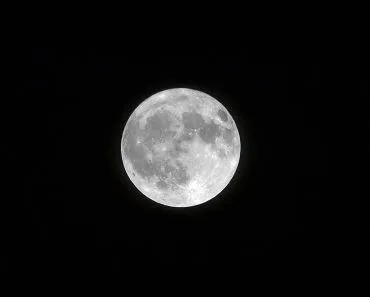
The Moon has helium-3 because it has no air and no global magnetic field, so the solar wind (a stream of charged particles from the Sun, about 0.002% of it helium-3) has hit the bare surface for over four billion years and buried helium-3 in the top layer of dust. Earth's magnetic field deflects that same wind, and almost all of our helium-3 comes from a radioactive form of hydrogen (tritium) breaking down inside nuclear-weapons stockpiles, leaving about 100 kilograms available worldwide. Estimates put at least a million tonnes on the Moon, but at about 12 milligrams per tonne of dust, so digging up five million tonnes yields only 33 kilograms.
Every few months a headline announces that the Moon could power the Earth. A startup wants to mine it. A space agency lists it as a reason to go back. The word in all of those stories is helium-3. Close behind it come “clean fusion fuel” and a number with a lot of zeros.
Read past the headline and the story thins out. What is helium-3? Why does a dead gray rock have it and we do not? And would a shovel of Moon dust do anything at all in a power plant? The Moon, for its part, has kept quiet on all three.
The answers turn out to be one story. It starts with a single neutron. It runs through four billion years of sunlight hitting bare rock. And it ends with a reality check the headlines tend to skip.
What Is An Isotope, And What Makes Helium-3 Different?
Hold a party balloon. The gas inside is helium. Almost every atom of it looks the same: a tiny core of two protons and two neutrons, with two electrons circling it. Chemists call that helium-4, because 2 + 2 = 4.
Now take one neutron away. The atom still has two protons, so it is still helium. It still floats, still refuses to react with anything, still makes your voice squeaky. But it is lighter by one neutron, so it gets a new name: helium-3.
That is all an isotope is. The U.S. Isotope Program defines isotopes as atoms of the same element that differ only in their number of neutrons. The proton count decides which element you have. The neutron count is the variable. We have a full explainer on what happens when you remove a neutron from an atom, so we will keep this short.
Hold on to one idea, because the rest of the article rests on it: helium-3 and helium-4 are the same element, one neutron apart. In a test tube they are twins. In a fusion reactor, and in where they end up in the solar system, that one neutron changes everything.

Why Is Helium-3 So Rare On Earth?
Helium-4 is common enough that we sell it in cans for balloons. Helium-3 is the twin nobody has met. NIST's isotope tables put its share of natural helium at 0.000134%. That works out to about one helium-3 atom for every 750,000 atoms of helium-4.
Why so few? Helium-3 has no factory down here. A 2021 review in the journal Joule lists Earth's natural sources. Cosmic rays striking lithium atoms, and a slow leak from the planet's deep interior that adds “not even a few kilograms per year.”
A 2021 NASA Kennedy Space Center paper puts the total at about 100 kilograms. That is all the helium-3 available on the whole planet. One heavyweight boxer's worth, for all of humanity.
If you have seen the worry that Earth will run out of helium in a century, that is about helium-4, the balloon gas. It is a separate story. Helium-3 never had enough to run out of.

Can Helium-3 Be Made Artificially?
Yes, and the way we do it is odd. Almost every gram of helium-3 in a lab today started life inside a nuclear weapon.
The trick is tritium. Tritium is hydrogen with two extra neutrons (one proton, two neutrons), and it is radioactive. Over time one of those neutrons turns into a proton. Count again: two protons, one neutron. That is helium-3. The Joule review gives tritium a half-life of 12.3 years. In that time, half of any batch has become helium-3.
Tritium is used to boost the power of nuclear warheads, so the United States keeps a stockpile of it. That stockpile turns into helium-3 at about 5.5% a year. The helium-3 has to come out. A 2011 government audit says it “can diminish the effectiveness” of the weapons. At the Savannah River Site in South Carolina, staff extract it every day. It goes into pressurized cylinders. Helium-3 is the only fusion fuel that begins as weapons maintenance.
Could we make more on purpose? In theory. In practice, tritium is itself scarce and hard to make. The Joule authors see “little prospect” of making helium-3 this way at power-plant scale. Which is why people started looking up.

Why Is There So Much Helium-3 On The Moon?
Step outside on a sunny day. Light is hitting you, but so is something else: the solar wind, a thin stream of charged particles blowing off the Sun. NASA clocks it at a million miles an hour or more. A tiny fraction of it, about 0.002%, is helium-3.
You never feel that wind, and you have Earth to thank. The planet sits inside a magnetic bubble, called the magnetosphere. NASA describes it as deflecting most of the solar material sweeping toward us. Whatever sneaks past the bubble then has to get through the atmosphere. So the solar wind's helium-3 almost never touches the ground.
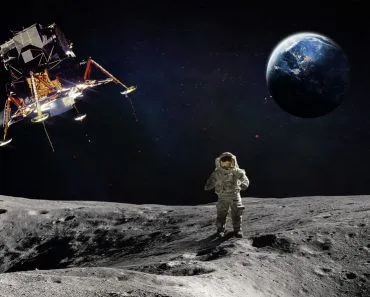
The Moon has neither defense. NASA's Moon fact sheet gives it a “thin and tenuous atmosphere” and, today, only a weak magnetic field. So the wind hits the surface at full speed, and each helium-3 nucleus buries itself in the top layer of dust. NASA's review of the lab work puts the depth at about 26 nanometers into grains of a mineral called ilmenite. Which is to say, just under the skin.
Now add time. The same NASA paper credits the Moon's helium-3 to “over 4 billion years of bombardment from the solar wind.” Four billion years of a faint breeze, landing on a surface nothing ever washes. The Moon is not rich in helium-3 because it made any. It is rich because it never had a roof.

How Much Helium-3 Is There On The Moon?
Here the headlines and the measurements part company. Apollo astronauts brought back dust, and labs measured the helium-3 in it. Neil Armstrong's bulk soil sample averaged 11.8 parts per billion. Individual samples ran from 9.22 to 17.9.
Parts per billion is hard to feel, so convert it. One tonne of Moon dust is a billion milligrams. At 11.8 parts per billion, that tonne holds about 12 milligrams of helium-3. That is a small pinch, from a pickup truck's worth of dust.
Now scale up. In 1985, researchers at the University of Wisconsin reviewed the Apollo results. Their estimate: at least a million tonnes of helium-3 in the top three meters. NASA's technology directorate repeats that figure. A million tonnes sounds enormous, and in energy terms it is. The Joule review reckons one tonne of helium-3 matches about 100 million barrels of crude oil.
But the dust does not hand it over. NASA's numbers for a proposed lunar mining machine tell the story. Take 33 kilograms of helium-3. That is a year's fuel for one 400-megawatt fusion plant, if one existed. To collect it, the machine would dig up nearly five million tonnes of dust. Then it would heat that dust to 700 °C (1,292 °F) to drive the gas out. Five million tonnes in, 33 kilograms out. That is about 150,000 tonnes of Moon dust per kilogram of fuel.
Sit with that ratio for a second. It is mining in the way that panning a river for gold is mining. Except the river is on the Moon and the gold is a gas.


What Did China Find In Its Moon Samples?
Here is what the science says about “what did China find on the Moon,” minus the mystery.
In December 2020, China's Chang'e-5 mission landed in Oceanus Procellarum, on the near side of the Moon. It brought a scoop of dust home. The far-side landing people half-remember was a different mission. Chang'e-4, in January 2019, was the first spacecraft to soft-land on the side of the Moon we never see. It brought nothing back.
Two results came out of the Chang'e-5 samples. First, a 2022 study in the journal Materials Futures put grains of ilmenite under an electron microscope. It found “huge amounts of helium bubbles” trapped in a thin glassy skin on the grains. The glass matters. Helium sitting inside a crystal needs baking out at high temperature. For the bubbles, the authors report, “mechanical methods at ambient temperatures can easily break the bubbles.” In plain terms: crush, don't cook. It is one lab result on a few grains, not a mining plan. But it could change what a mining plan looks like.
Second, in September 2022 China's space agency announced a new mineral in the samples, named Changesite-(Y). The same announcement said its scientists had measured the helium-3 content of the dust. So, what did China find? A new mineral, some helium bubbles in glass, and a confirmation of what Apollo found fifty years earlier. Not a treasure chest. Which, for a science mission, is a good day.

Is Helium-3 Fusion Clean Energy?
This is the part the headlines get most wrong, so slow down here.
Fusion means squeezing two light atomic nuclei together until they merge. Energy comes out. It is the reaction that powers the Sun and hydrogen bombs. Almost every fusion reactor under construction today runs on deuterium and tritium, two heavy forms of hydrogen. The Department of Energy says why. That fuel “reaches fusion conditions at lower temperatures than other elements.” Even so, “lower” means more than 100 million degrees. The ITER reactor in France will run its plasma at 150 million °C or more. That is at least ten times hotter than the center of the Sun.
The catch with deuterium-tritium is that the reaction throws out an energetic neutron. Neutrons carry no charge, so the reactor's magnets cannot hold them. They hit the walls and, over time, make the metal itself radioactive.
Helium-3 is the fix, on paper. Fuse deuterium with helium-3 and you get a proton and ordinary helium-4, with no neutron. The energy rides out on charged particles, which magnets can steer. So NASA's paper lists less shielding and less radioactive waste. It also lists a chance to make electricity without a steam cycle. That is where the word “clean” comes from.
Now the reality check, in two parts. First, the Joule review says deuterium-helium-3 needs “much higher temperatures” than deuterium-tritium. Its verdict is that the fuel “would only be considered for a second or third generation of fusion reactors.” No reactor has run on it. Second, “no neutrons” is not true in practice. Deuterium in the chamber will also fuse with other deuterium. Half of those reactions spit out a neutron. Fewer neutrons than a deuterium-tritium reactor, yes. Zero, no. Aneutronic, the technical word for “no neutrons,” turns out to have an asterisk on it.
So helium-3 fusion is real physics. It is cleaner than the alternative. And nobody can build it yet. Our piece on thorium reactors tells a similar story. A better fuel is only better once a working reactor exists.

So, Why Does The Moon Have Helium-3 But Earth Barely Has Any?
Pull the threads together and the answer is one clean chain.
Helium-3 is helium missing a neutron. The Sun blows a little of it into space, all the time, in the solar wind. Earth catches almost none. A magnetic bubble and a thick atmosphere turn the wind aside first. Our helium-3 comes instead from tritium decaying in weapons stockpiles. There are about 100 kilograms of it worldwide.
The Moon has no bubble and no air. So for four billion years the wind has landed on bare dust and stayed there. A few dozen nanometers deep, at about 12 milligrams per tonne. Add up the whole surface and that is at least a million tonnes. Dig up one square kilometer, three meters deep, and it is 33 kilograms. Both numbers are true. Only one of them appears in press releases.
The fuel it would feed is cleaner than today's designs, and harder to light. No reactor runs on it, and neutrons are still in the mix. The Joule authors conclude that the case for hauling it home “will be difficult to make from an economic point of view.” Earth already has abundant deuterium and lithium for the reactors we can build. The Moon is still worth going back to, for reasons that have nothing to do with fuel.
None of that makes the Moon less remarkable. Think about what it is. A four-billion-year recording of the Sun, written one atom at a time into dust that nothing has ever disturbed. First read by a man with a scoop in 1969. The helium-3 was never the treasure. The record is.

References (click to expand)
- Isotope Basics — U.S. DOE Isotope Program, isotopes.gov
- Atomic Weights and Isotopic Compositions for Helium — NIST Physical Measurement Laboratory
- Lunar Helium-3: Mining Concepts, Extraction Research, and Potential ISRU Synergies — A. D. S. Olson, NASA Kennedy Space Center, AIAA ASCEND 2021 (NASA NTRS 20210022801)
- Harnessing Power from the Moon — NASA Space Technology Mission Directorate
- The helium bubble: Prospects for 3He-fuelled nuclear fusion — Joule (Cell Press), 2021
- Managing Critical Isotopes: Weaknesses in DOE's Management of Helium-3 Delayed the Federal Response to a Critical Supply Shortage — U.S. Government Accountability Office, GAO-11-472
- Earth's Magnetosphere — NASA Science
- Moon Facts — NASA Science
- Characteristics of the lunar samples returned by the Chang'E-5 mission — National Science Review (Oxford Academic)
- China's Chang'e-4 probe makes historic landing on moon's far side — China National Space Administration
- Taking advantage of glass: capturing and retaining the helium gas on the moon — Li et al., Materials Futures, 2022 (IOP Publishing)
- New mineral found by Chinese scientists — China National Space Administration
- DOE Explains... Deuterium-Tritium Fusion Fuel — U.S. Department of Energy Office of Science
- Fusion Conditions — EUROfusion
- Hotter than the Sun — ITER Organization
How this article was made. It was researched from the sources cited above and drafted with the help of AI, then fact-checked, edited and approved by Abhishek Jain before publication. Illustrations that are not credited to a photographer are generated diagrams or illustrations, not photographs.