Athletic wheelchairs have tilted, or ‘cambered’, wheels because angling the tops of the wheels inward (negative camber, typically 10°–22° for sports chairs) widens the base for lateral stability when cornering, shortens the turning radius, and brings the push-rims closer to the shoulders for stronger, lower-strain propulsion.
Despite what parathletes lose to disability, they more than make up for with their undying sportsman spirit. This sportsmanship, when supplemented with purpose-built equipment, enables them to play competitive sports without risking injury. One such piece of equipment is the parathletic wheelchair. A careful look will show you that their wheels are bent inwards, almost as though they had broken at the axle. However, they are far superior to conventional wheelchairs in terms of function.
Are Tilted Wheels Common?

It might surprise you that wheels not sitting at right angles to the ground are a common occurrence. However, the degree of inclination is usually too insignificant to be noticeable to the unaided eye. This inclination of wheels to the axle plane is known as camber. It is introduced into the wheel assembly to account for various surfaces and traction conditions that a vehicle, including wheelchairs, must encounter.
What Exactly Is The Role Of Camber?
In an ideal world, wheels would sit at right angles to the ground, rotating perpendicular to the axle plane. However, this system is severely restricted in that it can only function flawlessly when vehicles are traveling over perfectly flat surfaces and in a straight line. The grip of the wheel due to its contact with the ground has an important role to play in this. Let’s examine this in further detail.
Wheel Contact And Traction
The contact patch of the wheel with the road, for all practical purposes, is a rectangular patch. When the vehicle is going straight, the weight of the vehicle, and consequently the frictional force due to road contact, is evenly distributed within this rectangle.
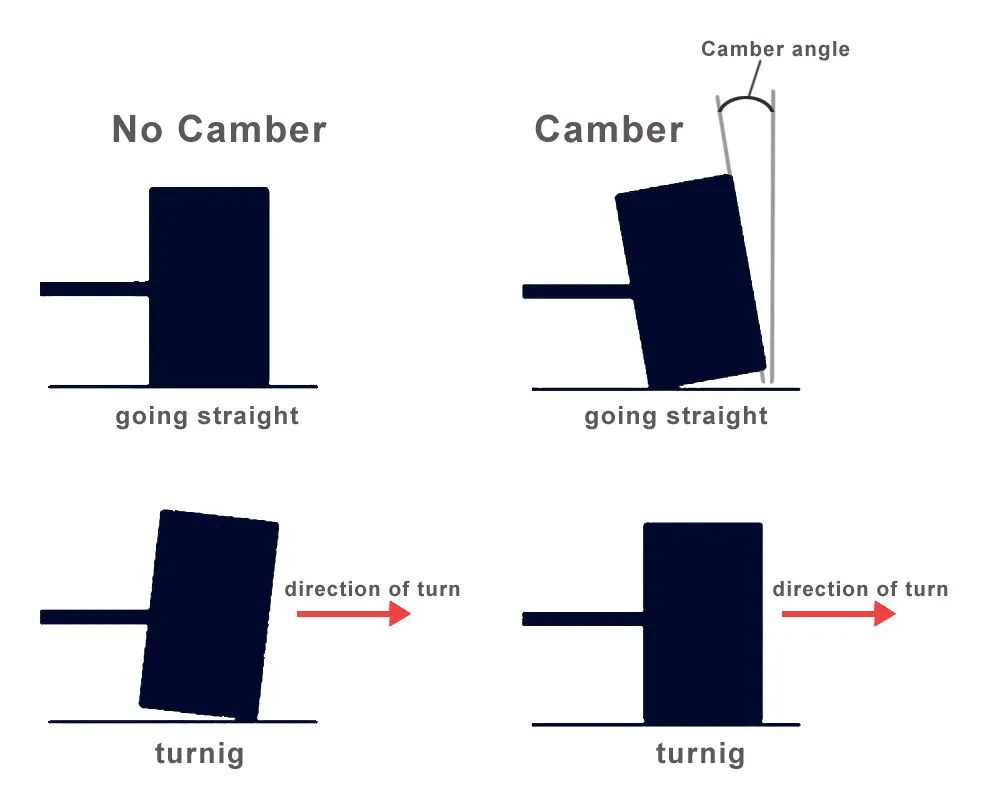
However, when the vehicle turns, the weight of the vehicle shifts to the outside edge of the outer wheels. Friction is a function of weight exerted by the vehicle on the ground, so the grip gets concentrated on the outermost edge of the outermost tire, greatly reducing the stability of the vehicle.
By introducing camber to the wheel, the contact patch that would otherwise be restricted to a small portion of the tire increases to a more rectangular configuration. This provides more grip, and consequently more stability, to the vehicle when turning.
General Camber Angles In Wheelchairs
When wheels are inclined in such a way that their tops are closer together, the camber is negative. Conversely, wheels that are closer together at the base are said to have positive camber. Wheelchairs have only zero or negative camber.
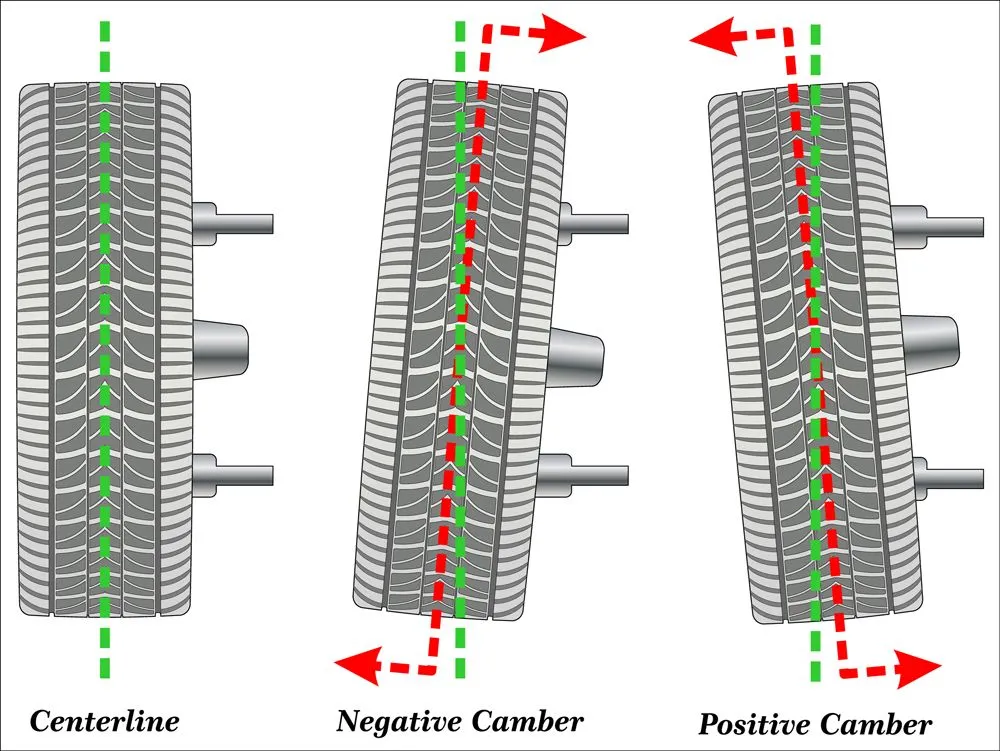
Depending on their use, wheelchair camber ranges from about 3° on everyday active chairs, up to 10°–15° on racing wheelchairs, and as much as 18°–22° on basketball, tennis, and rugby chairs. Lower-camber wheelchairs are more often found in domestic use, while higher-camber wheelchairs are reserved for performance-oriented applications.
Construction Of A Sports Wheelchair
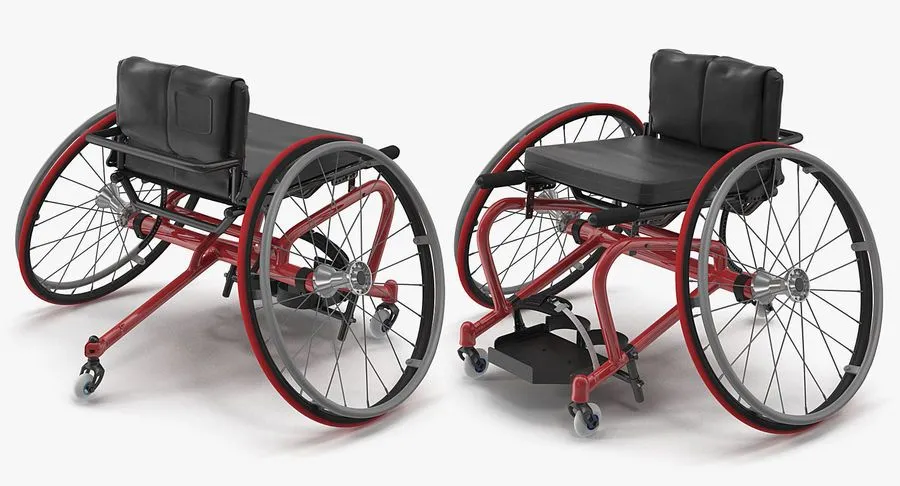
Sports wheelchairs can either be rigid or collapsible, although rigid frames dominate in competition because they are lighter and waste less energy per stroke. While entry-level hospital and transit chairs are still often built from steel, modern everyday wheelchairs are typically aluminum; sports models go further, using high-strength aluminum alloys, titanium, and carbon fiber composites to shave weight. While they may look like fancy derivatives of their domestic counterparts, sports wheelchairs have added utility. A brief outline of their construction provides some valuable insight.
1. Frame
The frame is rigid and consists of several main and cross members that are capable of maintaining the shape of the wheelchair while absorbing a wide range of forces transmitted from the ground.
2. Castors
Castors are the front wheels responsible for steering the wheelchair. While they’re usually in the same plane as the rear wheels on normal wheelchairs, they are placed closer together on sports wheelchairs. Racing wheelchairs go further and use just one front wheel, controlled by a mechanical steering compensator that the athlete sets pre-race to counter the curve of the track.
3. Camber Wheels And Push-rims
The highlight of performance wheelchairs, camber wheels are responsible for the movement of the wheelchair at high speeds with relative ease. The camber and placement of push-rims enhances the ease of propulsion.
4. Anti-tip Castors
A rear wheel located behind and between the camber wheels is added to prevent the wheelchair from tipping over if the parathlete leans backward. Rugby and basketball chairs typically add a reinforced front bumper as well, which doubles as a forward anti-tip and as the contact point for offensive or defensive plays.
5. Seat Belts
Seat belts are present at the waist and calf level to safely secure athletes in place.
Advantages Of Wheelchair Camber
Adding camber does more than add to the appeal of the wheelchair; it provides many functional advantages too:
1. The wider footprint makes the wheelchair more stable, reducing any risk of overturning.
2. Adding camber has been observed to improve both the ergonomics and acceleration of wheelchairs, making it conducive for extended use in sports without inducing too much fatigue.

3. The reaction forces from the ground are much better distributed, reducing the amount of shock that is transferred to the user when traversing uneven terrain.
4. By placing the upper part of the wheels closer to the user than the lower part, the shoulder joints are much more closely aligned to the wheel plane. This reduces the amount of strain a person experiences when pushing the wheelchair, making it suitable for extended use.
5. When moving through tight areas, the chances of chafing the hands against walls and doorframes is reduced significantly, as the upper part of the wheel is closer to the body, as compared to the lower part.
6. Adding camber shortens the turning radius of wheelchairs, enabling them to make quicker and tighter turns, which is a great competitive advantage in sports.
Disadvantages Of Wheelchair Camber

1. The overall width of the wheelchair increases. While the ergonomics are better suited for the user to navigate more comfortably, the overall increase in dimensions can restrict the number of spaces such a wheelchair can access.
2. High camber wheelchairs are quite complicated and expensive to manufacture, due to the use of specialized camber tubes and axle plates that help incline the wheels.
3. Cambered wheels load their inner edge more heavily and wear unevenly, so sport chairs commonly run purpose-built wheelchair tires (sometimes with asymmetric tread profiles) instead of generic ones — which adds to the cost and complexity of the wheelchair.
Thus, while it is easy to understand the benefits of adding significant camber to wheelchairs, the cost and complexity of their construction make them somewhat impractical for everyday use.
References (click to expand)
- Tsai, C.-Y., Lin, C.-J., Huang, Y.-C., Lin, P.-C., & Su, F.-C. (2012). The effects of rear-wheel camber on the kinematics of upper extremity during wheelchair propulsion. BioMedical Engineering OnLine.
- Veeger, H. E. J., van der Woude, L. H. V., & Rozendal, R. H. The effect of rear wheel camber in manual wheelchair propulsion. Journal of Rehabilitation Research and Development. PubMed.
- Para sport explained: Wheelchairs used in wheelchair sports. International Paralympic Committee (paralympic.org).