
Table of Contents (click to expand)
- What Are Skid-mounted Helicopters?
- Construction And Utility Of Helicopter Skids
- Advantages And Disadvantages Of Skids On Helicopters
- Skid Vs. Wheeled Helicopters: A Comparison
- How Many Wheels Does A Helicopter Have?
- What Is A Helicopter's Tail Skid?
- Why Do They Not Land Helicopters Right On Their Belly?
- A Final Word
Skids are used for light duty helicopters, enabling them to stably and safely land on both paved and unpaved surfaces.
When human flight is spoken of, airplanes are invariably the first thing to come to mind, only later followed by helicopters. There is no denying that fixed-wing aircraft (airplanes, in common parlance) are the face of the aviation industry.
This however, is not to say that helicopters are insignificant to the industry. Capable of heavy lifting (both figuratively and otherwise), they are an interesting world of their own. Modern-day helicopters take transportation, warfare, agriculture, medicine, rescue and stealth in stride.
The question at hand today is quite basic: Why do some helicopters have wheels, while others only have skids?
What Are Skid-mounted Helicopters?
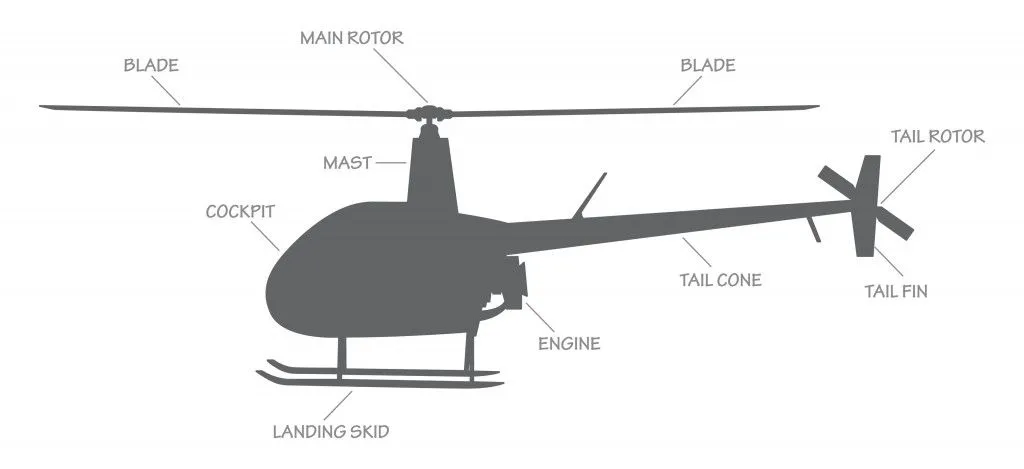
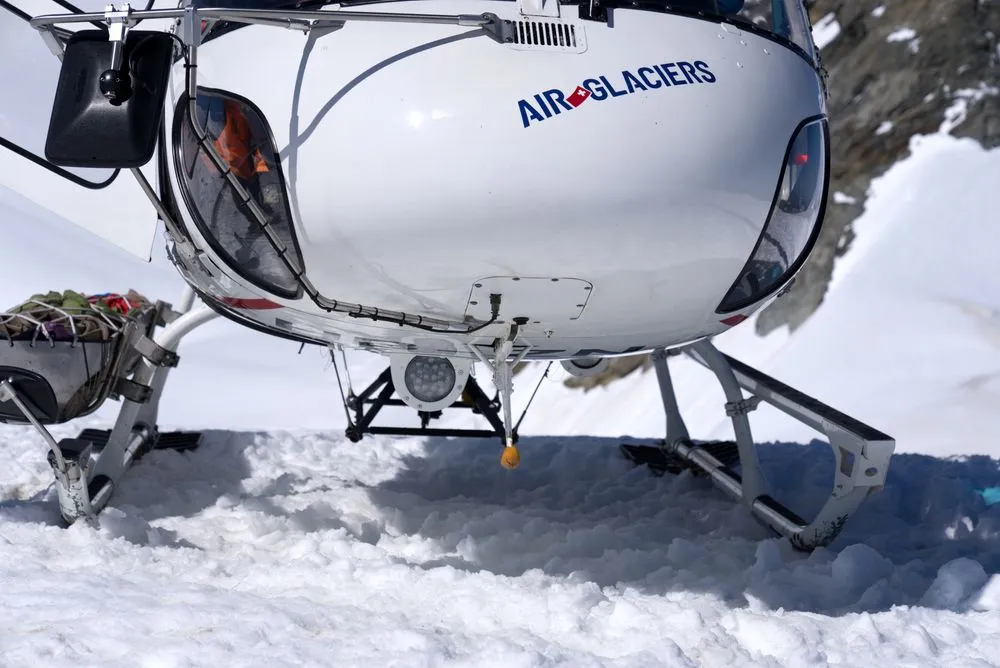
A helicopter’s landing gear determines the way it sits on the ground. While some helicopters have wheels as their landing gear, others have tubular framework projecting from underneath their fuselage. This framework is known as a skid.
Construction And Utility Of Helicopter Skids
The skid assembly on helicopters is generally made of hollow tubes. It is composed of cross tubes mounted at the front and rear of the belly pan. These cross tubes run across the belly pan’s width and are equipped with a suspension mechanism at their ends. This suspension mechanism connects to skid tubes, which are perpendicular to the cross tubes, and run the length of the helicopter’s fuselage.
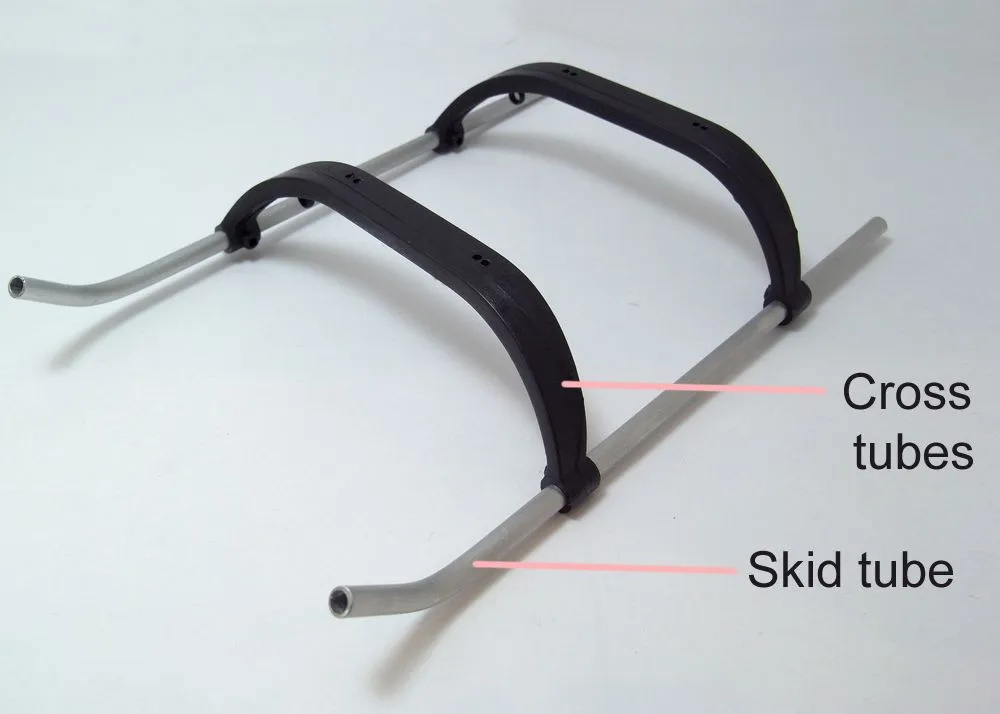
Skids are equipped with abrasion strips capable of withstanding friction generated due to minor slides during landing and take-off. They are bolt-on arrangements and do not require major provisions in the fuselage to attach to the helicopter. Skids lend a wider stance to the helicopter, and distribute its load throughout the skid tube. The presence of suspension components in the skid assembly take the helicopter’s weight upon landing, and can account for most landing surfaces.
Advantages And Disadvantages Of Skids On Helicopters
Skids are simple in design, construction and can be easily incorporated into the helicopter’s design. They are inexpensive to construct and replace, as compared to landing gear of wheeled helicopters.
The skid’s design also enables them to land on a variety of surfaces, both paved and unpaved. The suspension can take the impact of hard landings and be replaced at minimal cost in the event of sustaining damage. Skids significantly increase the height of the helicopter, thereby providing more room for passengers to get in and out with the main rotor running. They can also be retrofitted with inflatable floats to help them navigate maritime operations too!
However, the downside to skids is that they cannot be retracted, so they increase the helicopter’s drag. They also run the risk of catching on cables when flying at low altitudes. The biggest disadvantage of skids, however, is that they cannot taxi on their own.
How Do Skid Mounted Helicopters Taxi On The Airfields?
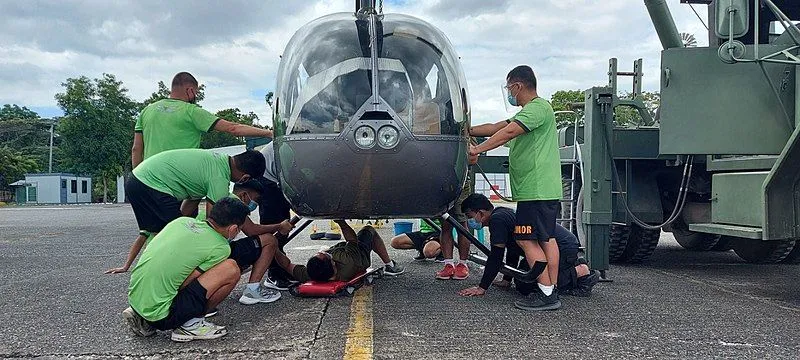
Due to absence of wheels, skid helicopters need to be assisted while taxiing on airfields. This is achieved by adding wheeled dollies under the skid, much as you would place a trolley under a heavy suitcase. This makes them easier to haul to and from their hangars.
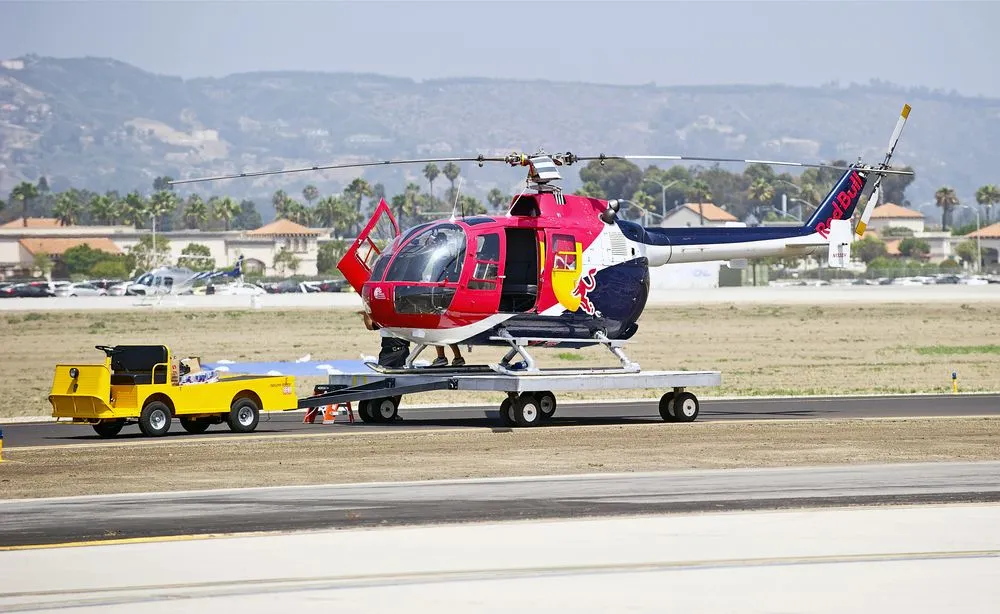
Helicopters can also fly very close to the ground at reduced speeds (hovering), which is an alternative to ground taxiing. Rotorcraft flying very close to the ground benefit from ground effect, which enables them to remain in the air without exerting the engine.
Skid Vs. Wheeled Helicopters: A Comparison
Asserting that one rotorcraft is better than the other is quite naïve; after all, the aircraft that suits one’s purpose in the most economical manner is the best.
1. Construction And Maintenance
Skids are simple, bolt-on frames upon which the helicopter can land. They are not retractable, and are easier to swap out in the event of damage. Wheels as landing gear, however, demand a much more complex design. Wheels can either be retractable or fixed, and are more expensive to service.
2. Landing Surfaces
Wheeled helicopters concentrate their load on the contact patch of their tires only, acting as point loads. Due to this, they can only be landed on paved surfaces, such as helipads. On the other hand, skids distribute the helicopter’s load across their length. This enables them to land on both paved and unpaved surfaces (grass lands, rocky outcrops, etc.) without upsetting the chopper’s stability.
3. Fuselage Design And Aerodynamics
The placement of a helicopter’s center of gravity (CG) greatly affects its stability. As skids are bolted on, they can be made wider than fuselage, to keep the CG centered. Wheeled helicopters, on the other hand, must have a wider fuselage to keep the CG centered.
Widening the fuselage or adding skids adversely affects the drag coefficient, which is an important consideration in aircraft design. Thus, the design of fuselages is greatly dependent on the type of landing gear to optimize their aerodynamics.
4. Uses
Due to their construction, skid-mounted helicopters are generally reserved for light duties. They are incapable of carrying huge loads and find use in ferrying a small number of passengers, carrying out ground-level reconnaissance, etc.
In wheeled helicopters, however, the critical nature of their job far outweighs any cost savings from using skids. They are generally used for heavy-duty purposes, such as transporting vehicles and troops, airlifting operations, and even active combat duties.
How Many Wheels Does A Helicopter Have?
There is no single answer, because it depends entirely on the machine. A skid-mounted helicopter technically has no wheels at all, and only borrows a set of removable ground dollies when it needs to be pushed around a hangar. Wheeled helicopters, on the other hand, almost always follow one of a small handful of layouts.

The most common is the tricycle arrangement, which uses three wheels. In a tricycle-nosewheel layout, a single steerable wheel sits under the nose and two larger main wheels sit further back, as seen on heavy-lift cranes like the Sikorsky CH-54. Some helicopters instead flip this around into a tricycle-tailwheel layout, with the two main wheels up front and a small wheel right at the tail, an arrangement used on early machines such as the Sikorsky R-4. Either way, the count is three.
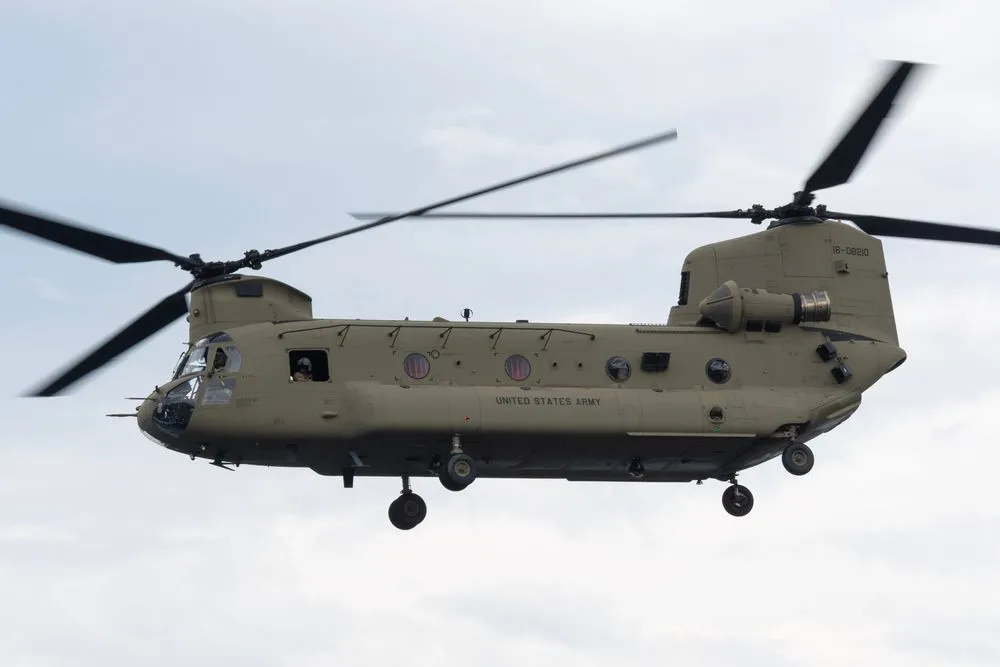
Larger helicopters need to spread their weight over a wider footprint, so they add a fourth leg. The twin-rotor Boeing CH-47 Chinook, for instance, uses a quadricycle layout that stands on four landing-gear legs instead of three. On the heaviest machines, an individual leg may carry a pair of tyres rather than a single one, so the total number of tyres can climb higher than the number of legs. As a rough rule, skids stay practical only up to about four tonnes of helicopter; beyond that, wheels take over.
What Is A Helicopter's Tail Skid?
Look closely at the back of many helicopters and you will spot a second, much smaller skid tucked under the tail boom, well behind the main landing gear. This is the tail skid (sometimes called a tail bumper), and it has nothing to do with holding the aircraft up on the ground.
Helicopters frequently lift off and touch down slightly nose-high, which tips the tail downward. Because the tail rotor and tail boom hang low at the very rear, a steep flare or a heavy landing can let the tail drop far enough to strike the ground. A tail skid is a small, sacrificial strut fitted below the tail rotor so that it, rather than anything expensive, takes the first hit. It absorbs the impact and gives the pilot a clear warning that the tail is sitting too low.
The stakes are high, because on a helicopter a tail strike can damage the tail rotor itself, the tail boom, or the tail fin, any of which can ground the aircraft. A tail skid may be a simple fixed stub or a retractable fitting, but its job is always the same: keep the vulnerable tail clear of the ground.
Why Do They Not Land Helicopters Right On Their Belly?
Since helicopters are capable of vertical flight, it is tempting to think of using the belly pan as a stable landing surface, rather than opting for either wheels or skids. After all, helicopters don’t swoop down and land like airplanes, do they?

Well, the construction of a helicopter’s fuselage is such that the belly pan is not designed to take the brunt of landing surfaces. Whenever helicopters land, they invariably slide by a small amount.
If used as a landing surface, their base could get damaged, compromising the overall aircraft. Also, it’s much easier to replace smaller parts like wheels and skids than the whole belly pan!
A Final Word
Helicopters are designed to go places and do things that most airplanes cannot. They are as much of an asset to aviation as airplanes are. While skid-mounted helicopters are generally preferred for light duties, they also have many important qualities, such as resilience, ease of maintenance and feasibility, which make them just as impressive and useful as wheeled choppers!


