Table of Contents (click to expand)
A temperature gun (also called a non-contact infrared thermometer or IR thermometer) measures the infrared radiation that an object emits. A converging lens focuses the IR onto a thermopile sensor, which produces a small voltage proportional to the temperature difference between its hot and cold sides. That voltage is then amplified and converted into a temperature reading in °C or °F.
If you have walked into a hospital, airport or factory floor any time in the past few years, chances are good that someone has held a gun-shaped device to your forehead. Don’t worry, this is the one gun you actually want pointed at you.
A temperature gun, also known as a laser or non-contact thermometer, is an infrared thermometer that measures the temperature of an object from a certain distance. Originally meant to measure the temperature of moving objects and inaccessible surfaces, infrared thermometers have since found their way into hospitals, airports, food-service kitchens, factories and even the back of every electrician’s van.
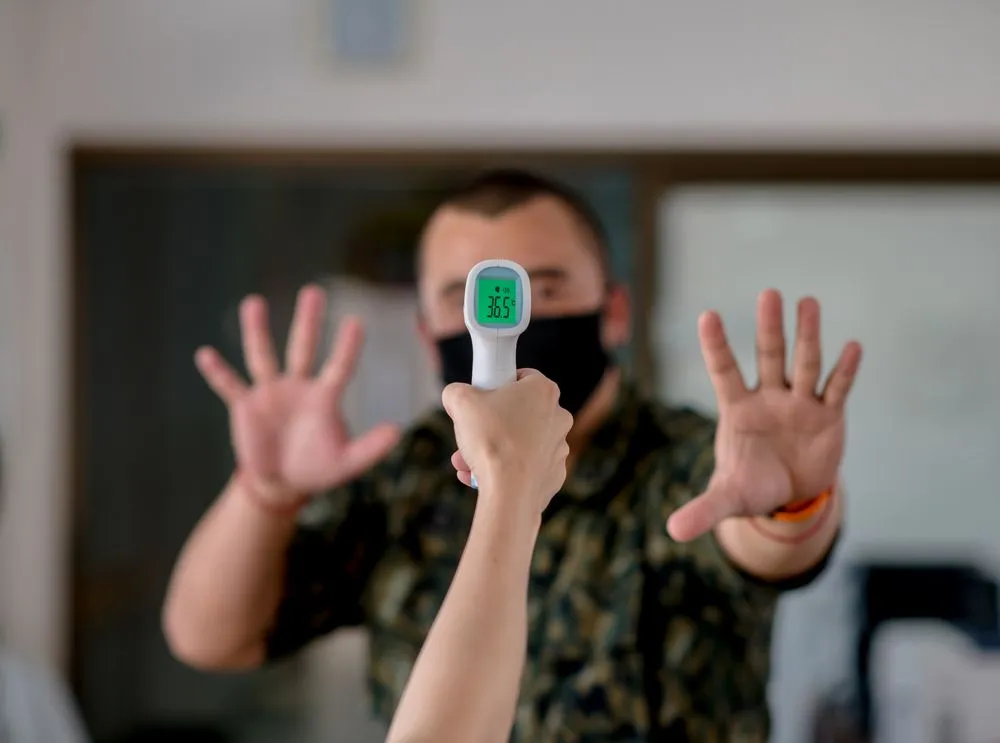
Temperature guns are being utilized at airports to screen passengers, by shopkeepers to check incoming customers, in driveways, and every other possible area, but how do these guns work? Aren’t we supposed to stick a thermometer under our armpits or insert it beneath our tongues to measure our body temperature?
Well, not anymore!
Black Body Radiation
Infrared thermometers take advantage of the fact that all objects, including humans, at a temperature above absolute zero, emit heat in the form of thermal radiation. This is a concept known as black body radiation.
Absolute zero (equivalent to -273.15 degrees Celsius or -460 degrees Fahrenheit) is the lowest possible temperature an object can attain and also a point where atoms exhibit strange and exotic behavior. However, at any temperature above absolute zero, atoms are in a constant state of motion and possess kinetic energy. The higher the temperature, the more kinetic energy the atoms/molecules possess. When the electrons in these excited atoms jump from one orbit (energy state) to another or when two excited molecules collide, energy in the form of electromagnetic radiation is emitted. This kind of electromagnetic radiation, emitted solely by the kinetic energy and movement of particles in matter, is classified as thermal radiation.
Being a subset of electromagnetic radiation, thermal radiation comprises more than a single wavelength. It includes radio waves, infrared waves, and visible light. The type of thermal radiation emitted depends on the source temperature. As mentioned earlier, the higher the temperature, the faster the molecules move, so the greater the amount of radiation emitted. At high enough temperatures, objects start radiating visible light.
The sun’s surface, for example, sits at a temperature close to 5,500°C (about 5,800 K) and emits most of its thermal radiation as visible light. Humans and all animals, on the other hand, emit infrared radiation that lies just beneath visible light in the electromagnetic spectrum.

Stefan-Boltzmann Law
The knowledge of infrared radiation being emitted by humans and animals has mostly been employed for thermal imaging. An infrared thermometer takes this a step further and puts a number to the amount of thermal radiation given off. IR thermometers do this by employing the Stefan-Boltzmann law.
The law states, ‘The thermal energy radiated per unit surface area per unit time by a black body is proportional to the fourth power of its absolute temperature’.
Mathematically,
E ∝ T4
Here, E is the radiant energy emitted per unit area per unit time and T is the absolute temperature of the object.
Upon removing the sign of proportionality, a constant term known as the Stefan–Boltzmann constant (σ = 5.67 x 10 –8 Wm –2K –4) gets added to the formula.
E = σT4
The above equation relates radiant energy to the temperature of a black body, a body/object that absorbs all radiation incident at it. However, a perfect black body doesn’t exist yet (although Vantablack comes pretty close), so the above equation must be adjusted for all other regular objects.
E = eσT4
The formula is modified by adding a term called emissivity (e). This is the ratio of radiant energy emitted by a regular surface to the radiant energy emitted by a black body surface at the same temperature. Emissivity values range from 0 to 1. An emissivity of 1 represents a perfect black body and 0 represents a perfect reflector. Human skin has an emissivity value between 0.97 and 0.99! (Source)
How A Temperature Gun Works
A typical infrared thermometer has the following parts: a laser, a converging lens, an IR sensor (a thermopile), an ambient/reference temperature sensor, an amplifier, and other electronic components to convert and display the result in numeric values.
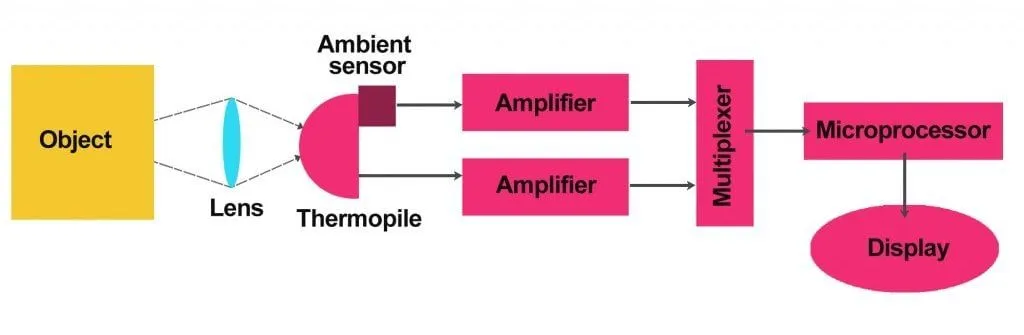
When you point the temperature gun at something or someone and shoot, a laser is discharged from the thermometer. The laser, however, doesn’t have any functional use, nor is it the thing that actually measures the temperature. The laser is only present to help accurately pin-point/aim at the object to be measured.
Infrared radiation, like visible light, can be reflected, absorbed, and concentrated. Thus, IR radiation emitted by an object or a human is first focused onto the thermopile inside the temperature gun using a converging (convex) lens. Next is a thermopile, an electronic device that converts thermal energy into electrical energy. The thermopile is made by stacking several thermocouples in series so that their small individual Seebeck voltages add up into one larger, more easily measured signal.
The temperature of the thermopile increases with the amount of radiation incident on it. However, the opposite side (the one facing the other side of the gun) of the thermopile stays at a slightly lower temperature, as infrared radiation is not directly incident on it. This difference in temperature leads to the development of a voltage difference, and thus electricity (thermoelectric effect). The electrical reading is then amplified using an amplifier.
Ultimately, the electrical reading is passed through to a typical data acquisition circuit and the final temperature reading is displayed on an LCD or LED panel, almost always in Celsius or Fahrenheit (consumer guns rarely bother with Kelvin).
An ambient sensor present near the thermopile helps compensate for any thermal radiation entering the temperature gun from the atmosphere itself.
An optical chopper is another component that is often incorporated in temperature guns. An electric motor drives the optical chopper and helps the thermopile receive radiation on two different wavelengths. They also consist of various emissivity settings to help check the temperature of different objects. IR thermometers are characterized based on their distance-to-spot ratios (D:S) and, obviously, this number represents the ratio of the size of the spot/area being measured to the distance of the thermometer from the spot. The greater the D:S ratio, the greater the range and accuracy of the IR thermometer.
Temperature Guns Applications
A temperature gun finds extensive use in various industries. It is primarily used by firefighters to check for hot spots while extinguishing a fire, in manufacturing and electronic industries to monitor machine temperatures, the performance of heating/cooling systems, insulation systems, car engines, inspecting electric panels and other temperature-sensitive electric parts, etc. An IR thermometer can also be used to ensure food safety by monitoring heater/oven temperature and food temperature, as well as in agriculture to monitor plant and soil temperature, among other things.
The most important application of a temperature gun in recent times has been for public safety. Temperature guns allow for easier, faster, and more secure temperature checks of a greater number of people in places like airports. They have previously been employed to check travelers for fever during epidemic events like Ebola and SARS. The same screening approach was rolled out globally during the COVID-19 pandemic, although later FDA work (see references) has cast doubt on how well non-contact thermometers actually catch fever in adults.
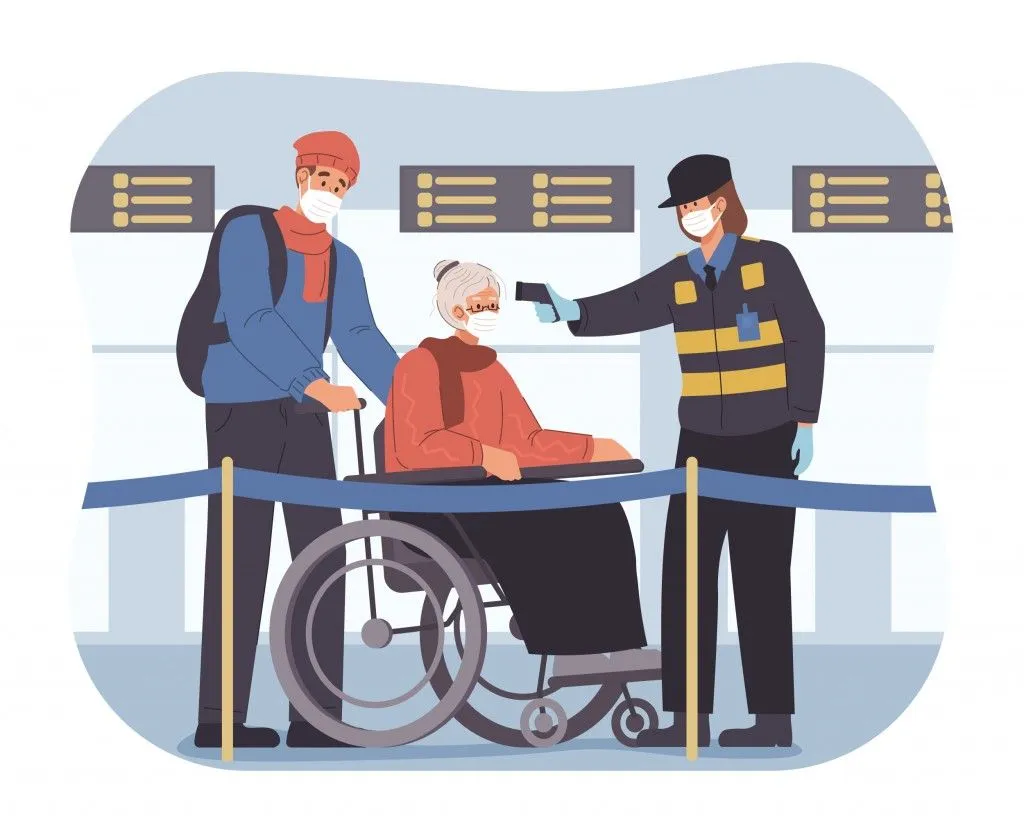
Using a temperature gun reduces the risk of cross-contamination and spreading disease due to its non-contact approach. Also, the temperature readings are obtained at a much quicker pace than traditional methods. However, a temperature gun should only be used to screen patients, not diagnose them.
The temperature reading displayed by an IR thermometer is affected by a variety of factors. This includes how and where the IR thermometer is used and its calibration. Important points to consider include positioning of the laser on the forehead, ensuring the body and forehead temperature hasn’t been influenced due to excessive clothing or use of head covers, like caps or facial cosmetics, or the environment (i.e., do not take readings in direct sunlight).
While the accuracy of temperature guns has always been up for debate, given mass-screening scenarios (the sheer volume of temperature measurements, the number of bodies to be screened, and the high risk of contamination), a slightly inaccurate but non-invasive technology can be the more practical choice. A 2021 FDA clinical evaluation of six commercial non-contact infrared thermometers, however, found that 48% to 88% of individual readings fell outside the manufacturer’s claimed accuracy, and four of the six devices missed more than half of true fevers. Treat a temperature gun’s reading as a screening hint, not a clinical diagnosis.
References (click to expand)
- Do humans give off radiation?.
- Correlation Between Temperature and Radiation.
- Webster J. G.,& Eren H. (2017). Measurement, Instrumentation, and Sensors Handbook: Electromagnetic, Optical, Radiation, Chemical, and Biomedical Measurement. CRC Press
- Non-Contact Thermometers for Detecting Fever: A Review ....
- Non-contact Infrared Thermometers.
- Sullivan, S. J. L., et al. (2021). Clinical evaluation of non-contact infrared thermometers. Scientific Reports.