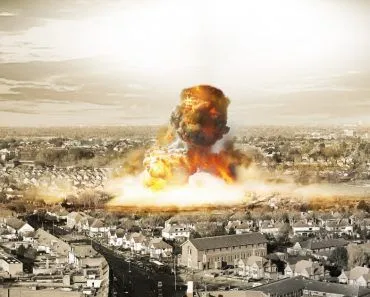
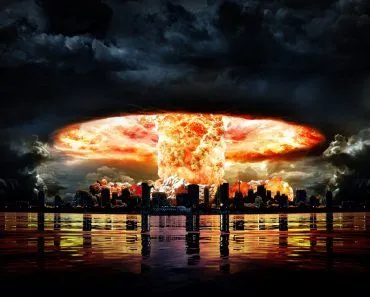
A nuclear (or any sufficiently powerful) explosion creates a mushroom cloud because it suddenly releases an enormous amount of heat. The fireball, much hotter than the surrounding air, rises rapidly as a buoyant plume, drawing cooler air and debris up its stem (Rayleigh-Taylor instability). When it hits a stable layer of the atmosphere - typically the tropopause - it can rise no further and spreads out sideways, forming the cap of the “mushroom”. Big volcanic eruptions and large conventional blasts can produce the same shape.
If you’ve ever looked up pictures of nuclear explosions on the Internet, you have likely observed something rather intriguing about them: regardless of the type of explosion or where they occur, all of them appear to form a ‘mushroom cloud’ in the sky.
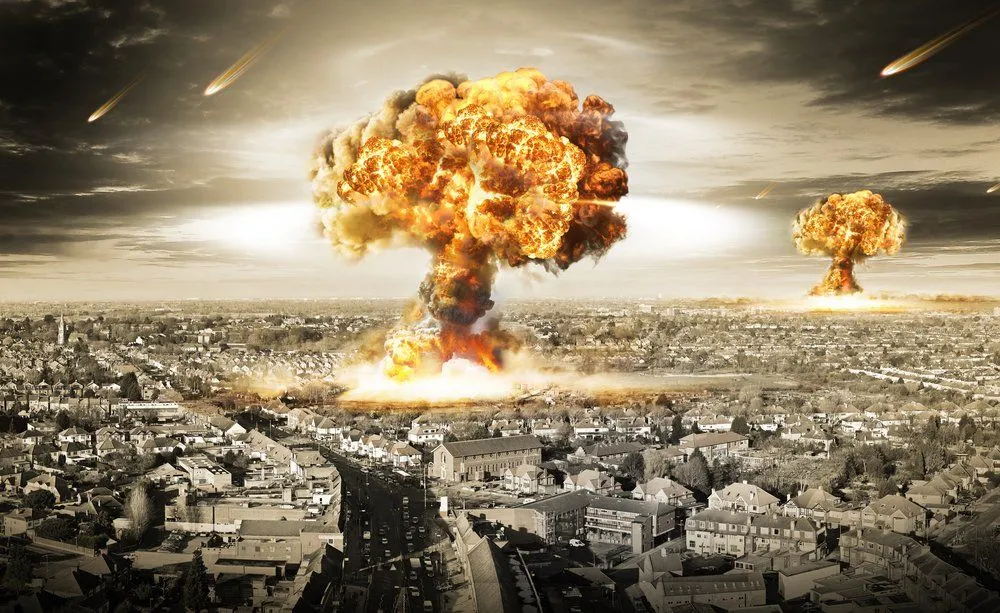
One noteworthy aspect of nuclear explosions is that they’re markedly different from regular explosions, i.e., the ones caused by dynamites, grenades, missiles etc. So, why do nuclear explosions cause such dramatic and consistent formations in the sky?
What’s A Mushroom Cloud?
A mushroom cloud is an iconic mushroom-shaped cloud of smoke/debris that forms in the sky following an extremely large explosion. Although it’s usually associated with a nuclear explosion, a mushroom cloud can be formed following any event that results in a rapid release of heat, like a volcano, a forest fire, an impact event (a large-scale collision between astronomical objects) or a particularly powerful explosion (like those caused by vacuum bombs).
Why Do Nuclear Explosions Cause Mushroom Clouds?
A particularly powerful explosion is accompanied by a sudden release of a great deal of heat. This heat interacts with the surrounding air, making it hotter and less dense, resulting in what’s known as Rayleigh–Taylor instability in scientific circles. Simply put, it says that when two fluids of different densities (and thus subject to different accelerations) interact, the lighter fluid pushes on the denser fluid.
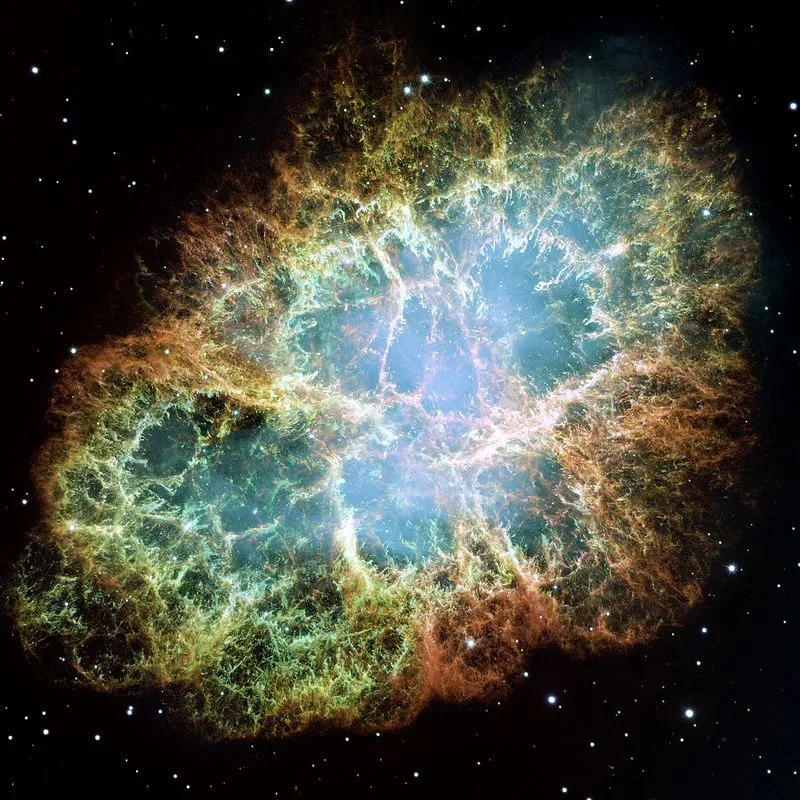
Apart from the mushroom cloud itself, the suspension of water atop oil, volcanic eruptions, jet streams of winds that regulate Earth’s climate, and supernovae explosions are some instances where Rayleigh-Taylor instability comes into play.
As mentioned earlier, the sudden release of energy following an explosion heats up the surrounding air which then starts to expand. The giant fireball created in the initial stages of the explosion is incredibly hot, with temperatures running up to millions of degrees of Celsius, which is akin to what you could expect to find in the middle of the Sun!
Now, the hot air within the fireball rises rapidly in the air, creating a vacuum that is then rapidly filled by the surrounding air, which also expands and starts to rise. This process continues for quite some time, during which the fireball continues to quickly rise through the sky.
As the fireball continues to rise, it experiences resistance from the air on top of it, which pushes it down sideways. This leads to the flattening of the top of the cloud, which then appears like the cap of a mushroom. The displaced gas, which is at a lower temperature than the air in the center of the column, trickles down the sides of the column, only to get sucked back in by the rising column to travel upwards again.
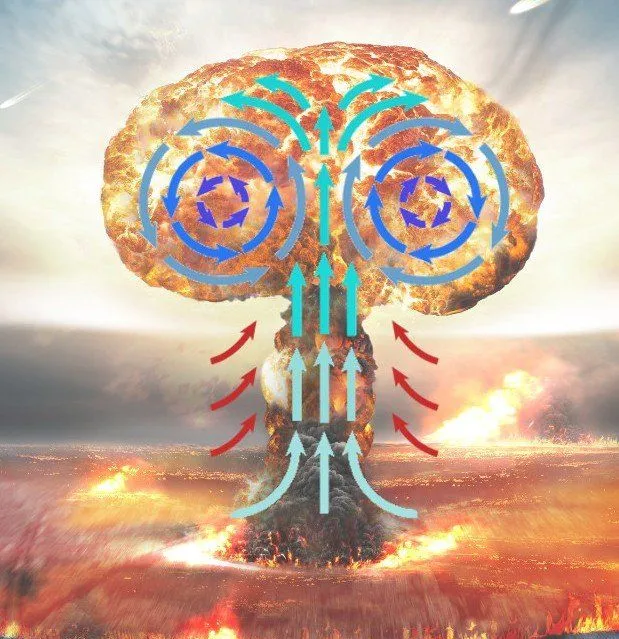
This is the reason why the edges of an explosion’s fireball appear to be curling constantly. Since a nuclear explosion occurs at a much larger scale than regular explosions, the fireball it creates is proportionally gigantic.
End Of The Fireball’s Journey
The fireball continues to rise until it reaches a stable layer of the atmosphere, typically the tropopause - the boundary between the troposphere and the stratosphere, around 10-17 km up depending on latitude. There the temperature stops dropping with altitude (and even rises again, thanks to ozone absorbing solar UV), and the buoyant plume can no longer punch its way up. The rising air stops abruptly and spreads out horizontally, making a perfect top for the mushroom cloud.
Why Do Mushroom Clouds Have Rings?
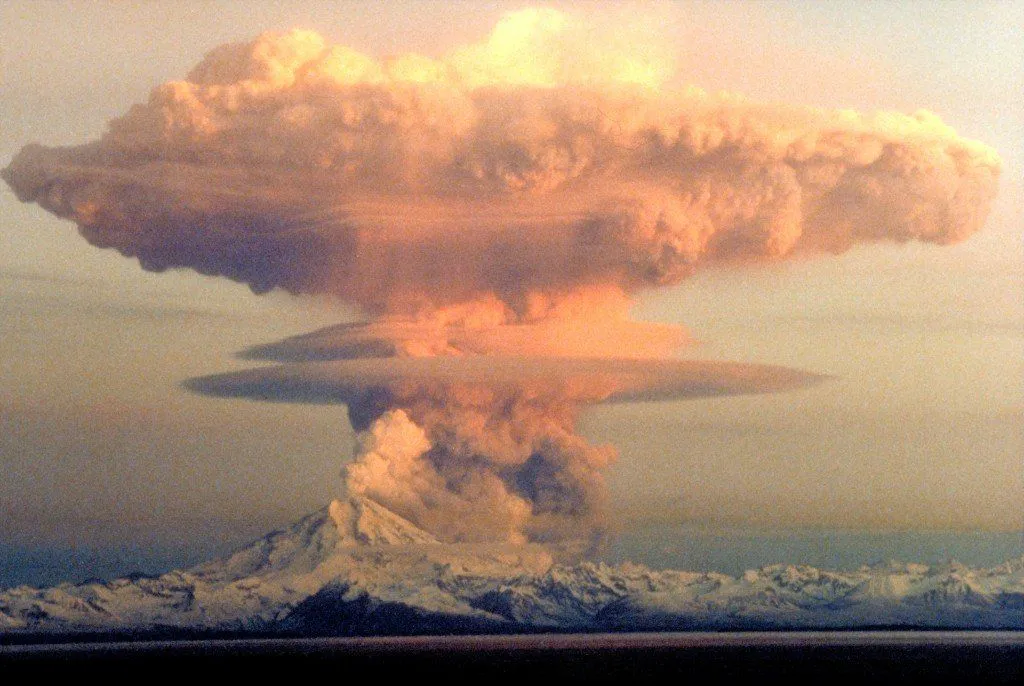
Look closely at a good photograph of a mushroom cloud and you will notice that the cap is not a smooth dome. It rolls. The top of the cloud curls outward and tumbles back down on itself, wrapping into one or more rings. That rolling doughnut of gas has a name in fluid dynamics: a toroidal vortex ring, and it is the very same structure a smoker blows across a room as a smoke ring.

The ring forms for a simple reason. As the buoyant fireball rushes upward, its outer edges scrape against the cooler, denser air around it and are slowed down, while the hotter core in the middle keeps racing ahead. The lagging edges peel outward and curl back underneath, setting the whole mass spinning around a circular axis, much like water turning over at the lip of a fountain. This is the rolling, poloidal circulation of a vortex ring.
That same rotation is what builds the mushroom. The circulating ring drags a column of air and debris up through its center (the stem) and rolls it over at the top to spread the cap, all while pulling in surrounding air known as afterwinds. So the rings are not a decorative quirk. They are the visible edge of a doughnut of gas that is quietly turning itself inside out as the cloud climbs.
How Big Is A Nuclear Mushroom Cloud?
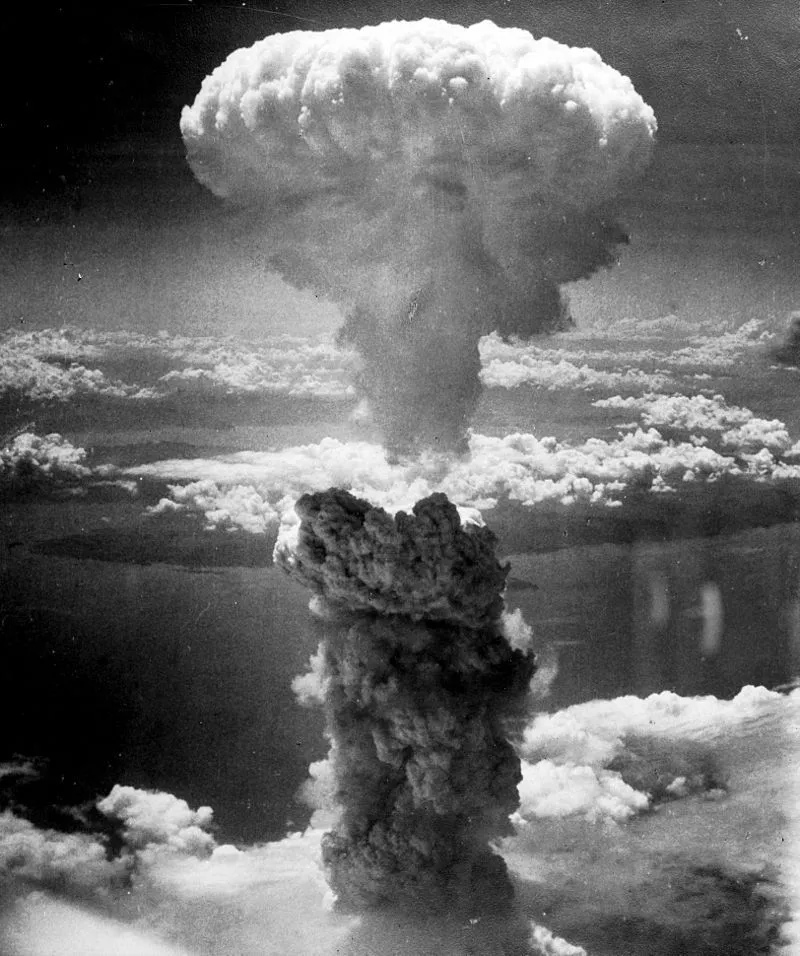
Mushroom clouds formed as a result of nuclear explosions can go thousands of meters in the sky, easily surpassing the height of Mt. Everest – the tallest mountain peak in the world.
The strength of nuclear explosions is measured in Kilotons and Megatons of TNT. The TNT equivalent is generally used to express the amount of energy released in a bomb’s explosion. A bomb is marked to have a yield of ‘1 Kiloton’ when its detonation releases a certain amount of energy which is equivalent to detonating 1,000 kilograms of TNT. 1 Megaton is equivalent to 1,000 Kilotons.
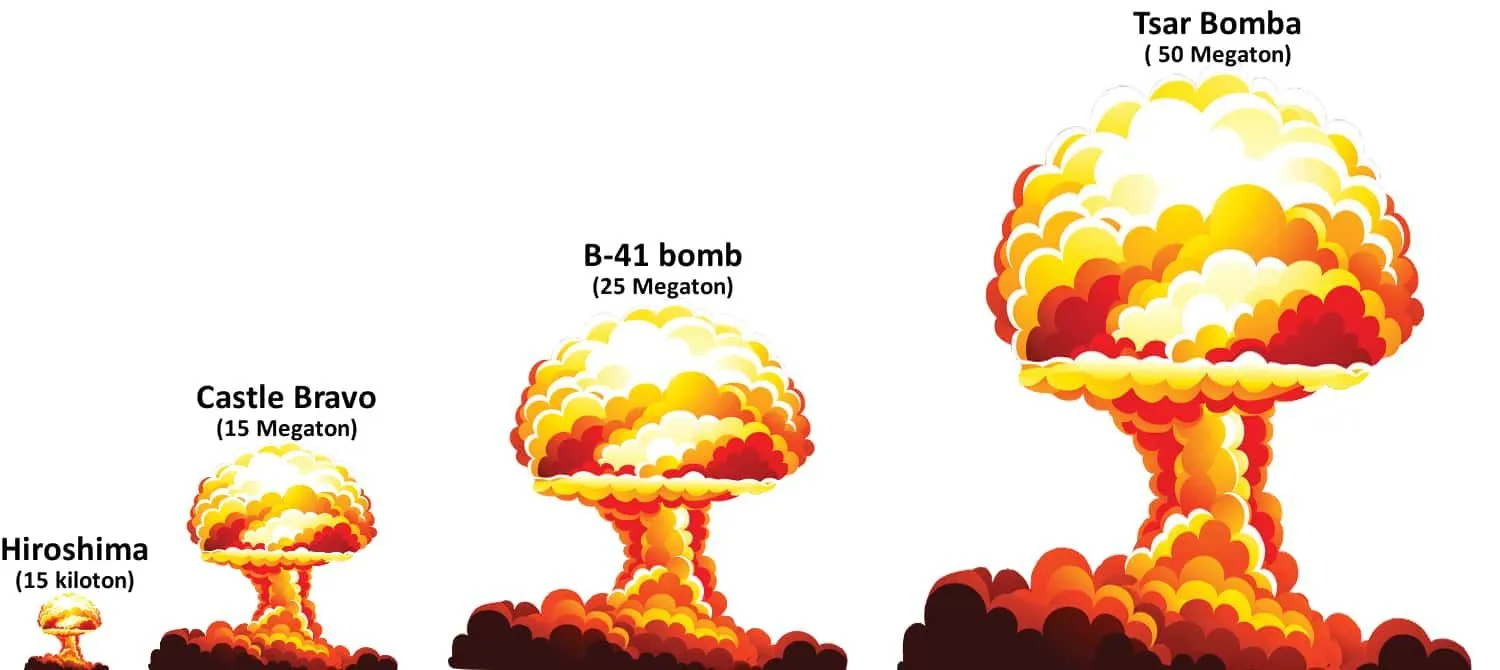
The nuclear explosion that occurred in Hiroshima, Japan in 1945 exploded with an energy of 15 kilotons.
What Are The Biggest Nuclear Bomb Explosions Of All Time?
These are the 3 most powerful man-made explosions in the history of mankind (in descending order of their strength):
- The biggest, most powerful nuclear explosion of all time occurred as a result of the detonation of Tsar Bomba, the most forceful nuclear weapon ever detonated. It was a Soviet bomb tested on 30 October 1961 over Novaya Zemlya, with a yield of about 50 megatons - around 3,300 times the energy of the Hiroshima explosion. (Its original design called for 100 Mt, but it was fielded with a lead tamper instead of uranium to roughly halve the yield and the fallout.)
- The second-most-powerful nuclear weapon ever fielded was the American B-41, a thermonuclear bomb deployed in the early 1960s with a design yield of about 25 megatons - though, unlike Tsar Bomba, it was never tested at full yield.
- Among test detonations, the next-largest after Tsar Bomba was the Soviet Test 219 on Novaya Zemlya in 1962 at about 24 megatons. The largest American test was Castle Bravo, fired in March 1954 with a yield of around 15 megatons - more than twice what its designers had expected.
How Long Does A Mushroom Cloud Last?
Less time than you might think. The dramatic, textbook mushroom shape is a fleeting stage, not a lasting monument. After detonation, the fireball shoots upward at speeds of around 300 miles per hour (about 480 km/h), and the cloud rises and stabilizes over roughly 20 seconds to 10 minutes, by which point it has reached its ceiling. A 10-kiloton blast tops out near 8 km, while the largest thermonuclear clouds punch well into the stratosphere.
Once the cloud stops being fed heat from below, the buoyant engine driving it switches off. High-altitude winds then take over, shearing the tidy stem and cap sideways and smearing the cloud into a drifting, shapeless haze. The crisp mushroom silhouette begins to break up soon after the cloud stops rising, as those winds pull it apart. Much of what you watch vanishing is simply water, because as the plume mixes with drier air, its condensed droplets evaporate and the cloud appears to melt away.
What disappears from view has not necessarily left the sky, though. The finest particles, including radioactive ones, are light enough to ride the upper atmosphere for days or even weeks, circling far downwind before they finally settle.
Are Mushroom Clouds Radioactive?
A mushroom cloud is not radioactive because of its shape. It is radioactive because of what gets swept up inside it. When a nuclear weapon detonates close to the ground, the rising fireball vacuums up enormous quantities of dust, soil and debris, which mix with the bomb's radioactive fission products high in the cloud. As the cloud cools, those contaminated particles rain back down as fallout.

How much fallout there is depends on how the bomb goes off. A surface burst, where the fireball touches the earth, drags up so much irradiated soil that its stem turns a dark gray or brown, and it drops heavy, sand-sized fallout close to home; for a 10-kiloton blast, the most dangerous concentrations land within about 10 to 20 miles (16 to 32 km) downwind. An air burst, detonated high enough that the fireball never touches the ground, leaves a cleaner white, steamy column and scatters far less local fallout. This early fallout is also fiercely, but briefly, radioactive: it sheds more than half of its energy in the first hour and over 80 percent within the first day.
Here is the reassuring part. That radioactivity comes entirely from the nuclear reaction, not from the mushroom shape itself. The identical cloud thrown up by a volcano, a wildfire or a large conventional explosion carries dust and ash but no fission products, so it drops no radioactive fallout.
As you can see, a sudden, rapid and concentrated release of heat in a relatively cool surrounding is all it takes to form a mushroom cloud in the sky. So, the next time you see an image of a mushroom cloud, don’t jump to the ‘it must be nuclear way’ conclusion; it might just be a powerful volcanic eruption or a raging forest inferno. Neither of those options are ideal either, but it’s better than a sign that the nuclear apocalypse has begun!
References (click to expand)
- Mushroom cloud - Wikipedia. Wikipedia
- Rayleigh–Taylor instability - Wikipedia. Wikipedia
- Mushroom Cloud Physics: Not Just for Nukes. Popular Mechanics
- Anatomy of a mushroom cloud. Los Alamos National Laboratory
- Fallout from a Nuclear Detonation. Radiation Emergency Medical Management (U.S. HHS)
- Vortex ring - Wikipedia. Wikipedia