When you stretch a rubber band, its tangled polymer chains line up, so the entropy drops and the band gives off heat and feels warm. When you let it relax, the chains re-tangle, entropy rises, and the band absorbs heat and feels cool. This entropy-driven warming and cooling is called the Gough-Joule effect.
Rubber bands are useful for all sorts of daily tasks, from tying back your hair to closing a bag of potato chips, but have you ever considered the nature of these strange rubber rings? For example, when you stretch a rubber band, not only does it seem to get thinner and change color, but even the temperature of the rubber changes! On the other hand, if you release a rubber band and let it go back to its normal size and shape, the rubber feels cool to the touch and the color returns to normal.

You may not believe me, so go and try it for yourself, and then come back to find out why rubber bands behave in such peculiar ways.
What Is A Rubber Band?
Rubber bands are rings of rubber that vary in size, thickness, strength and color, and are used in a wide variety of industries around the world. Rubber bands are typically made from organic rubber, as it offers much better elasticity than synthetic rubber products. Rubber that you see in everyday use often comes from the rubber tree (Hevea brasiliensis), which is mainly cultivated in Southeast Asian countries, such as Thailand and Indonesia. Rubber is a unique material because it is primarily composed of polymers, which are long-chain molecules.
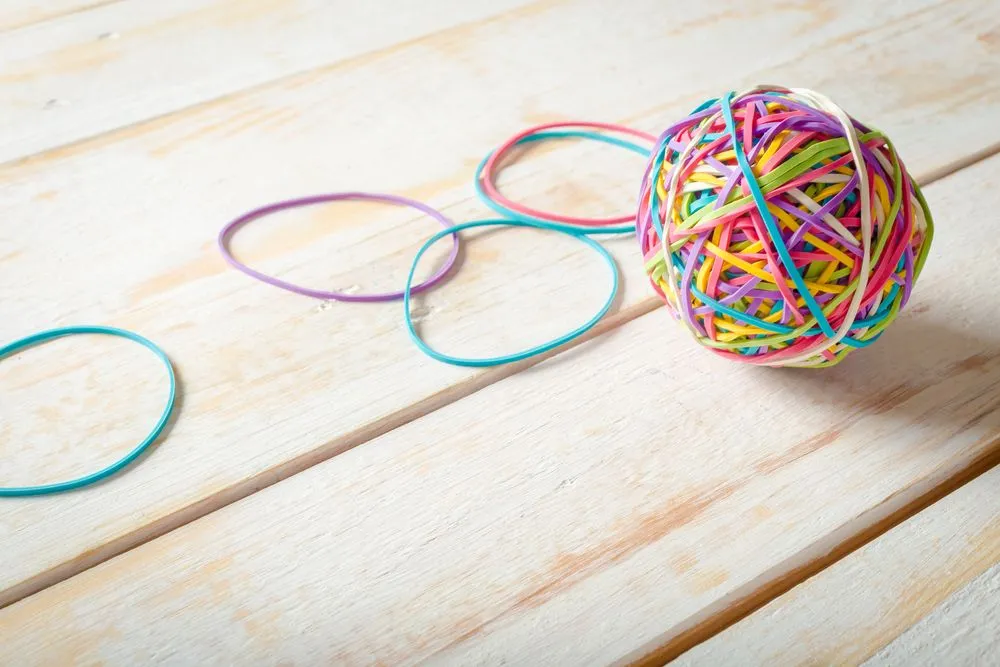
When a rubber band is in its relaxed form, meaning that it isn’t being stretched, these long-chain molecules are tangled up with one another. When a rubber band is in its stretched form, those same polymers will unwind and become straight. When a rubber band is taut, its color will often change to a lighter shade, even white. If you continue to pull the rubber band, you are actually stretching the molecules themselves, not just untangling them into straight lines. Provided you don’t push the rubber band from the “elastic range” into the “plastic range”, the band should return perfectly to its original form. However, if you stretch the rubber band too far, it will experience plastic deformation, and eventually reach a fracturing point, when it will snap!

Why Do Rubber Bands Change Temperature?
Now that you understand the basic physical nature of rubber bands, we can dive into the unexpected thermodynamic behavior of rubber bands. As mentioned above, rubber bands tend to give off heat when they are stretched, and feel cool to the touch when they’re allowed to return to a “normal” state. While many people associate heat release with an energy change, there is no significant difference in the energy of a normal rubber band and a stretched one. However, there is a difference in entropy!
When you stretch a rubber band, you are aligning the polymers and eliminating all the chaotic tangles. In effect, you are lowering the entropy of the molecules, but the universe prefers to move towards entropy. Order requires energy and effort, while entropy is the natural direction of matter. When a rubber band is allowed to release and return to its high-entropy state of tangles and knots, the elastic force that causes that contraction is considered an entropic force!
Clearly, the entropic force acting on the polymers wants to resist being stretched, so when we pull on a rubber band, we are performing work on the material. This work that our fingers or hands are performing contributes energy to the rubber band, but it isn’t required to untangle the polymers. Some of that energy will cause the polymers to move more rapidly, but the rest of that energy will be given off as heat, which we can clearly detect (hold a stretched rubber band against your cheek!).
On the flip side of this process, when you release a rubber band, the polymers must perform some level of work to overcome the forces keeping them straightened. The energy to perform this work comes from heat, which is consumed in the polymers’ return to a high-entropy position. This utilization of heat from the surrounding air, and the high-vibrating polymers, will cause the rubber band to feel cooler (even than the surrounding air) once it returns to its normal, relaxed state.

This is also the reason behind another bizarre fact about rubber bands; while most substances expand when warmed up and contract when cooled, a rubber band that is held under tension behaves in the opposite fashion. Give a stretched, loaded rubber band more heat energy and it will shrink, increasing its entropy, while cooling it will cause it to loosen and stretch. A relaxed, unstretched band, on the other hand, swells slightly with heat like any other ordinary solid, a quirk we will return to below.
Does A Rubber Band Expand Or Shrink When You Heat It?
So far we have talked about what happens when your fingers do the stretching, but what about heat itself? Warm up a metal wire or a glass rod and it grows a little longer, because almost every solid expands as its atoms jiggle harder. A relaxed rubber band lying loose in a drawer does the same thing and swells slightly when it warms up. Hang a weight from that same band, though, and something strange happens: heat the stretched band and it does not sag lower, it actually lifts the weight by contracting.

This backwards behavior is known as the Gough-Joule effect, named for the English scientist John Gough, who first noticed it in 1802, and James Prescott Joule, who investigated it carefully in the 1850s. The reason ties straight back to entropy. When a band is under tension, its polymer chains are pulled into orderly, low-entropy lines. Adding heat gives those chains more energy to writhe and re-tangle, and the universal pull toward higher entropy wins, so the band shrinks and hauls the weight upward.
The switch is not instant, however. At very small stretches, below roughly 10% elongation, a loaded rubber band still lengthens a touch when heated, just like ordinary matter. Only once you pull it past that crossover point, called the thermoelastic inversion, does the entropic contraction take over and the band begins to shrink with heat instead. In other words, a rubber band only defies the usual rules of thermal expansion once you have already stretched it far enough.
What Makes Rubber So Elastic?
It is worth pausing on just how unusual rubber's stretchiness really is. A steel spring stores energy when you stretch it because you are prying its atoms slightly apart, and it can only manage a tiny fraction of extra length before it deforms for good, a relationship captured by Hooke's law. A rubber band, by contrast, can be pulled to several times its original length and still snap back perfectly, and that springiness does not come from stretching chemical bonds at all. It comes from entropy.

In a relaxed band, the long polymer chains are coiled and tangled in a huge number of random arrangements, which is a high-entropy state. Stretch the band and you force those chains into far fewer, more orderly configurations. Because nature always leans toward higher entropy, the chains tend to collapse back into their jumble, and that statistical pull is the restoring force you feel fighting your fingers. Physicists call it an entropic force, and it explains a delightfully counterintuitive result: because the force is proportional to the absolute temperature, a stretched rubber band actually pulls back harder when you warm it up.
None of this would work without one crucial step. Raw natural rubber is soft and sticky and would simply ooze out of shape. In 1839, American inventor Charles Goodyear discovered vulcanization, heating rubber with sulfur so that short sulfur bridges, called cross-links, stitch the polymer chains together into a single springy network. Those cross-links are what stop the chains from sliding permanently past one another, letting your rubber band stretch, recoil and return to almost exactly the same shape thousands of times over.
A Final Word
Next time you throw your hair up into a ponytail, perhaps you’ll think twice about the rubber band you so carelessly stretch around your locks. While they may seem like simple tools, they represent a rather unique and fascinating demonstration of our universal laws of thermodynamics. You may think your life is chaotic, but remember, everything from the rubber band on your wrist to the nuclear heart of the sun is also heading in the direction of entropy!
References (click to expand)
- Entropy of a Rubber Band - University of Washington Department of Chemistry
- Hirsch, W. (2003, February). "Disorder" in Unstretched Rubber Bands?. Journal of Chemical Education. American Chemical Society (ACS).
- (2015) Burning Rubber: a polymer physics lab for teaching entropy. Haverford College
- Gough-Joule effect - Wikipedia
- Origin of Rubber Elasticity - IntechOpen
- Vulcanization - Wikipedia