Table of Contents (click to expand)
- What Does "Crushing Strength" Mean For A Rock?
- How Hard Is The Great Pyramid Squeezing Its Own Base?
- Why Doesn't A Wider Base Help A Pyramid At All?
- How Tall Could A Pyramid Get Before Its Base Gives Way?
- Why Don't Earth's Mountains Reach That Ceiling?
- Why Can Olympus Mons Stand 27 Kilometers Tall On Mars?
- So, How Tall Could A Pyramid Get Before It Crushes Itself?
A solid stone pyramid crushes its own base only when the stack is kilometers tall: for limestone like the Great Pyramid's, the ceiling works out to roughly 7 to 25 kilometers (4 to 15 miles) if the whole base shares the load, and about a third of that if each column of blocks carries only what sits above it. The Great Pyramid, at 147 meters, squeezes its base to barely one percent of what the stone can take, so its builders stopped for their own reasons, not because the limestone was anywhere near failing. Real mountains stay well below that ceiling, because the planet's crust sags and flows under the weight long before the rock itself gives way.
Some forty-six centuries ago, a crew in the desert changed its mind halfway up a pyramid. The lower half of the Bent Pyramid at Dahshur climbs at a steep fifty-four degrees. Around halfway up, the slope eases to about forty-three. The whole monument looks as if it lost its nerve. The crew's next job, the Red Pyramid a short walk away, used the gentler angle from the ground up. The most repeated explanation is that the steep version began to crack, and the builders backed off.
Whatever happened at Dahshur, it raises a question physics forums enjoy. Does a pyramid have a theoretical point of failure? Give a crew unlimited stone and a floor that cannot sink. Let them keep stacking. Is there a height where the bottom blocks give way under everything above them?
What Does "Crushing Strength" Mean For A Rock?
Press your thumb down on a tabletop and nothing happens. Press the same thumb onto a drawing pin and the pin goes in. The force is the same. What changed is the area it acts on. Force divided by area is called stress, and stress decides whether a material breaks. Everything resting on a surface puts stress on it, a skyscraper on its foundations included.
Every rock has a stress it can take before it crumbles. Engineers measure it by squeezing a cylinder of stone in a hydraulic press until it fails. The number they record is the crushing strength (the formal name is compressive strength). It comes in megapascals, written MPa. One megapascal is about ten times the pressure of the air around you.
Rock varies a lot. Chalk gives up at a few megapascals. Ordinary limestone, the Great Pyramid's main material, fails between about 50 and 180 MPa. The exact figure depends on the quarry. Fresh granite and basalt take more still. For the rest of this article, limestone's band is the budget a pyramid has to spend.

How Hard Is The Great Pyramid Squeezing Its Own Base?
The Egyptians kindly ran the experiment for us. The Great Pyramid at Giza stood about 147 meters (482 feet) tall when new. Erosion and the theft of its casing stones have since trimmed about ten meters off. Each side of its base is 230 meters long. The whole thing weighs about 5.75 million tons.
Weight divided by base area gives the average stress on the bottom course of blocks:
- Square the side, and the base covers about 53,000 square meters.
- Multiply the mass by gravity, and the pyramid weighs about 56 billion newtons.
- Dividing one by the other gives a little over 1 MPa, about 160 psi.
Put that next to the limestone budget. The weakest limestone in the band takes 50 MPa. Khufu's masons were using about one percent of their stone's strength. The blocks under the peak carry up to about three times the average. Still barely a dent.
The Great Pyramid, then, is nowhere near crushing itself. It stopped where it did because it ran out of pharaoh, not physics.

Why Doesn't A Wider Base Help A Pyramid At All?
Now for the surprise in the formula. Lay out a base twice as wide to spread the load, and it does nothing. The stress at the bottom of a solid pyramid depends on its height alone.
Widening the base also widens the pyramid, and a wider pyramid holds more stone. A pyramid's volume is one third of its base area times its height. Density is the mass of each cubic meter of stone, written ρ and pronounced rho. Multiply the volume by density and by gravity, g, and you have the weight:
weight = ρ × g × (A × h ÷ 3)
Divide by the base area, A, to get the average stress at the bottom:
stress = ρgh ÷ 3
The area has cancelled out. Double the footprint and you double the load and the floor it rests on together.
A human pyramid works the same way. The people in the bottom row feel the number of rows above them, not the length of the row. The person at the bottom has strong opinions about height and none about width.
The division by three is the gift of the pyramid shape. A straight tower of the same height and stone puts the full ρgh on its base, three times as much. A pile of stone that wants to be tall wants to be a pyramid.

How Tall Could A Pyramid Get Before Its Base Gives Way?
Turn the formula around. If the stone fails at a stress S, the tallest pyramid it can hold up is:
h = 3S ÷ ρg
The Great Pyramid's mass and volume work out to a density of about 2,200 kilograms per cubic meter. Put in the weakest and strongest limestone, at 50 and 180 MPa, and h runs from about 7 to 25 kilometers.
That is the generous answer, because it assumes the whole base shares the load. Real masonry does not manage that. If each vertical column of blocks carries only what sits above it, the column under the peak feels the full ρgh. The ceiling then drops to a third: roughly 2 to 8 kilometers. A well-built pyramid sits somewhere between the two.
Granite barely moves the ceiling. It is stronger but also heavier, and the extra weight eats most of the extra strength. The best granite pyramid tops out near twenty-six kilometers on the shared-load model.
Even these numbers flatter the rock. A lab cylinder is squeezed from one direction only. A block buried under kilometers of pyramid is squeezed from all sides, and that makes rock harder to crack. But hold rock under that load for thousands of years and it stops snapping. It starts to flow. Geologists see the same shift in the lab when they raise the pressure around a sample. Brittle fracture gives way to plastic flow. That makes the kilometer-scale ceiling a ceiling, not a prediction. Long before the base shattered, it would be oozing.

Why Don't Earth's Mountains Reach That Ceiling?
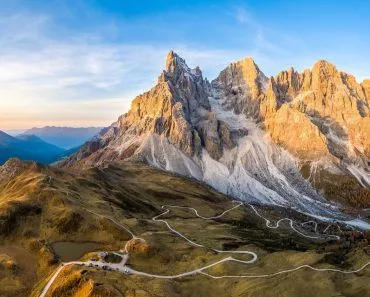
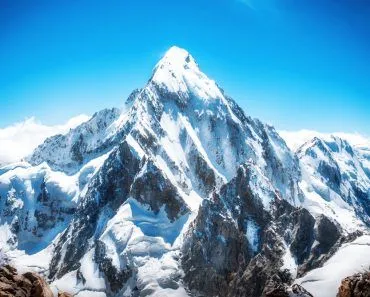
Earth has had billions of years and unlimited rock. Its tallest mountain stops at 8,849 meters (29,032 feet). The thought experiment assumed a floor that cannot sink. Earth does not have one.
The crust floats on the hot, slow-flowing rock of the mantle beneath it. A floating thing rides lower when you load it. Mauna Loa in Hawaii shows how much lower. The volcano rises about four kilometers above the sea, and its flanks run another five down to the sea floor. But the sea floor under it has sagged a further eight kilometers under the volcano's own mass. The summit ends up about seventeen kilometers above its base. Our article on why mountains do not sink covers this floating act, called isostasy.
So the planet gives way before the rock does. Victor Weisskopf of MIT made this a lecture-hall classic. He showed why peaks rarely rise above ten kilometers, “with the barest of algebra and no calculus in sight”.
Weather finishes the job. Above the snowline, glaciers grind summits down faster than the crust can push them up. Geologists call it the glacial buzzsaw. The weight removed lets the crust rebound and lift what is left. Together the two effects drive summits toward a window just below the snowline. Earth's mountains are limited by climate and a sagging floor, and only at a distance by the strength of rock.

Why Can Olympus Mons Stand 27 Kilometers Tall On Mars?
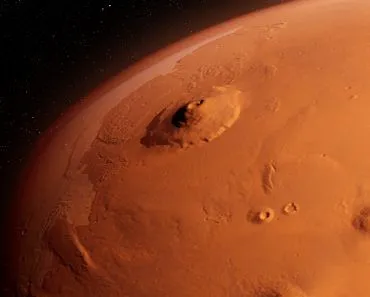
Mars, meanwhile, has a volcano that breaks the Earth rule. Olympus Mons stands about 27 kilometers high. That is three times the height of Everest.
Two things make it possible, and both are in the formula. The first is g. Gravity at the surface of Mars is a little over a third of Earth's. A column of rock there presses down with a little over a third of the stress the same column would produce here. Run Olympus Mons through ρgh and its base feels like the base of a ten-kilometer mountain on Earth.
The second is time in one place. On Earth the crust drifts over a volcanic hotspot and carries each volcano away before it grows too large. That is why Hawaii is a chain of islands rather than one monster. Mars has no plate tectonics, so the crust over its hotspot never moved. One long-lived eruption center fed Olympus Mons instead. The crust under it has sagged too, so its height is not a clean test of the crushing limit either. It is still the best evidence we have that the formula means what it says: lower g, taller pile.

So, How Tall Could A Pyramid Get Before It Crushes Itself?
The stress at the base of a solid pyramid is ρgh ÷ 3. The base width drops out, so height is the only thing that matters. For limestone like Khufu's, the base reaches crushing strength about seven to twenty-five kilometers up if the load is shared. If each column of blocks stands alone, the range is about two to eight.
The Great Pyramid uses about one percent of that budget. Whatever cracked in the Bent Pyramid cracked because its steep face let blocks slide and spread. A pyramid fails as a structure, by shifting, well before it fails as a material. The Red Pyramid's gentler slope records that lesson.
On a real planet there is also no floor that cannot sink. The crust flows out from under a growing mountain. Glaciers plane off anything that climbs past the snowline. Earth settles at about nine kilometers for those reasons. Mars, with weaker gravity and a crust that never moved, lets a volcano stand three times taller.
So yes, a pyramid has a theoretical point of failure. It is kilometers up, and on any real planet the first thing to give way is the ground it stands on.

References (click to expand)
- Great Pyramid of Giza — Britannica
- Dahshūr (Blunted Pyramid, Red Pyramid) — Britannica
- Mount Everest — Britannica
- Rock: Physical properties (density tables; stress and strain; brittle fracture to plastic flow) — Britannica
- Practical Rock Engineering, Table 2: Field estimates of uniaxial compressive strength — E. Hoek, Rocscience
- Normal variation of compressive strength for some rocks (compiled from Hanssen 1988, Hoek and Brown 1980, Hoek et al. 1992) — A. Palmstrom, RockMass.net
- Mauna Loa FAQs — U.S. Geological Survey
- Olympus Mons — NASA Science, Mars Facts
- Olympus Mons lava flows (PIA03763) — NASA Photojournal
- Mars Fact Sheet — NASA NSSDC
- Tectonics: Why does Mars have such big volcanoes? — Mars Education, Arizona State University
- Viki Weisskopf: Searching for Simplicity in a Complicated World — David Kaiser, MIT Physics Annual 2007
- Glacial effects limiting mountain height — Egholm, Nielsen, Pedersen and Lesemann, Nature (2009)
- Bent Pyramid — Wikipedia (supplementary: 54° and 43° slopes, bend height, Mendelssohn hypothesis and counterarguments)