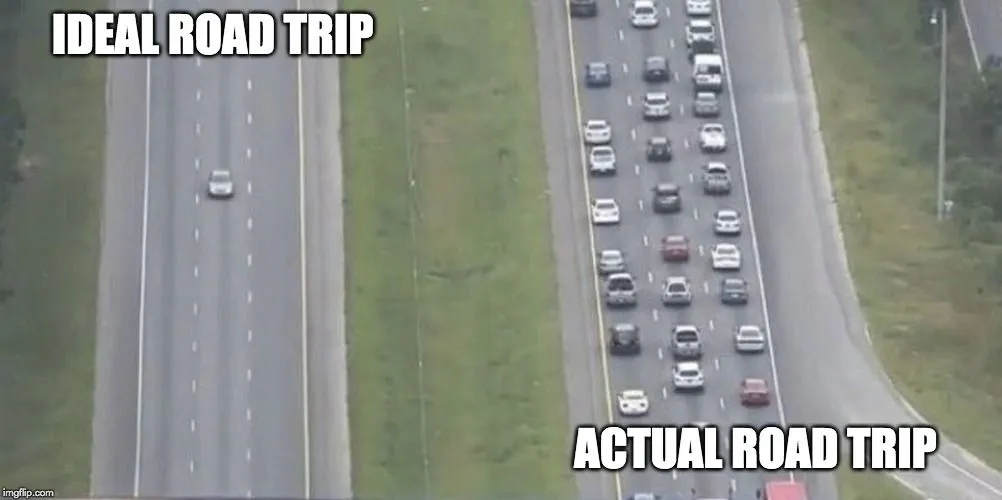
Groups of cars bunched together on a highway are called clusters, packs or platoons. They form, even without traffic lights, for a few reasons: drivers stuck behind someone misusing the passing lane, the habit of following a lead car to avoid a ticket, and the subtle pull of driving alongside others.
If you’ve ever taken a road trip across the country, then you have spent plenty of hours on the highway, sometimes with little to do except occasionally pass a lone truck. However, there are other times when you come over a rise and spy a large group of cars ahead, between 15-20, that all seemed to be grouped together on an otherwise empty highway. It seems unlikely that the mixture of cars and trucks would all be traveling together at a uniform speed, or caravanning to the same destination. Furthermore, with nothing ahead or behind the group for at least a kilometer (about half a mile), it seems more natural to spread out than to bunch together.
Despite these seemingly logical thoughts, all drivers have encountered these “packs” on highways and freeways, and have likely been just as mystified as you! Traffic engineers have names for them: a group of cars bunched together like this is called a cluster, a pack, or, more formally, a platoon. So… what causes cars on the highway to gather into these clusters, rather than each of them behaving as lone wolves?
Highway Lanes And Speeds
Everyone moves through life at their own pace, and the same thing is true on the highways of life; every driver prefers to move at their own speed. Some people strictly follow the speed limit, while some prefer a faster approach, and others may travel under the speed limit, particularly if they are in a large or unfamiliar vehicle. Due to this variability of speed, there are multiple lanes, typically increasing in speed from one side of the highway to the other.
For example, in a country where people drive on the right-hand side (i.e., USA, Russia, China, and about 2/3 of the planet), entry and exit ramps will be on the far right side of the highway, where speeds are typically slower for entering, exiting and merging. Moving to the left, there is often a center lane for literal “middle of the road” drivers, and the speed limit is often closely respected there. On the far left, nearest the median of the road, there is a passing lane, which is generally understood to be for cars that are driving faster than average. These lanes can also be called through lanes or express lanes, suggesting that these drivers aren’t planning on exiting or leaving the highway anytime soon. Note: In countries where people drive on the left-hand side of the road (i.e., the UK, Australia, New Zealand and Japan), these lanes and designations would be reversed.
For those who consider their driving to be on the “faster” side, the passing lane is a wonderful gift. When the passing lane is kept empty, except for those cars that are passing, a driver in a major hurry can increase their speed and move into the far left lane, passing those drivers in the middle and far right lanes. They can then merge back into the middle lane once the traffic ahead is cleared, or they can remain in the passing lane if they wish to maintain their elevated speed. Living “life in the fast lane” may save you time, but it also increases your chances of being pulled over for a speeding ticket, as you will often be exceeding the speed limit while passing other cars.
What Causes Packs To Form On Highways
In a perfect world, the execution of the strategy outlined above would result in the smooth flow of cars, each moving at their own desired pace, and an even distribution of cars along the highway (again, because each driver is unique). However, while the science on this phenomenon is difficult to study and therefore impossible to pin down with absolute certainty, there are some factors that are believed to contribute to the clusters or “packs” that we so often encounter while highway driving. Researchers who model traffic flow find that these clusters can emerge on their own, even on an open road with no signals or bottlenecks, simply from the random fluctuations in how individual drivers speed up and slow down.
Misuse Of The Passing Lane
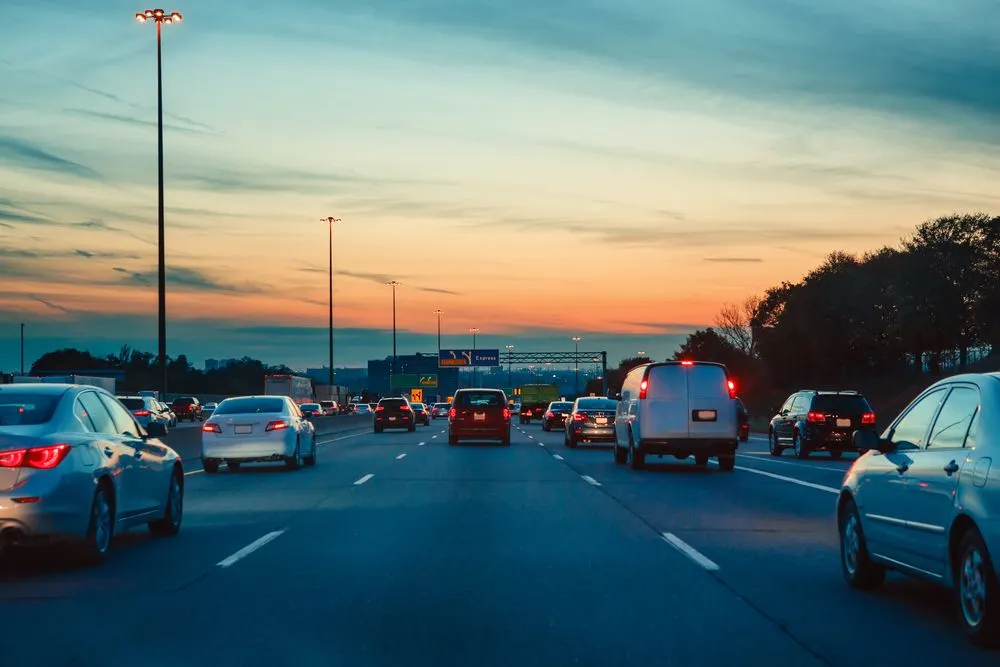
Slower cars using and remaining in the passing lane is perhaps the most common cause behind clumping on the highways. For example, if the right lane of a two-lane highway is filled with a string of trucks, most of the cars will be trying to pass, as trucks tend to travel below the speed limit. However, if a slower car enters the passing lane and remains at or below the speed limit, the flow of cars will be stymied, resulting in a backup and a “clump” of cars.
Even on three- or four-lane highways, the misuse of the passing lane can cause cars to merge into other lanes, where they will end up weaving and navigating through cars moving at slower speeds, often getting stuck in their route forward. Additionally, if there are a lot of cars on the highway, drivers will need to decelerate to accommodate the movement and variability of other cars. When one car brakes, others behind will follow, allowing fast-moving cars behind to catch up, creating a “pack” of cars waiting to return to their original, preferred speed.
It seems appropriate to note, at this point, that highway “packs” are often temporary and transient things, coming together and breaking apart over the course of a few kilometers (a couple of miles). However, we are prone to notice these groupings, as they require more attention and focus to navigate, so even though they are the exception, rather than the rule, we are still prone to notice and remember them.
Following A Lead Car
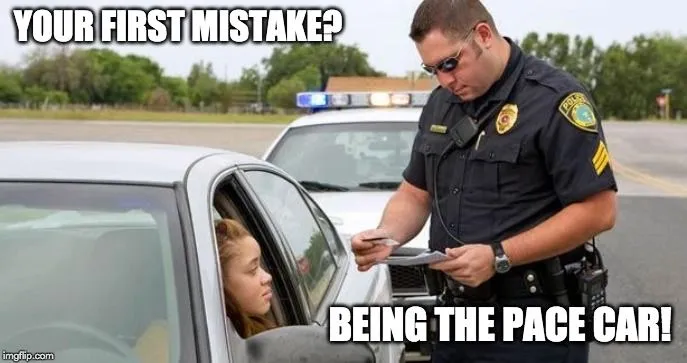
Another reason cars tend to clump together on the highway is our tendency to follow a lead car, particularly one that is moving a few kilometers per hour (a few mph) faster than us. This strategy allows the “pace car” to function as an early warning system for police on the highway. When they begin to brake, cars trailing by less than a kilometer (about half a mile) can similarly slow down to the speed limit, thus avoiding any traffic violations. When you have a dozen cars or so that are moving at or just above the speed limit, they might form a loose chain, with the lead car occasionally changing, as a way to prevent any individual from being pulled over.
Psychological Elements
In a slightly related way, there is also a comfort that comes with trailing another car at a safe distance. If you find yourself behind a car traveling at nearly the same speed, you can put on cruise control and simply drive, which requires less effort and attention than weaving into and out of the passing lane at a higher speed. Depending on your urgency and comfort level while driving, it may be more relaxing to position yourself behind another car and base your actions on their behavior, including increasing/decreasing speed and changing lanes.
Some studies have found that drivers who “pair” in this way begin to mimic the other partner, even in small nuances of lane location. When enough drivers adopt this behavior, albeit unconsciously, a pack will form on the highway. Basically, even when we’re alone in a car, life is a bit easier with a companion, even if it’s a complete stranger in another vehicle!
What Does It Mean When Traffic “Bunches Up”?
If you have ever heard a traffic report mention cars “bunching up,” that phrase describes exactly what we have been picturing: vehicles that ought to be spread evenly along the road instead clumping into tight groups. The same word turns up in public transit, where buses timed to leave at even intervals tend to slip into bunches (also called clumping, convoying or platooning) the moment one bus falls behind and the one behind it catches up. On a highway, the same thing plays out between individual cars, which is why a group of vehicles traveling together at a shared speed is formally called a platoon. These accidental packs are close cousins of phantom traffic jams, the mysterious slowdowns that ripple backward through traffic with no crash or bottleneck to explain them.

That word, platoon, now carries a second and very deliberate meaning, because engineers have started building platoons on purpose. In truck platooning, two to four trucks are linked by cooperative adaptive cruise control (CACC), a system that lets them swap information and brake and accelerate almost in unison while following each other at short gaps. Since the trailing trucks draft in the lead truck’s slipstream, the whole convoy cuts air resistance and saves fuel, according to the U.S. Department of Transportation’s Federal Highway Administration. So a pack of vehicles can be one of two things: an accidental clump thrown together by the flow of traffic, or an engineered convoy deliberately traveling as a single unit.
Is It Safe To Drive In A Pack?
“Pack driving” is the habit of settling into one of these clusters and matching the pace of the cars around you, letting the herd decide your speed. It feels reassuring, thanks to a comforting sense of safety in numbers, but most defensive-driving instructors advise against locking yourself inside a pack.

The trouble is space, or rather the lack of it. When you are boxed in on every side, you have nowhere to go if something ahead suddenly goes wrong. The Pennsylvania Driver’s Manual puts it bluntly, telling drivers to “avoid driving alongside other vehicles on multi-lane streets,” because “they block your view and close your escape route, and you are probably in their blind spot.” Inside a tight pack, all it takes is one distracted or hard-braking driver to trigger a chain reaction, and the closer everyone is bunched together, the less time each driver has to respond.
So the next time you crest a rise and spot a bunch of cars keeping pace with one another, the instinct to join them and cruise along at the same speed is the wrong one. The safer move is to ease off the gas and let the pack drift ahead, or, when the neighboring lane is clear, to pass through it, so that open road sits both in front of and behind you. Leaving a cushion of several seconds of following distance hands back the room, and the reaction time, that a pack quietly takes away.
A Final Word
Next time you’re flying down the highway and stumble upon a pack of cars spread across the lanes, instead of getting frustrated and tailgating or laying on the horn, slow down and try to determine what is causing the apparent slowdown. Defensive driving instructors actually recommend not staying inside one of these clusters: by easing off the gas and letting the pack drift ahead, you open up space around your car and give yourself room to react. Understanding why these packs form may help you navigate them more smoothly, and ensure that you have a safe, efficient and enjoyable trip on the highways of life!
References (click to expand)
- Daganzo, C. F. (2002, February). A behavioral theory of multi-lane traffic flow. Part I: Long homogeneous freeway sections. Transportation Research Part B: Methodological. Elsevier BV.
- Combinido, J. S. L., & Lim, M. T. (2012, November 5). Crowding Effects in Vehicular Traffic. PLoS ONE. Public Library of Science.
- Kerner, B. S., & Rehborn, H. (1996, May 1). Experimental properties of complexity in traffic flow. Physical Review E. American Physical Society (APS).
- Daganzo, C. F. (2002, February). A behavioral theory of multi-lane traffic flow. Part II: Merges and the onset of congestion. Transportation Research Part B: Methodological. Elsevier BV.
- Federal Highway Administration. (2021, January). Effective Indicators of Partially Automated Truck Platooning (FHWA-HRT-21-016). U.S. Department of Transportation.
- Saw, V.-L., Chung, N. N., Quek, W. L., Pang, Y. E. I., & Chew, L. Y. (2019). Bus bunching as a synchronisation phenomenon. Scientific Reports, 9, 6887.
- Pennsylvania Department of Transportation. Managing Space. Pennsylvania Driver's Manual.