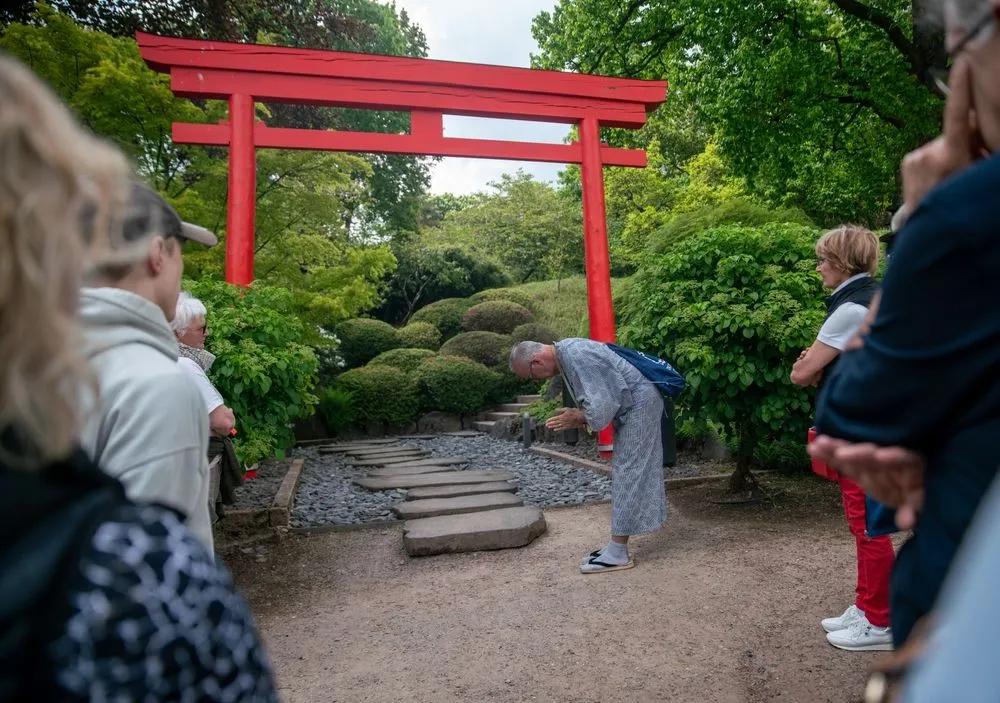
The Japanese bow, or ojigi, signals respect, humility, and acknowledgment. It grew from Buddhist devotional bowing introduced in the 6th century and was later formalized into samurai etiquette. The deeper and longer the bow, the more respect it conveys, ranging from a casual 15-degree nod to a formal bow of 45 degrees or more.
In the varied interactions of global greetings, while some people shake hands, others hug, and a few exchange cheek-kisses, Japanese citizens elegantly bend forward, weaving centuries of culture into a simple bow. However, before you dismiss this gesture as a mere bend at the waist, you must understand that there is more than meets the eye when you witness the practice of ojigi… this simple gesture is not as easy as you might assume.
Echoes From The Past: The Origins Of Ojigi
Bowing in Japan, or ojigi, is a profound and emblematic cultural tradition that encapsulates respect, humility, and acknowledgment. This nuanced gesture, prevalent in Japanese society, has a deeply rooted history in religious and warrior class customs.
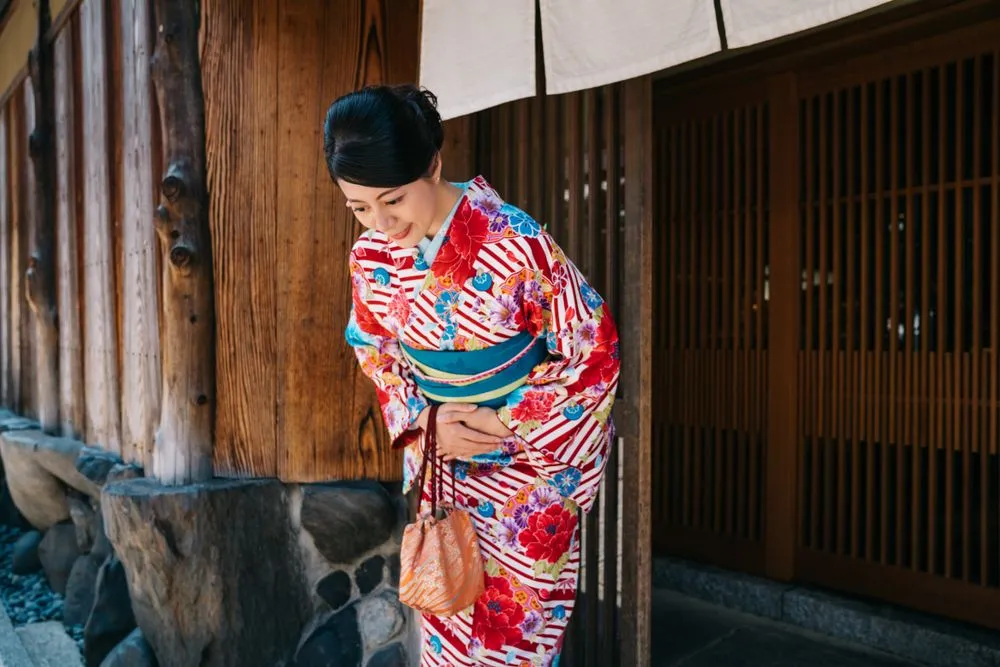
Bowing in Japan has been intrinsically linked to Buddhism, which arrived in the island nation in the 6th century (traditionally dated to 538 or 552 CE, by way of the Korean kingdom of Baekje). The highest form of a bow is reserved for gods and buddhas.
With Buddhism came the custom of bowing as a gesture of piety and respect. In religious contexts, devotees would bow to Buddha statues as a sign of deep devotion, while disciples would show their admiration by bowing to their masters. These religious practices have ensured that the ojigi remains relevant in Japan over the centuries.
Some scholars trace the deeper roots of the gesture all the way back to the agricultural rites of the Yayoi period (roughly 300 BCE to 300 CE), but it was the Heian court (794 to 1185) that first distinguished standing bows (ritsurei) from seated ones (zarei), laying down the prototype of the modern bow. By the Kamakura period, the warrior class, known as samurai, began to prominently influence societal norms. Samurai values, infused with Zen Buddhism teachings, contributed to a disciplined and regimented form of etiquette. Ojigi, as a part of this etiquette, became a more structured and practiced custom within the warrior class.
Handbooks Of Etiquette: The Muromachi Manuals
During the subsequent Muromachi period, the complexities of samurai etiquette found their way into written manuals. Prestigious schools like Ise and Ogasawara meticulously detailed the various aspects of proper behavior, including the intricacies of bowing.
These codified norms for ojigi had variations tailored for diverse scenarios, ranging from temple visits to formal indoor meetings. However, the rise of the chaotic Sengoku Era temporarily halted these intricate customs. As Japan grappled with internal strife, ideas of structured etiquette took a backseat.

The calm of the Edo period provided a much-needed respite and rejuvenation for these delicate customs. With the era’s peace and prosperity, the samurai class, perched atop the societal hierarchy, became cultural trendsetters. Their etiquette, especially ojigi, permeated all societal layers. The period’s urban expansion and artistic proliferation, combined with the rising prominence of tea ceremonies, further championed etiquette norms.
The Spectrum Of Bows: Variations And Nuances
Japanese bowing isn’t monolithic; it consists of different styles based on various situations and intent:
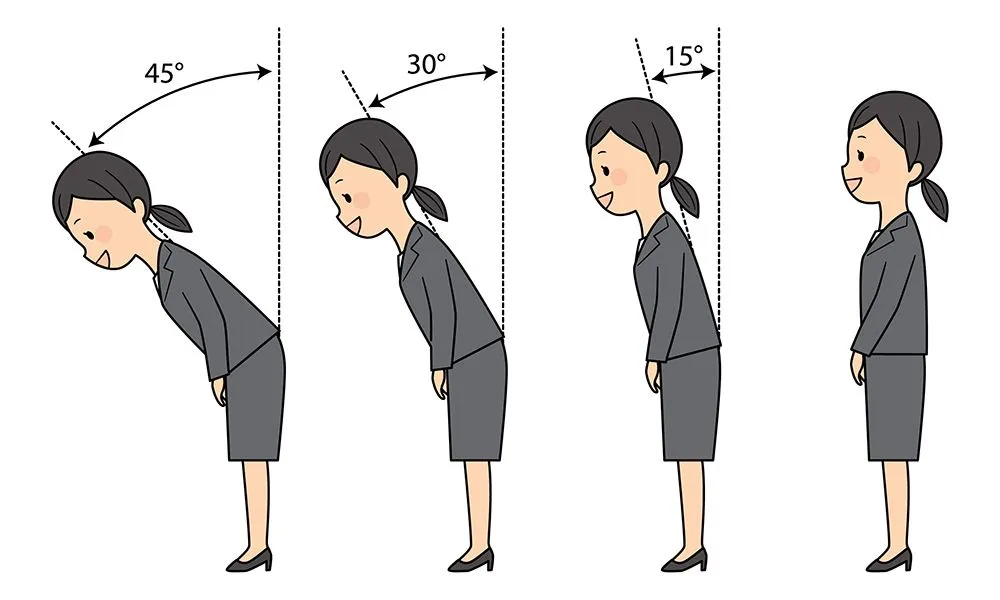
- Eshaku: This casual 15° standing bow is a common greeting among equals. It’s succinct, but not rushed, like a wave to greet someone with whom you are starting a conversation.
- Keirei: A more formal standing bow of about 30°, commonly used in business settings and reserved for individuals of higher status.
- Saikeirei: The deepest standing bow, typically a 45° to 70° bend held for a few seconds, this is an embodiment of sincere regret, deep reverence in religious contexts, or profound apologies.
- Senrei: A seated bow (one of the zarei performed from the kneeling seiza posture), with a slight roughly 30° inclination apt for semi-formal settings.
While the physical act might seem straightforward, the underlying etiquette is intricate. To illustrate my point, here’s what you can infer from a bow:
– Combining handshakes with bows is not advisable;
– During a bow, it’s crucial to avert eye contact. In Japanese culture, direct eye contact while bowing can be seen as confrontational;
– The depth and duration of one’s bow should mirror the social dynamics at play. A deeper bow signifies more profound respect, particularly towards seniors or superiors.
Dogeza: Japan’s Deepest Bow
Deeper than any of the standing bows sits the dogeza (土下座), whose name literally means to sit down upon the earth. Instead of bending at the waist, the person kneels directly on the ground and lowers the head until the forehead nearly touches the floor. It is the most extreme gesture in the whole vocabulary of ojigi, reserved for showing deference to someone of far higher status, offering a profound apology, or pleading for a great favor. English speakers usually translate it as “prostration” or “kowtow”.

The posture is astonishingly old. The earliest surviving mention appears in the Gishiwajinden, the oldest Chinese chronicle to describe the people of Japan, which records that commoners of the Yamatai kingdom would fall prostrate on the spot when they met a nobleman. Clay haniwa figures from the later Kofun period have been found frozen in the same kneeling pose. Through the Edo period, ordinary people were still expected to drop into a dogeza when addressed by a superior.
Today the gesture is rare, and that rarity is precisely what gives it force. Modern Japanese reserve the dogeza for moments when someone has strayed far outside expected behavior, and it reads less as an acknowledgment of rank than as a whole-body plea for mercy. It is the dramatic depth mentioned at the end of this article, and the reason a saikeirei, however formal, is only the deepest bow one can perform while still on one’s feet.
Bows Around The World
Now, it’s vital to understand that the essence of bowing transcends its physicality. It’s a gesture that signifies the willingness to momentarily set aside one’s ego, showcasing a respect that places the other individual on a pedestal.
The act of bowing, especially in the Japanese context, is symbolic of acceptance, submission, and a recognition of the worth of the person receiving the bow.
While the act of bowing is universal, from subtle nods in European churches to touching an elder’s feet in India as a sign of respect, Japan’s bowing culture stands out for its continued prominence and deeply ingrained societal norms.
Each bend and each angle are not just about physical motion, but a reflection of one’s intent, understanding, and the depth of acknowledgment of the other’s position in the societal fabric.
When And Where Do Japanese People Bow Today?
For all its ancient roots, the bow is no museum piece; it punctuates ordinary Japanese life dozens of times a day. People bow to say hello and goodbye, to open and close a meeting or a class, to thank someone, to apologize, to offer congratulations, and to ask for a favor. Bows in Japan quietly do the social work that a handshake, a wave, or a clink of glasses does elsewhere.
The depth simply scales with the moment. A quick 15° eshaku covers a passing greeting or a small word of thanks, a 30° keirei handles most business courtesies, and a deep saikeirei is saved for a sincere apology or an audience with someone of very high rank. Service culture turns the volume up further: railway staff can even be seen bowing to the trains themselves as they pull away from the platform, a gesture of gratitude toward the departing passengers.
Perhaps the clearest sign of how deeply the habit is ingrained is what happens on the telephone. Many Japanese will bow instinctively during a phone call, dipping the head to a caller who cannot possibly see them. The custom long outlasted the age of the samurai who helped formalize it, and shows no sign of fading from modern life.
Conclusion
In contemporary times, while many cultural traditions around the globe are being diluted, Japan’s bowing culture remains resilient. From casual encounters on the street to formal business settings and visits to temples, it’s an omnipresent gesture that harmoniously blends tradition with contemporary life.
Ojigi is not merely a physical gesture, but a window into Japan’s rich cultural tapestry. It’s a testament to centuries of evolving societal norms, religious influences, and class dynamics. Each bow, with its varying degrees and contexts, narrates a tale of respect, acknowledgment, and humility.
Whether it’s the dramatic depth of a Dogeza bow or the subtle bend of a business greeting, Japan’s bowing tradition is a captivating blend of history, etiquette, and societal values. So, the next time you find yourself facing a situation where the ojigi is called for, remember, it’s not just a bend, but a tangible bridge to centuries of tradition.
References (click to expand)
- Amri, M. (2019). Ojigi: The Ethics of Japanese Community's Nonverbal Language. Proceedings of the Social Sciences, Humanities and Education Conference (SoSHEC 2019). Atlantis Press.
- Bowing as a Communicative Gesture. Springer.
- Buddhism in Ancient Japan. World History Encyclopedia.
- Bowing in Japan. Wikipedia.
- Dogeza. Wikipedia.
- Bowing in Japan: The Definitive Guide. Tofugu.