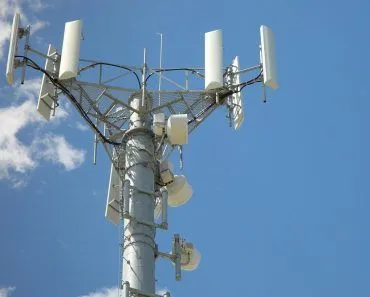
A cell tower, also called a cell site or base transceiver station (BTS), is a tall structure carrying antennas that transmit and receive radio-frequency signals to and from mobile phones in a defined area called a "cell." Most macro towers are 50-200 ft (15-60 m) tall and cover anywhere from a few hundred meters in dense cities to about 45 km (28 mi) in flat rural terrain. They can be standalone lattice towers, monopoles, or rooftop installations.
A cell tower (also called a cell site) is a cellular-enabled mobile device tower where an antennae and other electronic communications equipment are placed—usually on a tower, radio mast, or other raised structure—to facilitate communication through a cellular network, i.e., enable your mobile devices to function.
If you’re like roughly half of your American neighbors, then you own a cordless phone system that plugs into your home telephone line. A cordless handset, as the name suggests, connects wirelessly to what is technically called a base station—allowing you to have uninterrupted voice communication, while maintaining a link to the wires of the public switched telephone network (PSTN). For the uninitiated, PSTN refers to the international telephonic system standard that uses copper wires to carry analog voice data. When it comes to their working principle, a cellular tower and a base station that enables voice and data services for an Android or iPhone aren’t much different, except that the towers are built to cover a wide geographic area much larger than your home. Moreover, a cell tower is designed to simultaneously support hundreds of devices and operate on different radio frequencies. Cell sites allow users to maintain their connections while traveling from one base station to another, even while driving at 100 miles/hour on a fast-lane highway.
How Do Cell Towers Work?
A modern cellular network is organized as a honeycomb of overlapping cells, each one centered on a base station with directional antennas pointing outward, usually in 3 sectors of 120 degrees each. When you make a call or open an app, your phone sends radio-frequency (RF) signals on a licensed band (often somewhere between 600 MHz and 6 GHz for 4G/5G, and 24-40 GHz for 5G millimeter-wave) to the nearest tower with adequate signal strength. The tower's baseband unit digitizes the signal and forwards it through a fiber-optic or microwave backhaul link to the carrier's core network, which routes it to the recipient through the public switched telephone network (for voice), the carrier's data network, or the wider internet.
The tower itself isn't just an antenna; it's a small radio site. A typical macro cell site includes panel antennas at the top, remote radio units (RRUs) mounted close to the antennas, an equipment shelter or cabinet at the base with the baseband unit, an uninterruptible power supply and batteries, an air-conditioning unit, GPS for timing synchronization, and a fiber or microwave link back to the carrier's network. As you drive between cells, the network performs a handover in milliseconds, transferring your active session from one tower to the next so the connection stays alive.
What Are The Different Types Of Cell Towers?
Not every cell tower looks the same, and the shape you see by the roadside is really an engineering compromise between height, cost, land and how much a local council will let the structure stand out. Four main designs cover most of what carriers build.

Monopole towers are the single steel tubes you see along highways, usually 30-60 m (100-200 ft) tall, with the antennas bolted to the outside. They take up very little land and go up quickly, which is why developers tend to reach for them first.
Lattice towers, also called self-support or free-standing towers, are the classic criss-crossed steel frameworks. They typically stand 60-120 m (200-400 ft) on a triangular or square base, need a bigger foundation, and can carry far more antennas and tenants than a monopole, at the cost of more steel and more maintenance.
Guyed towers are slender masts held upright by tensioned steel cables (guy wires) anchored to the ground. Per foot of height they are the cheapest to build, so they are favored for very tall broadcast masts, some of which top 600 m (about 2,000 ft). The trade-off is a large land footprint, because the guy anchors splay out well beyond the base.
Stealth or concealed towers are disguised to satisfy zoning rules and keep neighbors happy. They masquerade as pine trees (nicknamed "monopines"), palm trees, flagpoles, church steeples, water tanks and even cacti. The camouflage costs extra and often leaves room for fewer antennas, but it lets a carrier put coverage exactly where a bare tower would never win approval. On top of these, carriers increasingly bolt small cells to lampposts, utility poles and building walls, and mount rooftop antennas in dense cities, to add capacity without erecting a full tower.
The Range Of A Cell Tower
The "range" of a cell tower depends on terrain, frequency band, antenna height, transmit power and the type of cell. As a rough guide:
- Macro cells (the big lattice and monopole towers) typically cover 1-2 km in dense urban areas, 2-5 km in suburbs, and up to roughly 45 km (28 mi) over open flat terrain. GSM 850 MHz can theoretically reach 35 km, the protocol's hard timing limit; LTE can go further with cell range extension techniques.
- Small cells and microcells covering a few hundred meters are increasingly used in stadiums, airports and dense downtown blocks to soak up traffic the macro tower cannot handle.
- 5G millimeter-wave (24-40 GHz) drops to as little as 100-300 m per cell because high-frequency signals are easily blocked by walls, trees and even rain, which is one reason 5G deployment requires far more sites than 4G.
Lower-frequency bands travel further but carry less data, so carriers mix bands by reusing the same lower spectrum on cells that are far enough apart to avoid interference, which is the "cellular" idea that gave the system its name.
How Is A Cell Tower Built?
Building a cell tower is less about the steelwork and more about the paperwork. The process starts when a carrier's radio planners spot a coverage gap or "dead zone" and pick a site that fills it. They then secure a land lease and, crucially, local zoning and permitting approval, which is usually the slowest part of the whole project. On an unregulated rural parcel a site can go from lease to live in under 60 days, while in tightly regulated or coastal areas the approvals can drag on for months or even years.

Once permits are in hand, crews dig and pour a reinforced concrete foundation strong enough to hold tons of steel and resist wind loads (guyed masts also need separate concrete anchor blocks for their cables). A crane then lifts prefabricated steel sections into place, and workers bolt or weld them together as the tower climbs. Panel antennas and remote radio units go on near the top, fiber and power cables run down to the equipment cabinet at the base, and the whole structure is grounded and fitted with lightning protection.
The physical build is surprisingly quick. Erecting the tower and installing the equipment typically takes only one to two months once approvals clear, followed by testing and commissioning before the site goes live. In other words, the tower that took years to approve can be standing and switched on in a matter of weeks.
Can Cell Towers Cause Cancer?
The radio waves transmitted by cell towers are non-ionizing: their photons carry too little energy to break chemical bonds or damage DNA the way X-rays or gamma rays can. The U.S. Federal Communications Commission sets RF exposure limits well below the threshold known to cause heating in tissue, and field measurements near typical cell towers usually show exposure thousands of times below those limits. In 2011, the International Agency for Research on Cancer (IARC, part of the WHO) classified RF electromagnetic fields as Group 2B, "possibly carcinogenic to humans," largely on the basis of some epidemiology of heavy mobile-phone users, not specifically tower emissions. Major reviews since, including by the U.S. National Cancer Institute and the FDA, have not found a consistent causal link between living near cell towers and any kind of cancer.
Cells-on-wheels (COWs)
A Cell on Wheels, or COW, is a portable cell site mounted on a trailer or truck. Carriers roll out COWs for temporary or emergency coverage: large events like the Super Bowl, music festivals and political rallies that briefly overwhelm permanent capacity, as well as disaster zones where hurricanes, wildfires or earthquakes have knocked out fixed towers. A modern COW typically carries a telescoping mast, panel antennas, an RRU and baseband unit, a generator, and either a fiber drop or a microwave/satellite backhaul link, so it can stand up a working cell within hours. Variants include COLTs (Cell on Light Trucks) and SatCOLTs (with onboard satellite backhaul) for situations where terrestrial fiber is down.
Future Of Cell Towers
With the introduction/discovery of efficient digital protocols associated with booming and upcoming 4G and 5G technologies, complimented by the additional spectrum availability, many mobile network providers are now looking to recombine cell towers. This would permit network operators to decrease the number of towers being used. This would, in turn, bring down the operating expenses associated with each tower. All of this would translate into increased revenues and profits for telecom players. For example, a while back, Sprint eliminated close to one-third of its cell sites. This translated into a reduction of almost 20,000 cell towers. We might see more operators following suit in the near future.
References (click to expand)
- Wireless Devices and Health Concerns - U.S. Federal Communications Commission
- Cell Phones and Cancer Risk - U.S. National Cancer Institute
- IARC Classifies Radiofrequency Electromagnetic Fields as Possibly Carcinogenic - International Agency for Research on Cancer, World Health Organization
- Cell Phone - Encyclopaedia Britannica
- Yang, J. et al. (2010). Accuracy Characterization of Cell Tower Localization - ACM UbiComp
- Types Of Cell Towers (Monopole, Lattice, Guyed, Concealed) - Steel in the Air
- Understanding Cell Phone Tower Construction - Northstar Towers
- How Long Does It Take To Construct A Cell Tower? - JP Tower Consulting