Table of Contents (click to expand)
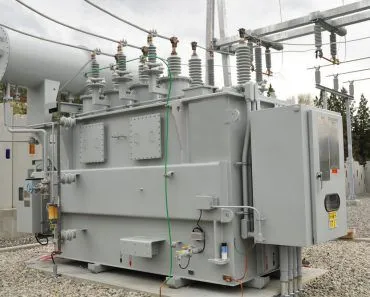
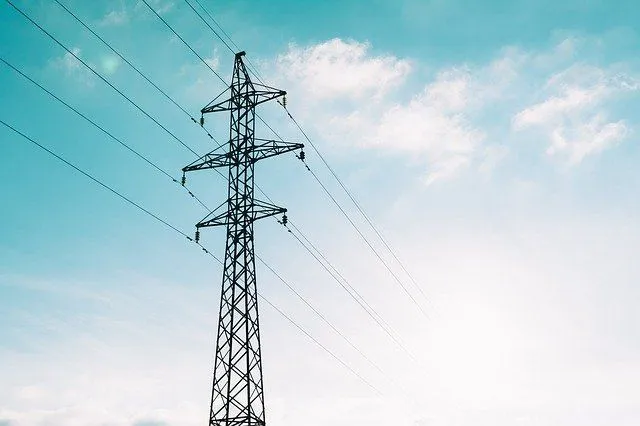
Electric power transmission moves bulk electricity from a power station to distribution networks. Transformers step the voltage up to 110 kV or more so less current flows and less energy is lost as heat. The electricity travels along high-voltage overhead lines, almost always bare aluminum, then is stepped back down and delivered to the socket in your home.
Electric power transmission is a very large sector of industry, despite being a subset of electric power generation. Electric power transmission is the bulk movement of electrical energy from the site of its generation (such as a power station) to the sites of distribution. The interconnected power lines that we see stretching over barren land from the city to the horizon compose the transmission network. It is only due to modern electric power transmission that electricity has been easily transported to different geographical areas and topographies where it was once inconceivable for electricity to reach. Before we jump into the nuances of electric power transmission, let’s first take a look at the history behind it.
History
In the earliest days of electric power transmission, it only dealt with the transmission of current of a constant voltage, also known as Direct Current (DC). The trouble with DC was the opposite of what you might expect: with the technology of the time, there was no practical way to step its voltage up for the journey and back down again at the other end. So DC had to be sent out at roughly the same low voltage it was generated at, around 110 volts. At low voltage you need a large current to deliver a given amount of power, and large currents bleed energy away as heat in the wires. That made it highly ineffective and economically unfeasible to push DC more than a mile or two. It also meant the generation stations had to sit close to the load they served, which would have demanded a large number of small generating stations dotted across every city.
Fortunately, this problem was soon put to rest with the advent of Alternating Current (AC). This type of transmission took off after Lucien Gaulard and John Dixon Gibbs built their "secondary generator," an early transformer, in 1881. The first long-distance AC line was 34 km (21 mi) long and was built for the 1884 International Exhibition in Turin, Italy. It was powered by a Siemens & Halske alternator delivering 2 kV at 130 Hz. Several Gaulard secondary generators were strung along the line with their primary windings wired in series, and the lower-voltage output from their secondary windings fed the incandescent lamps that lit up the streets, a vivid demonstration of stepping voltage down close to where the power was actually used. This system was a solid foundation upon which AC transmission could prove itself for long-distance power delivery.
Overhead And Underground Transmission
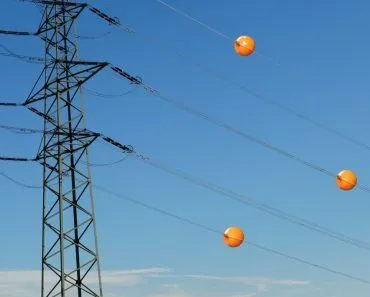
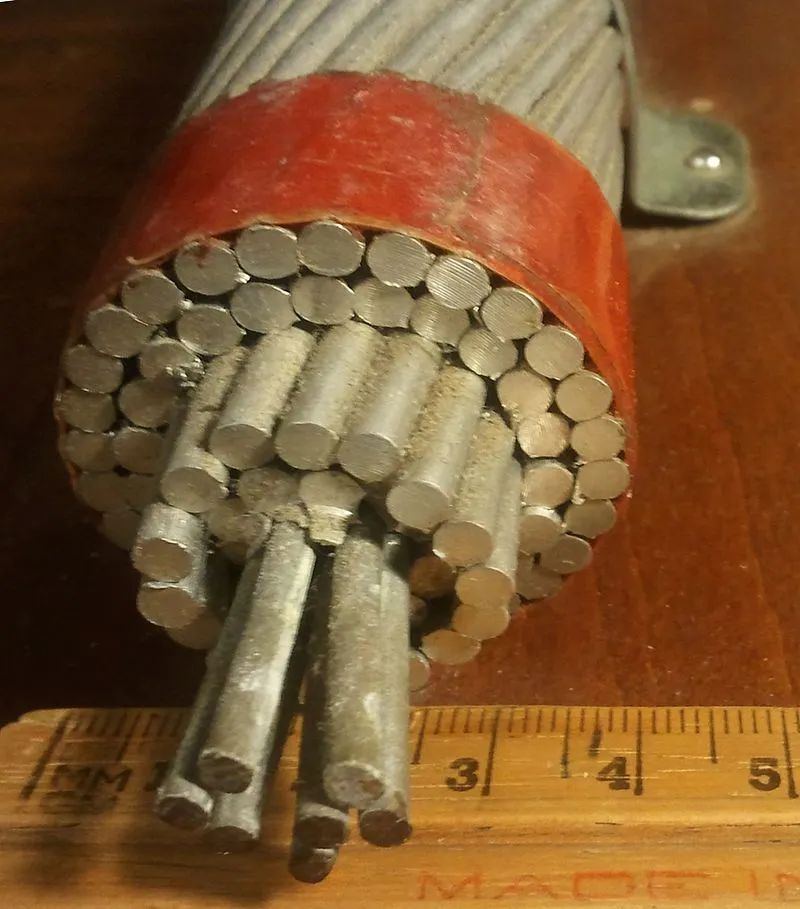
The most common type of electrical power with which most of us are familiar is overhead transmission. These high-voltage overhead transmission lines do not come with any insulation. The conducting material used for these long-distance lines is almost always aluminum, usually in the form of aluminum-conductor steel-reinforced (ACSR) cable, in which aluminum strands carry the current and a steel core gives the conductor the tensile strength to span the towers with far less sag than aluminum alone could manage. Even though copper is a better conductor than aluminum, aluminum is still the metal of choice. Aluminum conducts only about 61% as well as copper for the same cross-section, but pound for pound it actually carries more current, because it is roughly a third the weight. That lighter weight lets towers stand farther apart, and aluminum is several times cheaper than copper, so over the length of a transmission line the savings are enormous. Overhead transmission lines are manufactured by various companies around the world.
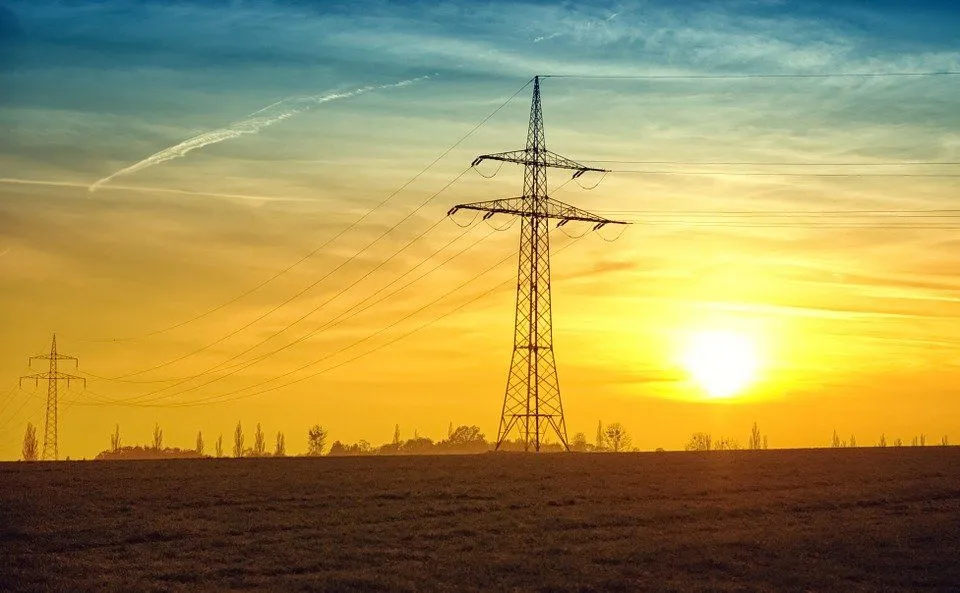
Today’s transmission-level voltage for overhead lines is 110 kV and above. Voltages of 66 kV and 33 kV are considered sub-transmission and are used for long lines when the loads are light. Voltages below 33 kV fall within the distribution part of the grid. However, there are some problems that accompany the usage and erection of these overhead transmission lines. Adverse weather conditions, such as high wind and low temperatures, can lead to serious power outages. Wind speeds as low as 43 km/h (27 mph) can set the conductors swinging far enough that neighboring wires encroach on each other’s safe clearance, which can trigger a flashover (an electric arc jumping the gap) and a loss of power.
Another way to overcome the shortcomings of overhead transmission lines is by using underground transmission lines. The best aspects of underground cables are that they can take up less line length than overhead lines. They are also not affected by the weather and have low to zero visibility. The major cost they incur appears at the front, i.e., excavation costs and insulation costs. Not only that, but the maintenance and repair of these lines are far greater, as it is hard to locate and reach the specific point that requires attention.
In metropolitan areas where this method of transmission is employed, they’re covered by a thick metal pipe and insulated with a dielectric medium. This proves to be an ingenious method on a number of fronts. If a fault were to occur that would damage the outer metal piping, it would cause the dielectric medium to leak out into the soil, thereby preventing further damage. Liquid nitrogen trucks are frequently employed to freeze portions of the pipe to enable the draining and repair of the damaged pipe section. The temperature of the pipe and soil are usually monitored constantly throughout the repair period. Underground lines are strictly limited by their thermal capacity, which permits less overload or re-rating than overhead lines. Long underground AC cables also have significant capacitance, which draws a large charging current and can sharply reduce their ability to deliver useful power to loads more than about 80 km (50 mi) away. For really long underground or undersea runs, engineers often switch to high-voltage direct current (HVDC) instead, which sidesteps the capacitance problem entirely.
Why Are Power Lines Deliberately Left Sagging?
Look up at almost any transmission line and you will notice something that looks like sloppy workmanship. The wire never runs straight from one tower to the next. It droops, sometimes deeply, hanging in a lazy curve before climbing to the next crossarm. It is tempting to assume that nobody bothered to pull it tight. In reality, that droop is one of the most carefully calculated numbers on the entire line.
The reason is that a metal conductor has no fixed length. It lengthens when it is warm and shortens when it is cold, and an overhead line is heated from two directions at once: by the sun and the surrounding air, and by the current it is carrying. As the U.S.-Canada Power System Outage Task Force put it, "heating also causes the metal conductor to stretch or expand and sag closer to ground level."

The swing is not subtle. On a summer day, the task force noted, conductor temperatures can climb from roughly 60°C on a morning with average wind to 100°C when the air is hot and the wind drops. One American utility's sag table for a bare ACSR conductor shows what that does across a 60 m (200 ft) span: the wire hangs about 20 cm (8 inches) below its supports at -18°C (0°F), and about 53 cm (21 inches) at 32°C (90°F). Same wire, same towers, well over twice the droop.
So engineers string lines expecting precisely that. "Transmission lines are designed with the expectation that they will sag lower when they become hotter," the task force wrote, which is why "towers and conductors are designed to be tall enough and conductors pulled tightly enough to accommodate expected sagging and still meet safety requirements."
The cold months are where the slack earns its keep. In that same utility table, the conductor pulls on its supports with about 264 pounds of force at 32°C (90°F), but 741 pounds at -18°C (0°F). As the wire cools it tries to shorten, the curve flattens, and the tension climbs steeply. The sag, in other words, is the give in the system. A line strung dead straight on a mild afternoon would have no slack left to surrender on a freezing night, and the contraction would have nowhere to go except into tension against the towers and the wire itself. That is why utilities limit how hard a conductor may be pulled in the first place: PG&E's transmission design criteria hold ACSR to 25% of its rated strength at 4°C (40°F) under final conditions, and never permit the resultant tension to exceed 50%.
How Much Sag Is Too Much?
If sag is deliberate, something has to decide how much of it is acceptable, and that something is clearance. These conductors are bare and uninsulated, so they must stay a specified distance above whatever lies beneath them. PG&E's design criteria require a new 230 kV line to clear the ground by 32 feet (9.8 m) under normal conditions, and a new 500 kV line by 37 feet (11.3 m). There is a second, lower bar reserved for emergencies, 29 feet (8.8 m) on that same 230 kV line, and this one is checked with the conductor assumed to be running hot: for ACSR, at 90°C (194°F). The rulebook, in other words, already takes it for granted that the wire will hang lower on a bad day than on an average one.

Come too close and the air stops cooperating. Air is an excellent insulator, but only up to a point, and a 345,000-volt conductor does not need to physically touch a tree to fault against it. As the task force noted, a short circuit or "flashover", which can start fires or damage equipment, "can occur if an energized line gets too close to another object." It is one reason the ground beneath a transmission corridor is kept stubbornly clear of anything tall, and one of the trade-offs lurking in the background when people ask why power lines aren't simply buried underground.
Here is the part that catches most people off guard: this geometry, rather than the metal itself, is usually what caps how much electricity a line is allowed to carry. Push more current through it and the conductor runs hotter, hotter means longer, longer means lower, and lower eats into the legal clearance. The U.S. Department of Energy puts it plainly. A line's rating may be set by the conductor's maximum operating temperature, "or, more typically, by the minimum allowable conductor-to-ground clearance (which is determined by safety codes)." In practice, the DOE adds, "safety codes regarding conductor-to-ground clearance are typically the limiting factor of capacity." Emergency ratings tend to cap the conductor's internal temperature near 100°C (212°F) for exactly that reason, "so that it does not sag too low."
The most famous story attached to all this deserves some care. On August 14, 2003, three of FirstEnergy's 345 kV lines in Ohio short-circuited against trees within 36 minutes of one another, early links in a chain that ended with an area holding an estimated 50 million people losing power. It is often retold as a tale of lines sagging into trees, but the task force was pointed about the distinction: "Overgrown trees, as opposed to excessive conductor sag, caused each of these faults. While sag may have contributed to these events, these incidents occurred because the trees grew too tall and encroached into the space below the line which is intended to be clear of any objects, not because the lines sagged into short trees." At the Harding-Chamberlin site, investigators measured the conductor 14.2 m (46 feet 7 inches) above the ground and the felled tree at 12.8 m (42 feet), a figure the report treats as a minimum, since parts of the tree had already been carted off before anyone measured it. The wires were doing what they were designed to do. The trees were the ones out of spec.
This clearly shows that various kinds of transmission have their respective pros and cons. The bottom line is that the transmission of electricity from the power station to the power socket in your home is no small feat!
References (click to expand)
- Electricity delivery to consumers. U.S. Energy Information Administration (EIA).
- EME 801: Energy Markets, Policy, and Regulation. Penn State.
- Electric power transmission. Wikipedia.
- Final Report on the August 14, 2003 Blackout in the United States and Canada: Causes and Recommendations. U.S.-Canada Power System Outage Task Force (April 2004).
- Dynamic Line Rating Systems for Transmission Lines: Topical Report. U.S. Department of Energy (April 2014).
- Overhead Transmission Line Design Criteria (Document 068177). Pacific Gas and Electric Company.
- Conductor Sag Tables - ACSR (106-15). Design and Construction Manual, We Energies.