A hydraulic press is a machine that uses Pascal’s Principle to multiply force. A small force F1 on a small piston of area A1 creates pressure F1/A1 in the fluid; that same pressure acts on a much larger piston of area A2, producing a much larger output force F2 = F1 × (A2/A1). That is how a small input on the slave cylinder can crush a car at the master cylinder.
If you’ve ever been to a dumpster or industrial area, chances are that you would have come across a hydraulic press. The machines you might have seen are used for crushing cars, molding and casting metal objects, and a whole host of other applications. Any kind of work that involves the application of high pressure over a finite and small area is the perfect job for the hydraulic press. Now, let’s look at what principle the hydraulic press is constructed on.
The hydraulic press relies on Pascal’s Principle, established by the French mathematician Blaise Pascal in his 1647-1648 hydrostatics experiments and laid out in his posthumously published Traité de l’équilibre des liqueurs (1663). Pascal’s Principle states that a pressure change applied at any point in a confined, incompressible fluid is transmitted undiminished throughout the fluid, in every direction.
For a hydraulic press, that means the pressure on the small piston must equal the pressure on the large piston:
F1 / A1 = F2 / A2
Rearranging gives F2 = F1 × (A2 / A1), where F1 is the input force on the small piston, A1 is the area of that small piston, F2 is the output force on the large piston, and A2 is the area of the large piston. If the large piston has 100 times the area of the small piston, the output force is 100 times the input. The ratio A2/A1 is the press’s mechanical advantage. What you gain in force, you lose in distance: the large piston only moves 1/100th as far as the small piston for the same fluid volume.
How Exactly Does A Hydraulic Press Work?
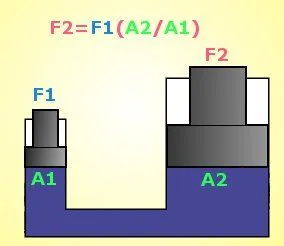
Now that we are aware that the hydraulic press is based on Pascal’s Principle, we can move on to the construction and working of the hydraulic press. The components of a hydraulic press include cylinders, pistons, and hydraulic pipes. The working of the press is quite simple and primitive. The system comprises two cylinders that are filled with a fluid. The fluid present inside the two cylinders is usually oil. The fluid (the oil) is filled into the smaller cylinder, which is also known as the slave cylinder.
A piston is inserted into the slave cylinder and pressure is applied. The pressure applied causes the fluid to move through a pipe and into a larger cylinder. The larger cylinder is known as the master cylinder. Because Pascal’s Principle requires equal pressure on both pistons, the same pressure now pushes upward on the much larger master piston, producing a much larger output force (F2 = F1 × A2/A1). The master piston travels a shorter distance than the slave piston does, because the same volume of fluid is being pushed. An industrial hydraulic press comes along with what is known as the press plates. With the help of these press plates, the material to be worked on is either punched or crushed into sheets.
What Are The Main Parts Of A Hydraulic Press?
The two-cylinder picture is the physics, but a working machine needs a few more parts to turn that physics into a useful tool. Whether you are looking at a benchtop laboratory press or a press the size of a building, the core components are the same.

- The frame is the steel skeleton that holds everything in place and absorbs the reaction force. Two shapes are common: the open C-frame (shaped like the letter C, giving easy access from three sides) and the stiffer H-frame (a closed rectangle that resists flexing and spreads the load evenly).
- The cylinder and its piston are where Pascal’s Principle does its work, converting fluid pressure into a straight-line pushing force.
- The ram (sometimes called the slide) is the moving block bolted to the piston. It carries the upper tool or die and slides down to squeeze the workpiece against the fixed bolster, the heavy plate that forms the work surface.
- The hydraulic power unit ties the system together. A pump draws oil from a reservoir and pushes it into the cylinder; control valves steer the flow and set the pressure; and seals keep the high-pressure fluid from leaking past the piston.
That last part, the seal, was once the hardest problem of all. Early presses leaked badly at the pressures needed to be useful, which is one reason a practical press took more than a century to arrive after the underlying physics was understood.
To see how much force these parts can deliver, plug real numbers into the press equation. A modern hydraulic brake offers a tidy example: pressing the pedal puts about 500 N on a master-cylinder piston roughly 0.5 cm across (an area near 0.20 cm2), and that pressure is felt by a wheel-cylinder piston about 2.5 cm across (an area near 4.9 cm2). Because the output area is about 25 times larger, the output force climbs to roughly 1.25 × 10⁴ N (about 12,500 N, or 2,800 lb) at each wheel. Scale the area ratio up, and that same idea is what lets an industrial press deliver hundreds or thousands of tons of squeeze.
Applications Of A Hydraulic Press
The common use for hydraulic pressing is primarily used for forging, clinching, molding, blanking, punching, deep drawing, and metal forming operations. With the growth and importance of light-weighting in the aerospace and automotive industry, more applications are constantly developing in Thermoplastics, Composites, SMC Sheet Molded Composites, RTM Resin Transfer Molding, GMT Glass Mat Transfer and Carbon Fiber Molding. All of these applications require precise control and repeatability.
Other applications of hydraulic presses include the following:
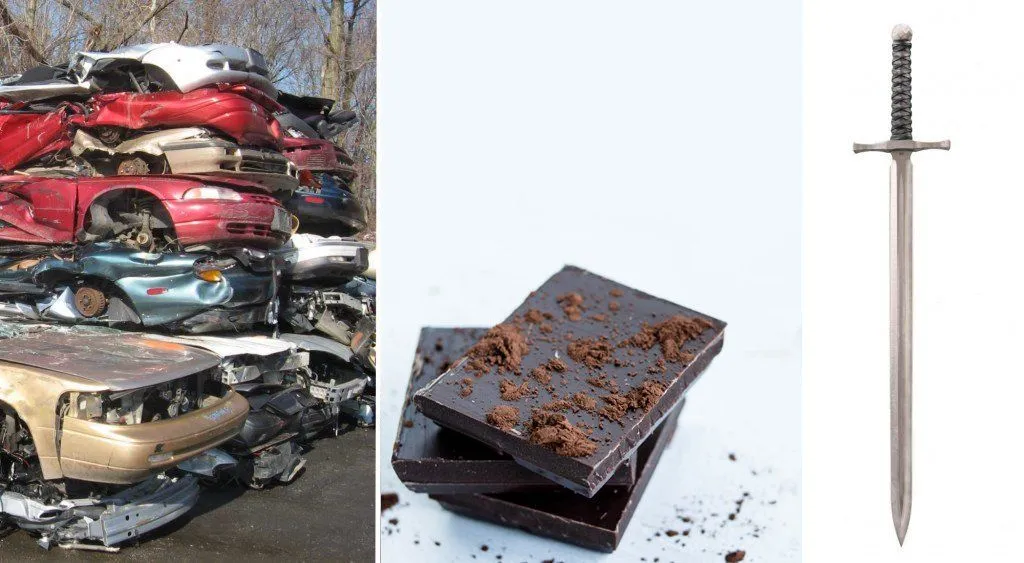
- It can be used for crushing cars. A hydraulic press is always at the heart of any crushing system. The process involves using a hydraulic motor, which applies a large pressure on the fluids of the cylinders. The fluid makes the pressure plate rise with a great amount of force, which therefore makes the pressure plates crush the car!
- It helps in producing fat-free cocoa powder. When cocoa beans are processed, a liquid known as chocolate liquor is derived. To obtain fat-free cocoa, the liquid is then passed through a hydraulic press, which squeezes out all the fat. After this, the liquid is processed further to make the cocoa powder, which is fat-free.
- It is used in the process of sword-making. This is when sheets of metal are beaten and compressed together. By applying more pressure, they can squeeze more metal into the perfect form factor for the sword. This high density of metals that is compressed into the form of a sword ensures that the sword is durable and does not break under any circumstances.
We can conclude by saying that whenever a large amount of force and pressure is required, hydraulic presses are the best machines to get the job done!
Who Invented The Hydraulic Press?
It is tempting to credit Blaise Pascal with the press itself, but he gave us the principle, not the machine. The physics was on paper by 1663, yet a press that could actually hold pressure took another 130 years to build. The reason was leakage: at high pressure, fluid squirted past every seal anyone tried.
The breakthrough came from the English engineer and locksmith Joseph Bramah, who was granted a patent for his hydraulic press in 1795 (the machine is still sometimes called the Bramah press). The key was a clever self-tightening leather cup seal that the pressurized fluid pushed harder against the cylinder wall as the pressure rose, so the harder the press pushed, the tighter it sealed. That one detail turned a leaky curiosity into a workhorse of the Industrial Revolution.

From there the presses only got bigger. The most spectacular examples came from the US Air Force’s Heavy Press Program, a Cold War effort to forge large, lightweight aircraft parts in one piece. One of its giants, the Alcoa 50,000-ton forging press built by the Mesta Machine Company, began work in 1955. It stands about 27 meters (87 feet) tall, weighs roughly 8,000 tons, and runs on hydraulic pressure of about 31,000 kPa (4,500 psi). Several presses from that program are still forging structural components for military and commercial aircraft today, more than half a century later, proof that Pascal’s simple rule about confined fluids scales all the way from a brake pedal to a building-sized machine.
References (click to expand)
- How It Works With The Hydraulic Press.
- https://www.specac.com/en/news/calendar/2018/01/how-does-a-hydraulic-press-work
- Hydraulic press.
- Pascal’s Principle and Hydraulics. University Physics Volume 1 (OpenStax) / Lumen Learning.
- ALCOA 50,000-ton Hydraulic Forging Press. ASME Engineering History Landmarks.
- Heavy Press Program. Wikipedia.
- Joseph Bramah. Wikipedia.