Cockroaches can survive headless, as they don’t breathe through their head, they don’t need to eat all that often, and their body doesn’t require their brain to be attached!
Cockroaches are some of the most enviable species on Earth, thanks to their ability to survive a number of life-threatening situations and come out just fine. For example, a cockroach possesses a higher level of immunity against radiation than humans, (although cockroaches cannot survive a nuclear explosion), it can hold its breath for as long as 40 minutes, and it can last for weeks without any food.
The most amazing thing of all, though, is that a cockroach can survive without its head! And I don’t just mean for a minute or two… a decapitated cockroach can go on living headless for weeks!
To understand why cockroaches can live without a head, let’s look at why humans can’t live without ours!
Blood
If a human being is decapitated, we lose a lot of blood. Anyone who has watched Game of Thrones can attest to this. Losing blood rapidly leads to an inevitable drop in our volume of blood. With extreme blood loss and a drop in blood pressure, oxygen cannot be transported to every part of the body, resulting in death.
Cockroaches don’t have this problem. Cockroaches and insects, in general, have an open circulatory system. This means that their blood does not flow in defined pipes like the arteries and veins of other animals. Their blood, called hemolymph, bathes their organs. Cockroaches do have a heart, which serves to get the hemolymph moving around the body, but it doesn’t generate the relatively high pressure that the human heart can achieve.
Without blood vessels, the heart doesn’t need to pump blood at high pressures to get it to reach every part of the cockroach’s body. Thus, if you cut a cockroach’s head off, it might lose a few drops of hemolymph, but nothing more and the head(less) wound will quickly be sealed off by clotting. Decreasing blood loss helps to conserve all the nutrients present in the hemolymph.
Do Cockroaches Have Blood, And Why Isn’t It Red?
Yes, cockroaches really do have blood, but it looks nothing like ours. As we just saw, the fluid inside a roach is called hemolymph, and if you have ever squashed one expecting a splatter of red, you were probably caught off guard. Cockroach blood is usually not red at all. In most roaches it is clear and colorless.

The reason comes down to one missing ingredient: hemoglobin. Our blood is red because it is loaded with this iron-rich protein, which grabs oxygen in the lungs and carries it around the body. As physiologist Joseph Kunkel of the University of Massachusetts Amherst explains, cockroach blood is not red because roaches do not use hemoglobin to carry oxygen at all. That job is handed entirely to the network of air tubes we will meet in the next section, so the hemolymph never needs a red, oxygen-grabbing pigment.
There is one odd exception. According to Kunkel, adult female cockroaches that are busy making eggs can have faintly orange blood, thanks to a yolk protein called vitellogenin, while males and youngsters stay colorless. So on the rare occasion you do spot something reddish under a swatted roach, it is far more likely to be gut contents or that egg-related tint than any true red blood.
Take A Breath
A human’s breathing apparatus lies in our heads. Our nose and mouth, the inroads of air to our lungs, are located in our heads. The air zooms in through the nose or mouth, passes into our trachea, and enters our lungs, where blood gets replenished with oxygen. The blood carries this oxygen to all the organs and tissues of our body. In return, the blood gets rid of the carbon dioxide produced by metabolic processes and the lungs throw this unneeded gas out through exhalation.
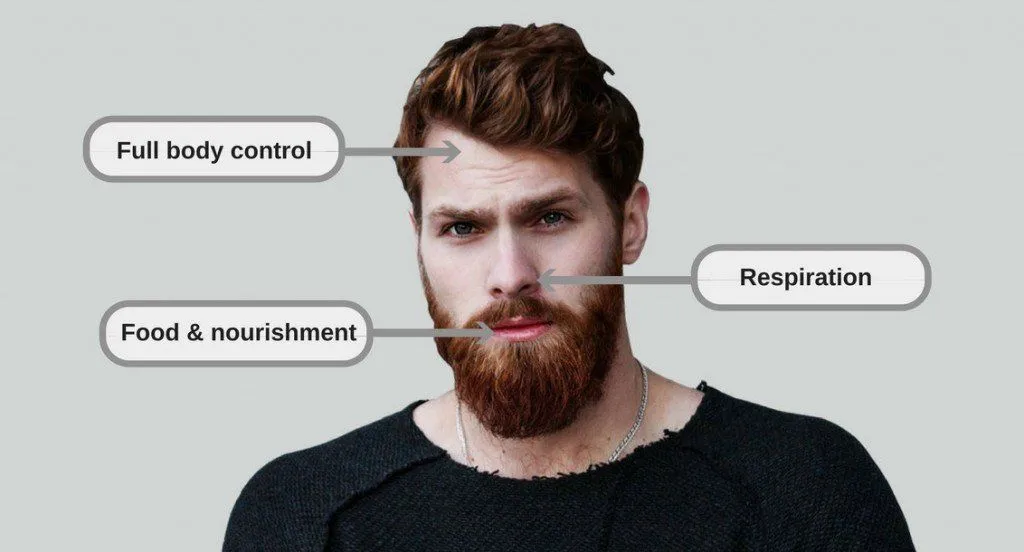
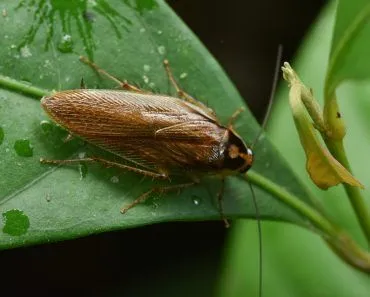
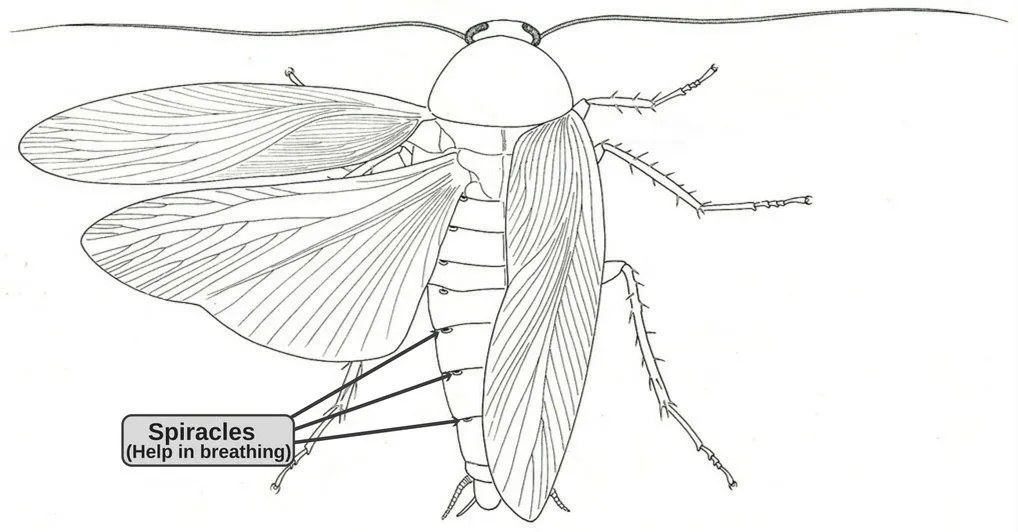
Cockroaches don’t have a nose. Instead, they breathe through tiny holes in their body called spiracles. In cockroaches, these spiracles are located on the sides of their body and can actually be seen as black dots along its sides (provided the cockroach is big enough and you are brave enough to hold it between your fingers).
Oxygen-rich air moves into the spiracles and is circulated throughout the body in elastic pipes called trachea. These trachea don’t lead to a pair of lungs, but instead directly deliver oxygen to muscles and other organs in the cockroach’s tiny body. The trachea subdivides into tracheoles that reach almost every part of the body. Every cell of the cockroach is close enough to a tracheole to receive its oxygen supply.
Thus, if humans lose their heads, there is no way for us to systematically take in oxygen. For the cockroach, its spiracle’s opening and closing is controlled by motor neurons in the muscles around the spiracle. These motor neurons work independent of the brain’s control, instead processing the signal at a one of the thoracic ganglia, clusters of nerves, that span the belly of the cockroach. One can consider this system as a rudimentary equal to a human spinal cord.
Do Cockroaches Need Oxygen, And Can They Survive Without It?
Cockroaches absolutely need oxygen, just like we do. Every cell in that tiny body runs on it. What is different is how casually a roach can go without a fresh supply. Because it breathes through spiracles wired straight to its muscles, rather than through a single nose and mouth governed by the brain, a cockroach can shut off its own air whenever it suits it.

And it does exactly that, all the time. When a cockroach is resting, it does not breathe in the steady in-and-out rhythm we do. Instead it holds its spiracles clamped shut for long stretches and only cracks them open in bursts, a pattern scientists call discontinuous gas exchange. In a 2009 study, Natalie Schimpf, Philip Matthews and their colleagues found that resting cockroaches hold their breath even longer in dry air than in humid air, effectively holding it in to keep from drying out. Sealing those spiracles is as much about saving water as it is about taking in oxygen.
This same trick is why a cockroach is so hard to drown. By snapping its spiracles shut, a roach can be submerged underwater and still survive for roughly half an hour. It is also the deeper reason a headless cockroach keeps “breathing.” With no lungs to inflate and no brain needed to run the show, losing the head simply does not interrupt the flow of air to the tissues.
This Leads Us To The Brain
Human brains are incredibly important. They control most of the bodily functions that allow us to live. Most involuntary muscle movements, like our heart beating and the expansion/contraction of our lungs is directed by the brain, more specifically, the medulla oblongata. Homeostasis, hormone balance and temperature regulation is controlled by a tiny part of the brain called the hypothalamus. Our brain even interferes in nutrient status and hunger, not to mention how muscle movement, sensing and emotions are also all controlled by the brain.
A cockroach doesn’t need to worry much about its brain. The cockroach brain controls a wide range of important tasks, such as integrating sensory input (tasting, smelling through its antenna), navigating, controlling its mouthparts and even certain social behaviors. However, the cockroach’s body doesn’t need its brain for essential tasks like breathing or metabolizing food to create energy.
Insects, the little headless cockroach included, have a series of ganglia, aggregates of nerves, along their belly (ventral side). These thoracic and abdominal ganglia are responsible for controlling muscles and organs in the region where the ganglia is situated.
If we lose our heads, we’d be dead in seconds, whereas the cockroach wouldn’t have to worry about most of its bodily functions being affected.
How Long Can A Cockroach Survive Without Its Head?
This is the question most people really want answered, and the honest reply is: a lot longer than seems decent. A headless cockroach does not keel over in minutes, or even hours. It typically carries on for several days at the very least, and under the right conditions it can stagger on for weeks.

Just how long depends almost entirely on the environment. In one set of experiments described by Scientific American, biologist Christopher Tipping carefully decapitated cockroaches and sealed the wounds, and a few of them lasted several weeks in a jar. Kunkel goes further, noting that a headless roach will survive for several days at a minimum and, as long as it is kept from developing any mold, it can last for as long as a month.
So what finally does them in? Not blood loss, and not suffocation. The usual killers are mold, bacteria or a virus taking hold in a body that can no longer groom or defend itself. A warm, dry room hurries things along, while a cool, damp one buys the body more time. And of course, with no mouth, a decapitated cockroach can neither eat nor drink, so even in the best case its days are numbered. Remarkably, the story runs in reverse too: kept cool and given a little nourishment, a severed cockroach head can twitch its antennae and stay alive on its own for hours, sometimes days.
What About Food?
As for the food, roaches are poikilothermic or cold-blooded creatures, which means that unlike their homeothermic counterparts or warm-blooded animals, they can last for days on a single meal from a particularly good food-finding day. Producing heat to keep a constant body temperature requires a lot of energy and therefore more food. Cockroaches don’t need that much, especially if they don’t have to perform any activity; for instance, without a head, they can’t be very physically active.
A cockroach can last for weeks without its head, provided it’s not attacked by a virus, bacteria, mold or predators in that period, and remains in a relatively cool environment.
It isn’t only the body that can last for weeks. The head of a cockroach can also survive just fine without its body. Give it nutrition and the head should also be able to last a few days to a couple weeks!
All of these findings have occurred within a lab, not out in the real world. There would be many other variables to consider if a cockroach lost its head out in the real world. Scientists perform such grim experiments to understand how a cockroach’s body functions. Without these experiments, we wouldn’t know much of what we know about the cockroach’s nervous system and the fact that it can survive without its head. If nothing else, these findings should open doors to some thrilling insect-related sci-fi!
References (click to expand)
- Cockroach FAQ - marlin. The University of Massachusetts Amherst
- Fact or Fiction?: A Cockroach Can Live without Its Head. Scientific American
- Heinrich, E. C., McHenry, M. J., & Bradley, T. J. (2013, January 1). Coordinated ventilation and spiracle activity produce unidirectional airflow in the hissing cockroach,Gromphadorhina portentosa. Journal of Experimental Biology. The Company of Biologists.
- Titlow, J. S., Majeed, Z. R., Hartman, H. B., Burns, E., & Cooper, R. L. (2013, November 4). Neural Circuit Recording from an Intact Cockroach Nervous System. Journal of Visualized Experiments. MyJove Corporation.
- Schimpf, N. G., Matthews, P. G. D., Wilson, R. S., & White, C. R. (2009). Cockroaches breathe discontinuously to reduce respiratory water loss. Journal of Experimental Biology.