Table of Contents (click to expand)
Rigel is a blue supergiant in the constellation Orion, generally the seventh-brightest star in the night sky and usually the brightest in Orion. Lying about 860 light-years away, it has a surface temperature near 12,100 K (roughly double the Sun's), a radius about 74 times the Sun's, and shines around 120,000 times more brightly than our star.
Since time immemorial, walking beneath the endless blanket of stars has been a mesmerizing pastime for human beings. As we grow older, we begin to recognize constellations and even choose our favorites, typically the ones we see the most often!
Constellations are fun to find, but when those constellations also have extremely bright stars, it becomes impossible to ignore them in the night sky. One of the first constellations that every child and amateur astronomer learns is Orion, which is not only an easy arrangement to spot, but also contains a star named Rigel, one of the brightest stars in the sky!
What Is Rigel?
Rigel is a massive blue supergiant star, and can be found in the constellation Orion, and it composes the “left foot” of the constellation. It is considered the seventh-brightest star in the night sky and is almost always the brightest star in the Orion constellation. However, this isn’t always true, since there is some variability in the star’s brightness, and a massive red supergiant named Betelgeuse (also in the Orion constellation) occasionally surpasses Rigel in terms of visible brightness.
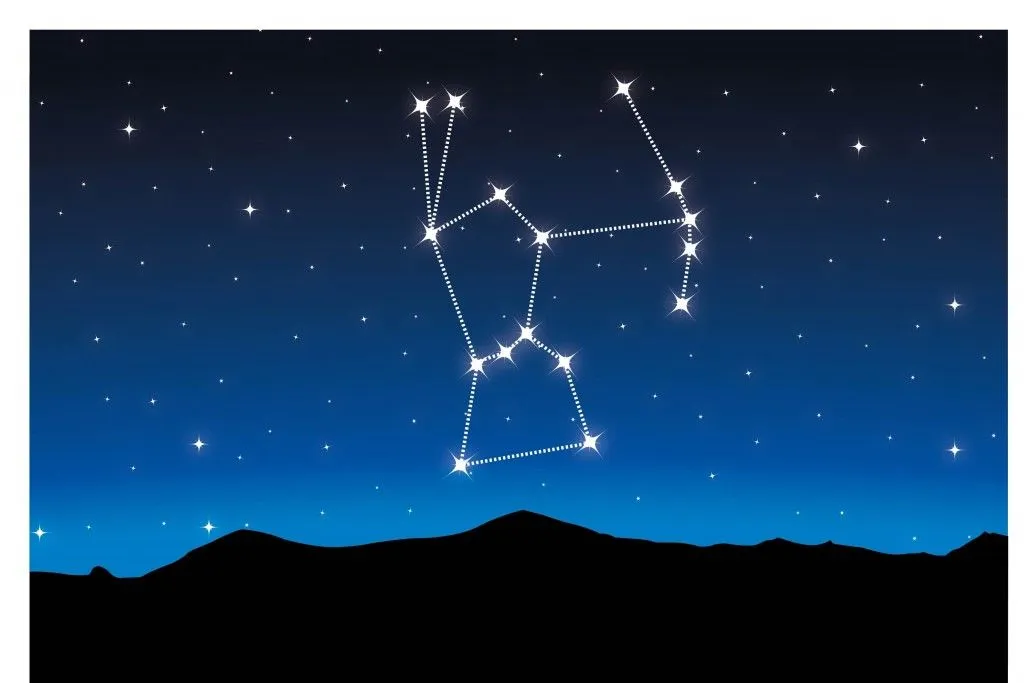
The name itself comes from the Arabic Rijl Jawza al-Yusra, meaning the "left leg (or foot) of the giant," which is exactly where the star sits in the figure of Orion. The more formal name for Rigel is Beta Orionis, whereas Betelgeuse earned the scientific title of Alpha Orionis. Being the brightest blue supergiant in the sky, its luminosity obscures one of its most interesting features, namely the other stars that compose this multiple star system. There is Rigel A (the main visible supergiant), along with the fainter companions Rigel B and Rigel C. Rigel B is itself a close pair (Rigel Ba and Rigel Bb), so the system holds at least four stars in all, each of them dwarfed by the supergiant.
In comparison to our sun, Rigel (Beta Orionis) is believed to be roughly 120,000 times brighter in terms of luminosity, with estimates climbing toward 200,000 if the star lies at the far end of its distance range. Because there is still some uncertainty about that distance, and because its luminosity is mildly variable, the exact figure is difficult to pin down. Suffice to say, it’s nearly impossible to miss this star in the sky, particularly due to its unique blue color, as compared to many of the yellow, orange and red-tinged stars in our grand astral proscenium.
Why Is Rigel So Bright?
If you’ve ever admired the Orion constellation, it would have been hard to miss the blue beacon that is Rigel, but that brightness is particularly remarkable because the best estimate on its distance from our solar system is approximately 860 light-years away. It can be difficult to comprehend such “astronomical” distances, but to help put it in perspective, the light from our nearest star, the sun, takes only 8 minutes and 20 seconds to reach Earth. In comparison, that glittering blue light you see in the night sky has taken more than 8 centuries to reach your eyes.

In terms of why this massive blue supergiant shines on the order of 120,000 times brighter than our sun, the answer is both simple and complex. Our nearest star, the Sun, produces as much energy as 100 billion tons of dynamite per second, and has an approximate surface temperature of 5810 K. It is also so large that roughly 1.3 million Earth-sized planets could fit inside of it. Even so, in comparison to Rigel, our sun is nothing special. Rigel is about 74 times larger in radius than our sun, and boasts a blistering surface temperature of roughly 12,100 K (about 21,300 °F), more than double our paltry star. That fierce heat is also why Rigel burns blue rather than yellow or red, since the hottest stars glow toward the blue end of the spectrum.
Being a different class of star and being at a different stage of its life cycle also affects the luminosity of Rigel. Due to its massive size, Rigel has already burned through a huge amount of fuel, so despite it only being about 8 million years old (a baby compared to our local star), it has already exhausted the hydrogen in its core. Eventually, it will begin to fuse helium, and later oxygen and silicon, just like other evolved massive stars, heading inevitably for its final end, a supernova. When this titanic star eventually explodes as a Type II supernova, it is expected to collapse into a dense neutron star or a black hole, and some astronomers suggest the blast itself could briefly shine like a second moon in the sky.

When a star is as large as Rigel, and burns through fuel at such a voracious pace, the sheer volume of energy being produced and radiation being emitted is monumental. Rigel remains one of the largest blue supergiants ever discovered, so it comes as no surprise that it shines like such a beacon among the stars.
How Does Rigel Measure Up?
Humans have an affinity for comparison, as it helps us understand the world (and universe), even if the scales are incomprehensible for our small, inexperienced brains. So, after learning that Rigel dwarfs our sun like a beach ball beside a cotton ball, it’s only natural to wonder how it measures up against the other stars in the sky.
Now, here’s a twist that trips up a lot of people: although Rigel is about 74 times wider than our Sun, it is only around 21 times more massive. A supergiant is puffed up and rarefied, so all that size doesn’t translate into a proportional amount of matter. And on the mass scale, that 21 figure is nowhere near the ceiling. Scientists believe the upper mass limit for stars in our universe is roughly 150 times the mass of our sun. Above that point, the radiation pressure pouring out of the newborn star is thought to be so fierce that it blows away the surrounding gas faster than gravity can pull it in, preventing the star from growing any heavier.

In other words, the heaviest stars can pack in several times more mass than Rigel, the star that gleams brightly to the naked eye in our sky from 860 light-years away! However, the more massive a star is, the shorter-lived it will be, and since so many stars form and exist within gaseous nebulas, largely obscuring our view, there could be even heftier stars out there, being born, growing up and burning out before we ever get a chance to witness their radiant glory!
What Galaxy Is Rigel In?
Given how impossibly far away Rigel feels, it is tempting to imagine it belongs to some distant galaxy, but it is very much a resident of our own. Rigel sits inside the Milky Way, the same barred spiral galaxy that holds the Sun, Earth and every other star you can pick out with the naked eye. At roughly 860 light-years away it may sound remote, yet on the scale of the Milky Way, which stretches about 100,000 light-years across, Rigel is practically a next-door neighbor.

To be more precise, Rigel lives in the Orion Arm, a minor spiral arm of the Milky Way that is also known as the Local Arm or the Orion-Cygnus Arm. This is the very same arm our Sun calls home, so in a galactic sense we are close neighbors. The arm actually takes its name from the Orion constellation, since many of its most recognizable stars, including Rigel, Betelgeuse and the trio that forms Orion's Belt, all glitter within it.
Rigel is also considered an outlying member of the Orion OB1 association, a sprawling group of hot, young, massive stars that condensed from the same giant clouds of gas in this region of the galaxy. In other words, nearly every star we casually admire in Orion, along with the famous Orion Nebula, belongs to the same local stellar family threaded through our corner of the Milky Way.
Is Rigel a Winter Star?
If you have only ever spotted Rigel on cold, clear evenings, that is no coincidence. For observers in the Northern Hemisphere, Rigel is very much a winter star. Its home constellation, Orion, climbs into the evening sky in late autumn and then dominates the night through the heart of winter. January is the sweet spot, when Orion stands high above the southern horizon soon after dark, making Rigel one of the easiest bright stars to find. By early March, Orion is already at its highest point just as the sky goes fully dark, and after that the Hunter slowly slips toward the sunset glow.

Rigel does not shine alone during these frosty months. It marks one of the six corners of the Winter Hexagon (also called the Winter Circle), a huge asterism that sprawls across the winter sky. The other five vertices are Sirius in Canis Major, Aldebaran in Taurus, Capella in Auriga, Pollux in Gemini and Procyon in Canis Minor. Together they frame a glittering ring of first-magnitude stars, with Rigel anchoring one corner while the rest of Orion, including ruddy Betelgeuse, sits inside the pattern.
Of course, whether Rigel counts as a "winter star" depends on where you are standing. The seasons are flipped in the Southern Hemisphere, so skywatchers down south enjoy their best views of Rigel during their local summer. Wherever you live, though, the principle is the same: when Orion owns the evening sky, its brilliant blue foot is one of the first stars to catch your eye.
A Final Word
Over the next few million years, as Rigel progresses through its life cycle, its brightness will continue to vary, but for as long as human beings are around, the mysterious gleam in Orion’s foot will continue to capture our imagination, and remind us of the magnificent scale and scope of the universe.
References (click to expand)
- Rigel: Orion's Brightest Star. Space.com
- Rigel | star. Encyclopaedia Britannica
- Earth's sun: Facts about the sun's age, size and history. Space.com
- Przybilla, N. et al. (2006). Quantitative spectroscopy of BA-type supergiants. Astronomy & Astrophysics. NASA/ADS
- Orion Arm. Wikipedia
- Blue-white Rigel is Orion's brightest star. EarthSky
- Winter Hexagon. Wikipedia