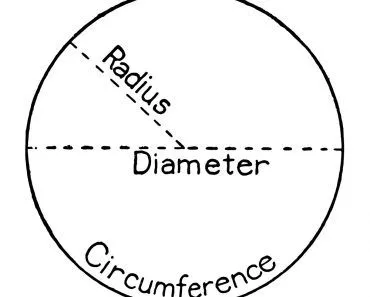
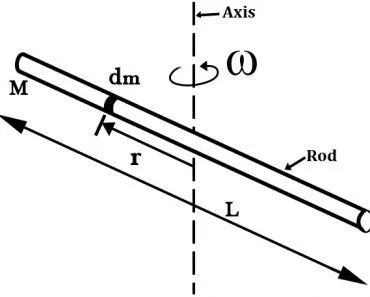
Tangential velocity (V_t = ω r) is the linear speed of a point along its circular path. Learn the formula, its derivation from angular velocity, and why outer riders on a merry-go-round move faster.
The tangential velocity is measured at any point tangent to a rotating wheel. Thus angular velocity, ω, is related to tangential velocity, Vt through the formula: Vt = ω r. Here r is the radius of the wheel. Tangential velocity is the component of motion along the edge of a circle measured at any arbitrary instant. As the name suggests, tangential velocity describes the motion of an object along the edge of this circle whose direction at any given point on the circle is always along the tangent to that point.
Jumping off a moving bus is dangerous, and so the conscious decision to make the jump evokes a sense of thrill. Jumping off the edge of a swirling carousel is the 9-year-old version of it unless you have a sibling who voluntarily gives you a This-is-Sparta-esque kick and sends you flying off into oblivion.
That carousel jump is exactly what this article is about — the physics of tangential velocity: how fast a point on a rotating object travels along its circular path.
What Is A Tangent?
A tangent is simply a line that touches a function at only a single point. The term function here is used to define any non-linear curve. It represents an equation – a relationship between the coordinates “x” and “y” on a two-dimensional graph.
For instance, consider the curve that we’re most familiar with – the good ol’ circle. A circle is defined by the equation 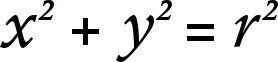 . This means that for a constant radius ‘r’, specific values of ‘x’ and ‘y’ trace out a splendid arc that like the end of a game of Snake meets its own end.
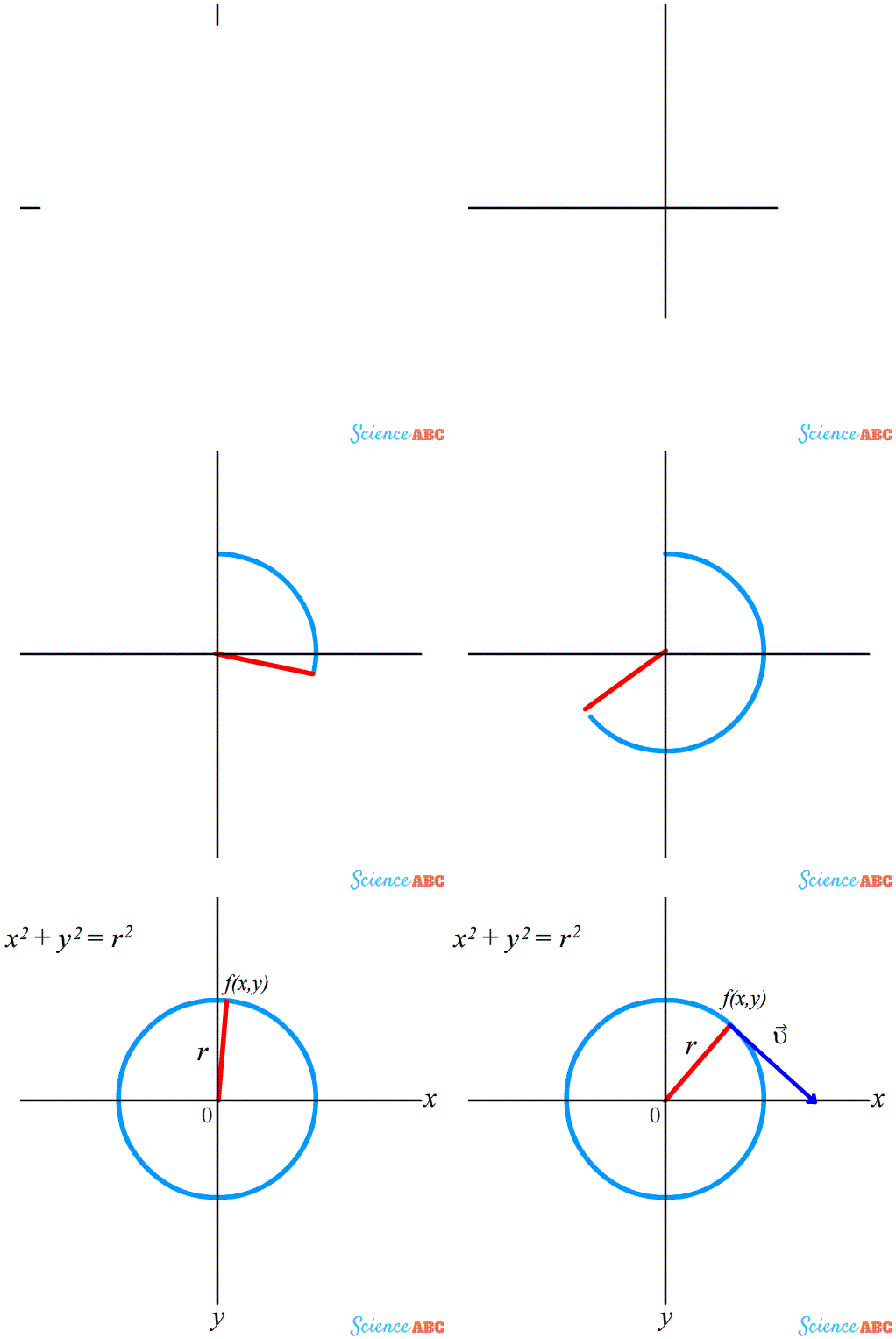
However, for simplicity, I’ve purposely considered an equation that describes an orthodox circle whose center lies on the origin — the reference point or the coordinates (0,0), and where ‘r’, the radius, is the distance from the origin to the edge of this circle.
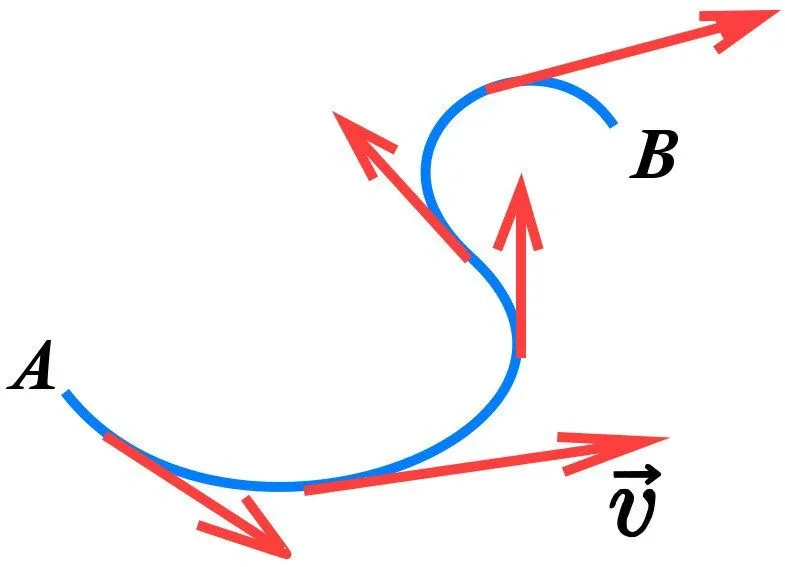
As the name suggests, tangential velocity describes the motion of an object along the edge of this circle whose direction at any given point on the circle is always along the tangent to that point. However, the concept is not restricted to just uniform circular motion; it also applies to all non-linear motion. If an object moves from Point A to Point B through a non-linear curve, then the red arrows represent the tangential velocity  at various points on this trajectory.
Let’s stick to the circle for now.
The Formula For Tangential Velocity
First, we calculate the angular displacement, ‘q’, which is the ratio of the length of the arc ‘s’ that an object traces on this circle to its radius ‘r’. It is the angular portion under the arc’s shadow, between the two lines originating from the center and connected to its ends. It is measured in radians.
The rate of change of an object’s angular displacement is called its angular velocity. It is denoted by ‘w’ and its standard unit is radians/second (rad/s). It is different from linear velocity, as it only deals with objects moving in a circular motion. Basically, it measures the rate at which angular displacement is swept.
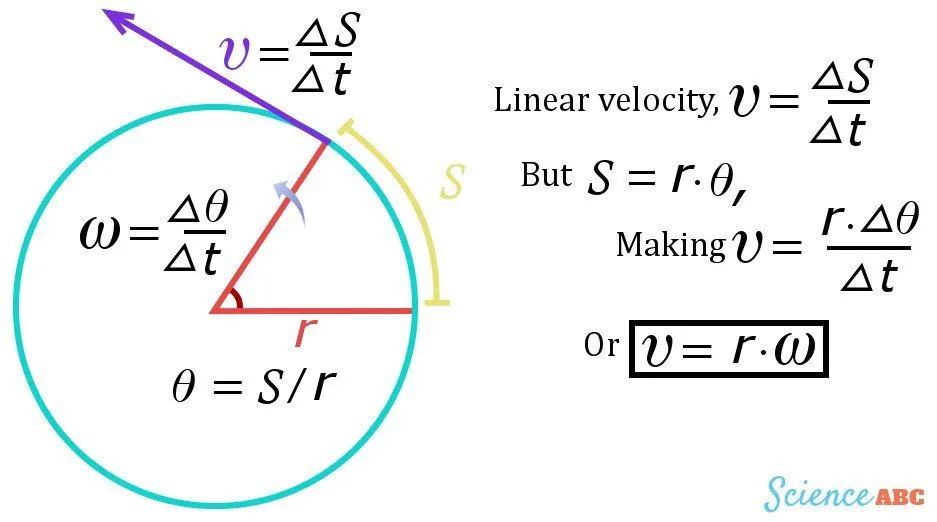
The linear component of angular velocity is known as linear velocity, which is the rate of change of an object’s linear displacement. Linear displacement is the arc ‘s’ cited above – the length of the arc. The rate of change of the product of radius ‘r’ and angular displacement ‘q’ is the object’s linear velocity. The radius is excluded from the operation, as it is a constant. We realize that the velocity is the product of the object’s angular velocity and the radius of the circle it traces.
The linear velocity of an object moving in a circle, measured at an arbitrary instant, is its tangential velocity itself!
Another way to define linear velocity is in terms of time period. If the time period is the time required by an object to go around the circle once, then the velocity at which it does so is ‘s/t’ (distance/time).
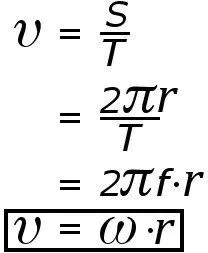
The reciprocal of ‘T’ is known as frequency and is denoted by ‘f’. This is the number of cycles achieved per second. The product 2πf is known as angular frequency and is denoted by ‘ω’, which helps us arrive at the previously derived result.
The Cross-Product
It is imperative to know that tangential velocity is a vector, that is, it has both size and direction. Vectors are indicated by an arrow above their standard symbol. Although their direction changes continuously, their total value remains the same. Each vector is a cross or the vector product of two vectors, which is the multiplication of their magnitudes and the sine of the angle between them. The resulting vector has a direction perpendicular to both involved vectors.
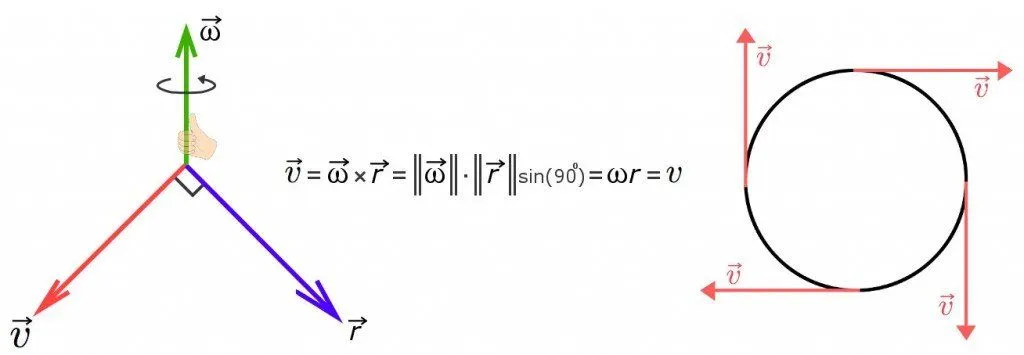
The two vectors whose product we require are the radius ‘r’ and angular velocity ‘w’. The right-hand rule states that if you hold the axis with your right hand and rotate the fingers in the direction of motion of the rotating body, then your thumb will point in the direction of the angular velocity, clearly implies that  and
and  are perpendicular to each other. And as the sine of 90 is one, the resulting perpendicular vector of these quantities at any point on the circle will always remain the same.
Interestingly, objects in or on the circle have the same angular velocity, but different tangential velocities. This is due to its dependence on the radius, as evident in its formula. Therefore, people at the rim of a merry-go-round would fly off at greater velocities than those seated deeper in it.
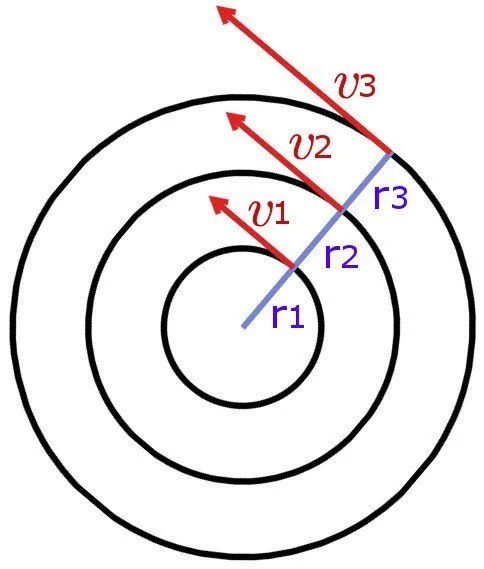
Angular Velocity vs Tangential Velocity
People often reach for the angular velocity formula and the tangential velocity formula in the same breath, so it helps to see exactly how the two hang together. Angular velocity (ω) is the rate at which the sweeping angle itself changes, ω = Δθ/Δt, and it is measured in radians per second (rad/s). For anything turning at a steady rate, one full lap covers 2π radians in one time period T, which gives the tidy shortcut ω = 2π/T = 2πf, where f is the frequency (the number of turns completed every second).

Tangential velocity is simply that angular velocity cashed out at a particular radius: Vt = ω r. The distinction that trips people up is this: every point on a rigid spinning object shares the same angular velocity, yet each point has a different tangential velocity, because ω is multiplied by how far out the point sits.
Picture a playground merry-go-round that completes one full turn every 4 seconds. Its angular velocity is ω = 2π/4 ≈ 1.57 rad/s, and every child on it shares that value. A child sitting 2 meters from the center races along at Vt = 1.57 × 2 ≈ 3.1 m/s (about 11 km/h), while a friend perched 1 meter out drifts at only 1.57 m/s. Same angular velocity, half the tangential speed.
Tangential vs Centripetal Acceleration
Once an object is looping around a circle, its tangential velocity can change in two completely separate ways: its size can change, or its direction can change. Physics hands each change its own acceleration, and keeping them apart clears up much of the confusion behind searches for a “tangential force” or a “centripetal velocity” formula.

Tangential acceleration handles the change in size. It points along the path, in line with the tangential velocity, and is written at = r α, where α is the angular acceleration (the rate at which ω itself changes). This is the component that actually speeds the object up or slows it down, and the push behind it is the tangential force, Ft = m at.
Centripetal acceleration handles the change in direction. It points inward, straight toward the center of the circle, and has the magnitude ac = v2/r = ω2 r. It never changes the object's speed; it only bends the path so the object keeps curving instead of shooting off along the tangent. The inward pull supplying it is the centripetal force, Fc = m v2/r. Because these two accelerations are perpendicular, the total acceleration is their vector sum, a = √(at2 + ac2).
This also settles a common mix-up. For an object locked onto a fixed circle the radius never changes, so its radial velocity is zero and its entire speed is tangential. The inward, radial effect shows up as an acceleration (the centripetal term), not as a velocity, which is why there is no separate “centripetal velocity” to solve for.
Importance Of Tangential Velocity
Tangential velocity can be observed in many cases, including any nonlinear motion, such as the abrupt jump from a swing or the deviation of a satellite or the Earth itself from its circular orbit. A satellite or planet stays in a stable circular orbit only when the inward pull of gravity (the centripetal force) is exactly balanced by its tangential velocity, which would otherwise carry it forward in a straight line.

However, when the Earth or the Sun suddenly disappears, we break our cycle and are instantly flung into space due to our linear speed. The motion draws a straight line through a point in space and time that marks the immediate instant where the pull of gravity disappeared – a tangent.
References (click to expand)
- Calculus I - Tangent Lines and Rates of Change. Lamar University
- Uniform circular motion - Richard Fitzpatrick. The University of Texas at Austin
- Relationship Between Linear and Angular Motion - www.public.asu.edu
- 10.1 Rotational Variables - University Physics Volume 1. OpenStax
- 10.3 Relating Angular and Translational Quantities - University Physics Volume 1. OpenStax