Table of Contents (click to expand)
An imaginary number is any real number multiplied by the imaginary unit i, defined as i = √(−1). The set was invented in the 16th century by Italian mathematicians Cardano and Bombelli to express the roots of polynomials such as x2 + 1 = 0, which have no real solution. Combined with real numbers, they form the complex numbers (a + bi), which are essential for AC electrical engineering, signal processing (Fourier transforms), quantum mechanics, fluid dynamics, and the geometry of rotation in the complex plane.
Imaginary numbers? As if the numbers we already have weren’t enough. The commentary on mathematics’ difficulty has become a platitude. We’re all aware that some proportion of all high schoolers are terrified by the unintelligible language their math textbooks are scribbled with, like Victorian readers encountering Ulysses for the very first time.
However, rather than experiencing relief, their terror is only exacerbated when the turn of a thin page marking the end of another arduous chapter introduced them to an entirely new dimension of numbers – imaginary numbers. Eventually, the introduction of imaginary numbers opened our eyes to an entirely novel branch of mathematics, another of nature’s absurd languages – complex mathematics. Why are they so significant if they’re not even real?
“Impossible” Numbers: What Are Imaginary Numbers?
If the number 1 is the unit or identity of real numbers, such that each number can be written as that number multiplied by 1, then imaginary numbers are real numbers multiplied with the imaginary identity or unit ‘i‘.
 The imaginary unit represents a clever way around a mathematical roadblock. Consider the simple quadratic equation x2 + 1 = 0. The value of x for which the sum becomes zero must be a number whose square is -1. But that is impossible! Squares of all real numbers, either positive or negative, can only be positive numbers. In other words, the problem has no real number solution.
Even so, let’s solve for x anyway. The solution turns out to be x = ±√(−1). There is the roadblock – negative numbers don’t have a legitimate square root. This indivisible unit √(−1) is denoted by i, such that the solution to the given equation becomes ±i. All numbers multiplied by this unit have come to be known as imaginary numbers. The unit can be used to derive the solutions for other similar quadratic equations. Consider x2 + 8 = 0. Here, x turns out to be ±√(−8), which can be written as ±√8 × √(−1) = ±2√2 i.
Witnessing this, impossible is the first word that would pop into anyone’s mind. The square root of negative numbers is highly counterintuitive, but so were negative numbers when they were first introduced. Even Euler was confounded by them. So, don’t worry if you can’t wrap your head around imaginary numbers; initially, even the most brilliant of mathematicians couldn’t.
The incredulity results from, of course, the denial of the comfort of certainty that we find in rituals to which we are indelibly accustomed. Imagine the astonishment of the Romans when they were introduced to Base-10 numbers. Or, the infinite numbers between them. If zero, or a symbol, a “something” to describe “nothing” wasn’t enough, the concept of negative numbers was introduced – numbers that represent a quantity less than nothing. This was a Roman’s worst nightmare. Despite their horror, we needed these new systems… all of them.
The existence of equations that are unsolvable in a single system is quite common. With only natural numbers, x + 1 = 0 would be unsolvable, unless we introduce integers. Now, despite the knowledge of both natural numbers and integers, the equation 2x + 1 = 8 would be unsolvable without introducing rational numbers. The equation x2 = 3 would be unsolvable without irrational numbers. And finally, x2 + 1 = 0 would be unsolvable without imaginary numbers.
One would assume that imaginary numbers arose from our need to solve quadratic equations, but their existence was actually hinted at by a cubic equation. One of the oldest and most popular problems that involved them was “To divide 10 into two parts, the product of which is 40”. This was solved by Girolamo Cardano, who divided 10 into two equal parts of 5. He squared them (25) and subtracted 40 from it, which left him with -15. He concluded that the square root of -15 added to or subtracted from 5 gives two parts, the product of which is 40.
Doesn’t make any sense? This would be much easier to understand if the operations were written this way: (5 + √(−15)) × (5 − √(−15)). A quick calculation would transmute this product into a simple subtraction: 52 − (√(−15))2
Now, because √(−1) = i (for simplicity, let’s ignore the other root: i) the operation becomes a sum:
25 − (√(−1))2 × (√15)2
25 − i2 × 15
25 − (−1) × 15 = 25 + 15 = 40
What Are Complex Numbers?
Subsequently, in 1572, the mathematician Rafael Bombelli published his treatise on algebra, which expounded the nature of imaginary numbers in splendid detail. This made him a central figure in the understanding of complex numbers. Complex numbers are a combination of both real and imaginary numbers. A complex number Z is the sum or subtraction of a real number A and an imaginary number Bi, such that Z = A ± Bi.
Despite this work of genius, Bombelli’s book was frowned upon. The numbers were dubbed fictitious – or even useless – by his peers. Descartes referred to them as imaginary in a tone that verged on ridicule. The numbers accrued acceptance when Euler and Gauss began to recruit them in their work. Other mathematicians gradually caught up and realized how immensely important they are, that these numbers fill an empty void in the subject. However, Descartes’ slur stuck, and we continued to refer to them as imaginary to this day.
In a way, every number seems fictitious. This is the central argument in the debate of whether math was discovered or invented. The Romans invented their system to count whole, countable things, such as to keep count of the number of elephants they lost in a war. The process can be roughly translated to: “Let us represent this exclusive set of elephants with this symbol. The introduction of a new elephant will transform this set into a new, different, exclusive set which can be represented by another symbol and so on.”

In that case, what do negative numbers entail? One can say that a negative number is a highly convenient way to limn debt. Without negative numbers, quantifying debt would have been extremely difficult. Similarly, complex numbers represent rotation. This renders them ubiquitous in branches of physics that involve vectors and waves, such as the laws of electromagnetism and Fourier Transform, an indispensable tool that we use to analyze music.
The new dimension I mentioned in the prelude is real. There is a plane solely dedicated to plotting complex numbers known as the complex plane. To understand what I meant by rotation, let’s step into this new dimension. A complex plane is a 2D plane on which real numbers are plotted on the horizontal axis, known as the real axis, and complex numbers are plotted on the vertical axis, known as the imaginary axis.
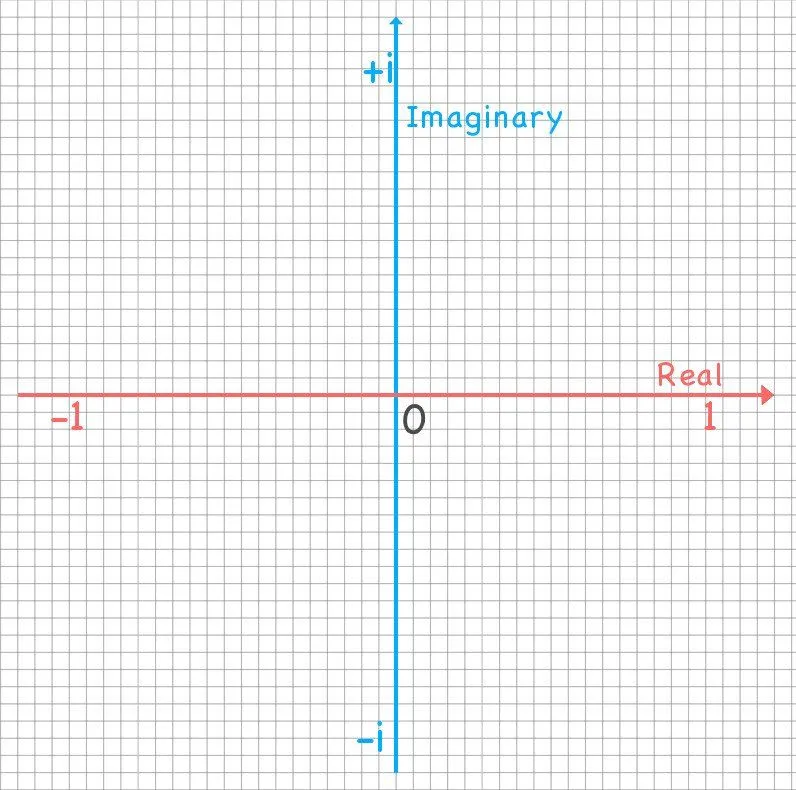
A peculiar pattern can be observed each time we multiply a real number with i. Graphically, the product x × i × i × irepresents a counterclockwise rotation of a vector of size x by 90º each time an i is multiplied to it. If we assume the value of x to be 1, only 4 vectors repeatedly emerge: i, −1, −i and 1; a quarter of a circle, a semi-circle, a three-quarter circle and a full circle.
However, if we were to rotate this vector by, say, only 45º, the resulting vector would lie in the middle of the two axes; the area it sweeps represents a small part – in this case, exactly one-eighth of a circle. A 45º line implies the equivalence of coordinates or, as it is popularly known, the y = x line. If one such coordinate is (A, B): (1,1), then one can conclude that the drawn vector represents the complex number Z = 1 + i.
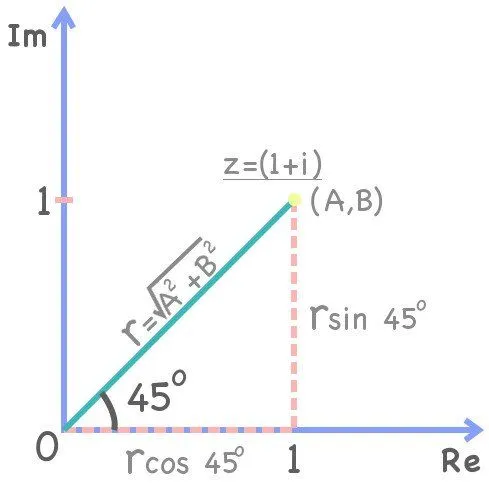
The same vector can also be represented as a vector sum of its horizontal and vertical components: Z = rcos ω + rsin ω i. Here, r is the hypotenuse of a triangle formed by the vector and its perpendicular components and ω is the angle the vector makes with the horizontal axis. The modulus r’s value is the Pythagorean sum of the two components. This property binds trigonometry and complex numbers in a conjugal relationship, rendering them utterly inseparable.
No wonder they are so ubiquitous in electronics and wave theory. This characteristic illustrates how deeply rotation is ingrained in complex numbers. This makes for efficient problem solving, problems that concern rotation, problems that would have been troublesome or tedious when tackled with conventional math – doable but inefficient. However, personally, their most commendable achievement remains their direct involvement in the formation of one of the most beautiful structures in abstract math, one of the most beautiful sentences written in nature’s languages.

The curve drawn on a complex plane, known as the Mandelbrot set, looks like an enormous garden that comprises a long nonlinear trail of infinite coniferous trees and spiraling flowers. It is absurd how the menial act of simply plotting coordinates can lead to such an aesthetic marvel. It is a visual treat for Mandala artists, a true testimony to splendor and detail. And remember, all of this came from imaginary numbers. Math never ceases to amaze me.
The Pattern In The Powers Of i
If you keep multiplying i by itself, something delightfully orderly happens. Because i is defined as √(−1), squaring it simply hands you back −1. Carry on, and the results begin to loop. The first four powers are i1 = i, i2 = −1, i3 = −i and i4 = 1, after which the sequence repeats itself forever: i5 is back to i, i6 to −1, and so on. As Paul’s Online Math Notes puts it, every power of i can be reduced to one of four possible answers, and they repeat every four powers.

This is the very same rotation we met on the complex plane, wearing different clothes. Each multiplication by i swings a vector 90º counterclockwise, so four multiplications carry you a full 360º back to where you began. That is precisely why only four values ever surface. To evaluate a monstrous-looking power such as i50, you need only divide the exponent by 4 and keep the remainder: 50 leaves a remainder of 2, so i50 = i2 = −1. The whole infinite ladder collapses into a tidy four-step staircase.
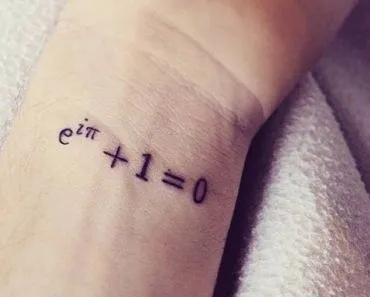
Imaginary numbers themselves are just as easy to spot. Any real number scaled by i qualifies: 3i, −7i, ½i and √2 i are all imaginary, as is the ±2√2 i we derived earlier. Stitch a real number onto one of them and you have a complex number, and it is this partnership that leads to one of mathematics’ most celebrated sentences. Euler’s formula, eix = cos x + i sin x, binds the imaginary unit to trigonometry, and its special case eiπ + 1 = 0, often crowned the most beautiful theorem in mathematics, knots together i, π, e, 1 and 0 in a single elegant stroke.
What Are Imaginary Numbers Used For?
For all the talk of their being imaginary, these numbers earn their keep in some of the most concrete corners of science and engineering. Their gift is that a single complex number carries two pieces of information at once, a size and an angle, which is exactly what you need whenever something oscillates, rotates or waves.
Electrical engineering leans on them constantly. In an alternating-current (AC) circuit, the opposition to current is not a plain number but an impedance, written Z = R + jX, where the real part is the ordinary resistance and the imaginary part, the reactance, captures how capacitors and inductors shift the current out of step with the voltage. Engineers even swap the mathematician’s i for a j, because i is already spoken for as the symbol for electric current. As one reference puts it, impedance “extends the concept of resistance to alternating current (AC) circuits, and possesses both magnitude and phase, unlike resistance, which has only magnitude.” Folding both into one complex number lets designers tackle a circuit with straightforward algebra instead of a thicket of trigonometry.
The same trick powers signal processing. The Fourier transform, the mathematical engine that lets your phone compress music, a radio tune to a station or software sharpen a photograph, is built on complex exponentials of the form e−iωt. Passing a signal through it yields complex numbers whose magnitude tells you how strong each frequency is and whose angle tells you its phase, decomposing a messy waveform into the pure tones hidden inside it.
Perhaps the most profound home of imaginary numbers is quantum mechanics. The Schrödinger equation, the master equation governing how particles behave, carries i right at its heart, and the wavefunction it describes is a complex-valued object. Whether this was a mere convenience was long debated. In 2021, a team led by Marc-Olivier Renou published a result in Nature arguing that complex numbers are physically indispensable, that no theory written with real numbers alone could reproduce the correlations quantum mechanics predicts. The tale did not end there. In 2025, three independent groups overturned that conclusion, showing that quantum mechanics can, after all, be rebuilt entirely with real numbers by relaxing one of its assumptions. Whether or not i is strictly essential, no working physicist would dream of doing quantum mechanics without it, a fitting tribute to numbers once dismissed as fictitious.
References (click to expand)
- Imaginary number. Encyclopedia Britannica.
- Imaginary Number. Wolfram MathWorld.
- Complex Number. Wolfram MathWorld.
- Merino, O. (2006). A Short History of Complex Numbers. University of Rhode Island.
- Complex Numbers. Paul’s Online Math Notes, Lamar University.
- Complex Numbers in Real Life. University of Toronto Department of Mathematics.
- Intro to the imaginary numbers. Khan Academy.
- Euler Formula. Wolfram MathWorld.
- Electrical impedance. Wikipedia.
- Fourier Transform. Wolfram MathWorld.
- Imaginary Numbers May Be Essential for Describing Reality. Quanta Magazine (2021).
- Quantum theory needs complex numbers. ScienceDaily (2021).
- Physicists Take the Imaginary Numbers Out of Quantum Mechanics. Quanta Magazine (2025).