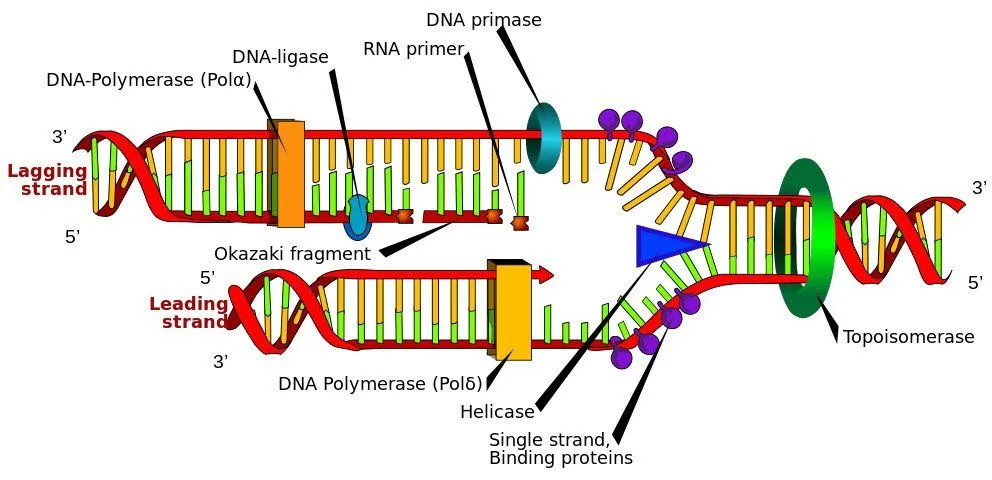
DNA replication has three main steps. (1) Initiation: helicase unwinds the double helix at the origin of replication, and primase lays down a short RNA primer. (2) Elongation: DNA polymerase reads each template strand 3′→5′ and builds the new strand 5′→3′, making the leading strand continuously and the lagging strand in short Okazaki fragments. (3) Termination: RNase H and DNA polymerase I remove the RNA primers, and ligase seals the remaining nicks, leaving two identical daughter DNA molecules.
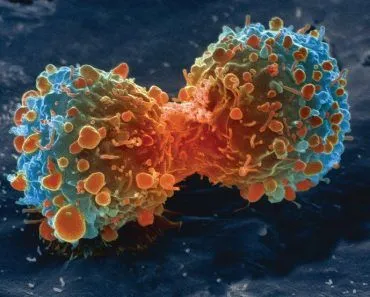
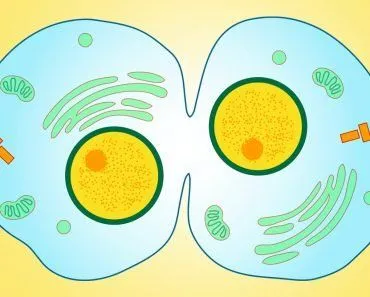
We all know that each human being begins their life as a single cell, which divides to form two cells, and these two go on to form four! This process helps us to form our tiny little body, which then grows into an adult! Now while all this is happening, our DNA is also being divided into these cells. But does the cell divide the existing DNA into two parts? Or does it make a second copy? If you think it is the latter, then you are correct! The cell does make a second copy, so when two daughter cells are formed; each one of them gets a complete set of DNA.
Structure Of DNA
Before we jump into the process of replication, let us take a quick look at the structure of DNA.
As we all know, DNA is the genetic code that helps our cells to develop and reproduce in a planned way. Because of which it is called the ‘Blueprint of Life’.
DNA is the genetic material that defines cells in bodies. In order for a cell to duplicate and divide into its daughter cells (either through the process of meiosis or mitosis), organelles and biomolecules must be copied first and then distributed among all cells.
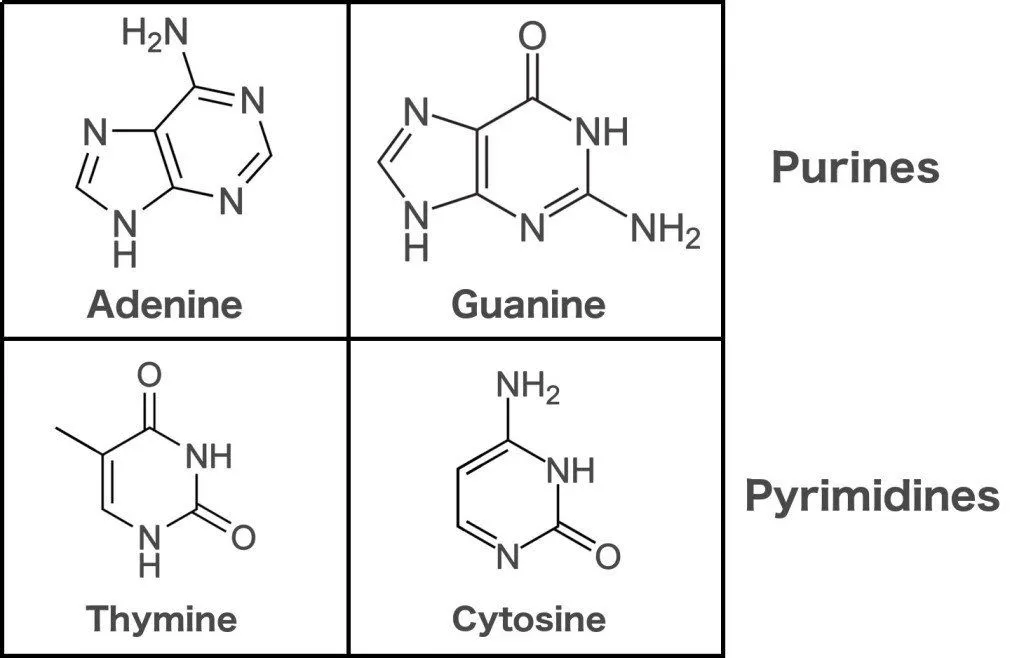
Getting back to its structure, DNA is made up of four nucleotides. Thinking what Nucleotides are? They are molecules, which are made of a phosphate group, a sugar ring, and a nitrogen base! These nucleotides are Adenine (A), Thymine (T), Guanine (G), and Cytosine (C). A and G are called Purines while T and C are called Pyrimidines. Those words can be a mouthful but you will be able to read them after a little bit of practice.
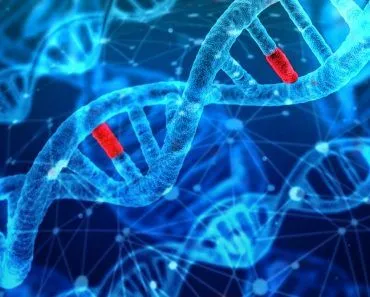
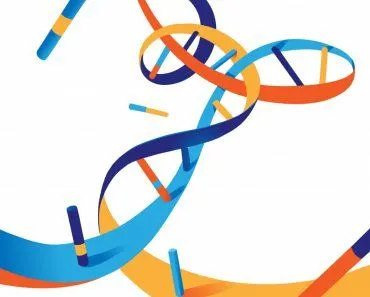
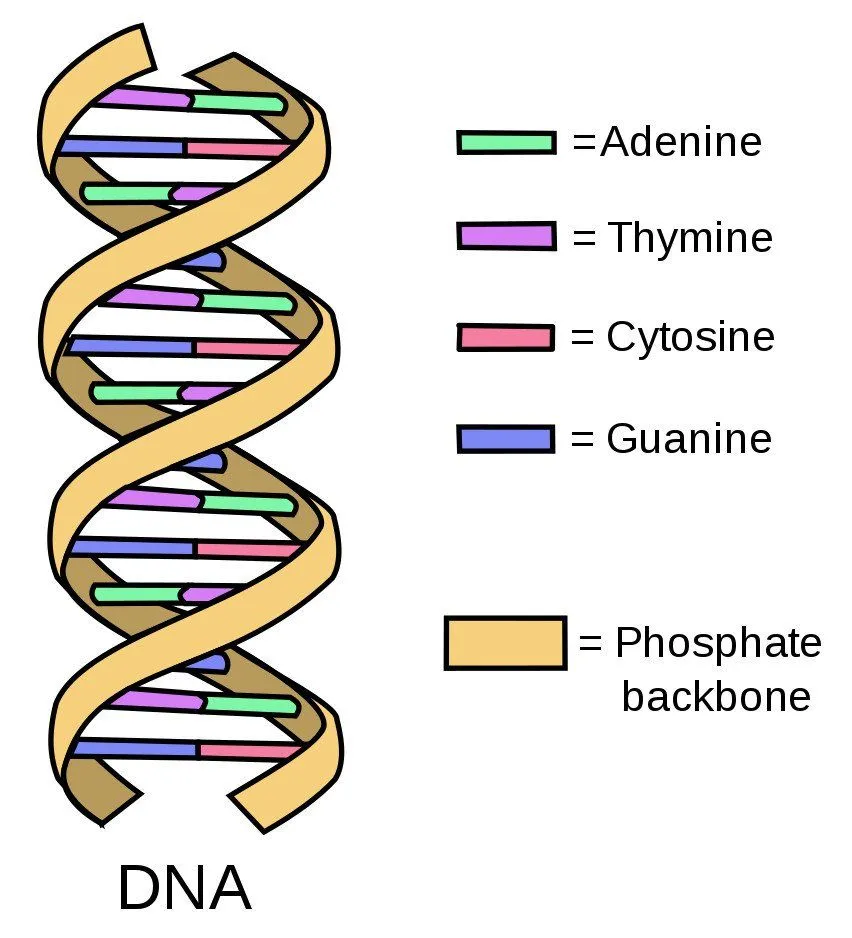
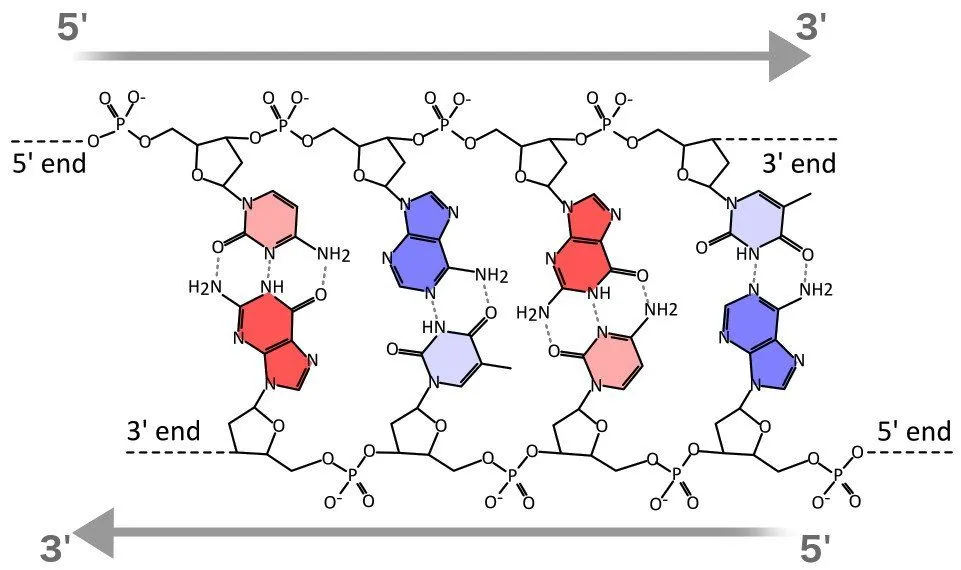
DNA is made of two strands. These strands have nucleotides lined up one after the other and those nucleotides are bound to the nucleotides on the other strand to create a ladder-like structure! Now the binding between nucleotides is very specific and the binding is via Hydrogen Bonds. A will bind to T and C will bind to G. These nucleotides bind to each other and are called as Base pairs. So there we have it. A seemingly never-ending ladder made of nucleotides pairing up with each other. If you picture DNA as that ladder, the two long sides (the rails) are the alternating sugar and phosphate groups of each strand, while every rung, or step, of the ladder is a single base pair (an A bonded to a T, or a G bonded to a C) holding the two strands together. But there is one more change, take that ladder and twist it! That’s it, our DNA looks like a simple double helix with specific nucleotide binding. Easy, right?
Directionality
These strands have two designated ends called 5’ and 3’ (you can read that as 5 prime end and 3 prime end). These numbers indicate end-to-end chemical orientation. The numbers 5 and 3 represent the fifth and third carbon atom of the sugar ring respectively. 5’ is the end, which joins a phosphate group that attaches to another nucleotide. 3’ end is important as during replication the new nucleotide is added to this end.
In terms of direction, if one strand is 5’ to 3’ while reading from left to right, the other strand will be 3’ to 5’. Simply put, the strands run in opposite directions. This orientation is kept for easy binding between nucleotides of the opposite strands.
Process Of Replication
Replicating the entire DNA is no easy job. The human genome (Genome means a complete set of genes present in the cell) is just over 3 billion base pairs long. The T2T consortium’s 2022 gapless sequence came in at 3.055 billion base pairs (nucleotide pairing, remember?). So making a copy of something that long sounds like it would take ages. But it doesn’t. Our cells have a whole crew of enzymes and proteins that move this process along quickly.
Each enzyme and protein have their own specific function. Let us look at the process step by step.
Initiation
- Helicase – The point at which the replication begins is known as the Origin of Replication. Helicase brings about the procedure of strand separation, which leads to the formation of the replication fork. It breaks the hydrogen bond between the base pairs to separate the strand. It uses energy obtained from ATP Hydrolysis to perform the function.
- SSB Protein – Next step is for the Single-Stranded DNA Binding Protein to bind to the single-stranded DNA. Its job is to stop the strands from binding again.
- DNA Primase – Once the strands are separated and ready, replication can be initiated. For this, a primer is required to bind at the Origin. Primers are short sequences of RNA, around 10 nucleotides in length. Primase synthesizes the primers.
Elongation
- DNA Polymerase III – This enzyme makes the new strand by reading the nucleotides on the template strand and specifically adding one nucleotide after the other. If it reads an Adenine (A) on the template, it will only add a Thymine (T). It can only synthesize new strands in the direction of 5’ to 3’. It also helps in proofreading and repairing the new strand. Now you might think why does Polymerase keep working along the strand and not randomly float away? Its because a ring-shaped protein called as sliding clamp holds the polymerase into position.
Now when replication fork moves ahead and the Polymerase III starts to synthesize the new strand a small problem arises. If you remember, I mentioned that the two strands run in the opposite directions. This means that when both strands are being synthesized in 5’ to 3’ direction, one will be moving in the direction of the replication fork while the other will move in the opposite.
The strand, which is synthesized in the same direction as the replication fork, is known as the ‘leading’ strand. The template for this strand runs in the direction of 3’ to 5’. The Polymerase has to attach only once and it can continue its work as the replication fork moves forward. However, for the strand being synthesized in the other direction, which is known as the ‘lagging’ strand, the polymerase has to synthesize one fragment of DNA. Then as the replication fork moves ahead, it has to come and reattach to the new DNA available and then create the next fragment. These fragments are known as Okazaki fragments (named after the scientist Reiji Okazaki who discovered them).
Termination
- DNA Polymerase I – If you remember, we had added a RNA primer at the Origin to help Polymerase initiate the process. Now as the strand has been made, we need to remove the primer. This is when Polymerase I comes into the picture. It takes the help of RNase H to remove the primer and fill in the gaps.
- DNA ligase – When Polymerase III is adding nucleotides to the lagging strand and creating Okazaki fragments, it at times leaves a gap or two between the fragments. These gaps are filled by ligase. It also closes nicks in double-stranded DNA.
The Replication process is finally complete once all the primers are removed and Ligase has filled in all the remaining gaps. This process gives us two identical sets of genes, which will then be passed on to two daughter cells. A bacterium like E. coli can copy its entire genome in under an hour, while a typical human cell takes around 6 to 10 hours of S phase to finish.
How does a human cell get through 3 billion base pairs that fast? Multiple origins. The cell fires off replication from tens of thousands of starting points at once, and the resulting pieces are then stitched together into the full genome.
It is important for DNA present in the nucleus to be replicated so that every new cell receives the appropriate number of chromosomes. Overall, this process is crucial for cell repair and growth and reproduction in living organisms.
When Does DNA Replication Occur?
So we know how the cell copies its DNA, but when exactly does all of this happen? Not at random, and not while the cell is busy dividing. A cell's life follows a repeating schedule called the cell cycle, and replication is slotted into one specific window of it.

The cell cycle is split into interphase (the long growth-and-preparation stretch) and the M phase (mitosis, when the cell actually divides). Interphase itself has three parts: G1, S and G2. DNA replication happens during the S phase, where the 'S' stands for synthesis. In the G1 phase before it, the cell simply grows and gathers the raw materials it will need. Then, in S phase, every chromosome is copied. Finally, in the G2 phase, the cell checks over the freshly made DNA and gets ready to split.
The timing is the whole point. By copying the DNA during S phase, well ahead of mitosis, the cell makes sure two complete sets of DNA are ready and waiting before it divides in two. In a typical human cell, the S phase takes roughly 6 to 10 hours to finish. Bacteria are the exception to this neat schedule: they replicate their DNA more or less continuously, rather than pausing for a dedicated S phase.
Where Does DNA Replication Occur?
The short answer is: wherever the cell keeps its DNA. In eukaryotes (that is us, along with animals, plants and fungi), almost all of the DNA lives inside the nucleus, so that is where replication takes place. Mitochondria, the cell's tiny power plants, carry their own small loop of DNA and copy it separately inside the mitochondria themselves, using a dedicated enzyme called DNA polymerase gamma.
Bacteria and other prokaryotes do things a little differently. They do not have a nucleus at all. Their single circular chromosome sits in a region of the cytoplasm called the nucleoid, and that is exactly where their DNA gets copied. With no nuclear membrane to work around and usually just one origin of replication, a bacterium can copy its genome remarkably fast, which is why an E. coli cell can duplicate its entire chromosome in under an hour.
Why Does DNA Replication Occur?
Every living thing grows, heals and reproduces by making new cells, and every new cell needs its own full set of genetic instructions. That is the whole reason DNA replication exists. Before a cell splits into two, it first copies its entire genome, so that each daughter cell walks away with a complete, matching set of DNA. Skip this step, and one of the two new cells would be left short of vital instructions.
There is an elegant safeguard built into how the copying works. DNA replication is semiconservative, which means each of the two new double helices ends up made of one old strand and one brand-new strand. The original strand acts as a template, and because A always pairs with T and G with C, the new strand comes out as an exact complement of the old one. This is how genetic information gets passed on, cell after cell, with very few errors.
References (click to expand)
- DNA Replication. The Cell: A Molecular Approach. NCBI Bookshelf.
- General Features of DNA Replication - www.biochem.uthscsa.edu
- DNA Replication. National Human Genome Research Institute.
- The human genome sequence is now complete. NHGRI, 2022.
- Biochemistry, DNA Replication. StatPearls. NCBI Bookshelf.
- DNA Replication in Eukaryotic Cells and the Eukaryotic Cell Cycle. Biology LibreTexts.