Table of Contents (click to expand)
Helium holds its two electrons more tightly than any other element holds its own, yet helium, not neon, is the one that has been squeezed into a solid with sodium at more than a million times atmospheric pressure and found bonded to hydrogen in the gas around a dying star. Neon's eight outer electrons include six in dumbbell-shaped orbitals that shove any approaching atom away, while helium's two electrons sit in one small sphere with nothing to shove with, so a partner can get close enough to interact. No neon compound with a real chemical bond has ever been made, which is why several chemists now argue that neon, not helium, is the least reactive element.
On the evening of March 23, 1962, Neil Bartlett was working alone in his chemistry lab in Vancouver. He let xenon, a colorless gas, meet the red vapor of a platinum compound. Where the two touched, a bright yellow solid appeared. Every chemistry textbook on the planet was now wrong. All of them said the noble gases could not react with anything.
Chemists have spent the six decades since then embarrassing those textbooks. Xenon, krypton and radon have hundreds of compounds between them. Argon fell in 2000. Helium, the smallest and most aloof of the lot, followed in 2017 when a team squeezed it into a crystal with sodium.
Neon has nothing, not one compound with a real chemical bond. And the scoreboard reads backwards. Helium grips its electrons harder than any other element, so by the usual logic it should be the last holdout. Why is the tighter atom the easier one to bond?
Why Are Noble Gases Unreactive In The First Place?
Rub a balloon on your hair and it sticks to the wall. That stickiness is electrons on the move. Nearly all chemistry is electrons moving between atoms or being shared between them. An atom reacts when it can gain, lose or share an electron and end up with less energy than it started with.
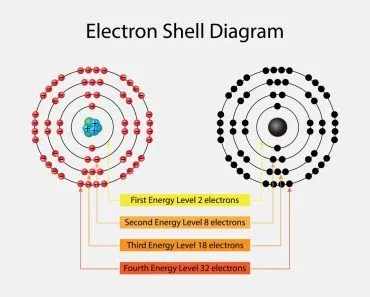
The outermost electrons do that work, and chemists call them valence electrons. A noble gas has a full outer shell. Helium's holds two electrons and is complete at two. Neon's holds eight and is complete at eight. A full shell has no gap to fill and no loose electron to give away. This is why atoms with eight valence electrons are so stable. It is also why helium and neon behave so alike: colorless gases that do nothing.
How hard an atom holds its electrons has a number: the energy needed to pull one electron off. For helium it is 24.6 electron-volts, the highest of any element. For neon it is 21.6. Neither atom will take an extra electron either. By the numbers, then, helium is the more stubborn of the two, and the numbers are about to lose the argument.

How Did Chemists Break The Noble Gas Rule?
Bartlett's trick was a bit of bookkeeping. His platinum compound was a greedy electron thief. It could even pull an electron off an oxygen molecule. He noticed that xenon gives up an electron about as readily as oxygen does. If the thief could rob oxygen, it could rob xenon. It did.
Once the rule was broken, the heavy noble gases fell fast. Their outer electrons sit far from the nucleus, behind layers of inner electrons, so the hold on them is weak. Argon was harder: its only isolated compound is HArF, a molecule of hydrogen, argon and fluorine. It was made in 2000 inside a block of frozen argon a few degrees above absolute zero. Argon's name comes from the Greek for "idle", so you will see it called the lazy gas. The label aged badly.
That left two holdouts, and the next to fall was the one with the tighter grip.

Can Helium Form Compounds? What Is Na2He?
In 2017 a team ran a computer search for crystals that should exist under crushing pressure. The search pointed at two sodium atoms to one helium, written Na2He. Then they made it in a diamond anvil cell, a device that pinches a speck of sample between the tips of two gem-cut diamonds. Sodium was loaded in helium and squeezed past 113 gigapascals, about 1.1 million atmospheres (16 million pounds per square inch). A laser then heated it above 1,500 kelvin (about 1,230 °C, or 2,240 °F). New spots appeared in the X-ray pattern, the sign of a new crystal.
Helium has its compound, then, with one deflating detail. In Na2He the sodium atoms form a lattice of cubes. Helium sits inside half of those cubes. The other half hold something stranger: a pair of electrons parked in empty space, belonging to no atom at all. The helium does not share electrons with sodium and does not take any. It sits in its cube like a tenant who pays no rent but keeps the neighbors apart. A follow-up gave the verdict: no local chemical bonds. Electric attraction over long distances holds the crystal together, and the helium atoms just reshape it. The same trick works on many salt-like crystals at a quarter of that pressure. Earth's deep mantle may be storing helium that way.
Na2He passes the strict test for a compound, with a fixed recipe and a repeating crystal that holds together. It still contains no bond to helium at all.

Where Has Helium Formed A Real Bond?
Helium does have one proper bond, and it is older than any star. Bolt a bare proton (a hydrogen atom stripped of its electron) onto a helium atom and you get HeH+, the helium hydride ion. A normal two-electron bond holds it together. It first turned up in 1925, as a stray signal in a mass spectrometer, a machine that sorts ions by weight.
It also turned up in the sky in 2019. A telescope aboard a modified Boeing 747 flew above most of the atmosphere. It picked up the ion's fingerprint in a planetary nebula, the cast-off gas shell of a dying star. The find mattered because HeH+ is thought to be the first molecular bond the universe ever made. That was about 100,000 years after the Big Bang, before hydrogen atoms had paired up and before any star had lit. This ion is one of the earliest witnesses to how we know the Big Bang happened.
The catch is the plus sign. HeH+ is an ion, and ions are desperate. Inside a mass spectrometer anything will bond to anything, briefly. The real test is a neutral molecule you could bottle, and there helium's record is thin. The molecule HHeF, modeled on argon's HArF, is predicted to exist as a shallow dip in the energy landscape. It would fall apart into hydrogen fluoride and helium in about 157 quadrillionths of a second. The neon version, HNeF, does not even have a dip for the molecule to sit in.

Why Is Neon Even More Stubborn Than Helium?
Holding your own electrons tight is one thing. Letting another atom get close is a different thing, and there neon slams the door.
Neon's eight outer electrons are not all alike. Two sit in a round 2s orbital. The other six fill three 2p orbitals. Each is shaped like a dumbbell, pointing out from the nucleus along its own axis, and all three are full. A rule of quantum mechanics says no two electrons may share the same state. It is called the Pauli exclusion principle. When another atom's electrons try to overlap those filled dumbbells, they get shoved out. Chemists call this pushback Pauli repulsion, and neon's inertness is pinned on its 2p shell. Helium has no p electrons at all. Its two electrons sit in one small round shell, so a partner can get much closer before the shoving starts. Getting closer means more chance to share.
Neon is not the worse partner in every way. It grabs a bare proton a little more readily than helium does, and its electron cloud is nearly twice as squishy. In the gentle stickiness that lets gases condense, then, neon beats helium. The moment a real bond is on the table, the order flips. Chemists have modeled several neutral molecules in both a helium and a neon version. Every time, the helium version is a dip in the energy landscape and the neon version is not. Neon is also the bigger atom. That holds the two ends of a molecule like H-Ne-F farther apart, so the electric glue between them is weaker.
Every molecule chemists have tried says neon is the stubborn one, whatever the ionization table claims.

So, Why Can Helium Form A Compound But Neon Can't?
Nothing has held on to neon for long. A neon atom has been seen parked next to a gold fluoride molecule in the lab, held by less than a tenth of an electron-volt. Call it a handshake, not a bond. Squeeze ice to nearly five thousand atmospheres and neon atoms can be trapped in its channels. Even there, the report says, there is no direct bonding. Neon ions fly around mass spectrometers all day. Charged, cold or caged, yes. Bonded, no.
So the answer has two parts. Helium's compound, Na2He, exists because extreme pressure made room for a small space-filler. Helium nudges the charged neighbors apart. HeH+, helium's one real bond, exists because a bare proton is desperate. It will share helium's electron pair, and helium's small shell lets it get close enough. Neon fails both tests for one reason. Its six 2p electrons push every would-be partner away before sharing can begin. Its looser grip on its own electrons never gets a chance to matter.
This is why several chemists now say neon is the most inert element, and helium only second. One of them titled his argument "Neon behind the signs", a nod to neon's one steady job. Another goes further. He wants helium moved out of the noble gas column and placed above beryllium. Beryllium also has a two-electron outer shell, and neon would then head the group. That rearrangement of the periodic table has not won, and the argument is partly a matter of taste. But the chemistry is settled. The old line about helium as the least reactive element now needs a footnote.
Earth's helium leaks into space and cannot be replaced. The sodium result suggests the deep mantle may store helium inside squeezed minerals. If so, the planet holds far more of it than we can drill for, locked in rock far below the reach of any well.

References (click to expand)
- A stable compound of helium and sodium at high pressure — Nature Chemistry (2017)
- Reactivity of He with ionic compounds under high pressure — Nature Communications (2018)
- On the position of helium and neon in the Periodic Table of Elements — Foundations of Chemistry (2018)
- Astrophysical detection of the helium hydride ion HeH+ — Nature (2019)
- NASA Ames Astrogram, April 2019: first type of molecule in the universe detected — NASA
- SOFIA: Stratospheric Observatory for Infrared Astronomy — NASA Science
- The ionization of hydrogen by electron impact as interpreted by positive ray analysis — Physical Review (1925)
- A stable argon compound — Nature (2000)
- Crystal structure and encapsulation dynamics of ice II-structured neon hydrate — PNAS (2014)
- Neil Bartlett, In Memoriam — University of California Academic Senate
- Neil Bartlett and the Reactive Noble Gases — UBC Department of Chemistry
- Helium — PubChem Periodic Table, NIH
- Neon — PubChem Periodic Table, NIH
- Experimental static dipole polarizabilities — NIST Computational Chemistry Comparison and Benchmark Database
- Neon, gas phase ion energetics (proton affinity) — NIST Chemistry WebBook
- Helium, gas phase ion energetics (proton affinity) — NIST Chemistry WebBook
- Argon — Royal Society of Chemistry Periodic Table
- Neon behind the signs — Nature Chemistry (2013)