Yes. A dropped bullet reaches a terminal velocity of roughly 80 meters per second (about 180 mph) for a 9mm round. Skin can be punctured at just 61 m/s, so a bullet falling tip-down can break skin, dent a car, or kill if it strikes the skull, though it is far less dangerous than one fired from a gun.
There have been plenty of urban legends about the dangers of walking underneath the Empire State Building, because careless sightseers might drop a penny off the top. This worrisome myth has been debunked, namely because of the shape and weight of pennies. The flat nature of the penny makes it float and be slowed down by air resistance; furthermore, it’s so light that even when thrown forcefully from the top, it isn’t likely to do any damage.

However, is the same thing true of heavier items, particularly those that are designed to be aerodynamic? For an extreme example, what would happen if you dropped a bullet from the top of a building?
Bullets, Gravity, And A Long Way Down
When calculating the force of anything being dropped, a few basic calculations need to be made. The simple equation for a falling object concerns the conservation of energy, namely the potential energy being converted into kinetic energy. For instance, when you hold a rubber ball in your hand a couple of feet above the ground, the ball has some potential energy that is converted into kinetic energy when you drop it.
So, one might think that when a bullet is dropped, instead of being fired from a gun, it can be less lethal. However, is that notion scientifically correct?
Terminal Velocity Of The Bullet
Terminal velocity is the highest velocity that the bullet will attain while falling through air after its drop from the top of the building. It occurs at the point where the downward force (due to gravity) becomes equal to the opposition offered by air against its downward movement.
Let’s assume that the bullet is a standard 9mm bullet, weighing about 124 grains (0.008 kg). Its cross-sectional area is 0.000064 meters squared and its drag coefficient is 0.295. Note that these values vary significantly according to the type of bullet used. Here’s the formula for calculating the terminal velocity of the bullet:
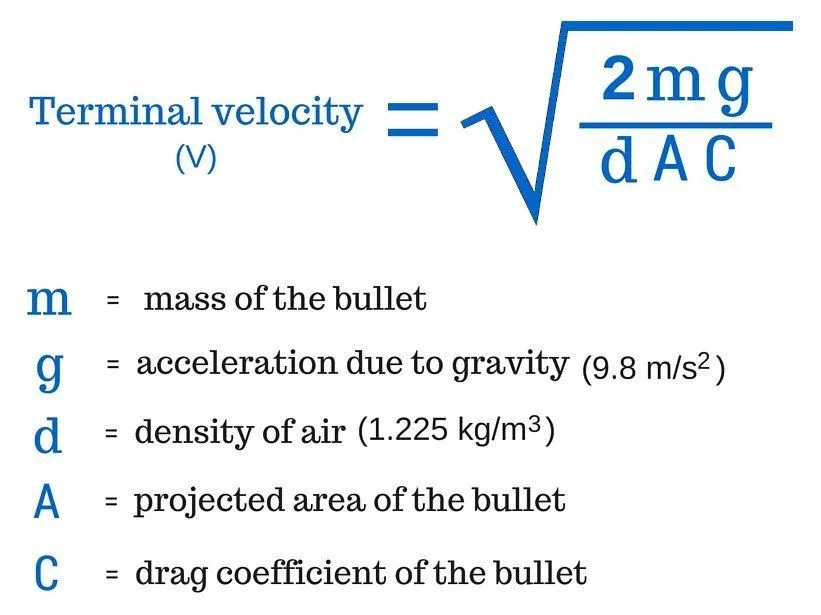
After plugging in all the values in the above formula, the terminal velocity of the dropped bullet comes out to 82.4 meters per second (184.3 mph).
This means that the bullet will reach the ground, and can potentially strike a human body, at a speed of 82.4 m/s (note that this is an idealized upper estimate; computer models put falling 9mm rounds closer to 45 to 75 m/s in practice). Either way, that is well within the danger zone: studies of celebratory gunfire find that a bullet traveling at only 61 m/s to 100 m/s can penetrate human skin, making matters even worse for anyone standing below.
It should be noted that the value of the terminal velocity of the bullet significantly varies according to its type and structure. Also, to make the calculation of terminal velocity less complex, we’ve assumed that the bullet comes down in a ‘tip-down’ orientation and there is neither wind nor humidity in the atmosphere during its fall. These are ideal conditions (to the point of being unrealistic), as there’s always some wind and humidity present in the atmosphere, which is why it would be very difficult for the bullet to maintain a ‘tip-down’ orientation. A bullet dropped from such a great height is bound to undergo continuous changes in its orientation, and is more likely to fall in a tumbling fashion.
Terminal Velocity By Caliber (And The Formula Behind It)
There isn’t one tidy terminal velocity for “a bullet,” which is exactly why people search for the figure attached to a specific round. The full drag equation is V = √(2W / (Cd × ρ × A)), where W is the bullet’s weight, Cd is its drag coefficient, ρ (rho) is the density of the air, and A is its cross-sectional area. It comes straight from setting the upward drag force equal to the bullet’s weight, the exact balance point we called terminal velocity above.

Because weight sits on top of that fraction and area sits underneath, a heavy, dense bullet with a slim profile falls faster than a light, wide one. That is why a small handgun round and a full-size rifle round return at noticeably different speeds. In practice, spent bullets coming back to earth land somewhere between roughly 45 and 100 meters per second (about 150 to 330 feet per second). A falling 9mm handgun round sits near the lower end, around 45 to 75 m/s, while heavier rifle bullets sit higher up the range.
We don’t have to trust the formula alone. In the early 20th century, US Army general Julian Hatcher studied .30 caliber rounds fired straight up and put their terminal velocity at about 90 m/s (300 feet per second, or roughly 186 mph). That measured figure sits comfortably beside the idealized 82.4 m/s we calculated for a tip-down 9mm, a good sign that the ballpark is right even though no real bullet obeys the tidy vacuum math.
Fired Straight Up Vs. Dropped: Can A Falling Bullet Actually Kill You?
The honest answer is “it depends,” and what it depends on is the angle. A bullet fired almost perfectly vertically loses its spin near the top of its climb, begins to tumble, and drifts back down at terminal velocity, far slower than the speed it left the barrel. A bullet fired even slightly off vertical behaves completely differently: it holds its spin-stabilized ballistic path, never really tumbles, and arrives travelling much faster than a bullet in simple free fall.

The television show MythBusters tackled exactly this in an episode called “Bullets Fired Up.” A round sent straight up came down at a terminal velocity too low to reliably kill, while a round fired at an angle stayed firmly in lethal territory. The problem is that firing perfectly straight up is nearly impossible, so most rounds loosed into the sky come back down at an angle, carrying enough speed to wound or kill.
And speed is the whole story. Skin starts to give way at around 61 m/s, and heavier falling bullets land squarely inside that 61 to 100 m/s danger band. Documented cases show spent rounds punching through composition shingles, metal decking, and vinyl roofing, and the same modest energy is enough to dent a car roof or crack a windshield. Structural engineers who investigate these strikes note that near-vertical shots often lack the energy for full penetration, while angled shots arrive with plenty to spare. So a dropped or skyward bullet really is less dangerous than one aimed at you, but “less dangerous” is a long way from “safe.”
Shape Of The Bullet
Now, bullets are designed to be aerodynamic and fly through the air as smoothly as possible, unlike a non-aerodynamic penny. Also, the calculation of potential energy is carried out assuming a vacuum, meaning no air resistance. However, there is air resistance on any object as it falls, which creates drag and slows down a falling object, thus reducing the final impact force. The aerodynamic nature of a bullet would offset this drag much more than a penny’s awkward shape, making it much more lethal than the latter.

The distance traveled before impact and the area of impact have a great deal to do with the ultimate force of the object and the damage done, respectively, and since the point of the bullet would mean a small area of impact, it doesn’t bode well if the bullet were to strike a human body. A bullet would likely be able to chip a sidewalk, puncture a hole in a soft-surface car window, or even kill someone if it landed directly on someone’s skull.
While there are more specific calculations for the exact dimensions and variables in this dangerous experiment, suffice to say that a bullet dropped off a building would do a lot more damage than a penny.

Think of all the stories of bullets returning to Earth after being shot into the air with deadly consequences. Those situations typically involve the bullets flying much higher (and thus building up far more potential energy before they begin their fall), but the end result can be the same. One documented review found that of 118 people treated for falling-bullet wounds in Los Angeles between 1985 and 1992, roughly a third died, a far higher fatality rate than for ordinary shootings.
Our advice? Don’t try this at home… or in Dubai, where the tallest building in the world can be found!
References (click to expand)
- What goes up, must come down: The dangers of celebratory .... Baylor College of Medicine
- Criminal Charges for Random Gunfire. The University of North Carolina at Chapel Hill
- Can a Falling Bullet Be Lethal at Terminal Velocity? Cardiac Injury Caused by a Celebratory Bullet. The Annals of Thoracic Surgery. PubMed, NCBI.
- Wintemute, G. J., Claire, B. E., S. McHenry, V., & Wright, M. A. (2012, July). Epidemiology and clinical aspects of stray bullet shootings in the United States. Journal of Trauma and Acute Care Surgery. Ovid Technologies (Wolters Kluwer Health).
- Celebratory gunfire. Wikipedia.
- Terminal Velocity. NASA Glenn Research Center.
- Ordog, G. J., et al. (1994). Spent bullets and their injuries: the result of firing weapons into the sky. The Journal of Trauma. PubMed, NCBI.
- Bullets in Roofs. Professional Engineering Inspections, Inc.