Yes, a gun fires in space: modern cartridges carry their own oxidizer, so no air is needed. You hear nothing, because sound cannot travel through a vacuum. The recoil still kicks the shooter backward (Newton's third law), and with no air to slow it, the bullet keeps traveling almost forever unless it hits something or is caught by a planet's gravity.
Action movies, particularly during the adrenaline-pumping chase sequences, the action packed excursions, or daredevil stunts, all seem somewhat incomplete without a gun, or rather… a bullet.
In fact, due to the popularity and power of a bullet in flight, there have been many movies and shows that demonstrate the movement of a bullet fired from a gun, in ultra slow motion, so that viewers can trace the path of a bullet as soon as it leaves the muzzle to when it finally strikes its intended target.
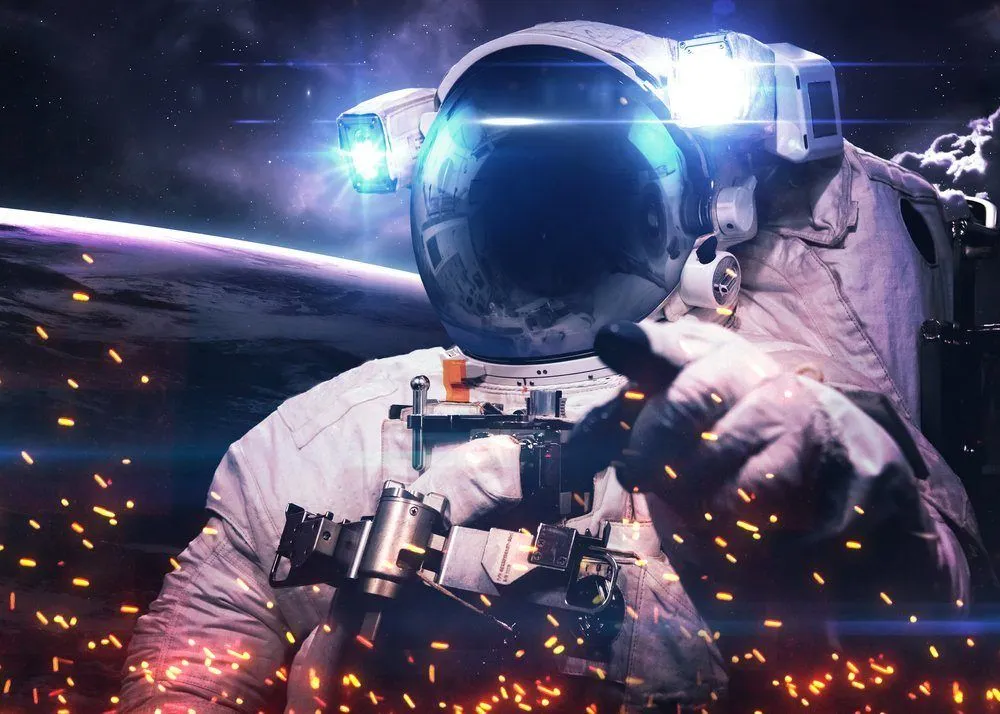
This fascination with bullets has made people shoot everything from weather balloons and fruit to pieces of wood and panels of glass, but many curious minds have also wondered something else: What would it be like to shoot a bullet in space?
Pull The Trigger
Firing a bullet is not much different in space than it is on Earth. The process of shooting, at least, is exactly the same. You might assume a gun needs air to fire, but it doesn’t: a modern cartridge carries its own oxidizer mixed into the primer and propellant, so the gunpowder ignites just fine in a vacuum. In fact, a gun really has been fired in space. In January 1975, the Soviet military space station Salyut 3 (Almaz) test-fired a 23mm Rikhter cannon mounted on its hull, the only known firing of a gun in space, done remotely after the crew had left. So the gun works perfectly well out there. However, it is the journey of the bullet that is dramatically different.
First of all, when anyone fires a gun on Earth, the obvious thing one expects is to hear the boom of the gunshot, i.e., the sound of the bullet leaving the muzzle of the gun. However, since there is no sound in space (as sound waves cannot travel in a vacuum), you wouldn’t hear the blast of gunshot.
So, the first major difference is the built-in silencer for the gun. No sound of the gunshot.
Mr. Newton At Work
Now, for the more interesting phenomenon… When you are on Earth and fire a bullet (say using a rifle), there is a recoil from the gun. This is due to Newton’s third law of motion: for every action, there is an equal and opposite reaction. Therefore, when you fire the bullet and it goes forward, it exerts a force of the same magnitude in the opposite direction of its motion, namely backwards. This is why you feel a sudden and violent force pushing back on your shoulder when you fire (those who are not used to this kickback can often get injured).
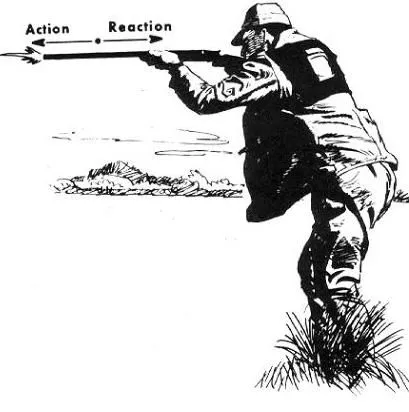 Even after being impacted by such a strong force, your feet stay on the ground thanks to the force of gravity. The gravitational pull of Earth keeps you planted on the ground, and friction under your feet plus your own body weight absorb the kick, preventing you from flying backwards in the opposite direction of the bullet. Out in deep space, though, far from any planet to anchor you and with nothing to brace against, what would happen?
Yes, you’d begin flying in the opposite direction of the bullet’s motion. Does that sound like a good idea to you?
Dear Back, Be Careful!
The common phrase, ‘I’ve got your back’ takes on a special meaning in space.
When fired at a perfect horizontal alignment with the orbit of a planet, the bullet you fire can travel forward, be caught in the orbital swing, and then come around to hit the shooter in the back of his body.

It seems pretty unbelievable, but if the conditions are perfect, firing a gun might not be healthiest idea for the shooter. This seemingly one-in-a-million chance is because the planet’s gravity continuously bends the bullet’s path into a curve; if you fire it fast enough and exactly parallel to the surface, that curve can close into a full orbit, bringing the bullet all the way around to strike the shooter from behind after one revolution.
Although the conditions would have to be accurate to an insanely high degree for this to happen, it is certainly not impossible. However, I ‘m sure that the person firing the bullet wouldn’t try to make the conditions that perfect.
Distance Traveled By The Bullet
Although the speed of the bullet would be relatively the same as its speed on Earth, the distance it travels would be very, very different.
On Earth, you could expect a bullet to travel a few miles before falling to the ground, because the force of gravity from the Earth is acting on it, pulling it down to the ground and robbing it of its much-needed energy to continue flying. In space, however, you can expect the bullet to go on and on, possibly forever. There is no air, so there is no friction or drag to slow it down or alter its course, and once it is far from any planet there is no strong gravitational pull to rob it of speed. By Newton’s first law, an object in motion stays in motion unless something acts on it, so the bullet simply keeps coasting at nearly its muzzle speed until it eventually hits something or is captured by a star or planet’s gravity. In fact, because the universe is expanding and that expansion stretches the distances between far-off galaxies faster than the bullet can cross them, a bullet fired into truly empty space might never catch up to anything at all.
How Fast Does A Bullet Travel In Space?
A gun’s muzzle velocity, the speed at which the bullet leaves the barrel, is set by the explosive push of the expanding gunpowder gases, not by the air outside. Take the same gun and the same cartridge into orbit and the bullet still leaves the muzzle at almost exactly the speed it would reach on Earth. A handgun round manages roughly 300 metres per second, a modern high-velocity rifle cartridge such as the .220 Swift clears 1,200 metres per second (over 4,300 km/h), and a tank firing a kinetic-energy round reaches around 1,700 metres per second. The old black-powder muskets, by comparison, mustered only 120 to 370 metres per second.

The real difference is what happens after the bullet clears the barrel. On Earth, the air pushes back on it the entire way, a force called drag, and it steadily bleeds off speed. Bullets are shaped to slip through the air, so the loss each second is small, but it never stops. In the vacuum of space there is no air to push back at all. With nothing to slow it down and, far from any planet, no strong gravity to brake its path, the bullet simply holds onto its muzzle velocity. It does not speed up either, because a bullet carries no engine of its own; once the gases have finished shoving it, that is all the speed it will ever have. So a bullet in space is not faster than one on Earth at the instant of firing. Space simply lets it keep that speed for a very, very long time.
Can You Shoot A Bullet Into Space From Earth?
So far we have assumed that you and your gun are already floating out in space. Plenty of people ask the mirror-image question, though: could you stand on the ground and fire a bullet straight up hard enough to reach space? The short answer is no, and it is not even close.

To break free of Earth’s gravity for good, anything launched from the surface has to reach the escape velocity of about 11.2 kilometres per second, close to 40,000 km/h. A rifle bullet leaves the muzzle at roughly 1 kilometre per second, which makes it around eleven times too slow. And a gun cannot simply be loaded with more powder to fix that: the expanding gas can only push the bullet up to about its own speed of sound, so no ordinary firearm can hurl a projectile anywhere near escape velocity.
You would not even reach the doorstep of space. The internationally used edge of space, the Kármán line, sits 100 kilometres up (NASA and the US Air Force draw the line a little lower, at 80 kilometres). A bullet fired straight up is fighting gravity the whole way, and the thick lower atmosphere drags away much of its speed within the first few seconds, so it slows, stops, and tumbles back to the ground long before reaching that height. This is exactly the point Isaac Newton illustrated more than three centuries ago with his famous cannonball: fire it faster and faster from a mountaintop and its arc stretches farther, but only once it is moving at orbital speed does it stop curving back down to Earth. That is why we launch satellites on rockets that burn for minutes on end, and not out of the barrel of a gun.
Overall, shooting a bullet in space is something that someone out there should definitely try (if possible, obviously). I would imagine that watching the bullet you just fired flying into the infinite abyss of darkness must be quite a sight to behold!
References (click to expand)
- What would happen if you shot a gun in space? | Live Science. Live Science
- What If You Shot a Gun in Space? - Science | HowStuffWorks. HowStuffWorks
- Can you fire a gun in space? | BBC Science Focus Magazine. BBC Science Focus
- Is the speed of a fired bullet the same in space and on Earth? Astroquizzical
- Muzzle velocity. Wikipedia
- How fast would a bullet need to leave a gun in order to get into space? The Naked Scientists
- Kármán line. Wikipedia