Table of Contents (click to expand)
- Can Cars Run On Water?
- Hydrogen-powered Vehicles
- The Role Of Water In Hydrogen Fuel Cells And Vehicles
- Sourcing Hydrogen – A Major Downside To Fuel Cells
- Importance Of Water As A Raw Material For Hydrogen Production
- Benefits Of Using FCEVs
- Challenges Of FCEVs
- Which Cars Actually Run On Hydrogen Today?
- What About Famous “Water-Powered Car” Claims Like Stanley Meyer’s?
- Conclusion
No, cars cannot run directly on water – liquid water contains no usable chemical or mechanical energy to extract. What is possible is to split water into hydrogen and oxygen and then feed the hydrogen into a fuel cell, which combines it with air to produce electricity, with water vapor as the only emission. Hydrogen fuel cell cars like the Toyota Mirai and Hyundai Nexo already work this way, but on-board electrolysis of water as a fuel source is ruled out by the second law of thermodynamics.
Considering our forever escalating fuel costs, filling up at a gas station can give us all sorts of wild ideas. While some friends might look to cycling as a healthy alternative, the more reasonable ones amongst us have more practical ideas: What if cars could run on water?
Can Cars Run On Water?
In its liquid state, water does not possess the mechanical or chemical energy required for propulsion. In the past, it was used with moderate success in the early years of automobiles in the form of coal-fired steam engines.
However, as the modern world faces major sustainability issues, the automobile industry is turning to other sources of fuel.
While electric cars are currently the next big thing in the industry, the debate as to whether they’re truly eco-friendly is still ongoing. Given that uncertainty, is there a way to use a resource as plentiful as water to power vehicles?
Hydrogen-powered Vehicles
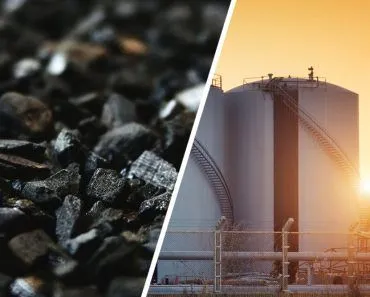
In steam engines, water is made useful by employing coal to convert it into steam. This continues our dependency on fossil fuels, making it unsustainable for modern use, whereas hydrogen, which powers fuel cells, is a constituent element of water itself.
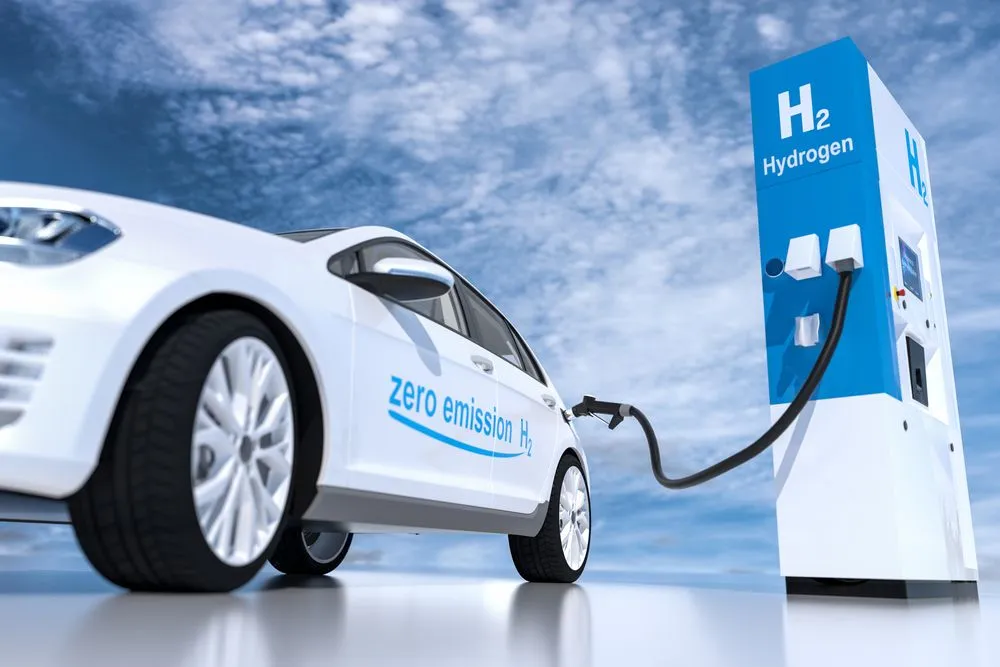
Hydrogen as a fuel has shown great promise in automotive propulsion. In separate designs, it has been used to generate electricity to power motors, as well as fuel combustion in modified IC engines.
It already finds use in commercial transport, such as buses and trucks, and even private transport cars. Owing to the difficulties in producing hydrogen, this format is not as popular as its electric and fossil fuel counterparts.
The Role Of Water In Hydrogen Fuel Cells And Vehicles
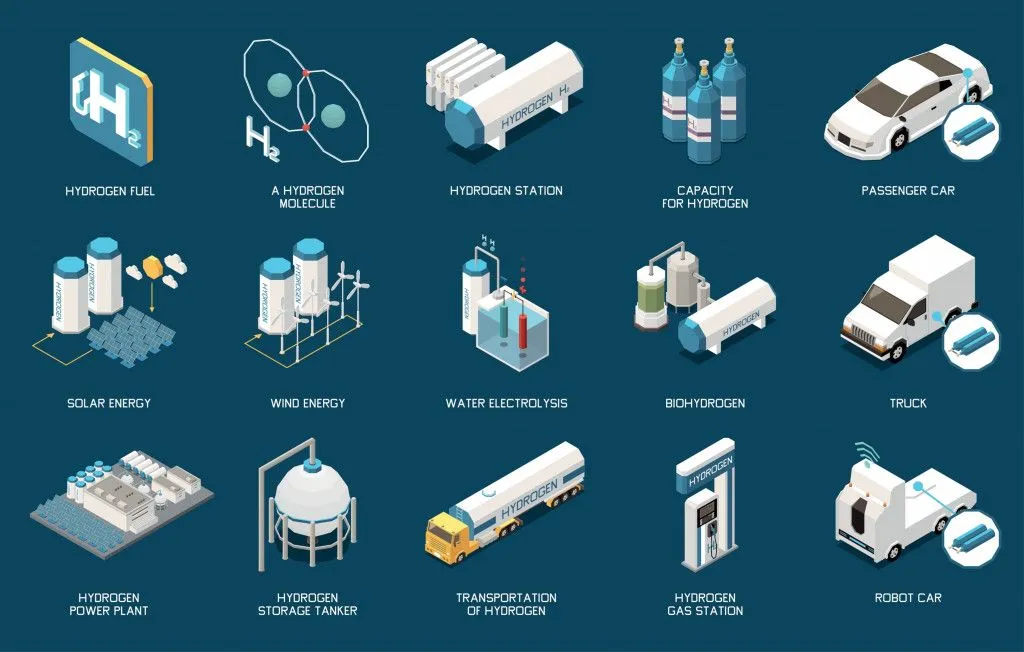
To understand the role of water in hydrogen-powered vehicles, it’s crucial to understand the working of hydrogen fuel cells. Hydrogen fuel cells use chemical energy to generate electricity that powers motors. Vehicles that run on this technology are also known as Fuel Cell electric vehicles (FCEVs).
While there are many types of fuel cells, polymer electrolyte membrane fuel cells are the most commonly used.
Working Of Hydrogen Fuel Cells
Fuel cells typically consist of a cathode and an anode. Hydrogen from the fuel tank is supplied at the anode, where a platinum catalyst splits each hydrogen atom into its two constituent subatomic particles, a proton (H+) and an electron (e−).
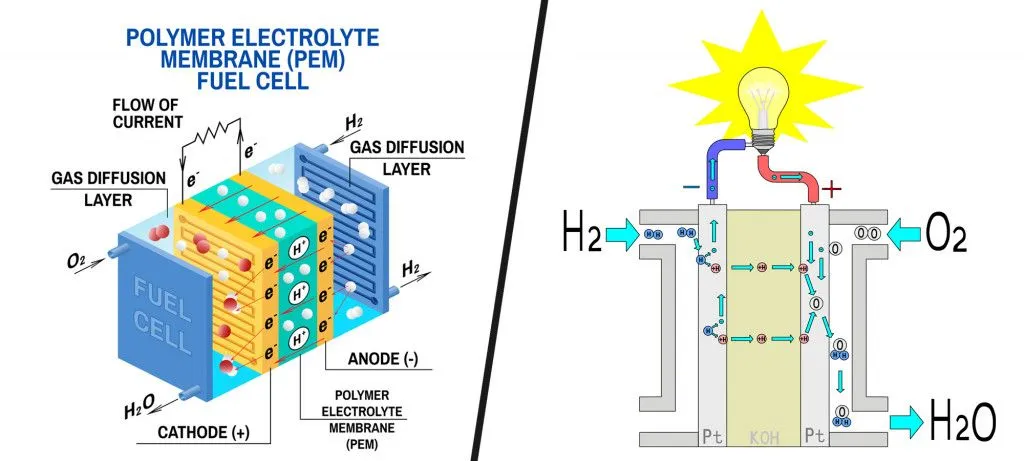
The proton passes through the polymer electrolyte membrane to the cathode, while the electron is forced through an external circuit – it is this stream of electrons that drives the vehicle’s electric motor. The cathode is supplied with air, where the protons, electrons, and atmospheric oxygen recombine to form water vapor – the only tailpipe emission.
To supplement the traveling range provided by hydrogen, FCEVs are equipped with brake energy recuperation technology, which stores surplus kinetic energy in an electric accumulator.
Sourcing Hydrogen – A Major Downside To Fuel Cells
Fuel cells are supplied with hydrogen stored in tanks aboard the vehicle. Like fossil fuels, hydrogen gets used up and must be replenished. Hydrogen can be either be generated in-situ, within the fuel cell, or be supplied externally. Hydrogen is expensive to produce, and transfers that infeasibility to hydrogen fuel cells.
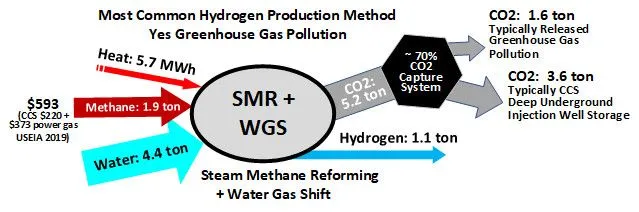
Currently, natural gas is the biggest source of hydrogen. This process involves reacting natural gas with superheated steam, resulting in the production of hydrogen, along with carbon monoxide and carbon dioxide. While the FCEV is devoid of greenhouse gas emissions, their presence in its upstream processes makes it unsuitable for long-term use.
Other sources of hydrogen include the electrolysis of water, and heat-based processes, such as the pyrolysis of organic material like feedstock. These methods are quite expensive, making them infeasible for large-scale deployment.
Importance Of Water As A Raw Material For Hydrogen Production
Water is not only the end product of a reaction in hydrogen fuel cells, but it is a source of hydrogen itself. This can create a loop, where ‘exhaust’ water from fuel cells is electrolyzed to produce the hydrogen essential for fuel cell functioning.
In such cases, dependency on hydrogen from external sources further decreases, further reducing the vehicle’s carbon footprint. While it is theoretically possible to create such a self-contained system, as per the second law of thermodynamics, it is impossible to create a self-sustaining system without incurring some loss of energy.
Thus, a loop architecture can have shortcomings that may not immediately be apparent.
Benefits Of Using FCEVs
The biggest advantage of using fuel cells is the immediate elimination of harmful tailpipe emissions. Apart from refueling times being as low as fossil fuel equivalents, they also have superior fuel economy. An average FCEV can replenish its hydrogen tank in under 5 minutes, and return fuel efficiencies in the range of 70MPGe (miles per gallon of gasoline equivalent).
This makes them a very competitive alternative to electric vehicles, which currently suffer from low range and high charging times.
Challenges Of FCEVs
As promising as fuel cell vehicles are, they cannot be deployed on a large scale. The biggest challenge faced by FCEVs is the sustainable and inexpensive production of hydrogen. Its distribution and handling is another challenge that is discouraging auto makers from exploring the option too deeply.
Which Cars Actually Run On Hydrogen Today?
Hydrogen fuel cell cars are not a laboratory curiosity; a handful of them are already on sale to the public. The best known is the Toyota Mirai, first launched in 2014 and completely redesigned in 2021. The second-generation Mirai stores its hydrogen in high-pressure tanks and carries an EPA-estimated range of about 647 km (402 miles) on a full fill, which takes only three to five minutes at a hydrogen pump.

The Hyundai Nexo, a fuel cell SUV launched in 2018, offers a similar EPA-estimated range of roughly 611 km (380 miles). The newest entrant is the Honda CR-V e:FCEV, which pairs a hydrogen fuel cell with a plug-in battery: it is rated for about 435 km (270 miles) on hydrogen, plus another 47 km (29 miles) on battery power alone, so short trips around town can run on electricity charged at home.
Crucially, none of these cars sip water. They all consume hydrogen gas that was produced elsewhere and pumped into the tank, exactly like the fuel cells described above. That distinction also explains why they remain rare: outside a few markets, chiefly California in the United States, hydrogen refueling stations are scarce, which keeps sales low even where the cars themselves work well. Producing that hydrogen cleanly, as so-called green hydrogen split from water with renewable electricity, remains the industry’s central challenge.
What About Famous “Water-Powered Car” Claims Like Stanley Meyer’s?
If a truly water-fueled car is impossible, why does the idea refuse to die? Largely because of a string of inventors who claimed to have built one. The most famous is the American Stanley Meyer, who through the 1980s and 1990s showed off a dune buggy he said ran on his “water fuel cell,” insisting it needed just 22 US gallons of water to drive from Los Angeles to New York.

The claim did not survive scrutiny. When two investors sued, an Ohio court in 1996 had Meyer’s device examined by three expert witnesses, who found “nothing revolutionary about the cell at all” and that it was simply performing ordinary electrolysis. The court ruled that Meyer had committed “gross and egregious fraud” and ordered him to repay the investors $25,000. Meyer died suddenly in 1998; the county coroner attributed it to a cerebral aneurysm, though that has not stopped conspiracy theories about his death from circulating to this day.
Meyer was not alone. In 2008, the Japanese startup Genepax unveiled what headlines called a “water-powered car,” claiming a single liter of any water could run it for about an hour. Skeptics quickly noted that the demonstrator was an off-the-shelf, Indian-built electric car, and that the energy likely came from a metal hydride reaction rather than the water itself; Popular Mechanics flatly called the claims “rubbish,” and the company closed its website in 2009. Every such device runs into the same wall as a self-powered water wheel: it would amount to a perpetual motion machine, which is forbidden by the first and second laws of thermodynamics.
Conclusion
While the idea of emptying a jug of water into your car’s fuel door for extended range is indeed appealing, the technology doesn’t exist just yet.
As the pressure on alternative propulsion systems mounts, to ease our reliance on fossil fuels, it is only a matter of time before we’re able to do just that!
References (click to expand)
- How Do Fuel Cell Electric Vehicles Work Using Hydrogen?. The United States Department of Energy
- Hydrogen Research and Development. The United States Department of Energy
- Fuel Cell Electric Vehicles - Alternative Fuels Data Center. The United States Department of Energy
- Hydrogen Fuel Basics | Department of Energy. The United States Department of Energy
- Water Emissions from Fuel Cell Vehicles - Department of Energy. The United States Department of Energy
- A Glimpse into Hydrogen & Transportation | US EPA. The Environmental Protection Agency
- Types of Fuel Cells | Department of Energy. The United States Department of Energy
- Fuel Cell Vehicles. U.S. Department of Energy / EPA (fueleconomy.gov)
- Toyota Mirai. Wikipedia
- Hyundai Nexo. Wikipedia
- 2025 Honda CR-V Fuel Cell Has an EPA-Estimated 270 Miles of Range. AOL Autos
- Water fuel cell (Stanley Meyer). Wikipedia
- Water-fuelled car. Wikipedia