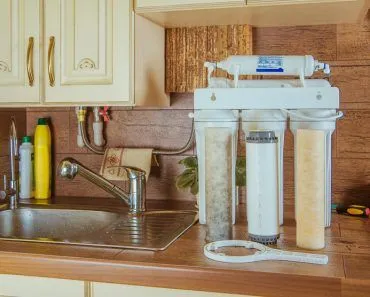
You actually can: boil sea water, capture the steam, and let it condense, and the salt stays behind as fresh water (this is distillation). The catch is scale. Boiling water is hugely energy intensive, and the leftover concentrated brine can harm local marine life, so we don’t simply boil the ocean to quench our thirst.
Obtaining fresh water for human consumption has been a major difficulty over the years. This is primarily due to the rising level of demand for fresh water due to the surge in the human population. Even though fresh water accounts for only about 2.5% of all the water present on Earth (and most of that is locked up in ice caps and deep groundwater), it’s hard to ignore another abundant source of water on our planet, which is when our eyes turn to the mighty oceans. We have so much water, in such a vast amount, if only we could convert it all to fresh water. Well, it isn’t that straightforward either, particularly when discussing the process or implications of achieving this feat. Let’s first address the methods that can be used to convert salt water into fresh water.
Can You Drink Salt Water If You Just Boil It?
This is where most people go wrong. Boiling salt water and simply drinking whatever is left in the pot does not give you fresh water; it gives you something even saltier. Boiling only turns water into vapor and sends it off into the air, and the salt cannot evaporate along with it, so every dissolved grain stays behind in the pot. As more water escapes as steam, the leftover liquid becomes progressively more concentrated, not less. Boiling does kill bacteria and other microbes, which is why we boil questionable fresh water to make it safe, but it does nothing to remove dissolved salt.

That distinction matters because seawater is already brutally salty. On average, every liter of ocean water carries about 35 grams of dissolved salts, roughly 3.5% by weight. Our kidneys cannot cope with a load that heavy. As the National Ocean Service explains, human kidneys can only produce urine that is less salty than seawater, so to flush out the excess salt you would have to urinate more water than you drank. The result is that drinking seawater leaves you more dehydrated, and thirstier, than before. To actually get fresh water out of that pot, you have to capture the steam and let it condense somewhere else, which is exactly the trick behind distillation.
Thermal Distillation
The most famous and age-old process of separating salt or any other impurity is by passing heat through the water. Although there are many forms of distillation, we will only be looking into the ideal thermal distillation process. Let’s set the tone for understanding this process by first defining boiling point. The boiling point of a liquid can be described as the temperature at which the vapor pressure of the liquid is equal to the surrounding atmosphere. Now, to scale down a desalination plant to its more rudimentary function, we see the distillation process being taught in middle school chemistry classes. When you observe the distillation experiment, it starts with the boiling of water, which results in the change of water into its vapor state. The vapor transfers from one beaker into another with the help of a tube. During its journey into the other container, the water condenses and precipitates. The unique thing about distillation is that only the water turns into vapor, leaving behind any impurities that it may possess, thereby helping us derive fresh water.
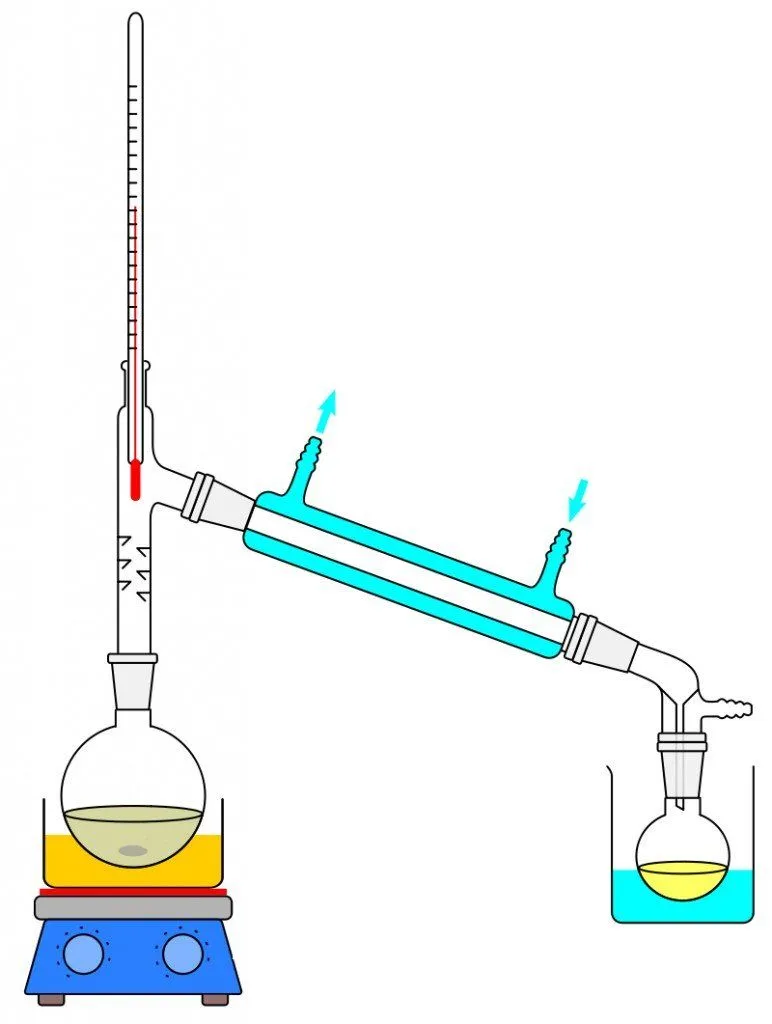
Although this is on a small scale, it might prove to be an ingenious method that can be scaled up to a level capable of helping the world. The problem is that the desalination of water on an industrial scale requires a lot of energy. Another major problem we run into is that salt dissolves very easily in water, forming strong chemical bonds, and those bonds are difficult to break. Energy and the technology to desalinate water are both expensive, which means that desalinating water on a large scale can be pretty costly.
How Does Nature Turn Seawater Into Fresh Water?
Here is the reassuring part: nature has been desalinating the oceans for billions of years, and it uses the very same principle as a distillation flask, just on a planetary scale. When the Sun heats the surface of the sea, water at the top evaporates and rises as vapor, leaving all of its dissolved salt behind in the ocean. High in the atmosphere that vapor cools, condenses into clouds, and eventually falls back to the ground as rain or snow. The rain that fills our lakes and rivers is, in effect, freshly distilled ocean water. This grand loop is the water cycle, and it is the reason a salty ocean quietly keeps refilling the world’s supply of fresh water. It is also why water can leave the sea even though the ocean never comes close to boiling, because evaporation happens at any temperature.

You can borrow the same trick by hand. A solar still is a simple device that lets sunlight evaporate salt water inside a covered container and then collects the pure droplets that condense on the cooler lid. In 1952, the United States military built an inflatable solar still for pilots stranded at sea; each floating ball could wring between 1.4 and 2.4 liters of drinkable water a day out of the ocean. It is slow, but it works, precisely because it copies what the Sun already does to the sea every single day.
Why Can’t You Just Filter the Salt Out?
If boiling and high-pressure membranes both sound like a lot of effort, it is natural to ask why we cannot simply pour seawater through a filter, the way a coffee filter catches grounds. The problem is that dissolved salt is not floating around as visible specks that a mesh can trap. When salt dissolves, each crystal breaks apart into individual sodium and chloride ions, and these are among the smallest particles in the water, far tinier than the pores of cloth, sand, paper, or even a household carbon filter. Water molecules and salt ions slip through an ordinary filter side by side, so the water comes out just as salty as it went in.
To pull them apart, you need something that works at the scale of individual molecules. That is why the two workable options both look a little extreme. Distillation forces a change of state, so that only water molecules leave as vapor, while reverse osmosis pushes water through a membrane whose openings are around a ten-thousandth of a micrometer, fine enough to let water molecules pass while blocking the larger salt ions. An everyday filter simply cannot reach that scale, which is the whole reason desalination is harder than it first appears.
Reverse Osmosis
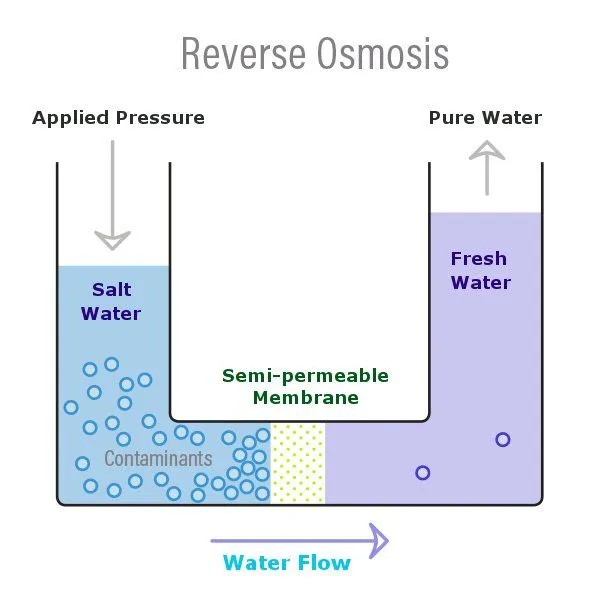
Reverse Osmosis (or RO, as it is popularly referred to) is one of the most famous water purification techniques available on the market today. It involves the use of a partially permeable membrane to purify water. A semi-permeable membrane is a membrane that will allow some atoms or molecules to pass, but not others. A simple example is a screen door, which allows air molecules to pass through, but blocks pests or anything more significant from crossing through the holes in the screen door. An RO membrane works on the same idea, but at a far finer scale: its pores are roughly a ten-thousandth of a micrometer across, just big enough to let individual liquid water molecules squeeze through while holding back the larger dissolved salt ions. Note that, unlike distillation, no boiling or vapor is involved here; the water stays liquid the whole way through. To understand the process of reverse osmosis, let’s first establish an understanding of what osmosis is.
 Osmosis is a naturally occurring phenomenon in which the solution with a lower solute (salt) concentration will tend to migrate to the solution with a higher solute concentration. We can understand this more intuitively with the help of the above diagram. Now, in the above diagram, there are two distinct solutions, one with a low saline content (fresh water) and the other with a higher saline content, and both are separated by a permeable membrane. You will notice that the water with the lower solute concentration will move or tend to migrate towards the water with the higher solute concentration.
Reverse Osmosis can now be understood as exactly what its name suggests, the reverse of this process. Whereas osmosis happens on its own, with no external force or energy, reverse osmosis drives water the other way, against the concentration gradient (from high salt content to low), and that can only be achieved by applying an external force, in this case pressure. In reverse osmosis, the semi-permeable membrane only allows the water to pass through and doesn’t allow the movement of the salt (or other things).
Disadvantages
Even if we try bringing an economic viewpoint into this and apply a dollar figure, the task is quite daunting, as rates for energy vary from place to place. Certain factors that influence the dollar figure are linked to labor, energy costs, land prices, financial agreements and even something as basic as the salt level of the water we intend to desalinate. In the United States, it can cost anywhere from $1 to $2 for every one cubic meter. One cubic meter of sea water is 1,000 liters (about 264 US gallons). Now, although this might initially sound cheap, if we try to compare it to the source of a river or an aquifer, then the cost of one cubic meter of water drops to about 10-20 cents. The fresh water obtained is much cheaper on a natural basis, rather than accessing it through desalination processes.
Dollars and oceans of fish
There are environmental issues linked to the desalination of water as well. Sea life can get sucked into desalination plants, killing small ocean creatures, including young fish and plankton, thus upsetting the food chain. Also, there’s the problem of what to do with the separated salt, which is left over as a very concentrated brine. Pumping this extremely salty water back into the ocean can harm local aquatic life. Reducing these impacts is possible, but it adds to the overall costs. Again, concerning RO, in particular, household RO machines are not as efficient as the industrial-scale ones, and the amount of reject water they produce is significantly higher. The reject water that comes from household RO machines cannot be reused for household amenities. In terms of the ratio, most household RO units send roughly 3 to 5 liters of reject water down the drain for every liter of clean water they produce. As we can see, the desalination of seawater as the major source of fresh water is not a feasible method, neither economically nor environmentally.
References (click to expand)
- Why Don't We Get Our Drinking Water from the Ocean? Scientific American
- Desalination. Water Science School, U.S. Geological Survey
- Point-of-Use Reverse Osmosis Systems. U.S. EPA
- Reverse osmosis - Wikipedia. Wikipedia
- Distillation - Wikipedia. Wikipedia
- Can humans drink seawater? National Ocean Service, NOAA
- Seawater - Wikipedia. Wikipedia
- Solar still - Wikipedia. Wikipedia