Yes, technically. A 1 TB hard drive that is completely full weighs about 10⁻¹⁴ grams more than an empty one. The extra mass comes from the small energy difference between aligned and unaligned magnetic domains on the disk’s platter, converted to mass via Einstein’s E=mc². You would never notice it on a kitchen scale (one electron weighs more), but the difference is real in principle.
In today’s world, data is king. Everywhere you look, data is being stored in some form or another. In the olden days, when any kind of data was stored in the form of paper, it was easily quantifiable as to how many kilograms of paper (or data) was being used or stored. However, in today’s world, such a comparison is rather foolish, as even enormous amounts of data can be saved on a hard disk, which was completely inconceivable in the past. The question remains, however… does all this stored data have mass? Before we answer that, let’s take a closer look at how we store and view data on a hard disk.
How A Hard Disk Works
A hard disk has a few parts that help it read and write data. The first primary part of a hard disk is the platter, which is a circular plate made from magnetic material. The platter is divided into billions of tiny areas. Each area on the platter can be magnetized (to a 1) or demagnetized (to a 0). The reason why this form of memory is magnetized is because even if the power supply is absent, this form of memory remains secure.
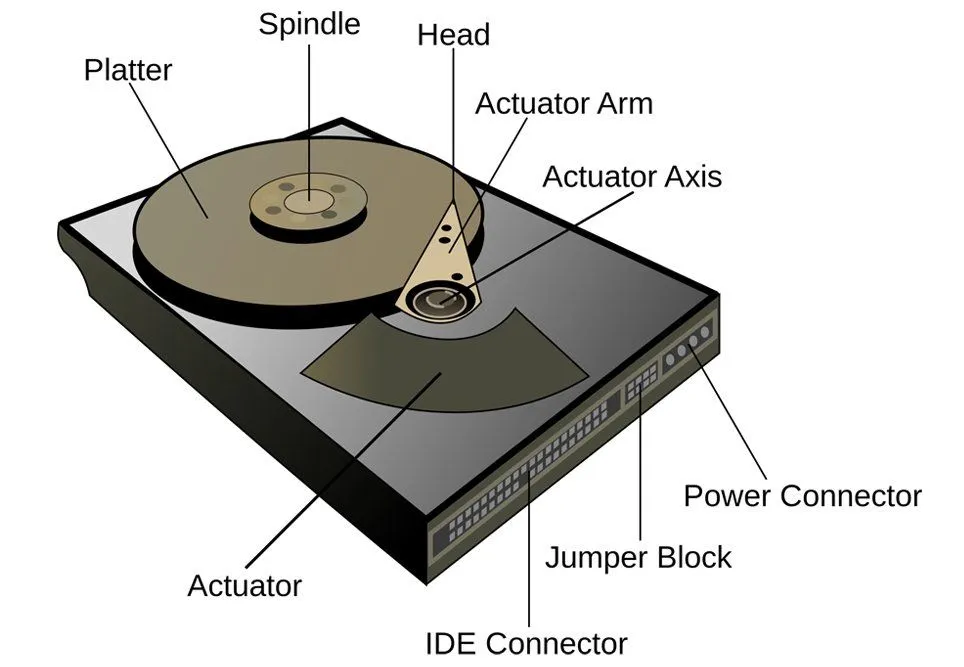
The data stored on a hard disk is not something haphazard, where magnetization and demagnetization can occur just anywhere. The computer carries the storage of data in an orderly fashion so that it can find the data later. Bits of data are stored on circular paths present on the platter known as tracks. Each track is further divided into smaller sections known as sectors. The computer has a detailed map as to which sectors of the hard drive have data in them and which do not. So, whenever it needs to write or access the data, it looks on the map and carries out the appropriate action.
There’s an arm mechanism that moves a tiny magnet called a read-write head back and forth over the platters to record or store information. There is also an electronic circuit that controls everything and acts as a link between the hard drive and the rest of your computer.
The Actual Weight
Now, ask almost anyone you know about whether there is a “weight” to data, and the answer they will probably give you is no. However, if you know someone who is a physicist or a person involved in science, their answer might be a bit different. For all practical reasons, we can state that the weight of a hard disk does not increase, but that statement can be questioned depending on what scale of measurement you are considering this “weight”. From a purely precise and scientific perspective, the weight does change by 10-14 grams, and you will see how this is calculated below.
Every atom has a certain property known as the magnetic dipole moment. The magnetic dipole moment theory states that every atom acts like a tiny bar magnet with a north and a south pole. The magnetic material the platter is made from is a ferromagnetic material. The magnetization process in a ferromagnetic material, when data is written on it, is that all the north poles tend to align in one direction. This leads to the formation of magnetic domains where a particular group of atoms all become magnetically aligned in one direction. If this magnetic domain of atoms aligns themselves towards the reading head, it represents a set bit (1); if it faces away from the reading head, it is called an unset bit (0).
It is also important to understand that each atom acting like a magnet has a certain amount of energy it gives out, depending on whether the atoms are aligned or anti-aligned. According to the laws of physics, the amount of energy that the pair of a magnetic dipole is:
Now that we know the amount of energy two magnetic dipoles create, we must bring one more equation into the picture, a famous equation from an equally famous scientist. It is none other than Albert Einstein’s famous equation E=mc2. Now, how does this equation play a role in finding out the digital mass of data? The reason why the above equation is introduced is to show that, just as mass interacts with gravity to produce the effect of an object having weight, so too does energy couple with gravity to give it weight. Thus, by taking the energy differences between the two possible magnetic alignments and dividing the resulting answer with c2, we get the equivalent mass of digital data.
You still may be wondering how we got around to the approximate change in mass of the hard drive as digital data fills it. Suppose we take 10 grams of cobalt as our choice of material into which we want to store data. The magnetic dipole moment contributed by each atom is provided through a single free electron. The magnetic dipole moment added from a single electron is equal to the Bohr Magneton. The Bohr Magneton is a physical constant in atomic physics – a natural unit for expressing the magnetic moment of an electron caused by either its orbital or spin angular momentum (hang in there, things get easier from here).

That would mean there are 1023 electrons (I’ll save you guys the calculations). A 1TB hard disk has close to 1012 domains present on approximately 400cm2. Assuming each domain has four neighboring domains, it would get -5J if all were aligned in the same direction and +5J if all were anti-aligned. If we plug these values into the above equation and divide it by c2, we get an effective mass difference of 10-14 grams. That is how we prove that digital data does have mass, even if it’s an incredibly tiny amount!
How Much Does A Hard Drive Actually Weigh?
We have been chasing the ghostly 10-14 grams of the data itself, but there is a far more down-to-earth question that most people actually mean when they ask about the weight of a drive: how much does the physical device tip the scale? Here the numbers are reassuringly ordinary. A standard 3.5-inch desktop hard drive is a solid slab of aluminium platters, a spindle motor and a read-write arm, and it weighs somewhere between roughly 450 grams for a 1 TB model and about 750 grams for a 6 TB one, according to Western Digital’s own specification sheets. The smaller 2.5-inch drives built for laptops are far lighter, tipping the scale at around 90 grams.

Notice what those numbers depend on: the number of platters, the motor and the metal casing, and not the amount of data stored inside. A 3.5-inch drive weighs the same half-kilogram whether it is factory-fresh and empty or crammed full to the last sector. The 10-14 grams that the data contributes is around 50 quadrillion (5 × 10¹⁶) times smaller than the drive wrapped around it, which is exactly why no bathroom scale, kitchen scale or laboratory balance you will ever meet can tell a full drive apart from an empty one.
Does Information Itself Have Mass?
So far, all of the mass has come from the magnetic medium. But is there something about pure information, stripped of any particular hard disk, that still ties it to the physical world? Physicists think there is, and the idea is captured in a maxim associated with IBM researcher Rolf Landauer: “information is physical.” Back in 1961, Landauer showed that you cannot erase a single bit of information for free. Wiping one bit must dissipate a minimum amount of energy equal to kT ln2, where k is the Boltzmann constant and T is the temperature. At room temperature that floor works out to a mere 2.9 × 10⁻²¹ joules per bit (about 0.018 electronvolts), but it is never zero. This result, known as Landauer’s principle, wires the abstract world of information directly into the concrete laws of thermodynamics.
For decades this was only a theoretical argument. Then, in 2012, a team led by Antoine Bérut and Eric Lutz built a one-bit memory out of a single microscopic bead held in a double-welled laser trap, and measured the heat given off as the bit was erased. The dissipated heat crept right up to Landauer’s limit and no lower, confirming the principle in the laboratory for the first time. Information, it turns out, carries an unavoidable energetic price tag, and because energy and mass are two sides of the same coin (E=mc2 again), that is another reason physicists are comfortable saying data leaves a genuine physical footprint.
How Much Does The Entire Internet Weigh?
If a single hard drive barely registers, what about the whole internet? This is where the question turns genuinely playful. In the mid-2000s, Harvard-affiliated physicist Russell Seitz tried to put a number on it. He reasoned that the internet is really an ocean of electrons in motion: billions of silicon chips, each running at a few volts and gigahertz speeds, spread across roughly 100 million servers that together draw tens of billions of watts. When he converted the mass-equivalent of all that flowing energy using E=mc2, he arrived at a now-famous figure of about 50 grams, roughly the weight of a single strawberry.

It is worth being clear about what that number really means. Seitz was weighing the energy that powers the internet, not the stored data itself. Estimates that instead ask what the raw bits weigh land on a far tinier answer, a fraction of a millionth of an ounce, because each bit contributes only a whisper of mass (it is remarkable how few atoms it takes to store a movie). Either way, the takeaway is the same one this article opened with: data, and the machinery that carries it, are astonishingly light, yet they are never quite weightless.
References (click to expand)
- Bohr magneton - Wikipedia. Wikipedia
- Was Einstein the First to Invent E = mc2? - Scientific American. Scientific American
- How does a hard drive work? - Explain that Stuff. explainthatstuff.com
- WD Blue Desktop 3.5-inch PC Hard Drive Data Sheet. Western Digital
- Landauer's principle - Wikipedia. Wikipedia
- Landauer's Principle: Past, Present and Future. Entropy / PMC (National Library of Medicine)
- How Much Does the Internet Weigh? AZoQuantum