The hottest thing ever observed is a quark-gluon plasma created at CERN's Large Hadron Collider, which briefly reached about 5.5 trillion °C, roughly 360,000 times hotter than the Sun's core. The coldest natural spot is the Boomerang Nebula, 5,000 light-years away, at about 1 K (-272.15 °C). The coldest temperature engineered by humans is roughly 6 millikelvin, achieved over a full cubic metre by the CUORE experiment in Italy; in tiny atomic samples, physicists have reached well below one billionth of a kelvin.
Remember that May when the temperature was so high you thought you were practically melting? The sweat made it unbearable to drive as your hands slipped off the steering wheel, like someone falling asleep and rousing the very next moment.
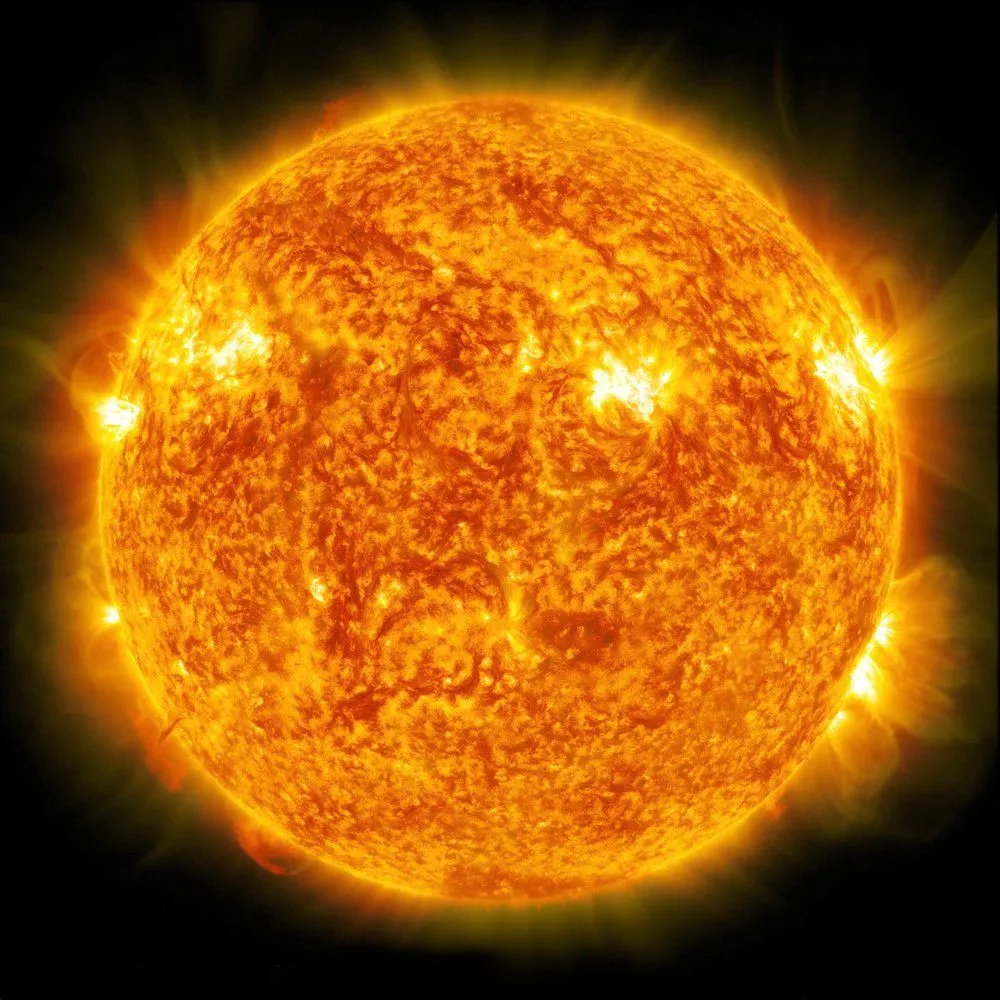
However, that might not have even been the hottest temperature in the States, let alone the rest of the planet. The hottest air temperature ever officially recorded on Earth is the 56.7 °C (134 °F) reading taken at Furnace Creek (then called Greenland Ranch), Death Valley, California, on July 10, 1913 (some modern climatologists have since argued the reading may be erroneously high, but it is still the official record). Compare this paltry amount to the source of the heat, the Sun, which boasts a temperature of 5,505 degrees Celsius on its surface, while its core burns at 15 million degrees Celsius! Now that’s hot! The Sun is obviously the hottest thing in our Solar System, but it is a mere thermos when compared to several other stars and stellar phenomena, particularly supernovas.
On the opposite side of the spectrum, colder temperatures come with a lower limit. The lowest possible temperature is so cold that traditionally restless atoms become statuesque, completely immobile. This is a huge change in their state, considering an atom’s love for heat and motion. Keep in mind that the phenomena described below burn or chill at stupefying temperatures that we have recorded. Even though breaking these barriers seems highly impossible, by some miraculous technological advancement in science, they could be broken in the future, just as the previous, once seemingly insurmountable temperatures were.
So, what are the hottest and coldest temperatures we have ever witnessed?
The Hottest Thing In The Universe: Supernova
A supernova is a transient event that marks the last evolutionary stage in the life of a star. The star’s life ends dramatically with a colossal explosion – the largest in space. The temperatures at the core during the explosion soar up to 100 billion degrees Celsius, 6000 times the temperature of the Sun’s core. However, supernovae aren’t the hottest things in the Universe – not even close. In fact, the hottest thing in the entire Universe has been found or rather created somewhere you would least expect – Switzerland!
In order to recreate the conditions that might have prevailed just moments after the Big Bang, physicists at CERN, Geneva, collided lead ions to form a quark-gluon plasma, “a subatomic soup”. The temperature, akin to the temperature that followed the mega-titanic explosion of Big Bang, at CERN’s LHC in Geneva, Switzerland reached a searing 5.5 trillion degrees Celsius or 9.9 trillion degrees Fahrenheit. That is 360,000 times the temperature at the Sun’s core!
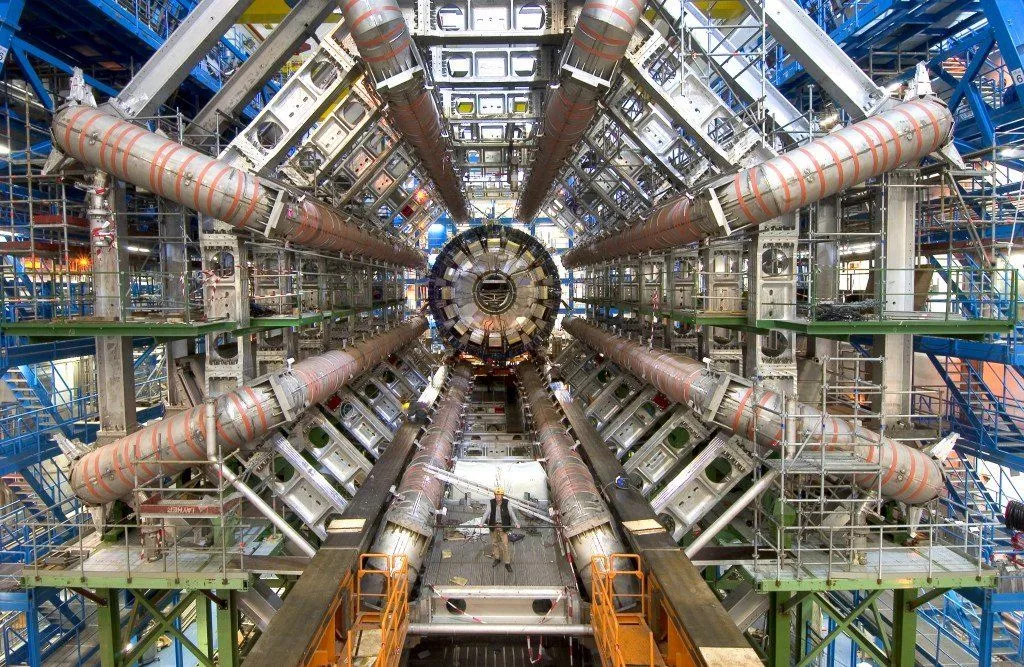
The achievement surpassed the previously held world record of 4 trillion degrees Celsius, producing a plasma 38% hotter than the one produced at an experiment performed at the Brookhaven National Laboratory, New York in 2010. The experiment sheds light on what might have happened merely microseconds after the Big Bang roughly 13.8 billion years ago.
Can it get any hotter? Well… yes, albeit theoretically. The Planck temperature, which equals 100 million million million million million degrees Celsius, also known as Absolute Hot, is a temperature beyond which matter betrays its conventional behavior. Beyond this temperature, all four fundamental forces are unified into a single force. Simply put, weird and inexplicable things happen. This absurd behavior is believed to be explained by the theory of everything, something that Albert Einstein was working on until his last breath. This overarching theory is yet to be discovered.
Is The Sun The Hottest Thing In The Solar System?
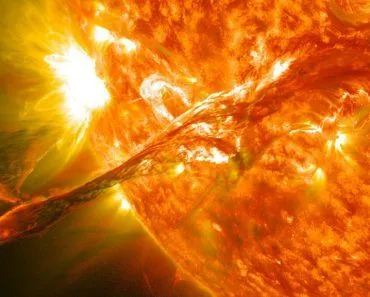
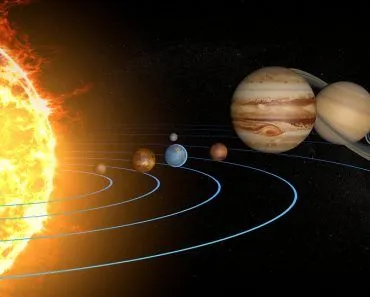
It seems obvious that the Sun, the blazing furnace at the heart of our neighborhood, must be the hottest thing in the Solar System. For the most part, that is true. The Sun's core simmers at roughly 15 million degrees Celsius (27 million °F), where hydrogen fuses into helium, and nothing else in the Solar System comes close to sustaining such heat. No planet, moon or comet even approaches it.

But the answer hides a couple of delicious twists. The Sun's visible surface, the photosphere, is a comparatively mild 5,500 degrees Celsius (about 10,000 °F). That is roughly the same temperature as the solid iron heart of our own planet, whose inner core sits near 5,400 degrees Celsius. So Earth's core is about as hot as the surface of the Sun, even if it is millions of degrees cooler than the Sun's core.
Stranger still, the Sun's surface is not even the hottest part of the Sun. Wrapped around it is the corona, the wispy outer atmosphere visible during a total eclipse, and it blazes at more than 1 million degrees Celsius (around 2 million °F), nearly 200 times hotter than the surface directly below it. Why the thin outer atmosphere should be so much hotter than the surface it sits on is a genuine mystery that astronomers call the coronal heating problem, and NASA's Parker Solar Probe was built partly to crack it.
And here is the real kicker: a humble bolt of lightning on Earth briefly reaches about 30,000 degrees Celsius, roughly five times hotter than the Sun's surface, though still far cooler than its core. So while the Sun's core reigns supreme, our own planet regularly out-sizzles the Sun's face.
What Is The Hottest Thing On Earth?
Leave the stars behind for a moment and the question of what is the hottest thing on Earth has a surprisingly layered answer, depending on whether you mean natural weather, natural geology, or something humans have engineered.

If you are asking about air temperature, the record still belongs to Death Valley's 56.7 degrees Celsius (134 °F) from 1913 that we met earlier. But that is barely warm compared to what the planet cooks up elsewhere. Molten basaltic lava erupting from Hawaiian volcanoes like Kilauea pours out at around 1,150 to 1,200 degrees Celsius (2,100 to 2,190 °F), hot enough to glow orange and set almost anything it touches ablaze.
Hotter still, and far more fleeting, is lightning. The bolt that splits the summer sky heats the narrow channel of air it rips through to roughly 30,000 degrees Celsius (about 54,000 °F). That is around five times hotter than the surface of the Sun, and it is the explosive expansion of that superheated air that we hear as a clap of thunder.
Yet the undisputed champion is something we built. The quark-gluon plasma created at CERN's Large Hadron Collider, described above, reached about 5.5 trillion degrees Celsius when physicists smashed lead ions together at nearly the speed of light on 13 August 2012. Guinness World Records lists it as the highest man-made temperature ever recorded. In other words, the hottest thing that has ever existed on Earth was made on purpose, for a few fleeting instants, inside a machine buried beneath the Swiss-French border.
The Coldest Thing In The Universe: Boomerang Nebula
Atoms love heat. They begin to stagger around as soon as any amount of warmth seeps in. As the temperature increases, they let loose and plunge into vigorous vibrations. On the contrary, as the temperature plummets, their motion dwindles. However, they can never achieve rest. Actually, theoretically, immobility is a possibility. As mentioned, there is a lower limit to temperature, a temperature at which motion completely ceases to occur. This temperature is known as the Absolute Zero and has a magnitude of -273.15 degrees Celsius or 0 Kelvin.
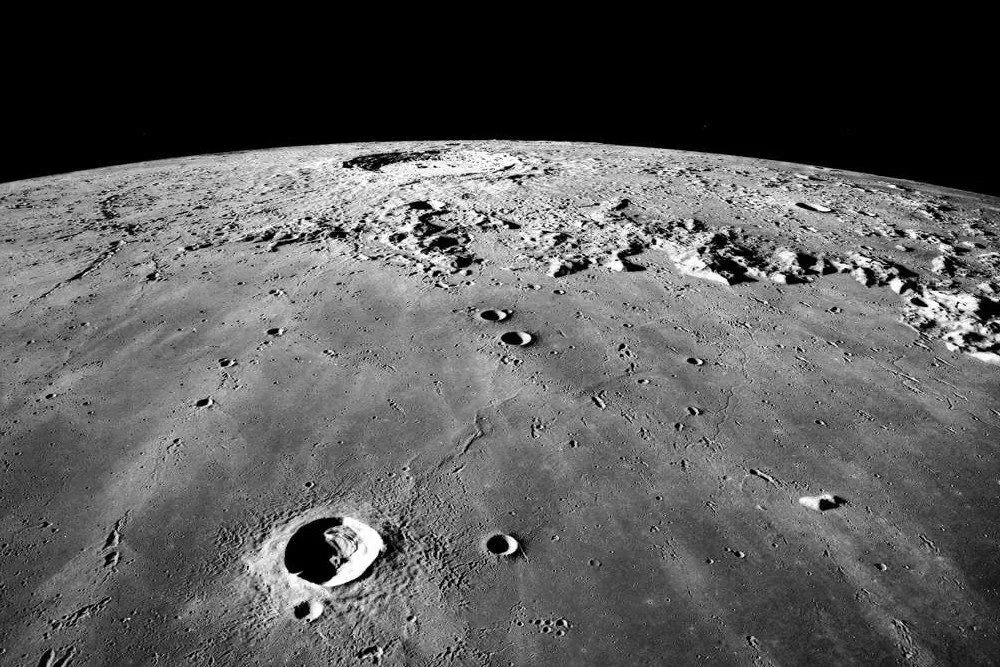
The coldest spot in our Solar System isn’t far away either. The permanently shadowed craters near the south pole of the moon measured around -240 degrees Celsius or 33 Kelvin, beating even the temperatures you’d expect on the remote and dark planet, Pluto. However, the coldest natural spot in the Universe currently is the Boomerang nebula, which resides 5,000 light-years away from us. Its temperature is measured to be 1 Kelvin or -272.15 degrees Celsius. Yet, that still isn’t the coldest temperature we have ever measured. Again, the coldest temperature we have come across was on our own planet!
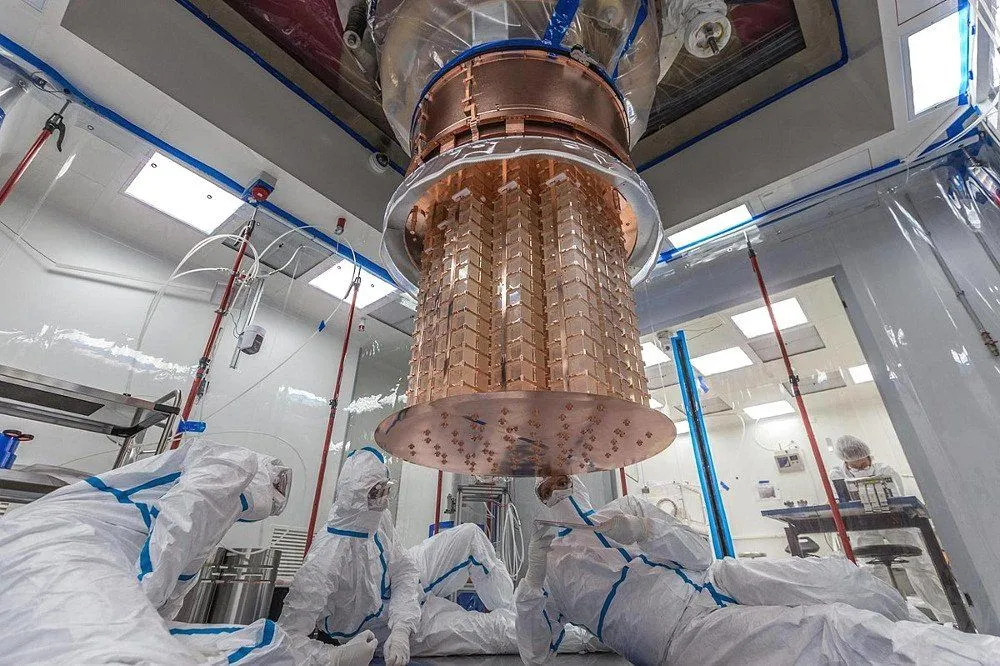
The coldest temperature was manifested in an underground lab in Italy. The volume represented the coldest cubic meter in the Universe. Researchers of the collaboration Cryogenic Underground Observatory for Rare Events (CUORE) created a refrigerator that cooled at an astounding -273.144 degrees Celsius or 6 milliKelvin. That is nail-bitingly close to Absolute Zero! The researchers maintained the temperature for two weeks to study the behavior of neutrinos – spooky subatomic particles that might hold the secret to the matter that surrounds us.
What Is The Coldest Place On Earth?
Just as the hottest extremes split between nature and the laboratory, so do the coldest. The coldest natural place on Earth is Antarctica. On 21 July 1983, instruments at Russia's Vostok research station, high on the East Antarctic ice sheet, recorded a bone-cracking -89.2 degrees Celsius (-128.6 °F). That remains the coldest air temperature ever measured by a weather station and recognized by the World Meteorological Organization.

Satellites have since spotted even colder patches. Analyzing readings from the East Antarctic Plateau, scientists have found surface temperatures dipping to around -98 degrees Celsius (-144 °F). Because it is hard to be sure exactly how far above the ice those remote measurements were taken, they are not counted as an official record, so Vostok's figure still stands.
Frigid as that is, it is nowhere near the coldest thing on Earth. That title belongs to the physics labs, where the CUORE experiment described above chilled a full cubic meter to about 6 milliKelvin, and where clouds of atoms have been coaxed to within a billionth of a degree of absolute zero. Antarctica may be the coldest place you could ever stand, but the true deep freeze lives inside a handful of humming refrigerators.
References (click to expand)
- Creating the coldest cubic meter in the universe (Update). Phys.org
- Hot stuff: CERN physicists create record-breaking subatomic soup : News blog - blogs.nature.com
- New Temperature Maps Provide a 'Whole New Way of ... - NASA. The National Aeronautics and Space Administration
- Planck Temperature | COSMOS. The Centre for Astrophysics and Supercomputing
- How Hot Is Lightning? National Weather Service (NOAA)
- How hot is a Hawaiian volcano? U.S. Geological Survey
- NASA's Parker Solar Probe and the Curious Case of the Hot Corona. NASA
- Highest artificial temperature. Guinness World Records
- Lowest temperature recorded on Earth. Guinness World Records
- Coldest Known Temperature on Earth Recorded in Antarctica. National Geographic