You can recognize about 5,000 faces but truly know only around 150 people, and still forget their names. The science of faces, names and Dunbar's number.
If you have ever returned to your home town or country after a long time away, it can seem like a strange dream. Some things are the same, but a great deal has also changed. When you walk down the street, you see plenty of new people, but also a surprising number of familiar faces. After years and years, there is still a flash of recognition on many faces, and your afternoon may quickly disappear while catching up with old acquaintances who never left home!
Humans have an uncanny ability to recognize faces, even if we aren’t able to immediately attach them to a name. From Hollywood celebrities and old high school classmates to your distant acquaintances, best friends and family members, we have a catalogue of facial memory in our brains that is surprisingly thorough. Of course, in this age of excellence, the question naturally arises: what is the limit to how many faces we can remember?

The answer is… we don’t actually know, but there have been some fascinating developments in this area of study in recent years.
How And Why Do We Remember Faces?
You have likely had the experience of recognizing someone’s face at a crowded party, and being absolutely certain you’ve seen them before, but can’t remember how. Don’t worry about your brain power, human beings are far better at recognizing faces than remembering names or other contextual details. Our visual sense is definitely our strongest, and has the most brain space dedicated to it, which makes sense given our evolutionary history. For millions of years, primates and early hominids didn’t have spoken language, and therefore relied largely on their visual abilities to discern family members from strangers, and predators from prey.

Aside from our sharp visual senses, remembering faces also comes naturally because there are so many variables to consider. There is eye color, the size of the nose, the shape of the mouth, beauty marks, dimples, wrinkles, eyebrow style and a dozen other spatial characteristics that our brains automatically take in and store. Additionally, when we meet someone, we tend to speak with them while maintaining eye contact, but occasionally looking at the person’s face. This is a longer stimulus for the brain to store, as opposed to someone’s name, which is an unoriginal string of audible input that is only said once, upon introduction.
More specifically, our ability to remember faces is based in the fusiform face area, located in the inferior temporal cortex, which is activated during facial recognition activities. We know that this is the case because damage to this area can cause an inability to recognize faces even of loved ones, a condition that we’ll discuss further below.
The more regularly we are exposed to someone’s face, including celebrities and public figures, the more reinforced it becomes in our memory. Perhaps that’s why so many people start awkward conversations with, “Don’t I know you from somewhere?” or “You know who you look like?”
How Many Faces Can We Remember?
So, now that we know what part of our brain allows us to have such a vast depth of memory for faces, how many faces can we actually recall? A 2018 study, conducted in the U.K. at the University of York and published in the journal Proceedings of the Royal Society B, found that the average person can recognize about 5,000 individual faces. That number may seem staggering, but think about it… if you patiently cycle back through different stages of life, different neighborhoods, friendship groups, families, classmates, co-workers and, of course, the hundreds of celebrities you could spot on sight (living and dead), your total would climb rather quickly too!
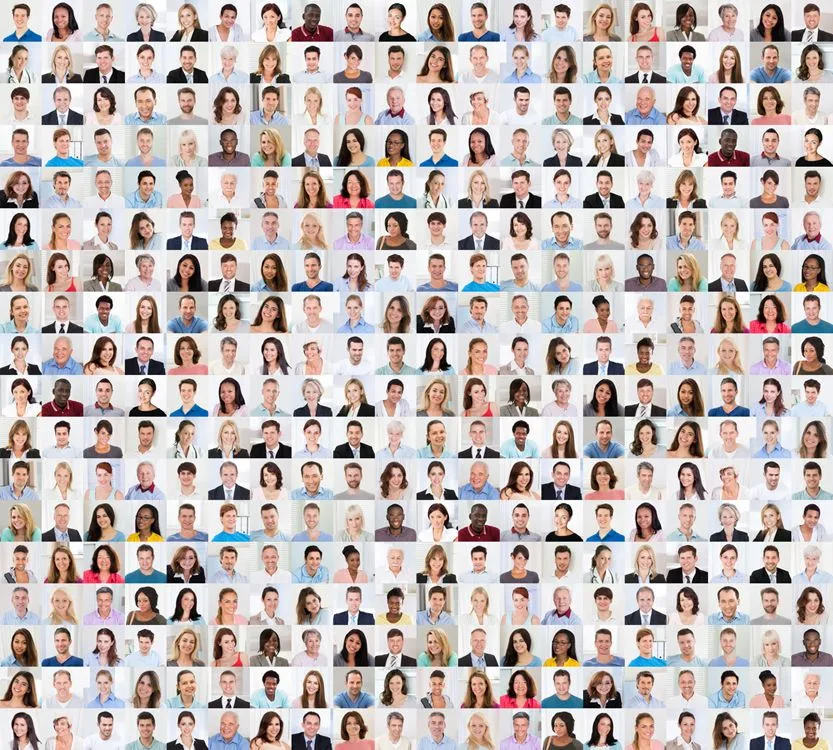
Well, a similar approach was taken by the researchers, as they had the participants spend one hour recalling all the people that they personally knew whose face they could visualize. They did not have to include the corresponding names, so “neighbor across the street” would suffice. Following this, the participants were shown thousands of images of celebrities and were asked to identify them. The range of performance varied greatly, from recalling 1,000 to as many as 10,000 faces! The average, however, sat at roughly 5,000, a remarkable total considering I can barely remember my own cousins’ names.
Face Blindness And Super-Recognizers
Now, there are many factors that could affect your ability to remember faces. Some people may simply have a greater aptitude for the ability, or that part of their brain is particularly well developed. On the other hand, the environment is also critical to consider. If you grew up in a small town until the age of 18, didn’t watch much television and considered yourself an introvert as an adult, your pool of available faces may simply be smaller than someone who grew up in New York City with a huge family, or an Army brat who bounced around between countries and homes every six months.
Additionally, there are those people who are unable to recognize faces, or struggle with this ability. If the fusiform face area in the brain is damaged, or underdeveloped, it can result in a condition called prosopagnosia, commonly referred to as “face blindness”. The fusiform gyrus, which controls our facial recognition, allows us to record more detail from faces than our brains do for other inanimate objects. Both the acquired (via injury) and congenital forms of this disease make it difficult or impossible for people to remember someone based on their face. This doesn’t affect a person’s ability to recognize other objects or their function, nor does it impair their cognition or decision-making abilities. Family parties, however, are likely difficult to navigate.
The opposite end of the spectrum from those suffering from prosopagnosia are people referred to as super recognizers. These individuals have significantly better-than-average facial recognition abilities. It is believed that they can remember up to 80% of faces they have seen, in comparison to the average person, who can recognize about 20% of the faces they encounter. Although it is known that this ability is directly related to the fusiform face area, the exact science behind this remarkable ability is still poorly understood. While the study conducted in 2018 found 10,000 as the upper limit of its participants, some super recognizers may be able to recall many thousands more than that!

Such an ability is potentially valuable, in our age of heightened national security and global crises. Numerous law enforcement agencies around the world employ super recognizers to scroll through thousands of hours of video or CCTV footage to find suspects, or to identify potential threats in large crowds. London’s Metropolitan Police, for example, set up a dedicated team of super recognizers, who famously helped identify suspects by trawling through CCTV footage in high-profile investigations.
Interestingly enough, studies on super recognizers have found that there is slightly more complexity to this subject. It was found that some super recognizers excel at remembering faces they have seen, but may not be as good at spotting a specific face in a crowd. Those who can spot a particular “target” face in a crowd may not be as skilled at verifying or matching faces, such as on a passport. The nuances of the fusiform area are still under study, as are the different areas of expertise where these skills can be employed!
Why Do We Remember Faces But Forget Names?
It is one of the most common social embarrassments there is: you spot a familiar face across the room, you’re certain you know the person, and yet their name is nowhere to be found in your memory. This lopsidedness isn’t a personal failing; it reveals something basic about how the brain files information. A face arrives as a rich bundle of visual detail that our fusiform face area is built to take in all at once, whereas a name is little more than an arbitrary string of sounds attached to someone in the very moment we’re busy studying their face.

The classic demonstration of this comes from a 1990 study by psychologist Gillian Cohen, published in the British Journal of Psychology. Cohen described what has become known as the Baker/baker paradox. Imagine two people are each shown the same photograph of a stranger. One is told that the man’s surname is “Baker”, while the other is told that the man is a baker by profession. Days later, the person who learned the occupation is far more likely to recall the word than the person who learned the surname, even though it is the exact same word.
Why the difference? A profession like “baker” plugs straight into a web of things you already know: flour, hot ovens, tall white hats and the smell of fresh bread. Those associations act as handholds, giving your memory several routes back to the fact. A surname, by contrast, hooks onto nothing; “Baker” as a name is just a label with no built-in meaning, so there’s nothing for the brain to grab. It’s the same reason you can happily recall that someone is a teacher or keeps two dogs, yet blank completely on whether they’re a Susan or a Sarah. If this happens to you constantly, you’re in good company, and we’ve dug into it further in our look at why we forget people’s names.
How Many People Can We Actually Know?
Recognizing a face and actually knowing a person are two very different things, and the numbers behind them sit surprisingly far apart. You might be able to pick thousands of faces out of a crowd, but the number of people you genuinely keep up with, the ones whose lives you follow and who would return your call, is much, much smaller.

The best-known estimate here comes from British anthropologist Robin Dunbar. In a 1992 paper in the Journal of Human Evolution, he compared the relative size of the neocortex, the brain’s outer thinking layer, across dozens of primate species and found that it tracked closely with the size of the social group each species lived in. Extrapolating that relationship up to our own oversized primate brains produced a now-famous figure: humans seem able to maintain roughly 150 stable, meaningful relationships. The idea that our social world is capped by our brainpower is known as the social brain hypothesis, and the 150 estimate is often called Dunbar’s number.
That 150 isn’t a flat list, either. Dunbar suggested it is arranged in nested layers of closeness: an intimate core of around 5 people who receive the lion’s share of your emotional attention, a wider ring of close friends, and progressively looser circles of casual friends and acquaintances stretching out to the edge of the 150.
It’s worth adding that the number is far from settled. A 2021 study in the journal Biology Letters reanalyzed the primate data with newer statistical methods and arrived at wildly different estimates with enormous margins of error, concluding that pinning human social capacity to any single figure is questionable. Still, the broad lesson holds: the same brain that lets us recognize a stadium full of faces keeps the circle of people we truly know remarkably small. For a related look at this ceiling in the age of social media, see our piece on whether it’s possible to befriend all your Facebook and Instagram connections.
A Final Word
Most human beings have a remarkable ability to recall thousands of different faces, even if we couldn’t summon their name if our lives depended on it. Thanks to a specialized (and vulnerable) part of the brain called the fusiform face area, you can spot your friend in a crowd, acknowledge your old neighbor in a grocery store, and avoid re-introducing yourself to any disastrous blind dates from your past!
References (click to expand)
- Jenkins, R., Dowsett, A. J., & Burton, A. M. (2018). How many faces do people know? Proceedings of the Royal Society B: Biological Sciences. The Royal Society.
- Superior Face Recognition: A Very Special Super Power. Scientific American
- The Average Person Can Recognize 5000 Faces | Smart News. Smithsonian
- Damasio, A. R., Damasio, H., & Van Hoesen, G. W. (1982, April 1). Prosopagnosia: Anatomic basis and behavioral mechanisms. Neurology. Ovid Technologies (Wolters Kluwer Health).
- Kanwisher, N., & Yovel, G. (2006, November 8). The fusiform face area: a cortical region specialized for the perception of faces. Philosophical Transactions of the Royal Society B: Biological Sciences. The Royal Society.
- Cohen, G. (1990). Why is it difficult to put names to faces? British Journal of Psychology. The British Psychological Society.
- Dunbar, R. I. M. (1992). Neocortex size as a constraint on group size in primates. Journal of Human Evolution. Elsevier.
- Lindenfors, P., Wartel, A., & Lind, J. (2021). ‘Dunbar’s number’ deconstructed. Biology Letters. The Royal Society.