Table of Contents (click to expand)
- How Warm Is The Air You Breathe Out?
- Does Air Cool Down As It Squeezes Through Pursed Lips?
- Why Does A Narrow Jet Of Air Drag In The Whole Room?
- Why Does Moving Air Feel Colder Than Still Air?
- How Can You Test Which Explanation Is Right?
- So, Why Does Your Breath Feel Warm Through An Open Mouth But Cool Through Pursed Lips?
The air leaving your lips is the same temperature either way, around 28 to 34 °C (82 to 93 °F), and it barely changes as it squeezes through pursed lips: the expansion cooling that textbooks blame comes to about one thousandth of a degree. What changes is the air that reaches your hand. A slow puff from an open mouth lands as nearly pure, warm breath, while a fast, narrow jet from pursed lips drags the room's own air into itself on the way, so what hits your skin is mostly room air moving fast, and moving air pulls heat out of skin faster than still air does.
Air cools when it expands, and air squeezed through pursed lips expands as it leaves. That is the explanation most people reach for. It is why, they say, the same breath can warm cold fingers and cool hot soup. It turns up in university tutorial sheets and on learned-society websites. It is also too small to feel, by a factor of about ten thousand.
The test takes two seconds. Put the back of your hand near your mouth and breathe out slowly, mouth wide open, the way you fog a window, and that feels warm. Now purse your lips and blow, and it feels cool. Same lungs, same air, two different sensations.
Where did the heat go? Nowhere, because the air did not change. What changed is what arrives at your hand. To see that, you first need to know what the air leaving your mouth is like.
How Warm Is The Air You Breathe Out?
Breathe out slowly onto your wrist. That air started deep in your lungs at your core temperature, about 37 °C (99 °F), and cooled a little on the way out. Measured at the mouth in hundreds of healthy adults, breath comes out at around 28 to 34 °C (82 to 93 °F). It runs warmer in a warm room and cooler in a cold one. So yes, warm breath is normal. It is the same breath you can see on a cold morning.
Heat only flows one way, from the warmer thing to the cooler one. Your fingers at a bus stop in January are colder than your breath, so breath warms them. Soup is hotter than your breath, so breath cools it.
The rest of this piece rests on one idea. Your breath comes out at the same temperature whether your lips are wide open or pursed. The lungs do not know what your lips are doing. If one feels cool and the other feels warm, the cause lies between your lips and your hand.

Does Air Cool Down As It Squeezes Through Pursed Lips?
Gases do cool when they expand. A bicycle pump gets hot when you squeeze air, and a can of compressed air gets cold when you let it out. The pursed-lip story is not silly, then, just a matter of how much.
Pursed lips do not squeeze air hard. The pressure behind them is known, because pursed-lip breathing is a medical technique. People with breathless lung conditions use it to slow the exhale. The pressure comes out at about 5 centimeters of water. That is roughly half a kilopascal, or about a two-hundredth of the pressure of the air around you.
Let air drop through a small pressure difference, with no heat going in or out. It cools by a fixed amount for each bit of pressure it loses. That amount is the Joule-Thomson coefficient. For air near body temperature it is about a fifth of a degree per bar of pressure drop. Written out, the temperature drop is the coefficient times the pressure drop:
ΔT = μ × ΔP
ΔT is the temperature drop, μ (the Greek letter mu) is the coefficient, and ΔP is the pressure drop. Three short steps get us to the number:
- ΔP: half a kilopascal is one two-hundredth of a bar.
- μ: one fifth of a degree per bar.
- ΔT: one fifth × one two-hundredth = one thousandth of a degree.
You cannot feel a thousandth of a degree. Blow twenty times harder and the drop is two hundredths of a degree, which you still cannot feel. The expansion story has the right direction and the wrong size. Against the gap between your breath and the room, it is off by a factor of about ten thousand.
The air does one more thing, and it is also too small to matter. Half a kilopascal can push air to a top speed near 30 meters per second (65 mph). Air moving that fast runs about 0.4 °C cooler while it moves. The moment it piles up against your skin and stops, it gets that back. The air that lands on you is the air that left your lips.

Why Does A Narrow Jet Of Air Drag In The Whole Room?
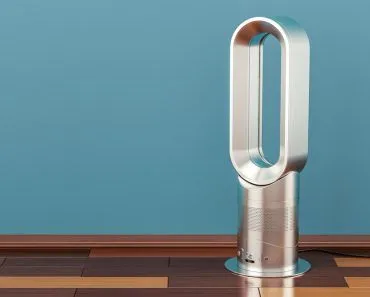
Stand beside a highway as a truck goes by, and the leaves and litter on the shoulder lift and chase after it. The truck did not invite them. Fast-moving air drags the still air beside it along, and that air drags the next layer outward. Engineers call this entrainment, and it is why a bladeless fan blows far more air than its motor ever touched.
A jet of air from pursed lips is a small truck. It leaves your lips narrow and fast and starts swallowing the room at once. Measurements of jets going back decades show the same pattern, and textbook jet theory puts it in two rules. The jet spreads out in a steady cone. And the amount of air flowing in the jet grows in step with distance from the opening, while its speed falls in step:
v ∝ 1 / x
v is the speed down the middle of the jet and x is the distance from the lips. Double the distance and the jet moves half as fast and carries twice as much air, all of it borrowed from the room.
The distance that counts is measured in widths of the opening. A pursed-lip opening is a few millimeters across. A hand-span away is dozens of openings downstream, deep in the zone where the jet is mostly borrowed air. An open mouth is a few centimeters across, and the puff is slow. A hand at the same distance is only a few mouth-widths out, and the breath has had almost no chance to pick anything up.
The "cool" air from pursed lips is not your breath, cooled. It is the room's own air, with a little breath mixed in, delivered fast.

Why Does Moving Air Feel Colder Than Still Air?
Room air at 21 °C is cooler than you. In still air you barely notice, because your skin warms a thin blanket of air sitting on it, and the blanket stays put. Heat has to trickle out through it. Moving air strips the blanket off and replaces it with cooler air, over and over. Heat then leaves your skin much faster. That is why a breeze feels cool, and why your arm cools down out of a car window instead of warming up.
Forecasters bake this into wind chill. The National Weather Service puts it in one line. As the wind increases, it draws heat from the body and drives down skin temperature. The air is no colder, but it takes your heat away faster.
The pursed-lip jet does this to your hand. It arrives as mostly room air, and it arrives fast. If your skin is a little damp, moving air also speeds up evaporation, which pulls out more heat still. The slow open-mouth puff does neither. It lands warm, and it lands gently.

How Can You Test Which Explanation Is Right?
The two stories make different predictions you can check without equipment.
If expansion did the cooling, it would happen at the lips. A pursed-lip jet would then feel cool at every distance. If the jet is picking up room air as it travels, it should feel warm at the lips and cool only once it has had room to mix. Purse your lips and blow with the back of your hand about a centimeter away, then slide it out to a hand-span. Close in, the jet feels warm, and far out it feels cool. The expansion story cannot explain that, and the borrowed-air story predicts it.
There is a second prediction, and it is a prediction only. In a room hotter than your breath, a sauna say, the jet would drag in air hotter than what left your lips and deliver it fast. The physics says the pursed-lip blow should then feel hotter than the open-mouth one. In a normal room it is the other way round. We found no published measurement of this, and a sauna is no place to run experiments on your face, so file it as a prediction.
A third check: wet the back of your hand and repeat. The jet now feels colder still, because fast air speeds up evaporation. Expansion cooling has nothing to say about wet skin.

So, Why Does Your Breath Feel Warm Through An Open Mouth But Cool Through Pursed Lips?
Your breath leaves at one temperature, around 28 to 34 °C, whatever your lips are doing. Squeezing it through pursed lips cools it by a thousandth of a degree, which is nothing. What pursed lips do change is the shape of the flow: a narrow, fast jet instead of a wide, slow puff.
A narrow, fast jet drags in the room. By the time it reaches your hand, most of the air in it is the room's own, cooler than your skin. It moves fast enough to keep stripping the warm layer off your skin, and your hand reads that as cool. A wide, slow puff reaches your hand still mostly breath. It is warmer than cold fingers and too gentle to strip anything, so your hand reads it as warm.
The soup case now answers itself, because soup is hotter than your breath and hotter than the room. A fast jet of mostly room air wins on both counts: cooler air, delivered faster, pulling heat out of the surface. An open-mouth puff would cool it too, but slowly, and you would look odd doing it.
Speed and mixing do most of the work, though not all of it. A damp hand adds evaporation. The room's own temperature sets how much the borrowed air helps. In a warm enough room, the pursed-lip blow stops feeling cool at all. Run the same physics on a glass of iced water and the jet should warm it, because the room's air is hotter than the ice.

References (click to expand)
- Validation of the Exhaled Breath Temperature Measure: Reference Values in Healthy Subjects — Carpagnano et al., Chest 151(4), 2017
- Host and environmental predictors of exhaled breath temperature in the elderly — Bijnens et al., BMC Public Health 13:1226, 2013
- Applications of positive expiratory pressure in spontaneous breathing: why, when and how? — Fagevik Olsén et al., Breathe 21(3), 2025 (PMC12362146)
- The pattern of respiratory muscle recruitment during pursed-lip breathing — Breslin, Chest 101(1), 1992
- Thermophysical Properties of Fluid Systems (Joule-Thomson coefficients for nitrogen, oxygen and argon) — NIST Chemistry WebBook
- Stagnation Temperature - Real Gas Effects — NASA Glenn Research Center, Beginner's Guide to Hypersonics
- Measurements of entrainment by axisymmetrical turbulent jets — Ricou and Spalding, Journal of Fluid Mechanics 11(1), 1961
- Chapter 7: Free Shear Flows, Part 1 (round jet similarity, after Pope) — Stern Lab, University of Iowa
- Mass entrainment rate of an ideal momentum turbulent round jet — Franco Medrano et al., J. Phys. Soc. Jpn. 86, 034401 (2017); arXiv:1605.08036
- Understanding Wind Chill — National Weather Service