Table of Contents (click to expand)
- What Is Radiation, And Why Does Each Kind Need A Different Shield?
- How Does Lead Stop Radiation? The Three Ways An Atom Can Stop A Gamma Ray
- Why Does Atomic Number Beat Density In Radiation Shielding?
- How Much Lead Equals How Much Iron? (The Half-Value Layer)
- Why Doesn't Lead Stop Neutrons?
- So, Why Does Radiation Stop In Lead And Not Iron?
Lead stops X-rays and gamma rays better than iron for two separate reasons: it puts a few more electrons in the beam's path per centimeter, and, far more importantly, each lead atom carries 82 protons to iron's 26, which makes it hundreds of times better at absorbing a photon outright. At the energies of a medical X-ray, a centimeter of lead cuts a beam about twenty times harder than a centimeter of iron, though at the higher energies of a gamma-ray source the gap shrinks to roughly double. Lead is a poor shield against neutrons, which ignore electrons entirely and are best slowed by hydrogen-rich materials such as water, plastic or concrete.
You have worn a radiation shield. It was heavy and probably a dull blue or a startling lilac. A dental assistant draped it over your chest before stepping out of the room. Inside the vinyl was a thin sheet of lead.
Nobody drapes an iron apron over you. Nobody lines an X-ray room with steel plate either. Ask why and you get one answer: lead is dense. True, and about a third of the story. Lead is only about one and a half times denser than iron. Yet at dental X-ray energies, a millimeter of lead does the job of two centimeters of iron.
The rest of the story is about what radiation is. It is also about the small number in the corner of every square on the periodic table.
What Is Radiation, And Why Does Each Kind Need A Different Shield?
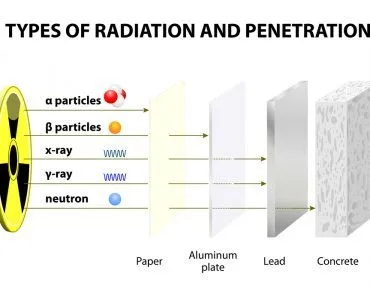
"Radiation" is a bucket word. The kind that matters here is ionizing radiation. That means anything with enough energy to knock electrons off the atoms it hits. It comes in four types, each stopped a different way. Unstable atoms give off the first three.
Alpha particles are heavy clumps of two protons and two neutrons. They cannot get through the dead outer layer of your skin. Beta particles are fast electrons. A layer of clothing or a thin sheet of aluminum stops them. Gamma rays and X-rays are the hard case. They are light, the same stuff as sunshine. Each packet just carries thousands of times more energy than anything your eye can see. Stopping them can take several inches of lead or a few feet of concrete.
One detail already breaks the "heavy stuff stops radiation" rule. Lead is the wrong shield for a strong beta source. A fast electron slamming to a halt in a heavy atom gives off X-rays, and those travel farther than the electron could. Safety rules say to stop beta particles with plastic or aluminum first. Wrap a strong beta source in lead and you have built a small X-ray machine.
A shield, then, is matched to what it is stopping.

How Does Lead Stop Radiation? The Three Ways An Atom Can Stop A Gamma Ray
An X-ray or gamma ray is a photon, a single packet of light. It has no charge and no mass, so it does not plough through a wall like a bullet. It flies through the mostly empty space inside atoms until it hits an electron or passes close to a nucleus. A shield is a game of chances, and every centimeter is another row of targets.
Photon energy is measured in kiloelectronvolts, or keV. A medical X-ray machine works at around 100 keV and below. The gamma ray from cesium-137, a radioactive isotope, carries 662 keV. When a photon finally hits something, one of three things happens:
- Photoelectric absorption. The photon is swallowed whole and one electron is kicked out of the atom. This is the main event at X-ray energies.
- Compton scattering. The photon glances off a loosely held electron, hands over part of its energy, and carries on weaker. This takes over at middle energies, including the cesium gamma ray.
- Pair production. Above about 1,000 keV, a photon passing a nucleus can vanish and become an electron plus its antimatter twin, a positron.

Why Does Atomic Number Beat Density In Radiation Shielding?
There are two knobs here, and the popular answer knows about one.
The first knob is how many electrons sit in the photon's path per centimeter. More electrons, more targets. This is the "lead is heavy" intuition, and it is sound. Compton scattering runs on it. A glancing hit off a loose electron does not care which element that electron belongs to. But here iron pulls a surprise. Iron atoms are small and light. A cubic centimeter of iron holds more than two and a half times as many atoms as a cubic centimeter of lead. Lead has more electrons per atom, iron has more atoms per centimeter, and the two nearly cancel. Count electrons per cubic centimeter and lead is ahead by only about a fifth.
The second knob is the atomic number, the count of protons in the nucleus. Lead has 82, iron has 26. The chance that an atom swallows a photon whole grows as roughly the fourth to fifth power of the atomic number. Lead's number is a little over three times iron's. Three to the fourth power is about eighty; three to the fifth is well over two hundred. Atom for atom, then, lead is a hundred to three hundred times better than iron at swallowing an X-ray.
Why does the proton count matter so much? A photon cannot be swallowed by a lone electron. The whole atom has to take part and soak up the recoil, and an electron held close to a big nucleus is what makes that possible. Big nucleus, tight grip, easy catch.
At medical X-ray energies, swallowing dominates. A centimeter of lead cuts a beam about twenty times harder than a centimeter of iron. At 662 keV, glancing hits dominate and only electron count matters. Lead's edge shrinks to roughly double. Lead is built for the photons hospitals produce.

How Much Lead Equals How Much Iron? (The Half-Value Layer)
Nothing stops a beam of gamma rays outright; a shield only makes each photon's survival less likely. So engineers talk about the half-value layer. That is the thickness of a material that lets half the photons through. Ten layers in a row cut the beam to about a thousandth.
The half-value layer comes from how hard one centimeter cuts the beam. Physicists call it the attenuation coefficient, μ (the Greek letter mu):
HVL = ln 2 ÷ μ
Here ln 2 is a constant a little under seven-tenths, and μ is in "per centimeter". Take μ for each material from NIST's tables and multiply by the material's density. For the cesium gamma ray, the half-value layers come out at about 5.5 mm of lead, 12 mm of iron, 38 mm of concrete, or 81 mm of water. For a 100 keV X-ray, the lead figure drops to a tenth of a millimeter. Iron still needs 2.4 mm.
Those are narrow-beam numbers. A real wall faces a broad beam, and photons that scatter sideways can wander back into the room. Real walls are built a little thicker for it. Per kilogram, lead's edge over iron at 662 keV is only about half again as much. A wall, a door or an apron has to be thin, and thin is where lead shines.

Why Doesn't Lead Stop Neutrons?
Everything above depends on electrons. Photons are stopped by electrons. So are alpha and beta particles, which carry a charge and feel every electron they pass. A neutron carries no charge at all. It flies through the electron cloud as if it were not there. It only notices a nucleus, and a nucleus is a tiny target in a large atom.
When a neutron does hit a lead nucleus, something worse happens: nothing much. The lead nucleus is about two hundred times heavier than the neutron. The neutron bounces off like a ping-pong ball off a bowling ball and keeps nearly all its speed. To slow a neutron down, you need it to hit something its own size. That means a hydrogen nucleus, a single proton of almost the same mass. NASA's shielding researchers call hydrogen the best neutron-scattering medium available for that reason. One pool ball hitting another head-on can stop dead.
The neutron shields, then, are the light, wet, plasticky things. Water, polyethylene, paraffin wax and ordinary concrete all qualify. Concrete counts because it carries hydrogen locked inside it. In NASA's tests, hydrogen-rich materials out-shielded metal alloys. The metals' large atoms made them poor at scattering neutrons. A jug of water beats a lead brick here, which is not the ranking most people would bet on. It is also why spacecraft shielding research favors plastics over metal.


So, Why Does Radiation Stop In Lead And Not Iron?
"Lead is heavy" was a clue, not the answer. Density gives lead a small edge in electrons per centimeter, and iron's crowded atoms nearly erase it. The real advantage is lead's atomic number. A lead atom swallows an X-ray hundreds of times more readily than an iron atom does. At the higher energies of a strong gamma source, the gap narrows to about double. Against neutrons, lead is beside the point. Water wins.
If a high atomic number is the trick, why not use something higher? Gold and tungsten carry more protons than lead and pack in about one and a half times the mass. They stop gamma rays in thinner layers. Depleted uranium, with 92 protons, needs less thickness still. But lead sells for about a dollar a pound. It melts at 327 °C (621 °F), low enough to cast into bricks or roll into sheet in an ordinary workshop. Tungsten melts above 3,400 °C and costs more than ten times as much even as raw ore. Depleted uranium is a radiation and chemical hazard inside the body, which is not what you want in a dentist's drawer. Gold works, and then you have made an apron out of gold.
Which brings the story back to that apron. In February 2024, an American Dental Association panel changed the advice. Lead aprons and thyroid collars are no longer recommended for patients during dental X-rays. This is not because the lead stopped working. A quarter-millimeter of lead still cuts about 90 percent of a hospital X-ray beam, and half a millimeter cuts about 97 percent. It is because the beam got better. The panel found that modern digital gear and a beam kept to the teeth being imaged protect you better than any apron.
If your dentist has stopped handing you the heavy vinyl, the physics has not changed. Lead is still the right metal for the job. The job just got a great deal smaller.

References (click to expand)
- X-Ray Mass Attenuation Coefficients, Lead (Z = 82) — NIST
- X-Ray Mass Attenuation Coefficients, Iron (Z = 26) — NIST
- X-Ray Mass Attenuation Coefficients, Water — NIST
- X-Ray Mass Attenuation Coefficients, Concrete (Ordinary) — NIST
- X-Ray Mass Attenuation Coefficients, Table 1: Material constants for elements — NIST
- X-Ray Mass Attenuation Coefficients, Table 2: Material constants for compounds and mixtures — NIST
- Radiation Basics — U.S. Environmental Protection Agency
- NPRE 441, Chapter 4: Interaction of Photons with Matter — University of Illinois Urbana-Champaign
- Gamma- and X-Ray Interactions in Matter (Chapter 7 handout) — University of Toledo, Radiation Oncology
- Ionizing Radiation: Control and Prevention — OSHA
- Radiation Protection Principles, Section 9 (beta shielding and bremsstrahlung) — University of Missouri–St. Louis
- Radionuclide Safety Data Sheet: Cs-137 — Stanford University EH&S
- Materials for Low-Energy Neutron Radiation Shielding, NASA/TP-2000-210281 — NASA Langley
- Analysis of the Utilization of Depleted Uranium as Shielding Material for the Storage Container of Disused Teletherapy Source — IAEA conference CN-295
- Depleted Uranium (RadTown) — U.S. Environmental Protection Agency
- Mineral Commodity Summaries 2025: Lead — U.S. Geological Survey
- Mineral Commodity Summaries 2025: Tungsten — U.S. Geological Survey
- Lead, element 82 (melting point) — PubChem, NIH
- Tungsten, element 74 (melting point) — PubChem, NIH
- ADA Releases Updated Recommendations to Enhance Radiography Safety in Dentistry — American Dental Association
- A simple quality control tool for assessing integrity of lead equivalent aprons — PMC, NIH