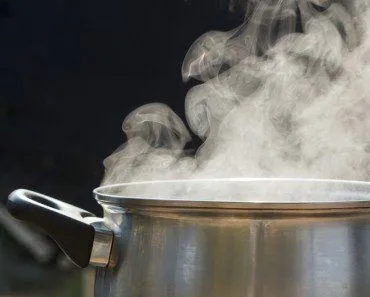
Milk boils over because its proteins and fats form a skin on the surface that traps rising steam. The trapped vapor inflates into foam that climbs the pan and spills. Water has no such skin, so its steam bubbles burst freely and never foam over.
We have all been in the position of having to explain why the milk spilled over on our watch, or perhaps we’ve just had to clean it up later. It would be tough to think of the same thing happening while boiling water, but why do you have to stand guard over boiling milk and not boiling water?
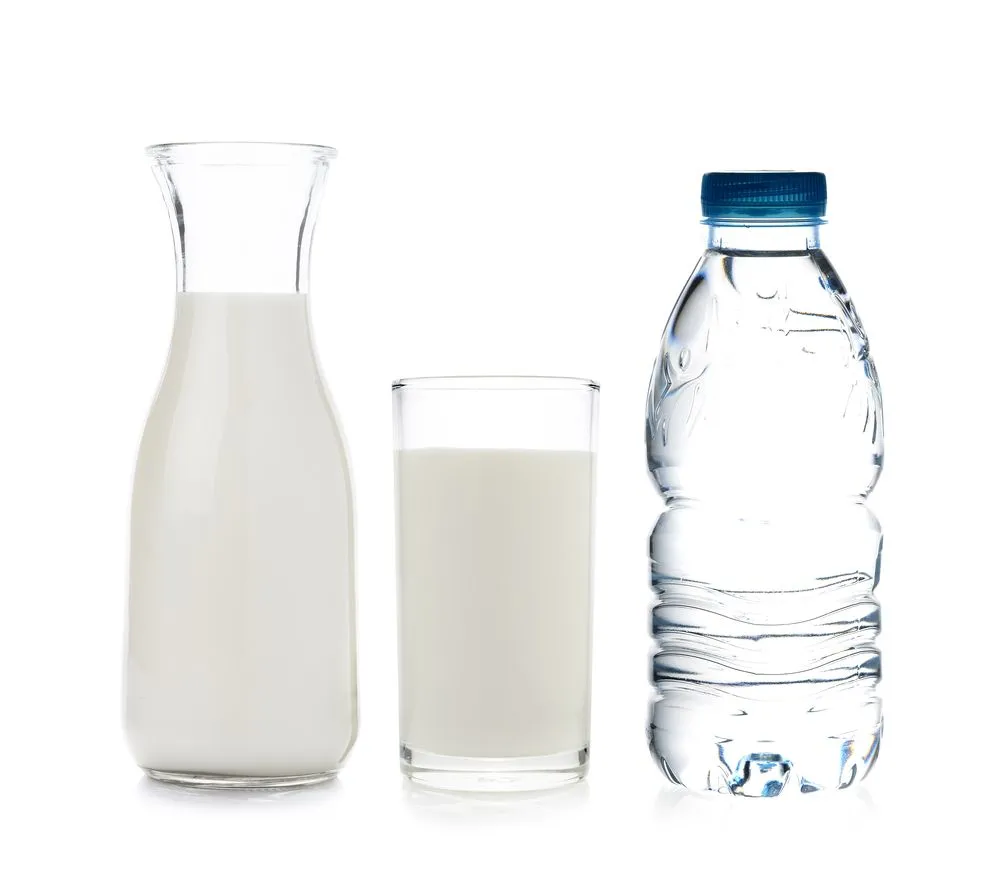
Firstly, let’s think about what water and milk are made of. Water is mostly just molecules of water or H2O clumped together to form a liquid. There are some minerals, but in too small a concentration to matter while we are trying to understand how it boils. Milk, on the other hand, is a complicated mix of chemicals, the main ones being proteins, fats, and water.
Those dissolved solids also explain a question many people ask: milk and water do not boil at quite the same temperature. The sugars, proteins, and minerals dissolved in milk nudge its boiling point a fraction of a degree above that of pure water, so where water boils at about 100 °C (212 °F) at sea level, milk boils at roughly 100.2 °C (212.4 °F). It is a colligative effect: the more particles dissolved in a liquid, the higher its boiling point. That said, you may have noticed milk seems to come to a boil faster than water. That is not because it boils at a lower temperature (it doesn't), but because milk holds a little less water per unit volume, so it takes slightly less heat to warm up.
What Happens In The Milk When Heated?
The constituents of milk must interact with each other to make the nice, stable liquid that we see and drink, but the way they behave with each other changes when they are heated.
Let’s look at what happens when milk is heated through the eyes of one of the proteins. When we boil milk, the internal structure of the protein changes, and it finds itself much stiffer than during the normal liquid phase. This brings in a new opportunity of friendship with the adjacent fat molecules, and they coagulate together to form a gel-like substance.
Just as they are enjoying this new-found friendship, being lighter than water and with energy provided by heat, they start moving to the top together.
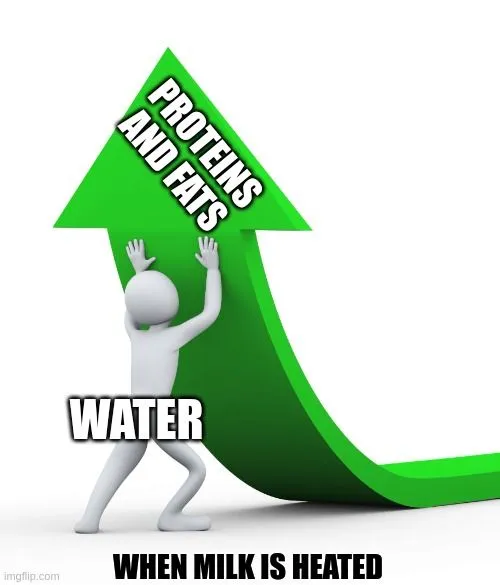
Once at the top, that protein-fat substance will see a lot of water being evaporated, since evaporation takes place only from the surface. The already small concentration of water on the surface is decreased further, and a layer of coagulated protein and fat covers it up.
At the bottom of the pan, it is very hot. With so much heat, water starts converting into vapor. The vapor here is also lighter than water, and similar to the protein and fat, will begin to go upwards. When it is about to reach the surface, it encounters a gel-like substance that won’t let it pass through.
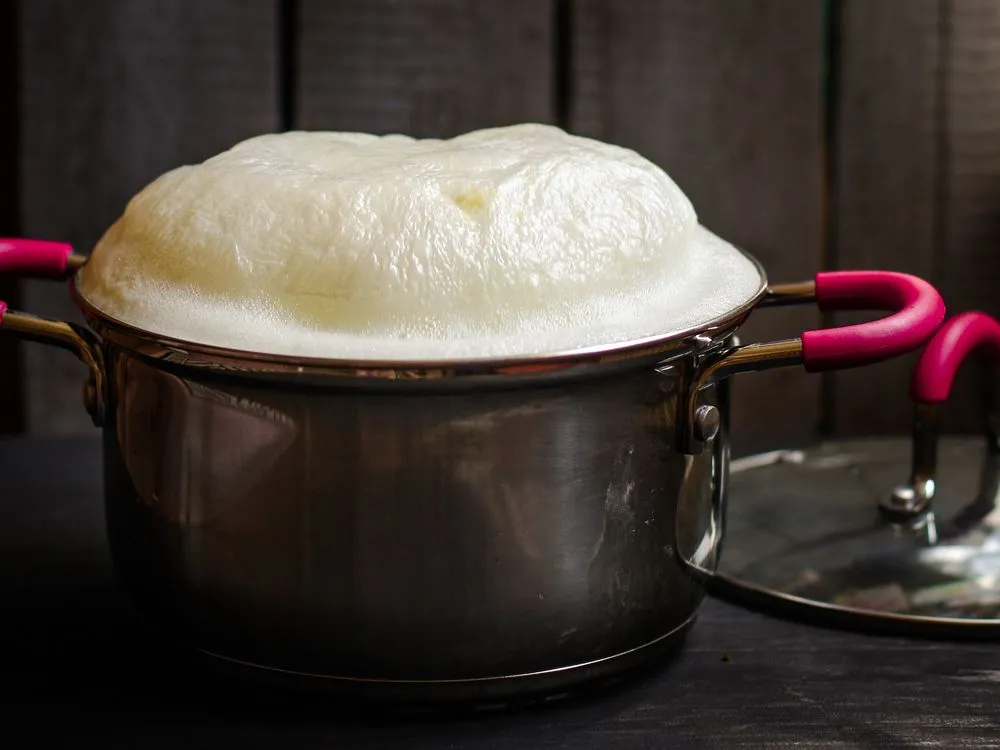
As the water vapor pushes through, bubbles are formed, just like our breath pushing on soap film makes bubbles. When more and more water vapor comes up due to heating, the same process of trapping and pushing through leads to the formation of many bubbles. That is how the foam on top of boiling milk is created.
Why Can’t The Foam Just Sit There On Top?
From here onwards, the process continues until either the protein-fat substance or the water is exhausted. However, a long time before the milk dries up to exhaust the water, the foam will be big enough to be pushed out and over by new foam forming underneath the brim of the vessel. You know what happens next: a lot of cleaning up of spilled milk.
In short, we have a three-step process: coagulation and rising of fats and proteins, rising of water vapor from the bottom, formation of a foam, and finally, the main event of spilling over.
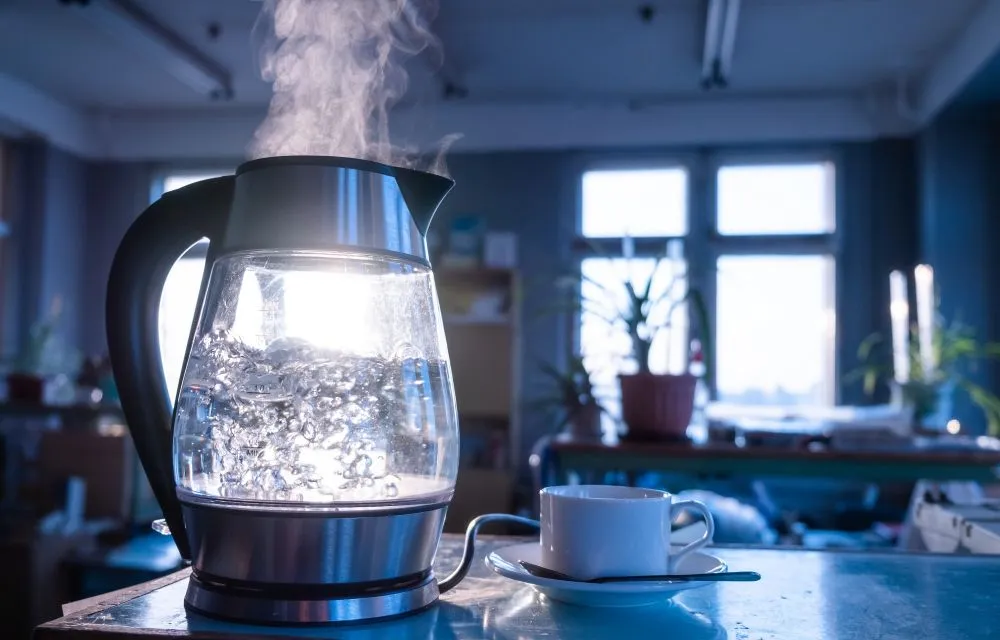
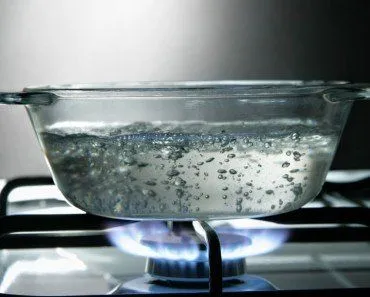
When we think about boiling water, we have only one of the above steps, i.e, the rising of water vapor from the bottom of the pan. The vapor has a straight path from the bottom to the air above. Water doesn’t have a substance that can trap water vapor and keep it from escaping. The vapor is free to rise to the surface and escape, so no foam is created, and no spillover is ever seen.
Does Milk Expand When Heated?
Watching milk climb the sides of a pan, it is tempting to think the liquid itself is swelling up. Mostly, it isn't. Two separate things are happening, and only one of them is real expansion.
The first is genuine thermal expansion. Like almost every liquid, milk takes up a little more room as it warms, because its molecules move more energetically and sit slightly farther apart. Since milk is about 88% water, it behaves much like water here, and water expands by only about 4% in volume between room temperature and boiling. A full liter of cold milk therefore gains only around 40 milliliters (under 3 tablespoons) by the time it is hot, nowhere near enough to send anything over the rim.
The dramatic rise you actually see is the second thing: foam. As we saw above, the protein-and-fat skin traps rising steam and inflates into froth, and that froth can double or triple the apparent volume in seconds. It only looks like the milk has expanded. The proof is easy: stir the pan or lift it off the heat, the bubbles collapse, and the liquid settles back to roughly the level it started at. Real thermal expansion would not disappear the instant you stop stirring.
Does Milk Evaporate When You Boil It?
Yes, but only part of it does, and that detail is the whole story. Milk is roughly 88% water, and it is that water which escapes as vapor. The fats, proteins, sugars, and minerals cannot evaporate at these temperatures, so they stay behind in the pan. Evaporation, rather than boiling, is what strips the water out, and the two are not quite the same thing. Keep the heat on and the milk does not vanish; it grows thicker, creamier, and more concentrated as the water leaves.

This is not just a kitchen curiosity, it is an entire industry. Evaporated milk is made by boiling off about 60% of milk's water under a gentle vacuum, which pushes the total solids from around 13% up past 23%. Add sugar and drive off even more water and you get sweetened condensed milk, the thick, sticky stuff in the can. Cooks use the very same principle whenever they reduce milk on the stove, simmering it for a long time until most of the water is gone and a dense, concentrated solid is left behind.
The skin that forms on hot milk is a small-scale preview of the same process. At the surface, where evaporation is fastest, the departing water concentrates the denatured proteins and fat into a tough film. So while your boiling milk is busy foaming over, it is also quietly turning into a slightly richer version of itself.
Can We Stop The Spilling?
Now that we know why milk spills, we can formulate ways to stop it from spilling over. The easiest place to tackle the spillover would be the foam created on top. Since the milk spills due to excessive foam, we can stop it right there.
What If We Create A Path For The Vapors To Escape?
This can be done by stirring the milk, so that not only the vapor can escape, but the layer formed on top gets redistributed throughout the entire vessel, and for some time the vapor can’t be trapped any further. Soon enough, once you stop stirring, the layer will be formed again.
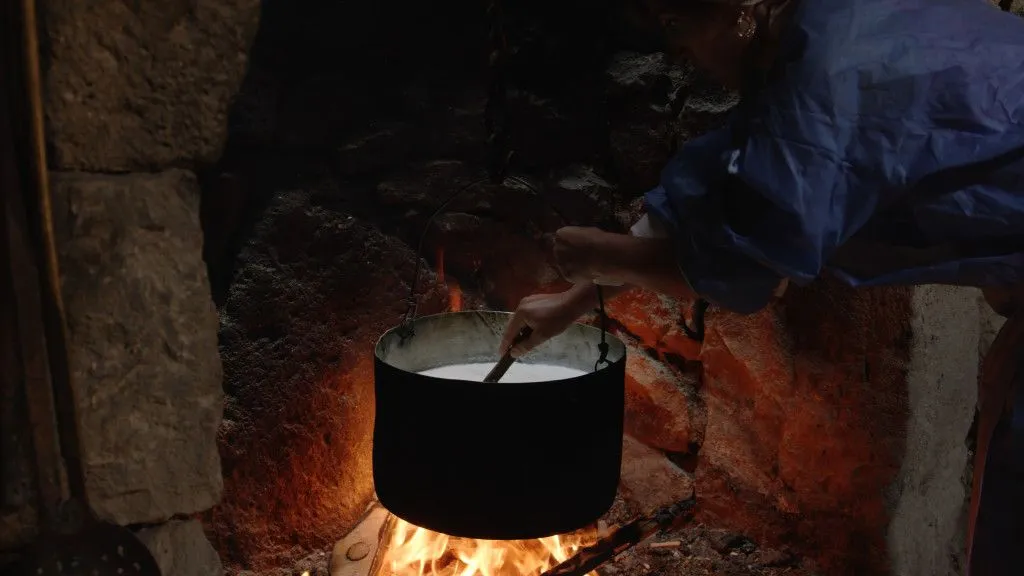
A more passive method to achieve the same result is to keep a spoon or ladle on top of the vessel. That way, there is a continuous escape route for the vapor rising to the surface.
This does work for some time, but upon heating further, the rate at which the vapor is created beats the rate at which it can leave. Thus, the remaining vapor starts getting trapped on either side and a large bubble of foam forms to spill over.
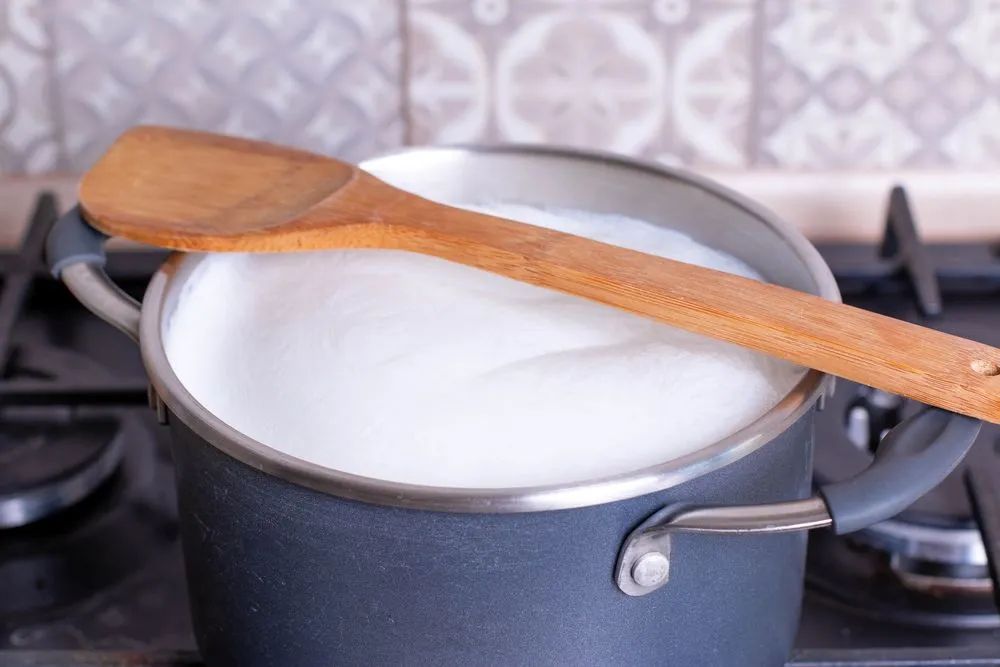
What If We Stop The Foam From Forming?
One rather interesting way to stop this spillover is by using a wide pan. The way this works is by allowing the bubbles formed by water vapor trapped in the coagulated substance to become too big to be stable. It’s a lot like a bubble popping when you try to make it too impressively large!
If we have a large pan, the bubbles will have room to grow really large, and when the surface tension provided by our coagulated substance can’t hold it, the bubble pops. This effectively stops the foam from forming at all, so the milk won’t spill over. However, be warned, as you will need a large vessel for this, even for small quantities of milk.
References (click to expand)
- S Silva. (2008) Formation and Stability of Milk Foams.
- Why does milk spill over when it boils?.
- Chandan, R. C. (Ed.). (2006, January 26). Manufacturing Yogurt and Fermented Milks. (R. C. Chandan, Ed.), []. Wiley.
- Boiling Point of Milk. Physics Van, University of Illinois.
- Evaporated milk. Wikipedia.
- Milk skin. Wikipedia.
- Milk. Wikipedia.
- Water (data page). Wikipedia.