Table of Contents (click to expand)
Squinting narrows your eyelids into a horizontal slit and pulls a row of eyelashes across your line of sight. Light from a bright source bends (diffracts) around those sharp edges, fanning out into the cross or plus-sign pattern. It is an entoptic effect, meaning the spikes are made inside your own eye, not in the light itself.
When you squint, your eyelids close down to a narrow slit and your eyelashes intrude into your field of view. Light from a point source diffracts (bends) around those sharp edges, producing the cross-shaped spikes you see.
Think back to the last time you were walking home in the dark, looking up at strange street signs as you tried to get your bearings. Perhaps one of those signs was illuminated by a streetlight above, but as you squinted to read the text, the streetlight appeared to burst into a plus sign or a “star polygon” in your field of vision.
When you stop squinting, the perpendicular beams disappear, leaving you once again standing in the darkness. This visual phenomenon is harder to explain than you might think, because so many vision problems can also produce glare, star bursts or other light-related artifacts. Yet even young people with perfectly healthy vision and no cataracts or refractive errors will see the same cross-shaped pattern when they squint.
While it may seem like a banal phenomenon, it touches on elements of our visual processing system, the anatomy of the eye and the behavior of visual light. In other words, it’s a quirky phenomenon that is well worth exploring.
How Humans See
Before we can explain the visual phenomenon of a starburst shape when you squint at a light source, we should take a brief review of how humans are able to see at all!
To begin with, the light we see is reflected off the objects in front of us and enters the eye through the cornea. The pupil, the dark hole in the middle of the iris, controls how much of that light is allowed in. Behind the cornea (and the pupil) sits the lens, which focuses the incoming light onto the retina at the back of the eye. Tiny ciliary muscles tug on the lens to change its shape, so we can refocus on things at varying distances and still make sense of what we are looking at.
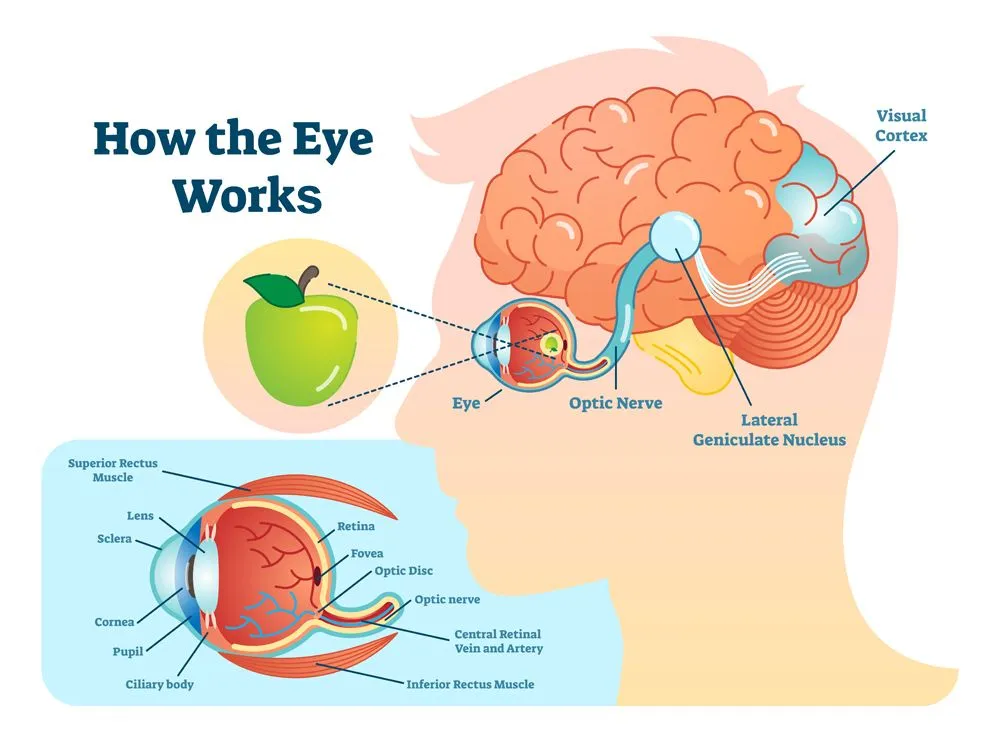
Once the light is focused onto the retina, photoreceptor cells (rods and cones) convert that light into electrical signals, which travel along the optic nerve to the brain, where the information is processed into the image you actually "see". That is a rudimentary description of a very delicate, complex and nearly instantaneous process, but it covers the basic elements that matter for the larger question this article tackles.
Don’t Look Into The Light!
Most human beings know not to stare directly at the sun (unless you happen to be the American president during a solar eclipse, of course) because of how the eye works. The cornea and lens of the eye behave a bit like a magnifying glass, focusing the sun's intense light onto a tiny spot on the retina. That focused energy can scorch the light-sensitive cells there (solar retinopathy) and cause permanent damage to your vision. Instinctively, perhaps for that very reason, when we look at any bright source of light, we tend to squint.
Squinting blocks part of the incoming light with your eyelid, so less of it reaches the retina. It also turns your eye into a kind of pinhole camera, narrowing the bundle of rays that get in and forcing them to pass closer to the optical centre of your cornea and lens. That cuts down on the blurring caused by stray peripheral rays and makes the image sharper, which is why people with mild refractive errors instinctively squint to read a faraway sign.
Now, when you look at a bright light source with your eyes wide open, particularly against a dark background, you often see a soft halo of light around it. Stare directly at a strong point source and you can over-stimulate your retinal cells, generating coloured after-image blotches that drift across your view even after you look away.
As you squint at the same light source, however, you start to see thicker, perpendicular beams or spikes of light around it, often in a plus-sign or cross arrangement. The cause is a piece of basic wave physics called diffraction. Whenever light passes by a sharp edge or through a narrow opening, the waves bend slightly around it and spread out in characteristic patterns. Squinting closes your eyelids down to a narrow horizontal slit and drags a row of fine eyelashes across your line of sight. Light from a bright point source bends around each of those edges and the spreading wavefronts add up into the long perpendicular spikes you see. It is the same physics that gives camera-aperture star-bursts and the iconic cross-shaped diffraction spikes around bright stars in Hubble images. A thin film of tears smeared across your eye by squinting adds extra micro-irregularities that scatter the light further, but the eyelid-and-eyelash aperture is doing most of the work.

Other Explanations For This Visual Phenomenon
It can be hard to separate this perfectly normal entoptic effect from the glare and halos that point to an actual vision problem. Seeing a neat plus sign when you deliberately squint at a streetlight is just diffraction at work. But other light artefacts can need medical attention, while a few are simply tricks of the light.
Cataracts are a major contributor to these symptoms. A clouded lens scatters incoming light instead of focusing it cleanly, which makes images look blurry and makes bright lights seem to bloom into halos and glare, particularly when driving at night.
If you have a refractive error like astigmatism, nearsightedness or farsightedness, the shape of your cornea or eyeball stops light from coming to a clean focus on the retina. That mis-focusing spreads point sources into smudges and streaks, which is why oncoming headlights can look like comets to someone with uncorrected astigmatism.
And then there is the cause behind the plus-sign pattern itself, the one we have been chasing. When you squint, you block a good chunk of incoming light with your eyelids and pull a row of eyelashes across the slit they form. Light from a point source diffracts around each of those edges, and the spreading wavefronts add up in your eye as the long perpendicular spikes of a cross. It is not light reflecting off the lashes onto your cornea; it is the waves of light bending around the lashes and the slit before they ever reach your retina.
Does Squinting Damage Your Eyes?
If you find yourself scrunching your eyes at every streetlight and passing headlight, you might start to wonder whether all that squinting is quietly wrecking your vision. The reassuring answer, according to eye doctors, is no. Squinting has no lasting effect on the health of your eyes; it does not damage them and it does not make your eyesight worse. Eye doctors treat squinting as a symptom of vision problems rather than a cause of them, and the popular notion that the habit itself ruins your eyesight is a myth rather than a fact.

It does not reshape anything inside your eye either. Your corneal curvature, lens power and overall refractive error stay exactly the same whether you squint or keep your eyes wide open, so the habit cannot accelerate nearsightedness or “lock in” a stronger prescription. All squinting does is temporarily shrink the effective opening of your pupil, which sharpens the image for as long as your eyes are narrowed and then fades the moment you relax them.
That said, the habit is not entirely without consequences. Holding a tight squint for long stretches makes the muscles around your eyes work overtime, and that sustained contraction can leave you with a headache. Over the years, repeatedly creasing the delicate skin at the outer corners of your eyes also feeds the fine lines we cheerfully call crow’s feet. And while the squint itself is harmless, a constant urge to squint at signs, screens or oncoming traffic is a classic sign of an uncorrected refractive error such as nearsightedness, farsightedness or astigmatism, which is a good reason to book an eye exam.
A Final Word
If you are seeing spikes of light or persistent glare every time a light source enters your field of vision, even with your eyes wide open, it is definitely time to book an eye exam and get yourself checked out. But do not panic when a lone streetlight in the distance appears to shoot out beams of light at 90-degree angles the moment you scrunch your eyes. That cross is simply diffraction at work, your eyelid slit and eyelashes bending the incoming light, the same way a camera aperture turns a bright bulb into a sparkly star. Stop squinting and the spikes vanish along with the slit that made them.
References (click to expand)
- Star Bursts Around Lights - Ophthalmology - UCLA Health. UCLA Health
- Why can people see more clearly when they squint their eyes?. The University of California, Santa Barbara
- Snydacker, D. (1963, March). The Maddox Rod Test: A Ten-Year Follow-Up* *Presented in part at the 98th annual meeting of the American Ophthalmological Society, Hot Springs, Virginia, May, 1962. American Journal of Ophthalmology. Elsevier BV.
- Hayashi, K., Manabe, S.-. ichi ., Yoshimura, K., & Hirata, A. (2013, June). Binocular visual function with a diffractive multifocal intraocular lens in patients with unilateral cataract. Journal of Cataract and Refractive Surgery. Ovid Technologies (Wolters Kluwer Health).
- Shingleton, B. J., & O'Donoghue, M. W. (2000, August 24). Blurred Vision. New England Journal of Medicine. Massachusetts Medical Society.
- Squinting. American Academy of Ophthalmology
- Squinting and Your Eyes. Specialty Vision
- Is Squinting Bad for Your Eyes? What an Eye Doctor Says. Classic Vision Care