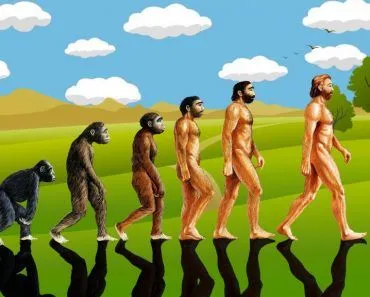
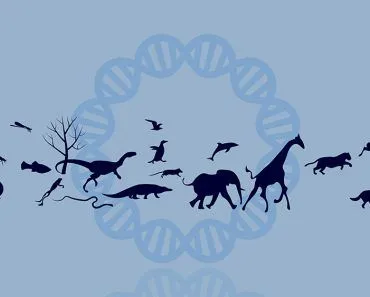
Sahelanthropus tchadensis, dated to about 7 million years ago, is the oldest known candidate for an ancestor on the human lineage. From there a series of hominins, including Ardipithecus, Australopithecus, and the early Homo species, gradually evolved key human traits: full bipedalism (walking upright on two legs), smaller canine teeth, the loss of tree-swinging arboreal adaptations, larger and more complex brains, and eventually tool use. The lineage culminates in anatomically modern Homo sapiens, which arose in Africa roughly 300,000 years ago.
The world is approximately 4.5 billion years old, and Homo sapiens have been around for about 200,000-300,000 years of that. Obviously, we have evolved quite a bit since the most primitive apes. Humans and chimpanzees shared a common lineage up until approximately 7-13 million years ago. After our last shared ancestor, one line branched off into beings that were bipedal, i.e., walked on 2 legs, rather than quadrupedal, i.e., walking on 4 limbs.
Before attempting to establish a timeline of the events and changes that led to the formation of ‘us’, we must understand that establishing an exact date is impossible. It’s not like we can just walk up to ancient people and ask them for their life history, and they didn’t exactly maintain records either. So how do we do it? The simple answer – fossils. Scientists use fossils and relics to date these different ancestors’ history and create a timeline of our evolution. It is important to remember here that whenever new information comes to light, and with the further progression of science, timelines may change to better explain and accommodate all of our findings. This is why most estimates have a broad window, ranging from a couple thousand years to a few million years.
Keeping this in mind, let’s try to understand the timeline of evolution for modern humans.
Modern humans are scientifically called Homo sapiens. Homo is the genus and sapiens is the species. Homo sapiens are the only members of the Homo genus that are currently alive, and we have obviously come a long way from our four-legged brothers. From the trees, our ancestors came down to the land and, over millions of years, gradually became bipedal, walking habitually on two legs rather than knuckle-walking. Further evolution brought a non-grasping (adducted) big toe, shorter arms, a longer stride, a larger brain, and eventually the form you see in the mirror every day.
Sahelanthropus tchadensis
This species lived about 7 million years ago, and had characteristics of both chimpanzees and humans. From reconstructions of their heads, it can be seen that they look very ape-like. Also, while evidence suggests that they walked upright on 2 feet, there is not enough clarity on that matter. However, they are majorly accepted as the oldest species of hominids. Hominids are members of the Hominidae family, which is the family to which humans belong. Sahelanthropus tchadensis also had a small brain, closer in size to that of the chimpanzee.
A Closer Look At Sahelanthropus tchadensis: The Toumaï Skull
Because Sahelanthropus sits right at the base of our family tree, it tends to attract more questions than almost any other name on this list, so it is worth pausing here. The genus name joins Sahel, the semi-arid belt of Africa just south of the Sahara, with the Greek anthropos, meaning human; the species name tchadensis simply means “from Chad.” The fossils were unearthed between 2001 and 2002 by a team led by the French paleontologist Michel Brunet, in the Djurab Desert of northern Chad. The centerpiece is a small but nearly complete skull, catalogued as TM 266-01-060-1 and nicknamed Toumaï, which means “hope of life” in the local Dazaga language.

What did its owner look like? From the neck up, mostly like an ape. Reconstructions put the braincase at only about 360 cubic centimeters (cc), within the range of a modern chimpanzee and, by the Smithsonian’s description, even slightly smaller. The clues that hint at something more human are subtler. Its canine teeth were small and worn flat rather than long and dagger-like, which is unusual for a male primate and counts among the earliest human-like traits in the fossil record.
Was it bipedal? This is the part scientists still argue about. The foramen magnum (the hole where the spinal cord leaves the skull) sits further forward on the underside of Toumaï’s cranium than it does in apes, which suggests the head was balanced on top of an upright spine rather than carried in front of it. In 2022, a study in the journal Nature describing a thigh bone and two forearm bones from the same site concluded that Sahelanthropus usually walked on two legs on the ground while still clambering through trees. Other researchers have since re-examined that thigh bone and argued it does not show habitual upright walking, so the question is not settled.
And what came before it? For now, Sahelanthropus is the oldest creature we can reasonably place on the human side of the tree, and nothing older has been confirmed as an ancestor. Beyond it lies the last common ancestor we shared with chimpanzees, a still-undiscovered ape thought to have lived somewhere between roughly 6 and 8 million years ago.
Orrorin tugenensis
This species lived about 6.2-5.8 million years ago. While it displays certain morphological similarities to Homo sapiens, like the femur, which points to bipedalism, and thickened enamel on the teeth, the jury is still out on whether it fits in the timeline of our evolution. If it is considered a direct ancestor of humans, then the position of certain other species in our timeline, specifically Australopithecus, is jeopardized. For a long time, Australopithecus has been assumed to be an important step in our evolution, so more proof is required to dethrone it. Apart from this, the fossils of Orrorin tugenensis also suggest that it survived in the dry evergreen forests. This goes against the most popular assumption that humans evolved in the savannas.
Ardipithecus
Ardipithecus is the first species that definitely exhibited bipedalism. It showed some distinctive features that are also found in modern humans. Apart from walking upright on 2 legs, it also had a big, grasping toe. This species had a small brain, closer to that of chimpanzees, and its canines were reduced in size. Its reconstructed pelvis suggests that it could walk on 2 legs, as well as climb trees. There are a few discrepancies about when it existed. The earlier estimate was about 4.4 million years ago, but a second estimate of 5.8 million years was later provided. However, this newer figure is not widely accepted.

Australopithecus
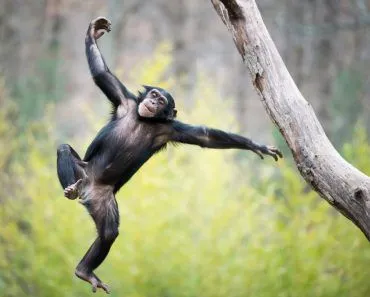
This genus is one the most popularly known genus in the evolution of humans. They existed from about 4.2 – 3.9 million years ago, up to approximately 2.5 million years ago. There are approximately 7 accepted species in this genus, the most popular of which is Australopithecus afarensis. This species lived for about 900,000 years, and the remains of over 300 individuals of this species have been found. The brain size of this species was about one-third that of humans. They had flat noses and protruding lower jaws. Their teeth were small, like those of modern humans. They had long, strong arms suitable for swinging from trees, but they regularly walked on 2 feet. Their ability to be arboreal and tree-swinging helped them to survive climate changes.

The young ones of this species grew faster than modern humans, and therefore had shorter periods of care and guidance by their parents. Another species of this genus was Au. africanus. They were similar to Au. afarensis, but they had bigger brains in a more rounded cranium. They also had smaller teeth.
As this genus evolved, they began exhibiting more features similar to homo sapiens, such as shorter teeth, molars and pre-molars, a broad lower chest, and other features of our skeletal system. One species, Au. sediba, exhibited a peculiar form of walking. It apparently turned its foot inward with each stride. This suggests that upright walking evolved in more than one pathway.
Paranthropus
This genus is also known as the robust australopithecine, and there is ongoing debate if the species should belong to the Australopithecus genus or should exist in a separate genus of Paranthropus. What is clear, however, is that they descended from Australopithecines. These species had more features similar to those of modern humans, as compared to their immediate ancestors. Mainly, they had stronger jaws and employed the use of muscles for chewing. They had flared cheekbones and bigger brains. They also had quite a thick layer of enamel on their teeth.

Homo
Finally, we come to the genus to which we belong. This genus came about 2.4 million years ago, and Homo sapiens are currently the only living members. The first species in this genus, Homo habilis, existed about 2.4 – 1.4 million years ago. They are credited with the first use of stone tools; but scientists have found stone tools from before their time as well.
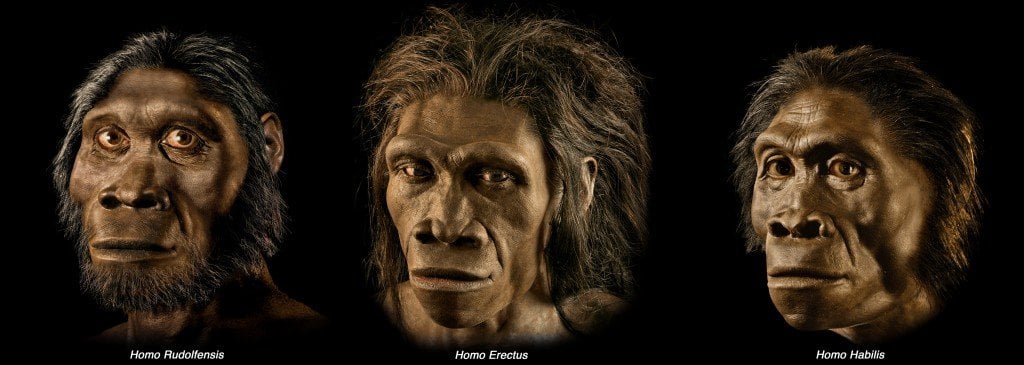
Another important species of this genus is Homo erectus. They are the oldest species with features and proportions that are very similar to modern humans. They had short arms and long legs, which marked the end of tree-swinging abilities and showed that these individuals were not arboreal. Studies also strongly suggest that they cared for the weaker and older beings in their groups. Homo erectus was also the first species to expand their demography outside Africa, although it is unclear as to whether they reached Europe.
Existing about 700,000 to 200,000 years ago, Homo heidelbergensis was the first species to live in colder climates. They also lived at a time where there was the definitive use of fire. They were the first species who regularly hunted larger animals and built simple shelters of wood and rocks. They had a comparatively flatter face, and possessed very prominent brow ridges.
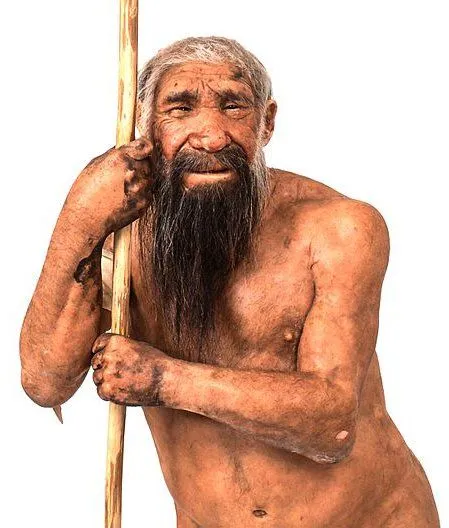
Homo neanderthalensis are the closest species to us as modern humans. They lived about 400,000 to 40,000 years ago and closely resembled us in appearance. They wore clothes, lived in shelters and had relatively sophisticated tools. They hunted regularly, and also consumed plants. Evidence suggests that they would bury their dead, often even giving offerings of flowers. They also made ornaments. Neanderthal fossils have been found across Europe, the Middle East (the Levant), and Western and Central Asia, including sites in Israel, Iraq, the Caucasus, and as far east as the Altai Mountains in Siberia.
There is another species in this genus, known as the Denisovans. They still haven’t been classified properly, but they seem to have existed around the time of H. neanderthalensis. There is also evidence that suggests there was interbreeding within these groups, which led to variations.
According to current estimates, Homo sapiens arose about 300,000 years ago. The best way to establish a rough idea of their appearance would be to simply look in the mirror.
A number of these species existed at the same time, because the appearance of a new species did not mean the immediate extinction of the previous ones. As we have seen in the case of the Denisovans, Neanderthals and Homo sapiens, there was also interbreeding between them. According to some scientists, this is the cause behind the variations between the different races currently existing on Earth. That being said, there are still plenty of unanswered questions about our ancestors, as well as discrepancies in the timeline. Time estimates are constantly changing, so please don’t hold me responsible, it depends on which source you trust! In time, however, hopefully we can get more concrete answers to the fascinating questions of our origin!
Every Species In The Homo Genus
The Homo genus first appears in the fossil record around 2.8 million years ago, and today we are its only surviving members. Over the years, scientists have named a number of species within it. Not every one is universally accepted, and the human family tree looks less like a straight ladder than a branching bush that rarely runs in a straight line, with the boundaries between species constantly redrawn as new fossils turn up. Still, here are the members of our genus you are most likely to meet:

- Homo habilis (about 2.4 to 1.4 million years ago): an early, small-brained species credited with some of the first stone tools.
- Homo rudolfensis (about 1.9 million years ago): a contemporary of H. habilis with a larger, flatter face, known mainly from East Africa.
- Homo ergaster (about 1.9 to 1.4 million years ago): an African form that many researchers simply fold into H. erectus.
- Homo erectus (about 1.9 million to 110,000 years ago): the long-lived species that was the first to spread out of Africa.
- Homo antecessor (about 1.2 million to 800,000 years ago): known largely from cave sites in northern Spain.
- Homo heidelbergensis (about 700,000 to 200,000 years ago): a large-brained species that built simple shelters and hunted big game.
- Homo naledi (about 335,000 to 236,000 years ago): a small-brained South African species found deep inside the Rising Star cave system.
- Homo floresiensis (about 100,000 to 50,000 years ago): the tiny “hobbit” of the Indonesian island of Flores.
- Homo luzonensis (about 67,000 to 50,000 years ago): a recently named species from Luzon in the Philippines.
- Homo neanderthalensis (about 400,000 to 40,000 years ago): our close cousins across Europe and western Asia, and arguably a separate species from us.
- Homo sapiens (about 300,000 years ago to the present): us.
You may also have heard of the Denisovans, known mostly from DNA and a handful of bones from Siberia and Tibet. They were clearly a distinct human population, but they have not yet been given a formal species name, which is why they do not sit on this list under a tidy Homo label of their own.
References (click to expand)
- Origins - online.sfsu.edu
- Human Evolution Interactive Timeline. The Smithsonian Institution
- Species | The Smithsonian Institution's Human Origins Program. The Smithsonian Institution
- Origins and Evolution of Human Language: Timeline. William Marsh Rice University
- Sahelanthropus tchadensis. The Smithsonian Institution’s Human Origins Program
- Sahelanthropus, the oldest representative of humanity, was indeed bipedal. CNRS