Table of Contents (click to expand)
- Structure And Functions Of Different Carbohydrates
- Structure And Functions Of Fibers
- Digestion Of Alpha-glycosidic Bonds And Beta-glycosidic Bonds
- Which Carbohydrates Can Humans Digest, And Which Ones Can't?
- If We Can't Digest Cellulose, How Do Cows And Termites?
- Conclusion: Do We Need To Eat Fiber If We Cannot Digest It?
Humans can't digest most dietary fiber because the sugar units in fiber (mainly cellulose) are linked by beta-glycosidic bonds, and the human digestive tract simply doesn't make the enzyme (cellulase) needed to break those bonds. The same sugar units linked by alpha-glycosidic bonds, as in starch, are easily broken down by our amylase enzymes. Fiber that escapes digestion is instead fermented by gut bacteria in the large intestine.
A major part of our diet consists of sugars, also known as carbohydrates. They are an important macronutrient that is readily available as fuel for the cells. However, there are only certain types of carbohydrates that our bodies can digest. While we can enjoy and digest the sweetness of glucose, sucrose and starch, we can’t digest fibers from plants.
So, what makes fibers impossible for our bodies to digest?
Structure And Functions Of Different Carbohydrates
The structure of fiber is key to understanding why our guts can’t digest it. Fibers are polysaccharides.
Carbohydrates can either be monosaccharides or polysaccharides.
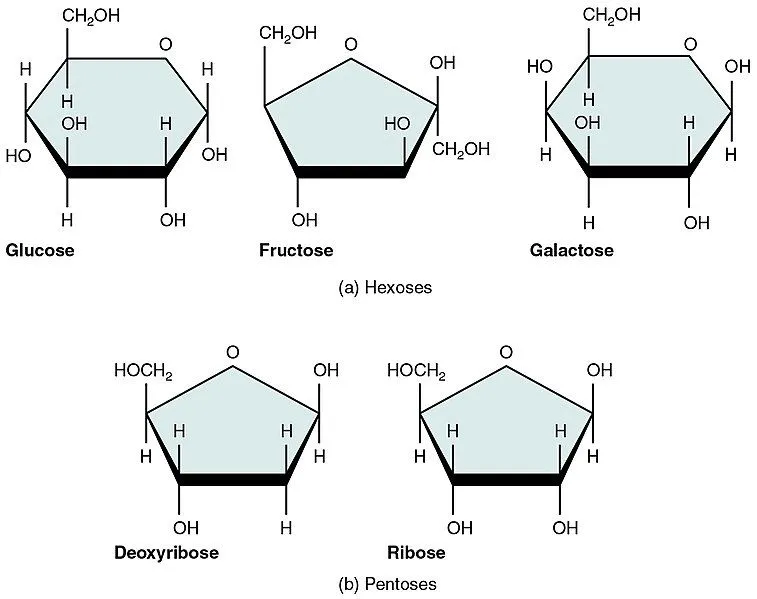
Monosaccharides are single-sugar molecules, such as glucose, one of the most commonly found sugars in nature, and the human body’s favorite sugar. Fructose is another simple monosaccharide abundantly found in fruits, and is similar to glucose. Monosaccharides can link to each other to form larger carbohydrates. Disaccharides contain two monosaccharides joined together. For example, sucrose (common kitchen sugar) is a disaccharide made by joining glucose and fructose.
When several monosaccharides link together, they form a polysaccharide. Polysaccharides can contain hundreds or thousands of monosaccharides connected to each other, making long chains. Some example of polysaccharides are starch components, such as amylose/amylopectin, cellulose and dietary fibers.
Given below is the structure of a common dietary carbohydrate.

This is the structure of amylose (one of the components of starch) that is present in potatoes and bread (or anything starchy). The amylose polysaccharide is made of glucose molecules connected to each other.
These glucose linkages differentiate digestible carbohydrates from dietary fibers.
Structure And Functions Of Fibers
Polysaccharides are often used for one of two things in nature: as a storage of energy-giving monosaccharides, like starch stores glucose, or as a strong unbreakable structural unit. The former is commonly starch or glycogen. The latter are usually fibers. Common fibers are cellulose, resistant dextrins, chitins and inulin (not to be confused with insulin, which is a hormone and not a fiber).
Shown below is a simplified structure of the fiber chitin, produced by fungi and insects.
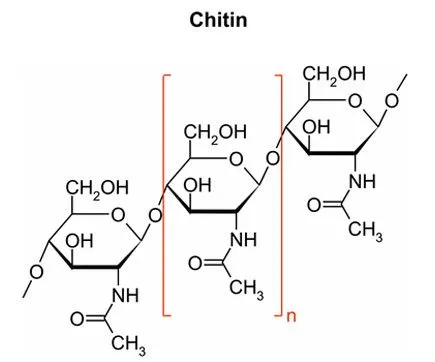
Dietary fibers, by definition, are indigestible by the human digestive system. Fibers characteristically have beta-glycosidic bonds between the component sugar molecules. These bonds make it indigestible by the body.
Digestion Of Alpha-glycosidic Bonds And Beta-glycosidic Bonds
Why does the type of bond make a difference in whether the body can digest one molecule over another?
Most carbohydrates that can be digested by our bodies are connected by carbons that have the same spatial arrangement. This is known as the alpha-glycosidic bond. The alpha-glycosidic bonds are present in disaccharides like sucrose and maltose, as well as polysaccharides, such as starch.
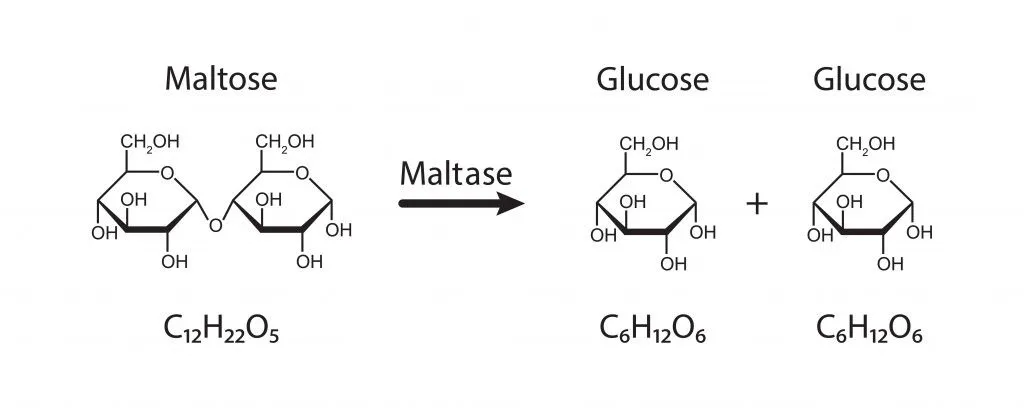
However, fibers have bonds known as beta-glycosidic bonds. In this, the carbons are arranged on the opposite sides, as shown in the figure below.
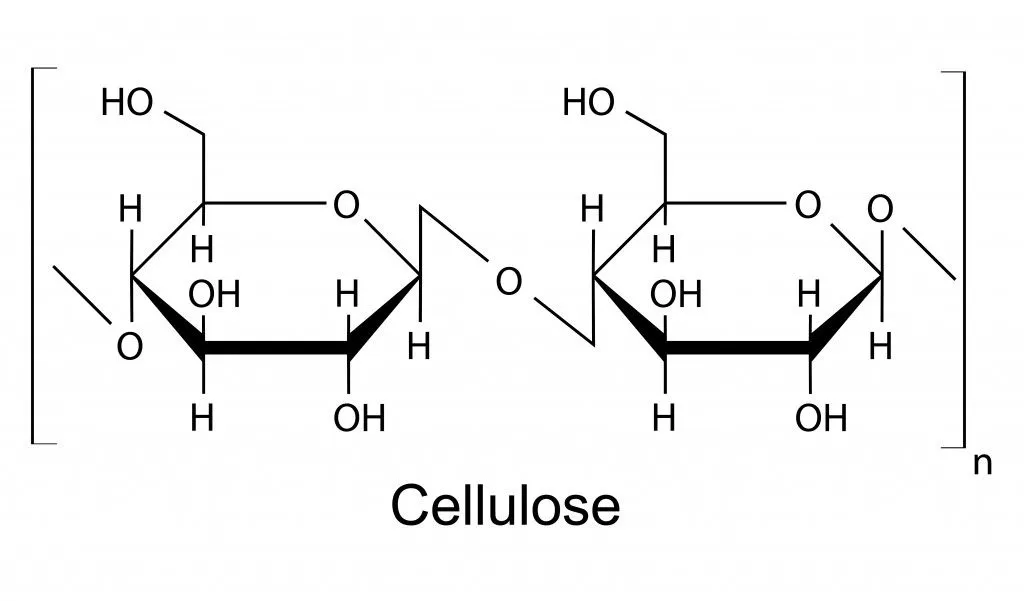
The carbohydrate-digesting enzymes in the human gut (mainly salivary and pancreatic amylase, plus maltase, sucrase and isomaltase in the small intestine) only handle alpha-glycosidic bonds. We do produce one beta-glycosidase, lactase, which splits the beta-1,4 bond in milk sugar (lactose), but we never evolved a cellulase to crack the beta-1,4 bonds in plant cell walls. If the enzyme can't recognize the molecule, it can't break it down. That is why fiber survives the journey through the small intestine essentially unchanged.
Biochemistry 0f Bonds For Nerds!
The difference in the glycosidic bonds is because not all sugar molecules have the same stereochemistry. Stereochemistry is the arrangement of atoms respective to each other. Even when the chemical formula of the sugars is the same, they can still exist in two forms that are structurally different from each other.
Moreover, every carbon that has four distinct groups for each bond is called a chiral carbon. The position of each group on the chiral carbon plays an important role in the biochemistry of the entire molecule. To understand it better, we take two forms of glucose, alpha-glucose and beta-glucose. These two molecules differ only in the positioning of one carbon group. However, it makes a huge difference in their structure and function in the body.
We saw how glycosidic bonds could either be alpha- or beta-glycosidic bonds. Alpha-glycosidic bonds form when carbon atoms on the two sugar molecules have the same stereochemistry. Hence, both the carbons have the alcohol group [-OH] on the same side, either facing upwards or downwards.
Beta-glycosidic bonds form when the carbons have opposite stereochemistry. One of the carbons has an alcohol group facing upwards, while the other has a downward-facing group. This leads to a more linear, and therefore stronger, structure to the molecule.
While this might look like a very minor change, it alters the chemical function of the molecule. Enzymes in the body are hyper-specific. Even a minute change in the stereochemistry means that the new molecule is unrecognizable to the enzyme.
Most of the carbohydrates found in nature have alpha-glycosidic linkages. However, fibers are known to have beta-glycosidic linkages.
Which Carbohydrates Can Humans Digest, And Which Ones Can't?
Once you know the rule, sorting food carbohydrates into “we can break this” and “we can't” becomes simple. The human gut secretes only alpha-glucosidases (starch-splitting amylases plus the brush-border enzymes maltase and sucrase-isomaltase), along with one lone beta-glycosidase, lactase. We can digest a carbohydrate only if we happen to make an enzyme that fits its exact bond, and that short enzyme list decides everything.
On the digestible side sit starch (both its amylose and amylopectin components), glycogen (the animal equivalent of starch), and the disaccharides sucrose, maltose, and lactose. Salivary and pancreatic amylase cleave the alpha-1,4 bonds of starch, and the brush-border enzymes finish the disaccharides into single sugars our small intestine can absorb. Lactose is the odd one out, since its two sugars are joined by a beta bond, but we make a dedicated beta-galactosidase (lactase) just for it, which is why losing that enzyme in adulthood causes lactose intolerance.
On the indigestible side sit cellulose, hemicellulose, pectin, plant gums, inulin, and chitin. Cellulose, hemicellulose, inulin, and chitin are locked up by beta bonds we cannot cut, while pectin and gums are built from other linkages (such as chains of galacturonic acid) that our enzymes equally fail to recognize. Resistant starch is a special case: chemically it carries the same alpha bonds as ordinary starch, but it is physically locked inside intact plant cell walls or a hardened, crystalline form, so amylase never reaches it and it behaves like fiber. In other words, “fiber” is not one molecule at all, but the umbrella term for every food carbohydrate our enzymes leave untouched.
If We Can't Digest Cellulose, How Do Cows And Termites?
Cellulose is the most abundant carbohydrate in the plant kingdom and a major fiber in our diet, yet mammals, humans included, do not make cellulase, the enzyme that snaps its beta-1,4 bonds. So how does a cow live on nothing but grass?

The trick is outsourcing. Cows and other ruminants (sheep, goats, and deer) carry a four-chambered stomach made up of the rumen, reticulum, omasum, and abomasum. The rumen is a huge fermentation vat teeming with bacteria, protozoa, and fungi that do make cellulase. These microbes break the cellulose apart and ferment it into short-chain (volatile) fatty acids such as acetate, propionate, and butyrate, which the cow then absorbs as its main energy source. Because the microbes get first access to the food before it reaches the true stomach, cows are called foregut fermenters. Horses and rabbits reach the same result from the other end, housing their gut bacteria in a greatly enlarged cecum and colon and fermenting there instead.
Termites are famous for eating wood, but they cannot fully digest cellulose on their own either. They produce some cellulase of their own in their salivary glands and then hand the rest of the job to a dense community of protozoa and bacteria in their hindgut, which complete the breakdown and ferment the sugars into fatty acids. The punchline is that we are not so different from any of them. Our own colon bacteria ferment part of the fiber we eat into those same short-chain fatty acids, as the next section explains. We simply never evolved a dedicated fermentation chamber, so most of the cellulose we swallow passes straight through as bulk instead of becoming a meal.
Conclusion: Do We Need To Eat Fiber If We Cannot Digest It?
Fibers travel through the digestive system into the large intestine. In the large intestine, dietary fibers show water-holding capacity, adsorptive functions and cation-exchange. Cation exchange is the process of exchanging sodium, chloride and potassium ions to regulate the absorption of these salts. In addition, the exchange of these ions also helps in the efficient absorption of water from the remaining food excreta. In addition, dietary fibers also form mesh-like structures in the large intestine. These structures form the perfect micro-environment for healthy gut bacteria to survive and thrive.
These characteristics make fibers extremely beneficial for healthy bowel movements and excretion, despite our body's inability to break them down! It is also worth distinguishing the two broad fiber types: insoluble fiber (cellulose, lignin) passes through more or less intact and adds bulk to stool, while soluble fiber (pectin, beta-glucans, inulin) dissolves in water and is fermented by the gut microbiota into short-chain fatty acids (SCFAs) like butyrate, propionate, and acetate. Those SCFAs feed the colon's cells, lower colon pH, and have been linked in modern studies to better cardiovascular and metabolic health. So we may not 'digest' fiber the way we digest starch, but our resident microbes do (in part) and we benefit from the result. The US Dietary Guidelines suggest about 25 g of fiber per day for women and 38 g for men, and most people in the US, UK, Australia, and Canada eat well under half of that.
References (click to expand)
- Carbohydrates - MSU chemistry. Michigan State University
- 1.4.1: Carbohydrates in the Diet - Chemistry LibreTexts. LibreTexts
- Turner, N. D., & Lupton, J. R. (2011, March). Dietary Fiber. Advances in Nutrition. Elsevier BV.
- (1982) Dietary fiber. - ScienceDirect.com. ScienceDirect
- 1,4 glycosidic bond - The School of Biomedical Sciences Wiki. Newcastle University
- Diet and Health: Implications for Reducing Chronic Disease Risk - Dietary Fiber. National Academies Press (US)
- 16.5B: The Rumen and Ruminant Animals - Biology LibreTexts
- Metabolomic profiling of 13C-labelled cellulose digestion in a lower termite - PMC