Standing still hurts more than walking for the same length of time because your calf and postural leg muscles are constantly contracted to keep you upright, each foot is taking half your body weight without a break, and your calf “muscle pump” isn’t firing – so blood and lymph pool in your lower legs. Walking shares the load between alternating legs, recruits the core, and squeezes the veins like a second heart, sending blood back to the heart.
There are quite a few man-made ideas and notions that really suck the fun out of our otherwise fantastic lives. People might have problems with a wide range of man-made concepts, but one that sits near the top of my list is the idea of waiting in line. There are only a handful of things that annoy me, and I’m sure that plenty of other folks (like the guy below) despise few things more than waiting in a queue.

Whether it’s the queue for a train ticket, at the grocery store or at a burger joint, standing idle in the same spot for too long is an unbearable activity. Ask me to take a walk for the same amount of time and return to the same spot and I will happily accept your proposal. This makes me think that the loathing we associate with waiting or standing in the same spot for too long is somehow related to the fact that it hurts our feet.
Walk around for 30 minutes, and you won’t feel a thing in your feet, but stand in a single spot for the same duration, and it’s likely that your feet will start hurting. Why is that?

Why Does Standing Still In A Single Spot Hurt The Feet So Much?
Short answer: While standing still, the legs aren’t really resting. There are some muscles, especially in the calves, which are constantly engaged to prevent you from swaying and keep you standing upright. Also, each foot supports the entire body weight, without being relieved of duty, even for a short while. There are some other reasons too.

Leg Muscles Are Constantly Engaged While Standing Still
This might seem like a no-brainer, but when you stand still, you don’t actually stand absolutely still. The body has the tendency to sway a little (thus shifting the bodyweight on either leg) almost constantly. In order to keep you upright, therefore, certain leg muscles, particularly in the calves, must constantly make small adjustments. In contrast, when you’re walking, a greater number of muscles in both the legs are engaged. Additionally, they also get assistance from the core muscles, which keep your gait stable. That’s one of the primary reasons why walking doesn’t hurt nearly as much as standing still for the same amount of time.
Distribution Of Body Weight

When one is walking, the body weight is borne alternatively by either leg. This way, both legs get rest very frequently, even if it lasts for only a second. Cumulatively, however, that second’s worth of rest amounts to either leg bearing most of the weight of the body for only half the time. On the other hand, when you are stationary, each leg basically supports half the body weight without getting any rest actual rest.
Moreover, standing still puts the entire load of the body on the underside of each foot, particularly the heels and balls of each foot. As a result, standing still and bearing the bodyweight for too long feels like an uphill task in comparison to simply walking around.
Less Oxygen Driven To Stationary Feet
The blood and lymph fluids begin to pool in one’s feet and lower legs when you stand still for too long. The heart can certainly push blood down to the feet, but returning that blood uphill against gravity is a different story – the veins in your legs have low pressure and rely heavily on the so-called skeletal muscle pump, especially the calf pump, in which contracting calf muscles squeeze deep veins and shove blood back towards the heart. Cardiologists sometimes call the calf a "second heart" for exactly this reason.
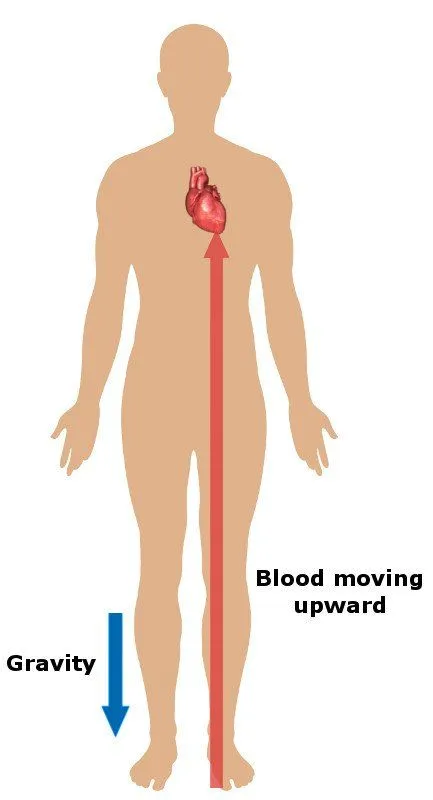
When you stand still, that calf pump is essentially switched off. Venous blood stagnates, swelling builds, and the leg muscles end up working with less fresh, oxygenated blood than they would if you were strolling around. Chronic standing without movement is in fact a known occupational risk factor for swollen feet, leg pain, and varicose veins.
What Happens To Your Body If You Stand Still For Too Long?
We have already seen that standing still nudges blood towards pooling in the legs, but what happens if you keep at it for hours at a stretch? The effects go well beyond sore feet. According to the Canadian Centre for Occupational Health and Safety (CCOHS), prolonged and frequent standing without the relief of walking causes blood to pool in the legs and feet, and over time this can bring on sore feet, swelling of the legs, general muscular fatigue and low back pain. Keep it up for years, as workers in many jobs must, and that pooling can progress into chronic, painful varicose veins and inflammation.

Varicose veins are the classic occupational souvenir of a standing job. When leg muscles stay contracted for long stretches, they squeeze the blood vessels and impair both blood and lymph circulation. The one-way valves inside your leg veins, which normally stop blood from sliding back down, can weaken and fail, a condition doctors call chronic venous insufficiency. Blood then collects in the lower legs, pressure builds, and the veins bulge and twist into the ropey blue cords we recognize as varicose veins. The Cleveland Clinic lists sitting or standing for long periods among its risk factors, along with swelling around the ankles by the end of the day.
There is also a more dramatic possibility: fainting. This is why soldiers occasionally keel over while standing rigidly at attention. Standing still, especially in the heat or with the knees locked, lets blood pool in the lower body and reduces the amount returning to the heart. With less blood reaching the brain, a person can suddenly turn pale, drop their blood pressure and faint, a reflex doctors call vasovagal syncope.
How Can You Reduce Leg And Foot Pain From Standing?
If your job or your daily commute keeps you on your feet, the good news is that a few simple habits can take a lot of the ache out of standing. The single most useful one is to keep moving, even a little. Occupational health guidance stresses changing your position frequently rather than freezing in one stance, and taking short walking breaks whenever the task allows, because a brief stroll switches the calf pump back on and drains the pooled blood.
When you genuinely have to stay put, shift your weight. The CCOHS recommends using a foot rail or a portable footrest so you can prop one foot up and swap between legs, which relieves the load on each leg in turn. If a seat is within reach, use it whenever the work lets you, even for a short breather.

What is under and around your feet matters too. Standing on hard concrete or metal all day is punishing, so an anti-fatigue mat, which cushions the shock and reduces foot fatigue, is worth its space. Supportive shoes with a proper arch support, a cushioned insole and a small heel beat flat, hard soles. For people prone to swelling or varicose veins, compression stockings gently squeeze the legs to help push venous blood back up, and elevating the feet to about 15 centimeters above heart level between spells of standing helps restore normal circulation.
The Psychological Aspect Of Standing Still For Too Long
As we just saw, there are a number of biological reasons that make the feet hurt when we stand in the same spot for too long, but there is also a psychological aspect to the discomfort we feel.
While standing in the same spot for too long, maybe even hours, we’re basically not doing anything! In the absence of a real, physical stimulus/activity to distract our mind, we get bored and eventually start thinking about how badly our feet hurt, which doesn’t really help the problem!
Furthermore, taking a brisk walk and jogging also releases certain neurochemicals (like endorphins) or “feel-good chemicals” that uplift our mood, making walking around a preferred option over standing still for too long.
References (click to expand)
- Chapter 18: Posture and locomotion - www.dartmouth.edu:80
- Gallery Feet | A Moment of Science - Indiana Public Media. WFIU
- Munih, M., & Kralj, A. (1997, January). Modelling muscle activity in standing with considerations for bone safety. Journal of Biomechanics. Elsevier BV.
- Working in a Standing Position - Basic Information - Canadian Centre for Occupational Health and Safety (CCOHS)
- Anti-fatigue Mats - Canadian Centre for Occupational Health and Safety (CCOHS)
- Chronic Venous Insufficiency (CVI) - Cleveland Clinic
- Varicose veins and occupational health: symptoms, treatment and prevention - Revista Brasileira de Medicina do Trabalho
- Can Standing Up Straight for a Long Period Cause Fainting? - UAMS Health
- Postural syncope: mechanisms and management - Medical Journal of Australia