Table of Contents (click to expand)
Your core body temperature has to drop by about 1–2°C for you to fall and stay asleep. Your feet and hands are densely vascularized, hairless heat exchangers with special arteriovenous shunts, so sticking them out from under the covers lets the body dump excess heat faster. The result: you cool down quicker and drift off sooner.
After putting on your comfy pajamas, you climb into bed, snuggling the soft blanket and bury your head against the soft pillow before finally sleep comes. However, without even realizing it, your feet, rather than enjoying the comfort of a restrictive blanket, sneak out to enjoy a cooler breeze. It’s a scenario that has happened to all of us at some point, and perhaps you’ve wondered why it’s so satisfying to sleep with your feet outside the sheets.
Cooling Down
When our bodies are ready to sleep, they initiate a host of physiological changes that put us in the ideal state for rest. One of these physiological changes is body temperature. When we sleep, we become cooler.
Humans are warm-blooded animals, and are scientifically called homeotherms. Homeotherm comes from Greek, where homeo means ‘the same’ and therm means ‘temperature’. Thus, animals that maintain a constant body temperature, usually above the ambient temperature, are known as homeothermic or warm-blooded animals. Humans maintain an approximate 36.8 ± 0.5 °C (98.2 ± 0.9 °F) body temperature, which is optimum for the function of our cells and tissues.
This temperature is maintained through heat generated by metabolic processes in the body and is regulated according to the outside temperature through thermoregulation. Even if the outside is scorching hot, thermoregulatory processes in the brain and the body will ensure that we don’t overheat. The body begins to sweat, and when the sweat evaporates, it lowers the body’s temperature. Blood vessels transport blood, nutrients, and gases like oxygen, but they also move heat. When we are hot, the blood vessels dilate, allowing more heat to escape through the skin. We can also change our behavior to roll up our sleeves or opt for fabric that’s more breathable.
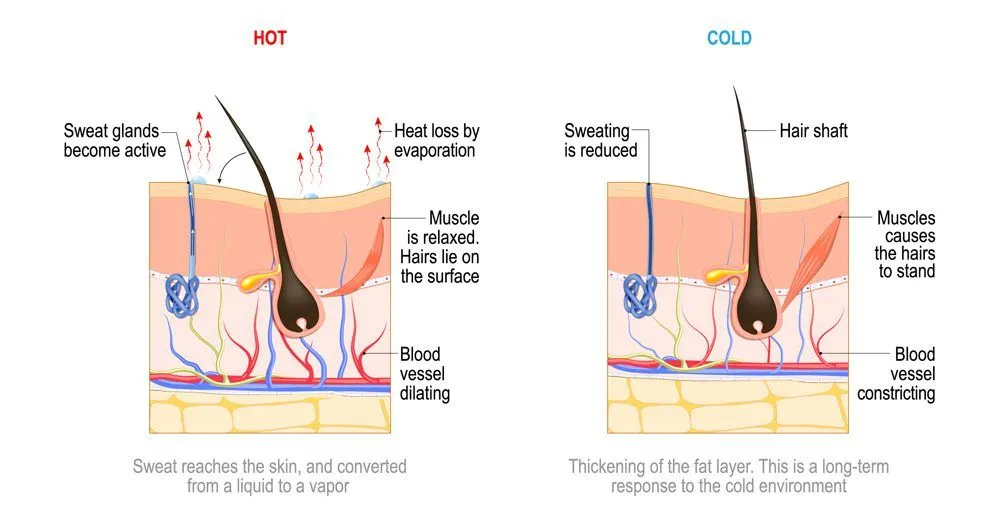
The opposite happens when we feel cold. The blood vessels constrict, we shiver to generate heat, and our behavior makes us wear warmer clothes and seek out warm or heated areas.
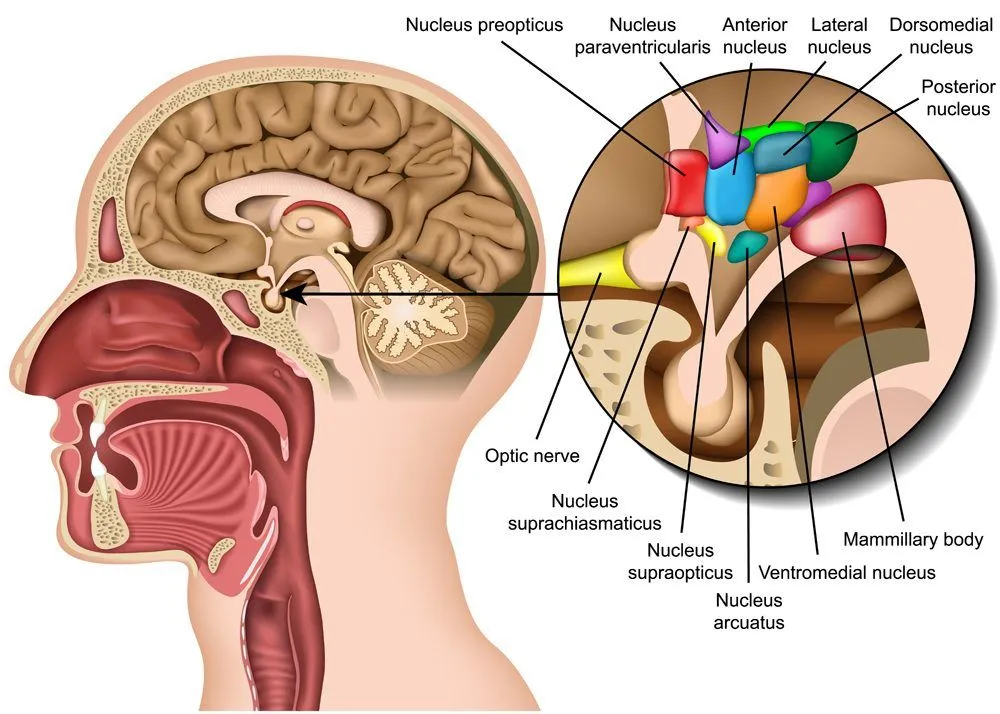
All of this is controlled by the brain and the hypothalamus, in particular. The hypothalamus is the control center for thermoregulation. It receives all the information related to the internal body temperature and ambient temperature, decodes it, and makes the appropriate changes. It releases hormones that cause physiological changes, as well as send out neural signals that alter our behavior.
The hypothalamus also receives information from the circadian center, the hypothalamic suprachiasmatic nuclei (SCN). This small area of the brain is a set of nuclei (a cluster of neurons) that control our circadian rhythm, the internal 24-hour light and dark cycle of the body. It is our circadian rhythm that controls when we feel most awake, as well as when we should sleep. Furthermore, it controls the bodily conditions that put us to sleep most effectively.
Feet And Sleep
This finally brings us to the main question—why we stick our feet out when we sleep.
One of the first physiological changes that occurs when we get ready to sleep is our body temperature. Research has found that our body temperature begins to decrease long before we put our head on the pillow and can decrease by 1 to 2°C when we are in a deep sleep. This also explains why we tend to fall asleep in cooler rooms.
As for our feet, the extremities, just like the hands, are important to transfer heat from the body to the outside. They are well-supplied with blood vessels that allow for heat transfer, as well as their mobility, which can allow us to dip our hands in cold water, for example, while their large surface area make them important heat exchangers.
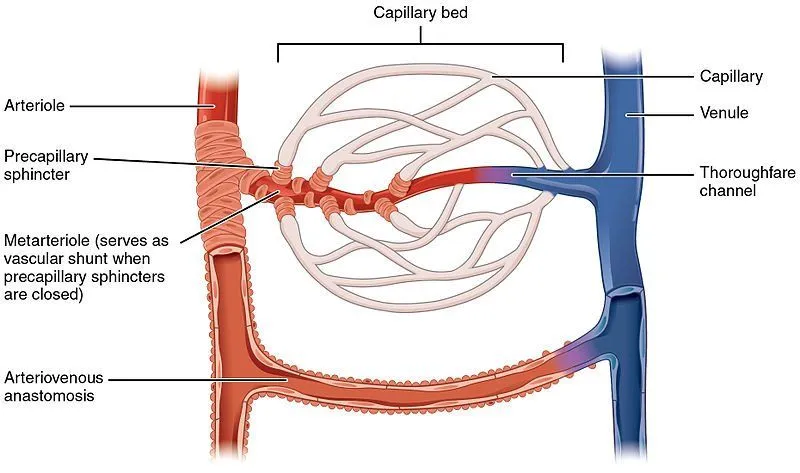
The blood vessels that supply our hands and feet with blood contain structures called arteriovenous anastomosis. This is simply a connection between two blood vessels, like a bridge between two separate roads. These anastomosis serve as shunts or alternate paths for blood to take, while also helping to increase the blood flow to particular regions.
Additionally, our feet are generally hairless. Without the hair acting as an insulator (which is why furry animals can stay so warm and cozy without a blanket), heat from the body can escape.
Now, for the body to drop to its preferred cooler temperature, it needs to lose heat. When the room is warm, or only marginally cooler than our skin, our bodies struggle to shed enough heat through the usual channels, so we instinctively stick our feet and hands out into the cooler air where the body can offload heat more rapidly.
A paper published in 1999 in Nature titled ‘Warm feet promote rapid onset of sleep’ explained how warm feet help the body cool down enough to sleep. It stated that warm feet, which the researchers artificially warmed by placing a warm bottle near the participants’ feet, help to dilate the anastomosis, which can then supply more blood to the feet. Along with dilated capillaries, the feet become fantastic heat exchangers between the body and its surroundings.
In colder temperatures, such as below 10°C, we probably want to snuggle our feet inside the blanket or cover them with socks to keep them warm so that we don’t lose too much heat. It’s all about what the body senses and then how it appropriately reacts, resulting in something we do without even thinking about it!
The connection between thermoregulation and sleep is critically important; in fact, research has found that being too hot or too cold can prevent a good night’s sleep. Being sleep deprived, also known as having sleep debt, can mess with the body’s ability to thermoregulate effectively, which might further disrupt one’s sleep cycle.
According to science, the best way to prep for sleep is to take a nice hot bath or drink a hot beverage (probably nothing caffeinated though). Coming out of a hot bath will prompt the body to cool down even further, since it will want to lose the additional heat from the bath. Similarly, a hot beverage will make one feel sleepy in no time.
Once in bed, switch off the lights, avoid your phone, keep the room slightly cold, stick one (or two) leg(s) out and go—as William Shakespeare said—“To sleep: perchance to dream: ay, there’s the rub.”
Do Your Feet Actually Control Your Body Temperature?
It is tempting to think of your feet as the body’s thermostat, but that is not quite right. Your feet do not decide anything. The decisions happen in the brain, in the same hypothalamus we met earlier, which is the real thermostat. Your feet are the effectors, the radiators the brain switches on and off to shed heat or hold onto it.

What makes the feet and hands such good radiators is the plumbing just under their hairless skin. This glabrous (hairless) skin is packed with tiny direct shortcuts between small arteries and small veins called arteriovenous anastomoses. When these shortcuts open, warm blood skips the fine capillary beds and pours straight into the wide veins near the surface, carrying a large volume of heat right up against the skin, where it can escape.
The brain runs these shortcuts as one set. From the hypothalamus, bursts of nerve signals reach all the anastomoses at once. Near the cool end of our comfort zone, roughly 26 to 36°C (about 79 to 97°F) for an undressed person at rest, they clamp shut to trap heat. Near the warm end, they open wide to release it. That is why your feet can feel icy one minute and toasty the next while your core barely moves. They are not controlling your temperature so much as carrying out the order, swinging hot and cold so that the part that matters, your core, does not have to.
How Much Heat Do You Actually Lose Through Your Feet?
You have probably heard that you lose most of your body heat through your head, and wondered whether your feet work the same way. The head figure is a myth. A 2008 paper in the BMJ traced it to a 1950s army experiment in which volunteers were bundled into arctic survival suits with only their heads left bare. Naturally the head lost the most heat, because it was the only part left uncovered. Dressed normally, the head sheds only about 7 to 10 percent of your total heat, roughly its share of your skin.

The same physics applies to your feet. There is no secret drain down there. How much heat a patch of skin loses depends mostly on how much of it is bare and how large the gap is between skin and air, not on some special property of the body part. Your two feet are only a small slice of your total surface area, so on their own they shed only a small slice of your heat.
So why does sticking them out feel so effective? Because feet are the most adjustable radiator you own. Thanks to those arteriovenous shortcuts, bare feet can ramp their heat output up on demand in a way that, say, a bare forearm cannot. It is not that feet leak a huge amount of heat all the time. It is that, when the body wants to cool down for sleep, uncovering the feet exposes the one radiator it can open widest. Cover them with a pair of socks and you close that radiator back down.
References (click to expand)
- Kräuchi, K., Cajochen, C., Werth, E., & Wirz-Justice, A. (1999, September). Warm feet promote the rapid onset of sleep. Nature. Springer Science and Business Media LLC.
- Romeijn, N., Verweij, I. M., Koeleman, A., Mooij, A., Steimke, R., Virkkala, J., … Van Someren, E. J. W. (2012, December). Cold Hands, Warm Feet: Sleep Deprivation Disrupts Thermoregulation and Its Association with Vigilance. Sleep. Oxford University Press (OUP).
- Gilbert, S. S., van den Heuvel, C. J., Ferguson, S. A., & Dawson, D. (2004, April). Thermoregulation as a sleep signalling system. Sleep Medicine Reviews. Elsevier BV.
- Campbell, S. S., & Broughton, R. J. (1994, January). Rapid Decline in Body Temperature Before Sleep: Fluffing the Physiological Pillow?. Chronobiology International. Informa UK Limited.
- Walløe, L. (2016). Arterio-venous anastomoses in the human skin and their role in temperature control. Temperature. Informa UK Limited.
- Vreeman, R. C., & Carroll, A. E. (2008). Festive medical myths. BMJ. BMJ Publishing Group.