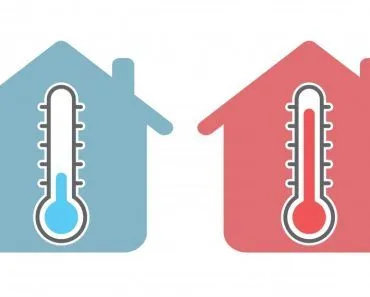
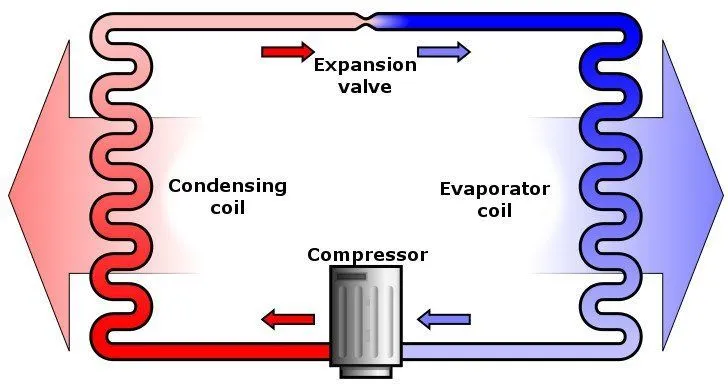
An air conditioner doesn't generate cold; it moves heat. A liquid refrigerant evaporates inside the indoor coil (the evaporator), absorbing heat from your room air. A compressor then pumps the gaseous refrigerant outdoors, where it condenses back into a liquid and dumps that heat to the outside air via the condenser coil. An expansion valve drops its pressure, and the cycle repeats until the thermostat is satisfied. The whole loop runs on the latent heat of vaporization - heat absorbed when a liquid turns into a gas.
Imagine being outside in the sweltering heat of a particularly hot summer day, doing godforsaken errands that can no longer be postponed. The heat is so unbearable that it feels like the hottest day on Earth since the dawn of civilization. But one thing keeps you on your toes: knowing you will be in your air-conditioned house in an hour.
The time has finally come: you open the door and enter your house. A gust of cooled air envelops every cell of your body, and you immediately feel better.

I am sure that you have all had this experience at least once in your life: the “cooling revolution” that air conditioners have brought into human society can never be discounted; though previous generations had fans and other ways to keep cool on hot days, they have never been as astonishingly effective as modern air conditioners in terms of sheer cooling capacity.
In this article we will talk about air conditioners and what they do – and how they do it – which makes them almost a necessity in urban areas.
How Does An Air Conditioner Work?
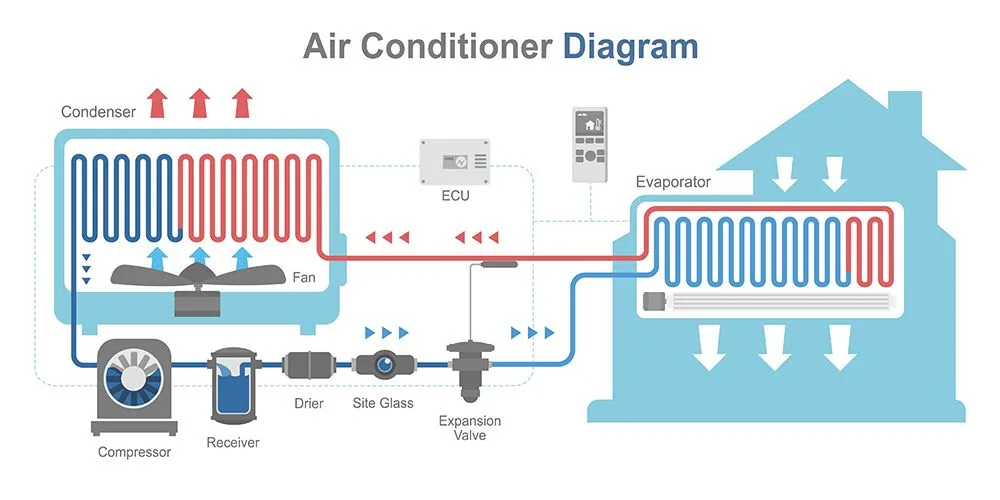
An air conditioner operates akin to a pump, extracting heat from a room and expelling it outdoors. This process involves a mechanism with refrigerant gas, heat exchanger coils, and a compressor. The functioning of air conditioning units is rooted in a fundamental principle of physics: the absorption of heat when a liquid transforms into a gas. In essence, air conditioners transfer heat from the interior of a room to the exterior. Let’s delve into the workings of this intricate machinery that ensures your comfort.
Key Components Of An Air Conditioner
Refrigerant
The refrigerant is the most important component of an air conditioner. It is the gas that moves through the heat exchanger coils of the unit, absorbing heat within a room and expelling it outside. The refrigerant circulates within the air conditioner in a cycle of evaporation and condensation, contributing to the reduction of the air temperature inside a room. Common refrigerants have historically included HCFCs (hydrochlorofluorocarbons) like R-22, HFCs (hydrofluorocarbons) such as R-410A and R-32, and HCs (hydrocarbons) like R-290. R-22 production and import in the U.S. ended in 2020 under the Montreal Protocol, and the high-global-warming HFC R-410A is itself being phased out under the AIM Act – as of January 2025, new residential air conditioners sold in the U.S. must use refrigerants with a global warming potential (GWP) of 700 or less, shifting the industry toward R-32 (GWP ~675) and the newer blend R-454B (GWP ~466).
Evaporator
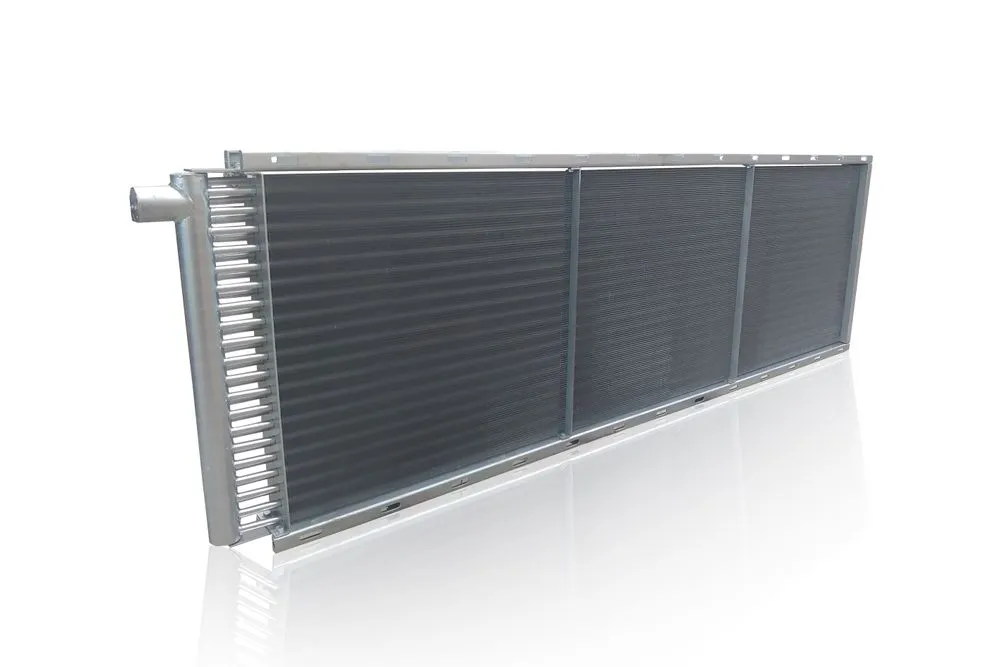
An evaporator is essentially a heat exchanger coil responsible for gathering heat from the interior of a room through the use of refrigerating gas. This component is named an evaporator because it’s where the liquid refrigerant absorbs heat (from the room) and transforms into a gas. Typically constructed from copper or aluminum, these metals are chosen for their excellent heat conduction properties. The evaporator features copper/aluminum tubes through which the refrigerant flows, along with fins connected to the tubes to enhance heat transfer between the refrigerant and the outside air.
Compressor
As the name implies, this component compresses the refrigerant gas into a high-pressure and high-temperature state. The compressor functions as a pump, taking refrigerant gas from the evaporator (or the unit inside the room), compressing it to elevate both pressure and temperature, and subsequently transferring the high-pressure/high-temperature gas to the condenser located outside the room.
Condenser
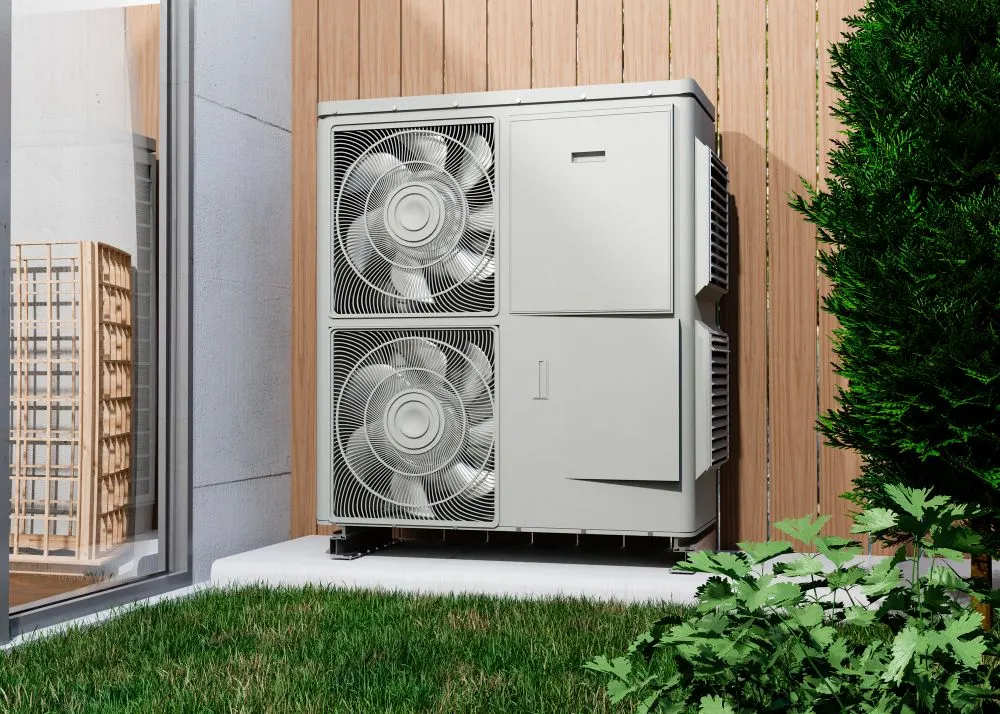
A condenser is another heat exchanger, situated outside the room. It earns its name by being the site where hot gas undergoes condensation into a liquid. When the high-pressure/high-temperature gas reaches the condenser, a fan blows ambient air over the heat exchanger, cooling the refrigerant gas and transforming it into a liquid. This procedure enables the refrigerant to release the heat it absorbed from the room. Similar to evaporators in construction, condensers are typically made of copper or aluminum. However, they are housed in a unit outside the room.
Expansion Valve
An essential component of air conditioning units, an expansion valve is positioned between a condenser and evaporator. It regulates the quantity of refrigerant flowing toward the evaporator. The expansion valve converts high-pressure liquid refrigerant from the condenser into low-pressure/low-temperature liquid. Subsequently, this low-pressure/low-temperature liquid is directed to the evaporator, where the cycle continues.
These are the main components of an air conditioner. Let’s look at how they work together to make an air conditioner do what it does.
AC: Operating Principle Of The Air Conditioner
To sum up, here is a 4 step process by with an air conditioner works:
- The refrigerant begins as a low pressure/low temperature liquid in the evaporator coil inside the house. Here, it absorbs heat from the indoor air. This cooled air is then circulated throughout the house. Meanwhile, the refrigerant turns from a liquid to low pressure gas as it absorbs heat.
- This gas is then transported to the unit located outside the house. Here, a compressor is used to transform this gas refrigerant to high pressure and high temperature.
- It is then moved to the condensation coil where the heat previously absorbed from your home is released into the outside air. A fan blows air over the condenser, cooling and converting the refrigerant back into a high pressure liquid.
- The refrigerant is then moved back into the home (indoor unit) through the expansion valve, beginning the cycle anew. The heat from inside your house is thus transferred outside, cooling the interior of your home.
Debunking The Myth
Many people believe that an air conditioner, with the help of machines installed in it, generates cooled air, which can cool a room so quickly. This might also explain why it consumes so much electricity. In reality, however, this is a mistake. An air conditioner is not a magical device; it does not generate cooled air. It only uses some physical and chemical phenomena very effectively to move heat from the room to outside.
What Happens When You Turn On The Air Conditioning?
When you turn on an air conditioner and set the desired temperature, say 22 °C (72 °F), the thermostat installed in it will detect that there is a difference between the temperature of the room air and the temperature you have chosen.
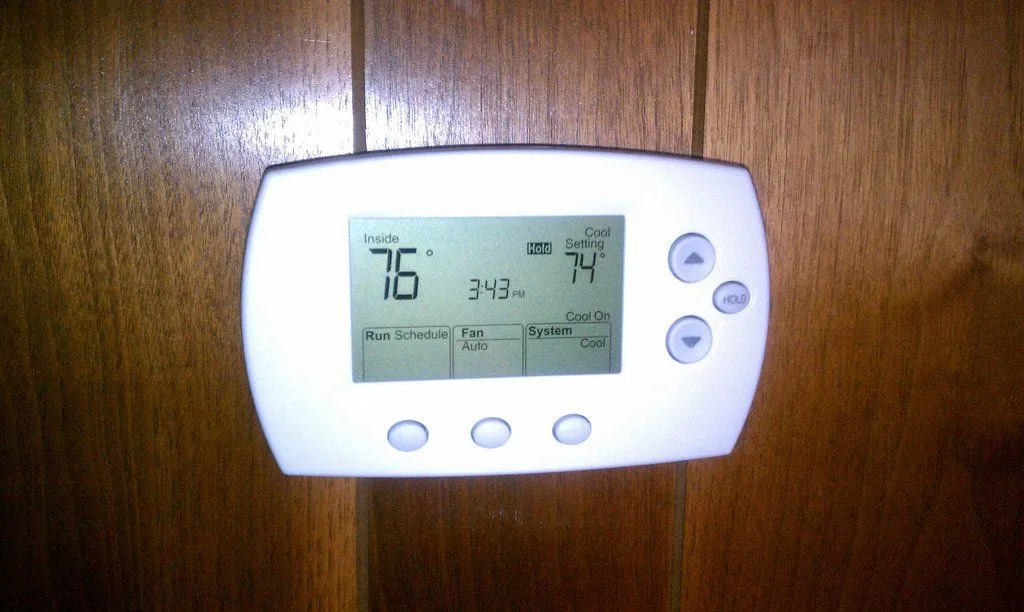
The whole process (explained above) repeats itself again and again until the desired temperature is reached. In short, an air conditioner sucks in warm air, again and again, cools it and pushes it back into the room until there is no warm air left to cool down.
As dependent as we may be on air conditioning, it is surprising that it was not originally designed for human comfort. The motivation for the first modern air conditioning system, built by Willis Carrier in 1902, was to control humidity at the Sackett-Wilhelms Lithographing & Publishing Company in Brooklyn, New York, where the paper and ink were warping in the summer heat! To believe that a machine that was supposed to support the publication of newspapers on a large scale could one day become an integral part of every modern household is something, isn’t it?
Which Principle Does An Air Conditioner Work On?
If someone asks which principle an air conditioner works on, the short answer is the vapor-compression refrigeration cycle. It is the same cycle that runs your refrigerator, and it is the method used in nearly every home air conditioner, fridge and heat pump. An air conditioner is really just a heat pump running in cooling mode: it applies external work (the electricity that drives the compressor) to pull heat out of a cool space and release it into a warmer one.
Two pieces of physics sit underneath that cycle. The first is the latent heat of vaporization: a liquid soaks up a large amount of heat when it boils into a gas, and gives that same heat back when it condenses into a liquid. By choosing a refrigerant that boils at a low temperature and forcing it to evaporate indoors and condense outdoors, the machine ferries heat from one place to the other.
The second is the second law of thermodynamics. Left to itself, heat only flows from hot to cold, never the reverse. To move heat the wrong way, from your cooler room into the warmer outdoor air, the system has to do work, and that work is exactly what the compressor supplies. This is why an air conditioner cannot simply manufacture cold; the best it can do is relocate heat, and it needs energy to push it in the unnatural direction. So when a physics exam asks which principle of thermodynamics an AC relies on, the answer it is looking for is the second law.
Because it moves heat rather than creating cold, an air conditioner is rated by its coefficient of performance rather than a simple efficiency figure. A typical unit shifts roughly three to four units of heat for every unit of electricity it draws, which is how it can cool an entire room without consuming as much power as you might expect.
Types Of Air Conditioners: Window, Split, And Central
Every air conditioner described so far runs on the same vapor-compression cycle, but that hardware can be packaged in several different ways. The three you are most likely to run into at home are window units, split systems and central air conditioning.

A window (or room) air conditioner is the all-in-one option. The evaporator, compressor and condenser all sit inside a single box mounted in a window or a hole in the wall, with the cold coil facing the room and the hot coil facing outside. It cools the single room it sits in. As a rough guide, the U.S. Department of Energy suggests around 20 BTU of cooling capacity for every square foot of living space.
A split system splits that box in two. An indoor unit holding the evaporator and a blower is fixed to the wall, while the compressor and condenser live in a separate cabinet outdoors, the two linked by insulated refrigerant lines. This is the familiar arrangement in most modern homes, and a ductless version known as a mini-split can cool individual rooms without any ductwork at all.
Central air conditioning is essentially a split system scaled up to cool a whole house. A single outdoor unit houses the compressor and condenser, an evaporator coil sits at the indoor furnace or air handler, and the cooled air is pushed through a network of ducts into every room. When all of those parts are instead combined into one outdoor cabinet, it is called a packaged system. In the United States, roughly two-thirds of homes are cooled by a central system.
References (click to expand)
- http://web.archive.org/web/20180219131633/http://www.uky.edu:80/bae/sites/www.uky.edu.bae/files/Chapter%207%20Heating%20Ventilation%20Air%20Conditioning.pdf
- Air Conditioning.
- Energy-Efficient Air Conditioning. ....
- Application of the Second Law of Thermodynamics in Residential Appliances - PMC (NIH).
- Heat Pumps and Refrigerators - HyperPhysics, Georgia State University.
- Consumer Central Air Conditioners and Heat Pumps - U.S. Department of Energy.